February 27, 2026 • 5 min read

February 27, 2026 • 5 min read
Faster. Cheaper. Nearly as good as Pro. Here's the honest breakdown.
Google just updated its AI image generation model — and for most marketing teams, it changes the default.
Nano Banana 2, built on Gemini 3.1 Flash architecture, takes everything that made Nano Banana Pro the benchmark for AI image quality and runs it at Flash speed. The result is a model that produces near-Pro output fast enough to generate fifty variants in the time Pro would give you five.
Here's what actually matters for marketers.
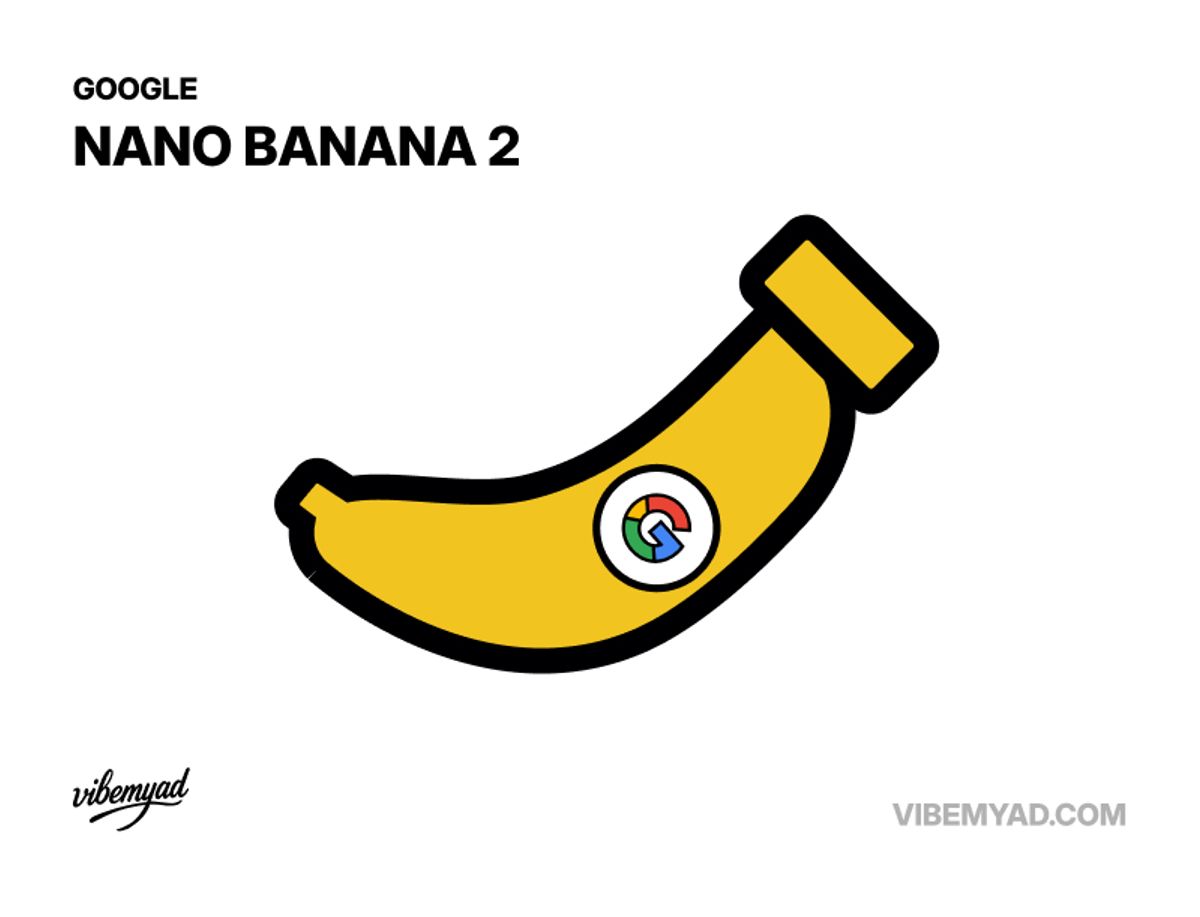
Google Nano Banana 2
Nano Banana 2 — officially Gemini 3.1 Flash Image — launched on February 26, 2026. It is now the default image model across the Gemini app, Google Ads, Google Search, and Flow.
The original Nano Banana launched in August 2024 and became the benchmark for photorealistic AI image output. Pro followed in November, pushing quality further at higher cost and slower speed. Nano Banana 2 is the version that makes Pro-level quality accessible to everyone — faster, cheaper, and built for production volume.
Nano Banana 2 is grounded in Gemini's real-world knowledge base and pulls from live Google Search during generation. When you ask it to render a specific product, location, or culturally grounded scenario — it understands the context. The output reflects actual world knowledge, not pattern-matched aesthetics. For product-forward ad creative, this matters.
Blurry text, misspelled words, inconsistent fonts — every AI image model has struggled here for years. Nano Banana 2 generates accurate, legible text for ad mockups, social creatives, packaging concepts, and display assets. It can also translate and localize text within the image itself — meaning multilingual campaign creative no longer requires separate production passes for each market.
Up to five characters and fourteen objects maintain fidelity across a single generation workflow without visual drift. This unlocks sequential creative — multi-frame social content, product series, storyboarded narratives — where visual continuity across generations was previously unreliable.
512px to 4K, full aspect ratio control. Vertical stories, square feed posts, wide-screen display — all from the same model without resolution workarounds.
Enhanced instruction following means the image you ask for is increasingly the image you get. For marketers giving specific creative direction, this reduces the iteration cycles needed to land on the right output.
You need one image to be as good as it can possibly be — hero creative going to scale, brand-critical outputs, maximum factual accuracy. When a single output represents significant budget and iteration time is available, Pro earns its cost.
You need volume and velocity — testing multiple angles fast, product-forward creative, multilingual campaigns, sequential content, any workflow where iteration speed matters more than ceiling quality.
The simple version: One perfect image — Pro. Twenty excellent images fast — Nano Banana 2.
Gemini App — replaces Nano Banana Pro as the default. Pro access retained for AI Pro and Ultra subscribers via the three-dot menu.
Google Search — live in AI Mode and Lens. Available in 141 new countries and territories, eight additional languages.
Google Ads — powering creative suggestions natively inside campaign creation. AI-generated imagery is now built into Google's own ad workflow.
Flow — new default image model for all Flow users at zero credits.
AI Studio and Gemini API — available in preview with published pricing.
Google Cloud — available in preview via Gemini API in Vertex AI.
At Vibemyad, Ad Gen doesn't default to a single image generation model. It selects the best model available based on what the specific creative task requires.
When you run a Product Replacer preset — taking a winning ad structure and replacing the product with your own — Ad Gen evaluates what that generation needs and picks accordingly. If Nano Banana 2 is the right tool for that output, that's what runs. If another model handles the specific task better, that's what runs instead.
The model selection is automatic. You don't choose it. You just get the best possible output for what you're building — whether that's rapid variant generation, product-forward creative, multilingual assets, or high-fidelity hero work.
As new models launch and the landscape shifts, Ad Gen updates accordingly. You're never locked into yesterday's best option.
Nano Banana 2 is now the default for most AI image generation use cases — faster, more accessible, and production-ready in ways the original wasn't.
Text rendering and subject consistency are the two capabilities that change real production workflows, not just benchmark scores.
Pro still has a role — single hero outputs where ceiling quality justifies the cost and time.
The best creative workflows don't pick one model and use it for everything. They match the model to the task.
Get notified when new insights, case studies, and trends go live — no clutter, just creativity.
Table of Contents


Rahul Mondal
Product, Design and Co-founder, Vibemyad

Rahul Mondal
Product, Design and Co-founder, Vibemyad

Rahul Mondal
Product, Design and Co-founder, Vibemyad