
October 30, 2025 • 8 min read
October 30, 2025 • 8 min read
You already know what the Facebook Ad Library is. You've used it. And at some point it wasn't enough. Here's what serious marketers use instead.
• Vibemyad Ad Vault is the best Facebook Ad Library alternative for performance marketers — it shows ad-level performance signals, creative lifecycle tracking, and category intelligence that the Ad Library has no equivalent for.
• The Ad Library's five core limitations are: no performance data, only active ads visible, no download or organization, compliance-built interface, and incomplete search results.
• Vibemyad Ad Vault shows three signals per tracked brand's ads — Momentum Signal (creative lifecycle), Market Signal (category trends), and Activity Signal (posting frequency).
• Vibemyad Ad Spider adds full brand-level analysis — creative themes, positioning patterns, and category whitespace — as the deeper layer beneath Ad Vault.
• The Ad Library is free and useful for occasional research. Vibemyad Ad Vault is for teams running serious paid spend where competitive intelligence has direct budget consequences.
The Facebook Ad Library confirms that ads exist — but knowing ads exist is not the same as knowing what's working, and for a performance marketer running real budget, that distinction is everything.
The Ad Library is not a bad tool. For a free transparency database, it does exactly what Meta built it to do. But the moment you try to use it as an actual competitive intelligence system — tracking what's winning in your category, identifying which creative concepts are sustaining performance, spotting where gaps exist before your competitors move into them — you hit its limits fast.
That friction is why you're here. And it's the same reason thousands of performance marketers, agencies, and brand teams have started looking for something built for the job they're actually trying to do.
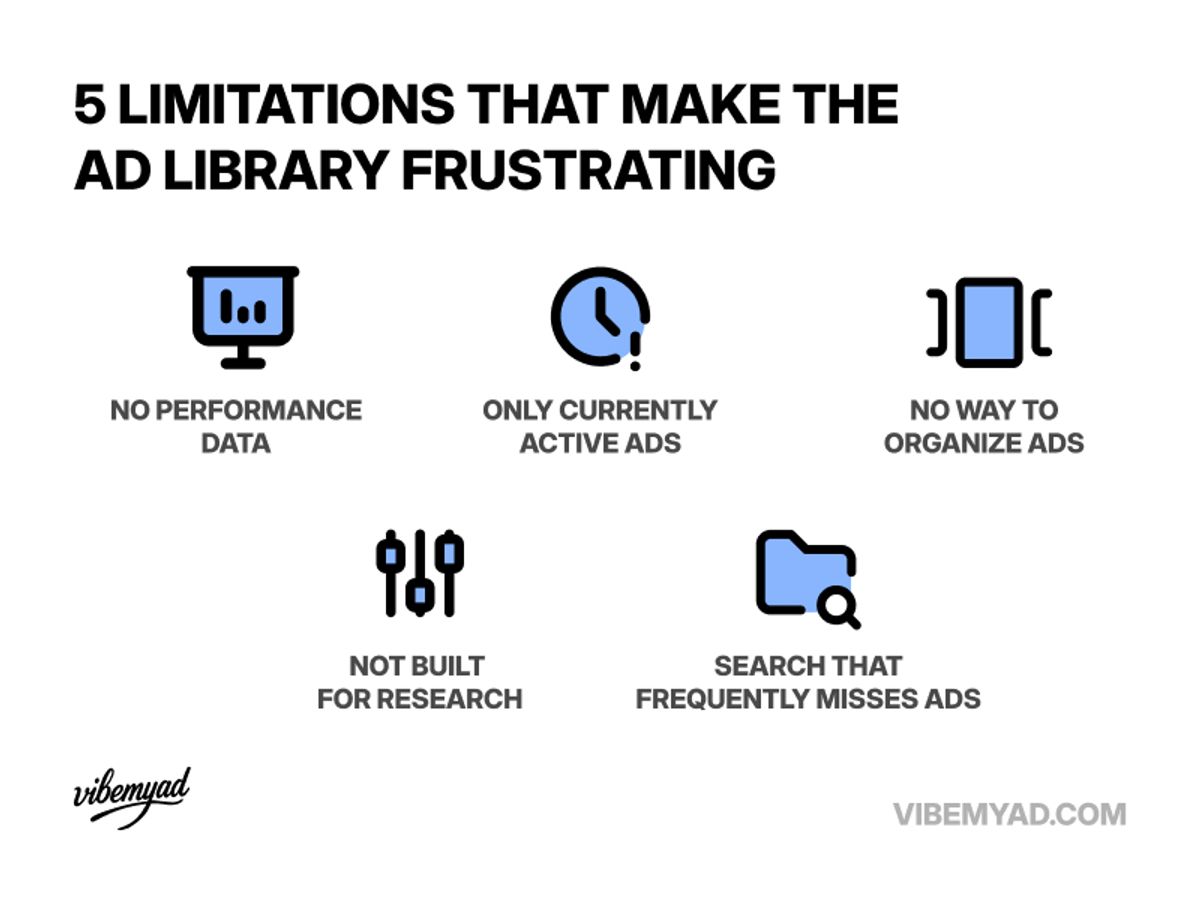
5 Limitations That Make the Ad Library Frustrating
You can see that an ad is running. You cannot see how it's performing. No engagement data, no reach, no spend signal, no indication of whether an ad is a winning creative being scaled or something someone forgot to switch off. You are analyzing ads in a complete performance vacuum.
The moment a competitor pauses or kills a campaign, it disappears from the Ad Library. Forever. You cannot study seasonal campaigns after they end. You cannot track how a brand's creative strategy has shifted over six months. Every time you close the tab, anything you didn't screenshot manually is gone.
No download button. No bulk export. No tagging. No swipe file. Researching five competitors seriously means hundreds of individual screenshots dumped into folders with no context attached. Sharing findings with a creative team means sending dozens of image files and hoping they understand what they're looking at.
The Ad Library was built for political advertising transparency, not competitive marketing intelligence. There is no filter for ad format. No sorting by date. No way to separate video from static from carousel. Researching a brand with 100 active ads means infinite scrolling with no way to surface what matters.
Experienced marketers consistently find that Ad Library search returns incomplete results. Ads with minimal text, recently launched creative, and ads on specific placements like Instagram Stories often don't appear at all. You cannot trust that what you're seeing is the full picture — which means every insight you draw from it is built on incomplete data.
Vibemyad Ad Vault solves every limitation listed above — ad-level performance signals, creative lifecycle tracking, and category intelligence all visible the moment you click a tracked brand's ad.
The workflow is simple: track brands from the Home dashboard, go to the Vibemyad Ad Vault, click any ad from a tracked brand, and immediately see what the Ad Library never shows you.
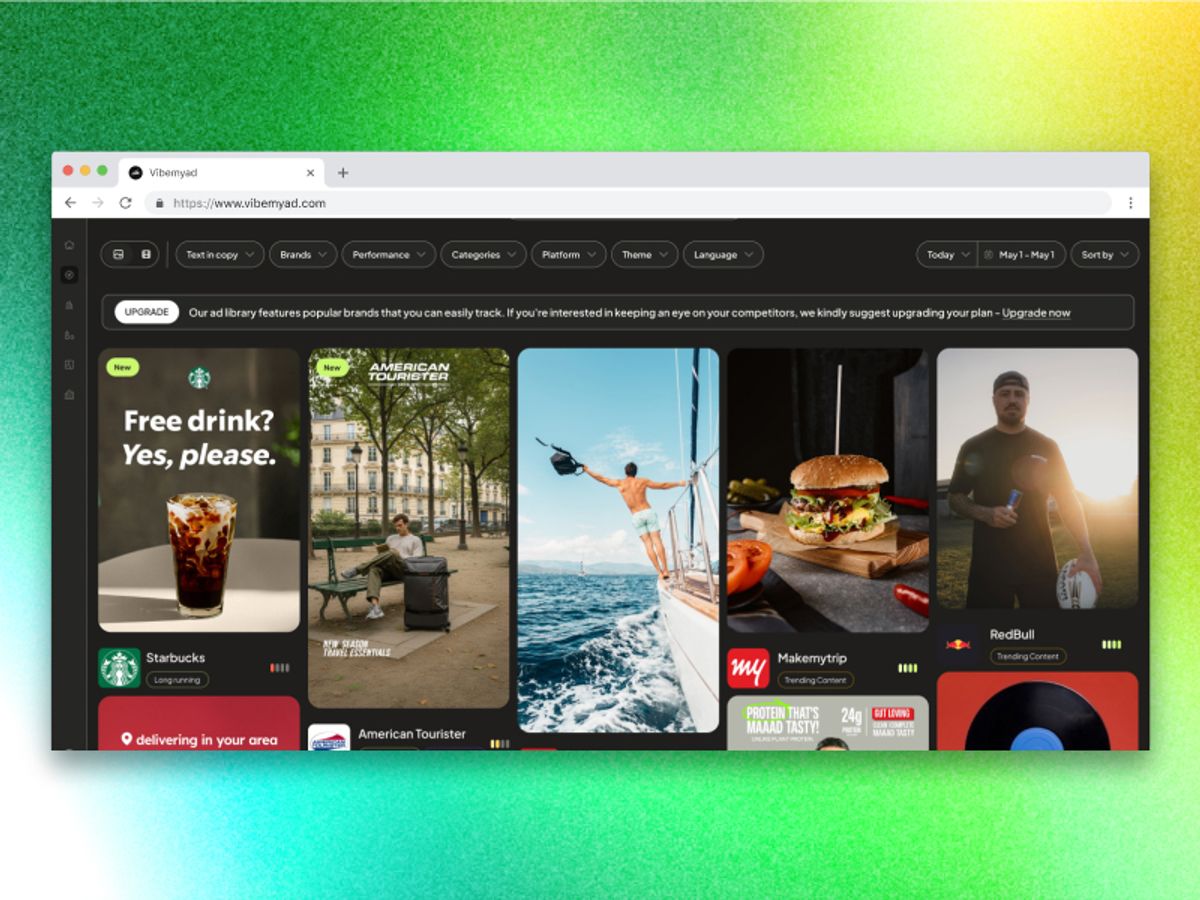
Ad Vault
When you click an ad from a brand you're tracking, Ad Vault surfaces the intelligence underneath it — not just the creative itself.
• Performance signals per ad. How long has this ad been running? What engagement signals has it generated? Is it being scaled across multiple variants and placements, or is it a single test that never got traction?
• Hook analysis and creative breakdown. What is the structural format of this ad? What creative approach is it using — problem-solution, testimonial, product demonstration? Understanding the hook is what makes competitive research actually usable when you brief a creative team.
• Runtime duration. Ads that have been running for 60, 90, or 120 days are almost certainly profitable. Nobody runs a losing ad for three months. Ad Vault surfaces this signal explicitly so you're not guessing which ads are winners.
All of this appears the moment you click a tracked brand's ad. No manual research. No spreadsheets. No guessing.
Vibemyad Ad Vault goes beyond any other ad library tool by showing three signals that tell you not just what a competitor is running — but what it means.
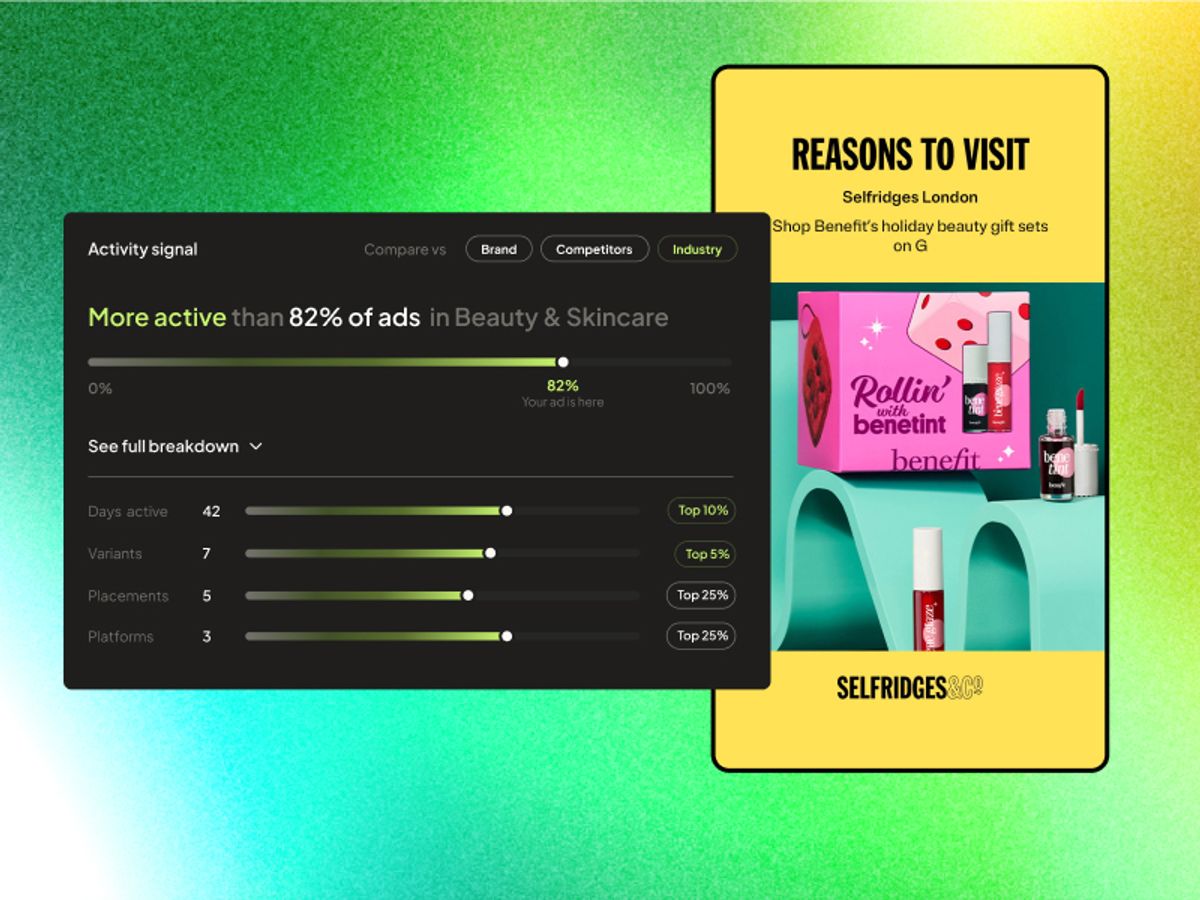
Activity Signal on a Selfridges Ad
The Activity Signal shows whether a competitor is in a testing phase, a scaling phase, or has gone quiet — based on how actively they are publishing new creative. A brand that suddenly increases creative output is likely in an active testing sprint. A brand that goes quiet may be regrouping or shifting strategy. Tracking activity over time turns a snapshot into a pattern — and patterns are what inform strategy.
The Market Signal tells you whether an individual ad concept has earned real traction — and whether the wider category is moving in the same direction.
A Strong Signal status means the ad has been running for 42+ days across multiple variants and placements, with longevity, share of voice, variants, and engagement all confirmed. High confidence. This is not a test — this is a concept being scaled because it is working.
Category Trend means other brands in your category are running similar creative. If four brands in Beauty and Skincare are all running Problem → Solution format ads in the last 30 days, that is a category-level signal — the format has been validated across your competitive landscape, not just by one brand.
The combination of Strong Signal plus Category Trend is the clearest possible indication that a creative approach is worth understanding deeply before you decide whether to follow it or find the gap around it
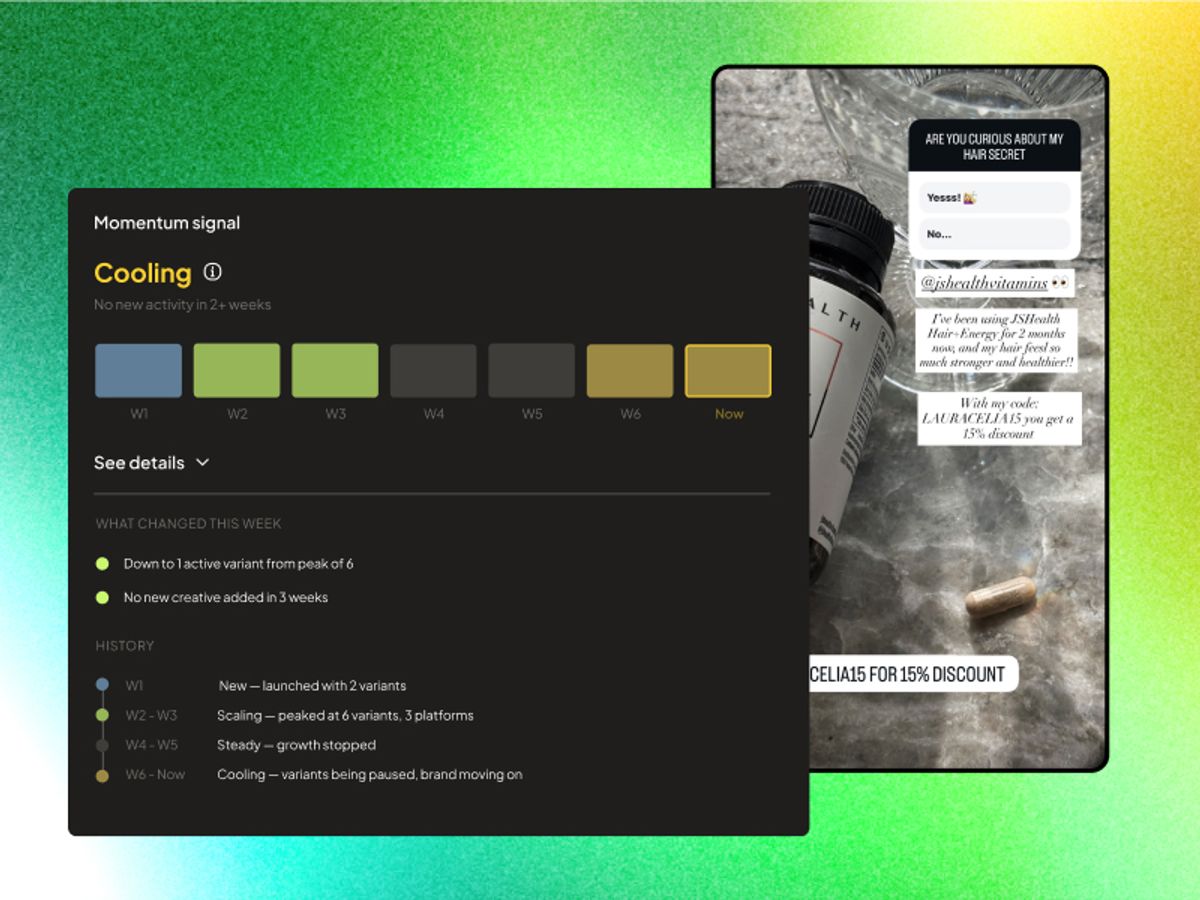
Momentum Signal on a JSHealth Vitamin ad
The Momentum Signal shows where a brand is in its creative lifecycle right now — New, Scaling, Steady, or Cooling — and how it got there. A brand showing Cooling status means no new activity in 2+ weeks, down to one active variant from a previous peak. A brand showing Scaling means they peaked at six variants across three platforms and are actively investing in this concept.
Underneath the current status, Vibemyad Ad Vault shows the full week-by-week history: when the concept launched, when it scaled, when growth stopped, and where it is now. This is the creative lifecycle of a competitor's campaign made visible — something the Ad Library has never been able to show.
Vibemyad Ad Spider answers "what is this brand doing across its entire creative strategy" — going one layer deeper than ad-level intelligence.
Where Vibemyad Ad Vault answers "what is this specific ad doing," Vibemyad Ad Spider covers creative themes across campaigns, positioning patterns, how a brand's messaging has shifted over time, and where whitespace exists in your category that no competitor has moved into yet.
The workflow connects naturally. Vibemyad Ad Vault surfaces the signal on an individual ad. Vibemyad Ad Spider gives you the full strategic picture of the brand behind it. For a broader view of how AI powers competitive ad research, see our guide on [AI tools for digital marketing](internal link).
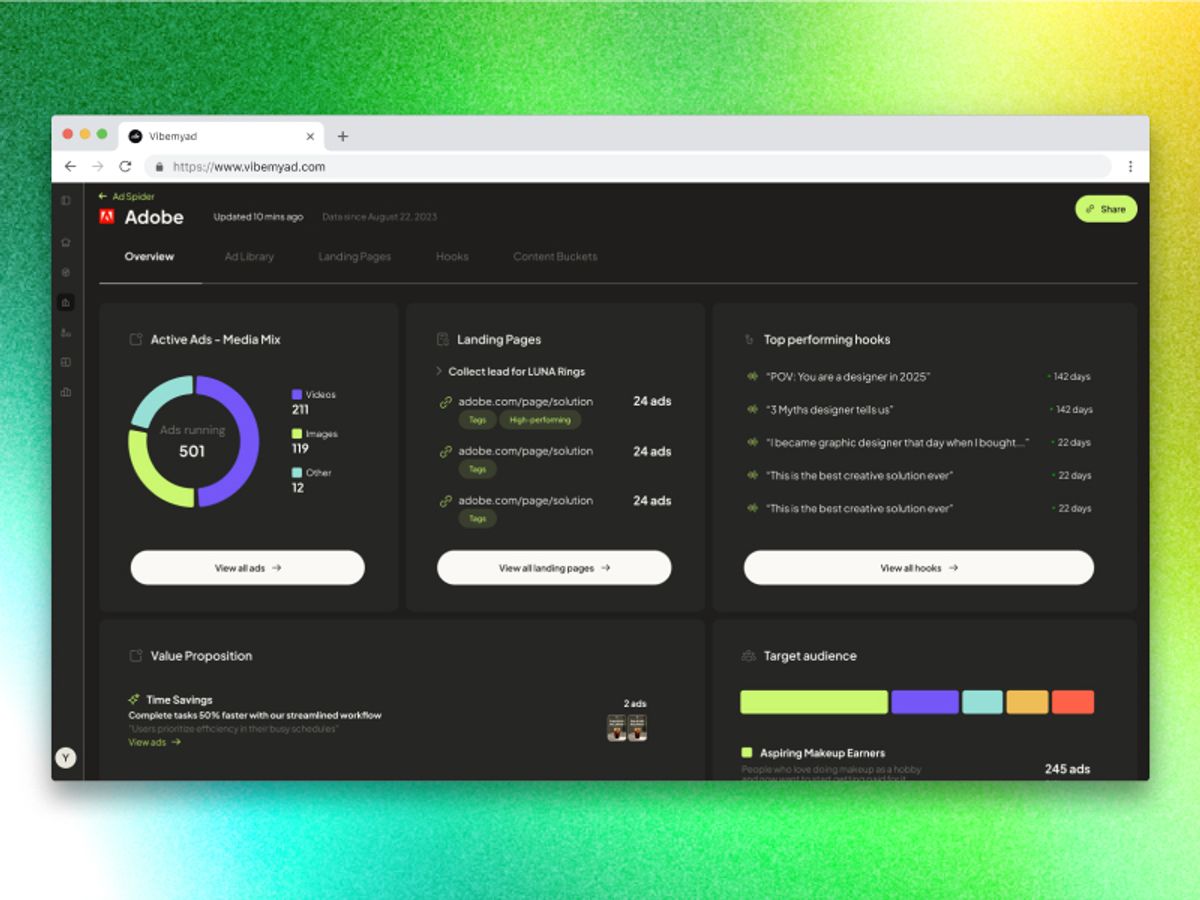
Ad Spider: The Brand Analysis Layer
The free Ad Library is fine if you check competitor ads occasionally for general inspiration, you're running a small budget where competitive intelligence is not yet a core workflow, or you need a quick one-off check on a specific brand.
You need Vibemyad Ad Vault if you are running serious paid spend where the difference between knowing what's working and guessing has direct budget consequences. If you need to know not just what a competitor is running but where they are in their creative cycle — scaling, cooling, testing. If category-level signals matter — knowing that multiple brands in your space are validating the same creative format before you decide whether to follow or differentiate. If you manage multiple brands or clients and manual research doesn't scale. If your creative team needs intelligence that feeds directly into production rather than living in folders of screenshots.
The honest calculation: if competitive research is taking your team eight or more hours per month, the manual process is almost certainly more expensive than the tool that replaces it.
Our agency turns research into your next campaign.



Rahul Mondal
Product, Design and Co-founder, Vibemyad


Ananya Namdev
Content Writer, Vibemyad

Rahul Mondal
Product, Design and Co-founder, Vibemyad
Table of Contents