
February 13, 2026 • 6 min read

February 13, 2026 • 6 min read
The fastest way to find winning ad hooks is to identify competitor ads that have been running for 30 days or longer. When advertisers keep spending on the same ad for weeks or months, it signals the hook is converting profitably. Nobody continues running ads that lose money.
Track 15-25 direct competitors using competitive intelligence platforms or manual Facebook Ad Library searches. Filter for ads running 30+ days. Extract the hooks (first 3-5 seconds or opening line). These are proven patterns audiences in your market respond to. Adapt the hook structure to your brand and product—don't copy verbatim, but learn the psychological triggers that work.
Most advertisers create hooks from brainstorming sessions or "best practices" articles. This approach fails because it's based on assumptions, not evidence. Winning hooks come from studying what's already converting in your specific market.
Meta's own research reveals that ad creative performance drops sharply after repeated exposure. A 2023 study published by Analytics at Meta found that at 4 repeated exposures, the likelihood of conversion drops by approximately 45%. The study analyzed ad impressions across Meta's platform and found that 19% of ad impressions had been seen more than five times within a 30-day period, with the mean count of user/creative previous exposures at 4.2 impressions.
This creates a simple performance signal: If an ad is still running after 30+ days while maintaining delivery, it has found a way to resist fatigue. According to Meta's 2024 Ad Performance Report cited by DashClicks, campaigns typically experience a 41% drop in CTR after an ad has been shown to the same user more than four times. Advertisers who refreshed creatives every 10-14 days maintained up to 30% higher engagement than those who ran the same visuals for longer periods.
When ads survive beyond this typical fatigue window, it indicates something fundamental is working. WordStream's 2024 Facebook Ad Data Report found that most creatives begin losing efficiency within specific timeframes: 7-10 days for eCommerce brands, 14-21 days for B2B campaigns, and just 5-7 days for high-frequency retargeting ads.
Meta's ad auction system actively reinforces this pattern. AdEspresso research found that CTR can drop by up to 50% when frequency exceeds 4, while Facebook's own data shows that ads shown more than 6 times typically experience a 60% increase in CPC. Poor-performing ads get throttled by the algorithm—low engagement signals result in reduced delivery and higher costs.
The Facebook Ad Library provides public transparency data showing ad start dates. When advertisers keep spending on the same creative for 30, 60, or 90+ days despite Meta's documented fatigue dynamics, it signals the hook is converting profitably. Nobody continues running expensive ads that lose money. These long-running ads reveal proven hook structures that resist the typical performance decline curve.
Long ad duration doesn't always indicate high performance. Several factors can create false positives:
Don't rely on a single long-running ad as validation. When you identify 5-10 different advertisers in your space all running variations of the same hook structure for 30+ days, that's a statistically significant pattern worth adapting.
Manual Facebook Ad Library searches work but become time-intensive when tracking 15-25 competitors. Here's the systematic approach:
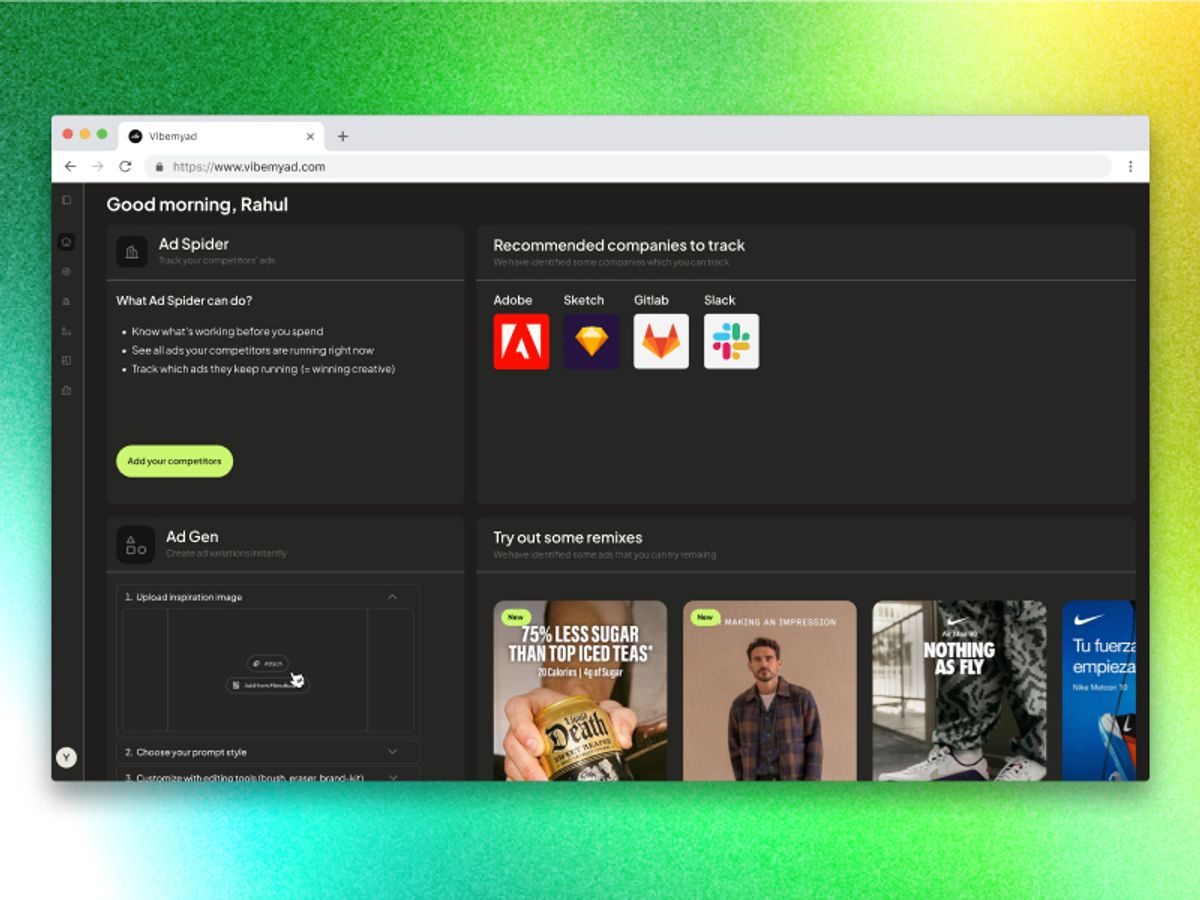
Add your Competitor on Vibemyad
List 15-25 brands selling to the same audience. Include larger competitors (what scales), similar-sized competitors (current tactics), and emerging competitors (what's new).
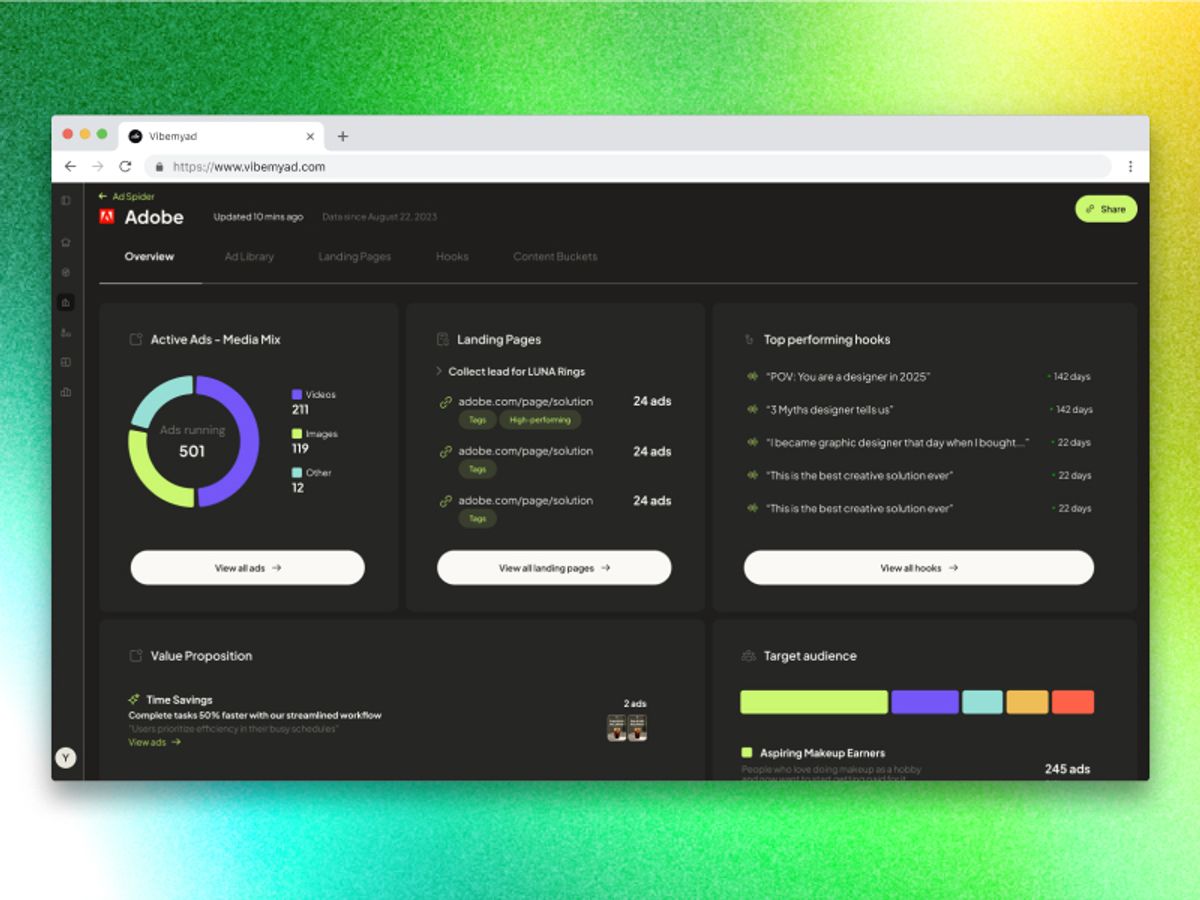
Track your Competitors on Vibemyad
Manual Method: Create a spreadsheet tracking competitor names, ad URLs, first seen date, and hooks. Check Facebook Ad Library weekly to monitor which ads are still running 30 days later. Works but requires 3-4 hours weekly.
Automated Method: Use Vibemyad's Ad Spider:
Ad Spider flags ads running 30+ days (the performance signal) and surfaces hook patterns automatically. Reduces research time from 3-4 hours to 20-30 minutes weekly.
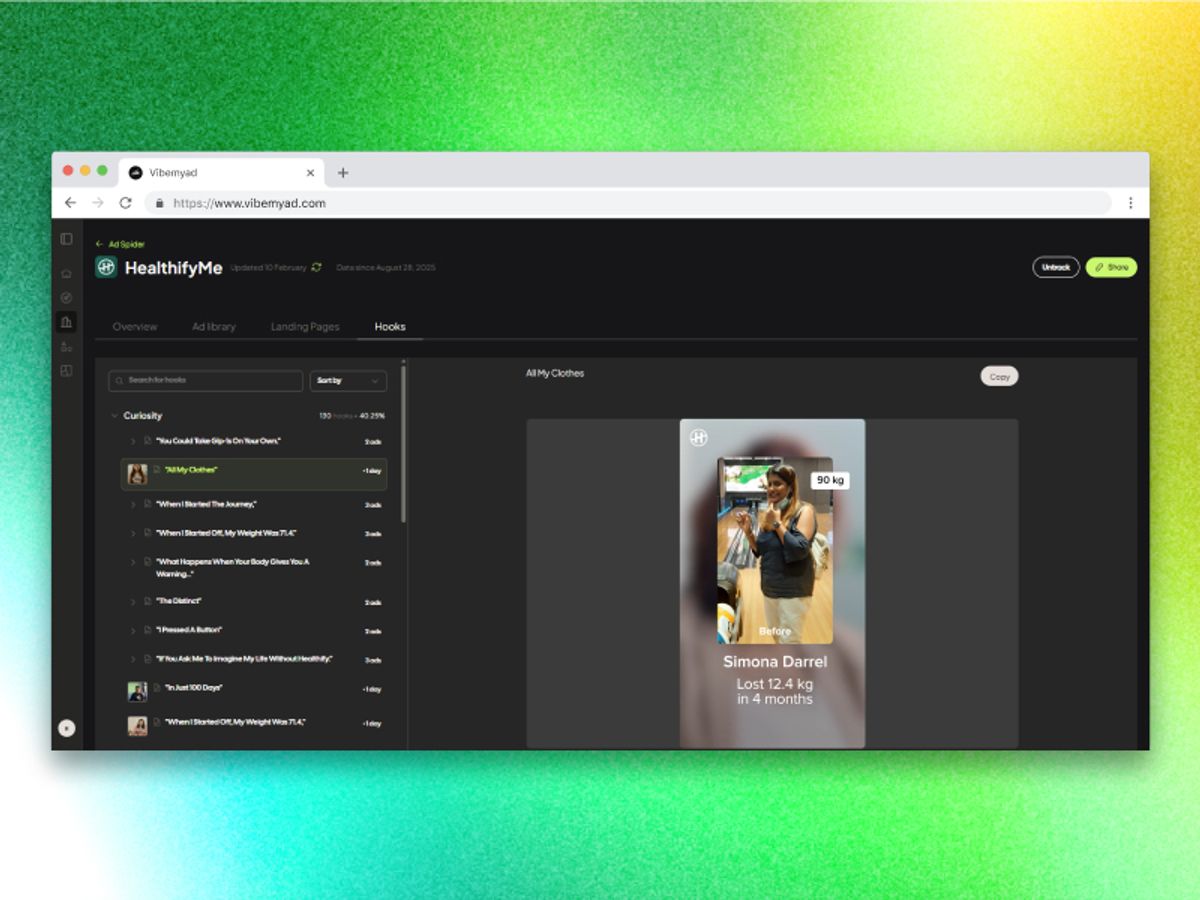
Extract Hooks from Ad Spider
Group hooks by psychological trigger: problem-solution, social proof, curiosity gap, transformation, comparison. When 3+ competitors run the same hook structure for 30+ days, that pattern is validated for your market.
Take the hook structure, not exact wording. If competitors run "Why [competitor] users are switching to us" for 45+ days, the validated pattern is comparison-based switching. Create your version using your brand voice.
Launch with $100-150 minimum budget per creative. Track conversions, not just CTR. Run for 7-14 days. If performance matches your baseline, you've validated the pattern.
Compile 10-15 validated hook structures from competitive research. Rotate them as creatives fatigue. Pull from your library instead.
Finding winning ad hooks isn't about creativity or guesswork—it's about competitive intelligence. The hooks that convert are already visible in your market, running profitably for weeks or months.
Track competitors systematically. Identify long-running ads as performance signals. Extract hook patterns, not exact copy. Adapt structures to your brand. Test with sufficient budget. Build a library of proven patterns.
This research-led approach replaces the endless cycle of failed creative tests with predictable, evidence-based hook development. Advertisers who study what's already working outperform those who brainstorm in isolation.
The winners aren't the most creative—they're the most observant.
Finding winning ad hooks in 2026 requires systematic competitive research, not creative guessing. Long-running competitor ads (30+ days) signal proven hook structures worth adapting. Tools like Vibemyad's Ad Spider automate this research process, turning competitive intelligence into actionable creative strategy.
Get notified when new insights, case studies, and trends go live — no clutter, just creativity.
Table of Contents


Rahul Mondal
Product, Design and Co-founder, Vibemyad


Arpita Mahato
Content Writer, Vibemyad


Ananya Namdev