February 17, 2026 • 6 min read

February 17, 2026 • 6 min read
If you want to research ads for your D2C brand, start by finding out what your competitors are running. Open their ads, look for messages they keep returning to, and decide which ideas deserve a test for your own product.
You can begin with Meta Ad Library for free. When you want to follow competitors over time, rather than repeat the same searches, use a tracking tool such as Vibemyad Ad Spider.
The process is straightforward: find the brands, review their ads, shortlist promising angles, then create and test your own executions. Here is how to do it.
Ad research means studying other advertisers' messages, visuals, formats and offers to inform your own campaigns. For a D2C brand, the aim is to answer a practical question: what should we make next, and why?
You might discover that competitors repeatedly explain a product feature, answer a buying objection or show the product in use. Those patterns give you starting points. Your research becomes useful when you can name the buying reason behind the ad, rather than just say that you like its design.
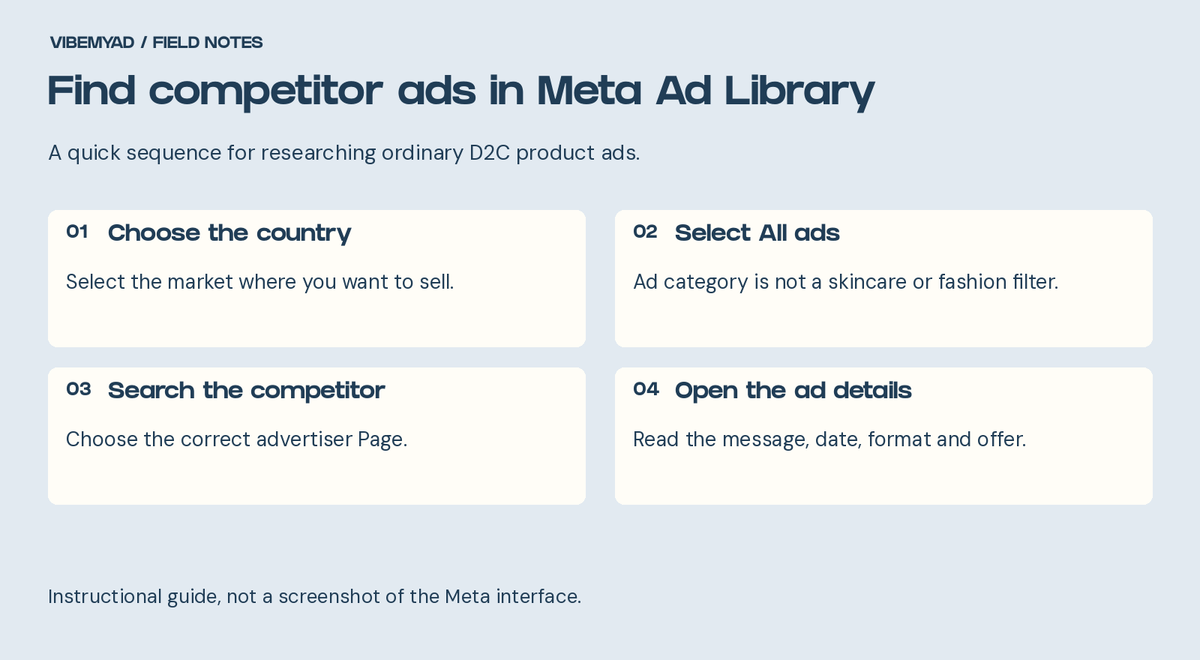
Quick-start guide to Meta Ad Library. This is an instructional graphic, not an interface screenshot.
Open Meta Ad Library. Set the country to the market you want to research. If you sell to US customers, start with United States.
Under ad category, choose “All ads” for ordinary D2C product research. This menu is not a product-category filter for skincare, clothing or food.
Type a competitor's brand name in the search box and select its advertiser Page from the suggestions. Check the name and profile image so you do not accidentally study a reseller or another business with a similar name.
Open the available ads and their details. Read the full message, inspect the image or video, and note the start date and status where shown. Follow the destination to see what the shopper reaches after clicking.
If you get no results, check the country, advertiser Page and any filters you have applied. A blank search is not enough to conclude that the brand never advertises.
Repeat this for a small set of direct competitors. I would begin with three to five brands selling comparable products at a similar price point. That is a manageable research list, not a rule about how many competitors every business needs.
For a closer look at finding individual advertisers, use our Meta Ad Library guide.
Save the ad link and date you reviewed it. Alongside those, record the product, opening message, format, offer and destination. A spreadsheet is enough to start.
Watch the whole video when you research a video ad. The opening may earn attention, but the demonstration, explanation and offer tell you what the brand is actually selling. For static ads, read the supporting copy as well as the headline.
Group the ads by their argument: convenience, price, fit, ingredients, durability or another relevant buying reason. Ten designs promoting the same benefit may represent one main concept with several executions.
Manual searches work for an initial review. Tracking becomes useful when you want to see what a brand keeps running and what changes between visits.
Open Vibemyad Ad Spider and use Get Started. Add the competitor brands you want to track, matching each to the correct Meta advertiser Page. Let the ads load before reviewing the brand's collection.
Review the available dates and related creatives. Compare the hooks, formats and product benefits across the collection. Use the research tools to investigate repeated themes or ask which angles appear across your selected competitors. Check those suggestions against the actual ads before putting them into your brief.
Vibemyad currently uses pay-as-you-go credits, starting at $20. The amount of research that covers depends on usage and the number of ads involved. Check the current pricing before you begin.
Start with a few relevant brands. Tracking a large list is only useful if you have time to review what it tells you.
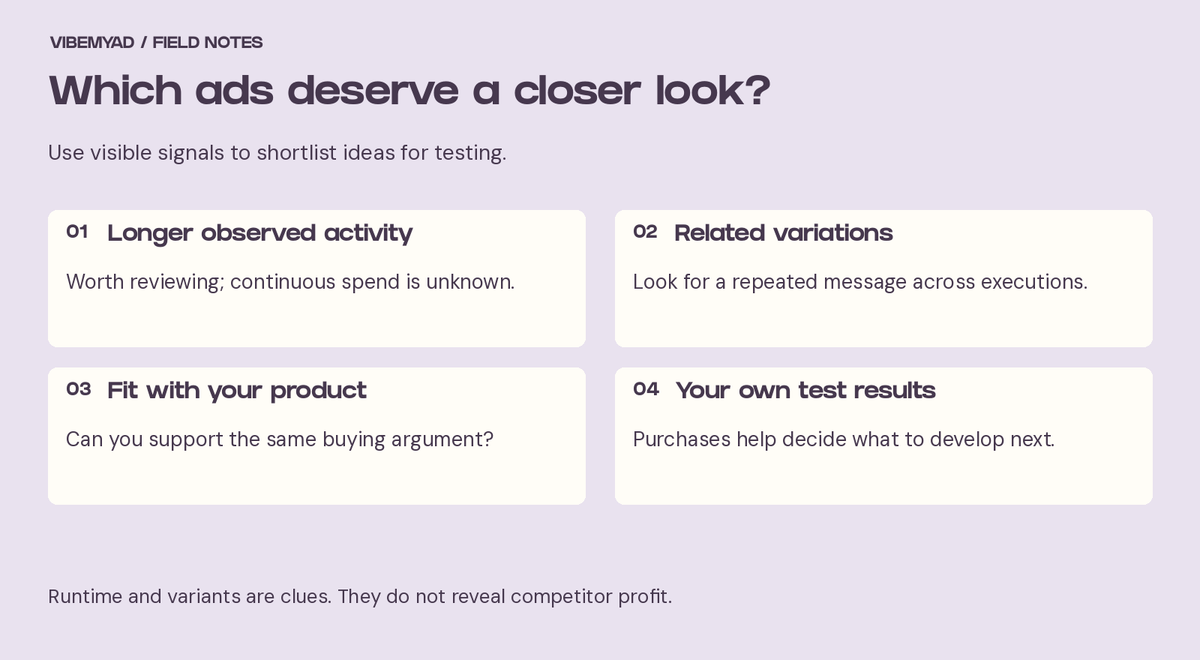
Signals for prioritising research. Public creative activity does not establish profitable performance.
Two useful clues are longer observed activity and multiple related variations. If a brand keeps returning to the same selling point across different executions, I would put that message on the shortlist for closer inspection.
Look at what repeats. Is it the benefit, the opening line, the demonstration or the offer? Then look at what changes. New headlines around the same demonstration suggest a different research takeaway from completely different products in a similar template.
These are potential winning angles, not confirmed profitable ads. Runtime does not reveal continuous spend, and several variants can be part of an experiment rather than the result of one. Competitor sales and acquisition costs are not visible just because the creative is public.
Use the clues to prioritise your research. An older ad with several variations and a clear connection to your product is usually more useful to investigate than an unrelated ad you saved because it looked attractive. You still need your own test to decide whether the angle works for you.
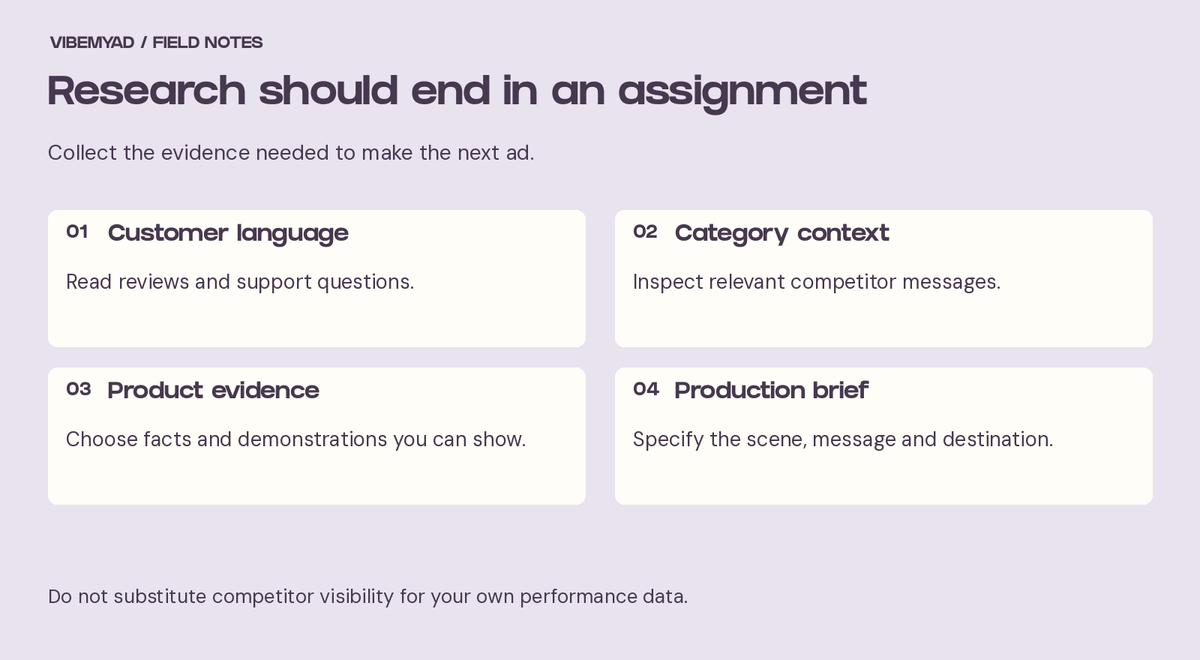
Research should end in an assignment
Suppose several relevant brands keep showing how easily their products fit into a daily routine. Write down that angle: ease of use. Then ask what your product can genuinely demonstrate about it.
Your brief might call for showing the setup, the product in use and the finished result. Choose the scene around your customer's routine. Use your own footage, copy and product evidence instead of reproducing the competitor's execution.
Before approving the idea, ask three questions. Does our customer have this concern? Does our product support the promise? Can we show the benefit clearly?
If you cannot answer those, a competitor's apparent success is not enough reason to produce the ad. Our guide to what makes an effective ad helps connect the message to the product explanation.
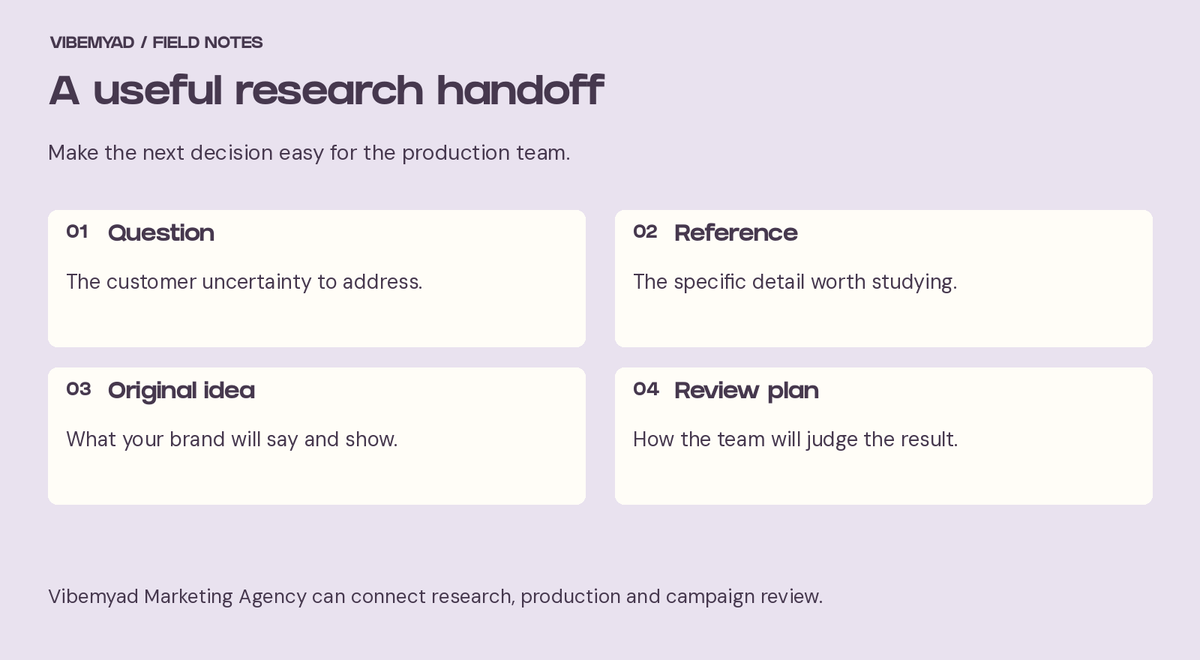
A useful research handoff
Produce a small set of distinct ideas that your budget can support. Compare purchase results and acquisition costs alongside attention metrics. When one concept gives you a promising signal, develop variations of that concept. Our creative testing guide explains how to structure that next step.
Set a weekly or fortnightly review for your tracked competitors. Note new messages, repeated offers and variations of existing concepts. Keep useful observations in the same research sheet, with the date and source.
The next review should leave you with a decision: continue the current angle, test a variation or investigate another buying reason. That gives the research a purpose beyond collecting more ads.
If you want this handled for you, Vibemyad Marketing Agency can research the competitors, develop the angles and produce the ads for testing. You can also use the platform yourself and bring us in when you need help with execution.
Get notified when new insights, case studies, and trends go live — no clutter, just creativity.
Table of Contents


Ananya Namdev
Content Writer, Vibemyad

Ananya Namdev
Content Writer, Vibemyad


Rahul Mondal
Product, Design and Co-founder, Vibemyad