
January 15, 2026 • 11 min read

January 15, 2026 • 11 min read
You checked Ads Manager this morning. 652 link clicks yesterday. You're excited—that's your best day yet.
Then you check Google Analytics. 47 sessions. Your Shopify dashboard shows 2 add-to-carts and zero purchases.
Where did the other 605 clicks go?
They didn't. They were never real. Welcome to the reality of Facebook click fraud in 2026—a $100+ billion problem that Meta profits from while advertisers bleed money without knowing it.
This comprehensive guide reveals the shocking fraud rates by placement (Instagram: 38%, Audience Network: 67%, TikTok: 79%), how bot traffic tricks Meta's algorithm into optimizing for fake users, and the exact prevention strategies that actually work. If you're running Facebook ads in 2026, you're statistically losing 6-67% of your budget to bots—here's how to stop it.
• Fraud rates by platform: Meta Facebook (6%), Instagram (38%), Audience Network (67%), TikTok Audience Network (79%)
• Financial impact: At least $100B stolen from advertisers annually through click fraud
• The bot mechanism: Bots click ads, 10% add to cart to appear human, Meta optimizes for bot traffic thinking they're real
• Worst placements: Audience Network (100% fraud - always exclude), Instagram (38% fraud rate)
• Safe placements: Facebook Newsfeed, Stories, and Reels show lowest fraud rates
• Warning signs: High link clicks with ghost town analytics, excessive abandoned carts, spam leads, great CPMs but zero conversions
• What works: Use purchase conversions only (not link clicks), implement server-side tracking, deploy bot protection, exclude Audience Network entirely
• Attribution confusion: Facebook's 7-day click/1-day view model vs GA4 creates discrepancies—not always fraud
• Prevention tools: Competent bot detection services (not simple IP blocking), offline conversions, click validation systems
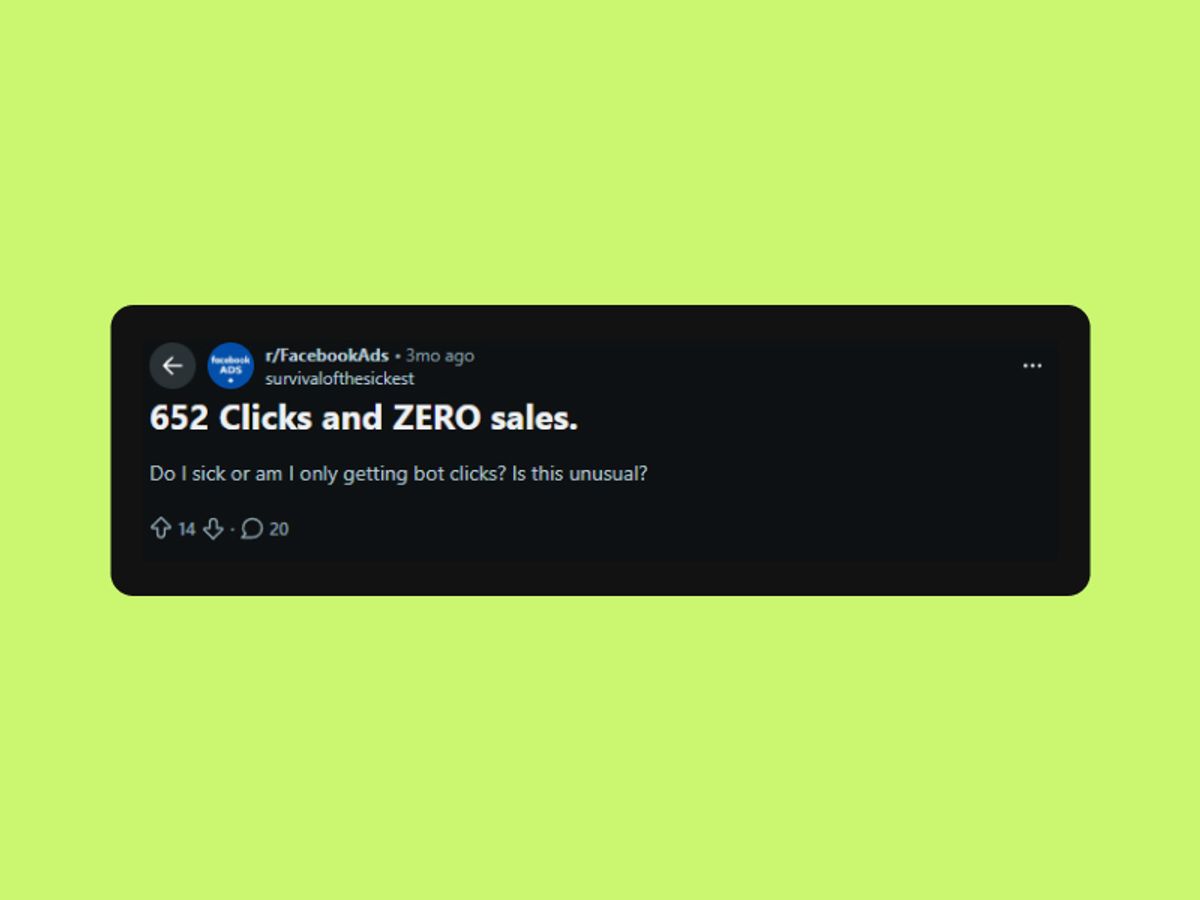
Real advertiser experiencing 652 clicks with zero conversions - a pattern confirmed by 125+ users in the r/FacebookAds community
One advertiser posted in r/FacebookAds: "I'm convinced 100% of Facebook ad clicks are fraud!!" His ads showed 652 link clicks. His website analytics showed almost no traffic. Zero purchases.
The post got 125 upvotes in hours. Why? Because hundreds of advertisers recognized the exact same pattern.
According to click fraud detection data from September-December 2025:
Click Fraud Rates by Platform (2025-2026):
Critical: These numbers reflect only proven bots. Actual fraud rates including suspicious traffic are likely higher.
Financial impact: At least $100 billion is stolen from advertisers annually through click fraud.
If you're spending $10,000/month on Instagram ads, statistically $3,800 goes to bots. On Audience Network? $6,700 of your $10K is fraud.
Multiple advertisers report the same timeline: September 2024 is when everything changed.
"This only began happening about two months ago. Facebook ads used to be gold for me. Now I get wayyy more clicks and almost zero sales."
Real case: An e-commerce store with a stable 2% conversion rate suddenly dropped to 0% conversion. No changes to landing pages, offers, or targeting. Just a flood of clicks that never converted.

Bot Click Mechanism
• Step 1: Bots click your ads—sophisticated networks programmed to browse Facebook and click everything.
• Step 2: Bots mimic human behavior—they scroll, spend 20-60 seconds on site, and critically, about 10% add items to cart before leaving.
• Step 3: Meta's algorithm gets confused—sees high CTR, engagement, and add-to-cart events but low purchases. Thinks: "Users are interested but checkout is broken." Keeps sending more.
• Step 4: Your campaign optimizes for bot traffic—Meta finds more "similar users" (more bots with similar digital fingerprints). Your CPC drops, CTR increases, but purchase rate craters.
Ad networks financially benefit from click fraud. Display/Audience Networks consist of third-party websites that get paid per click. Many are owned by fraud operations. Fraudsters generate fake clicks on their own sites, the ad network pays them (from your budget), and takes their commission.
Why Meta doesn't stop it: At least $100B+ is stolen annually through click fraud. Ad networks do little to stop it because they rely on this traffic to hit revenue targets. Every fake click is revenue.
Not all placements are equally compromised:
Audience Network: 67% fraud (ALWAYS EXCLUDE)
2 out of 3 clicks are fake. You have no control over where ads appear—many placements are bot-operated websites.
Action: Campaign Settings → Placements → Manual → Uncheck "Audience Network." Every time.
Instagram: 38% fraud
More than 1 in 3 clicks is fake, particularly in Instagram Explore and Shopping.
Safest placements (lowest fraud):
• Facebook Newsfeed (Desktop and Mobile)
• Facebook Stories
• Instagram Stories
🚩 Click-to-session discrepancy: Ads Manager shows 500 clicks, GA4 shows 150 sessions
🚩 Ghost town behavior: 90%+ bounce rate, <5 seconds on page, 0% scroll depth
🚩 Spam leads: Fake emails ("asdfjkl@gmail.com"), fake phones ("1111111111")
🚩 Geographic anomalies: Targeting USA, getting traffic from Bangladesh/Philippines
The principle: "The way to stop click fraud is to prevent bots from generating fake conversions. If you only allow human conversions, you'll be sent human traffic."
How to implement:
Change campaign objective from "Traffic" or "Engagement" to "Conversions"
Optimize for Purchase events only (not link clicks, not add-to-cart, not page views)
Let the algorithm learn for 7-10 days without changes
Set appropriate bid caps if needed, but let Meta find buyers
Why it works: Bots can click ads. Bots can scroll on landing pages. Bots can even trigger add-to-cart events (about 10% do). But bots cannot complete purchases because they don't have credit cards or payment information.
When you optimize for purchases, Meta's algorithm learns: "These users clicked but never bought—they're not valuable." Over time, bot traffic decreases because bots don't generate the conversion signal you're optimizing for.
Important: This strategy requires proper pixel implementation. If your Purchase event isn't firing correctly, verify it in Events Manager before relying on this method.
Expected timeline: You may see CPC increase and CTR decrease in the first 3-5 days as the algorithm shifts away from bots. This is good—you're paying for quality. Conversion rates typically improve 40-80% within 2 weeks.
Why client-side tracking fails against bots:
Browser-based Facebook pixels are JavaScript code that fires when someone loads your page. Bots can easily trigger these events—PageView, ViewContent, AddToCart—without being real humans. The pixel fires, Meta records the event, and you've just paid for bot traffic.
Why server-side tracking (Conversions API) works better:
CAPI validates events on your server before sending them to Meta. When someone completes a purchase, your server confirms: (1) the transaction actually processed, (2) payment was received, (3) order was created in your system. Only then does it send the Purchase event to Meta.
This adds a verification layer that's much harder for bots to fake because they can't create actual orders in your database.
Implementation options:
• Elevar: E-commerce focused, Shopify integration ($50-200/month depending on order volume)
• Tracklution: Enterprise-grade CAPI with advanced matching
• Triple Whale: Full attribution platform with server-side tracking built-in ($99+/month)
• Shopify native CAPI: Built directly into Shopify (included with Shopify plan)
Setup time: 30 minutes to 2 hours depending on platform complexity.
Expected impact:
• 20-30% improvement in conversion attribution accuracy
• Significant reduction in bot-triggered conversion events
• Better Event Match Quality scores (6.5+ vs 5.0-)
• More accurate algorithm learning from real customer data
Critical distinction: Not all bot protection is equal.
What doesn't work:
• Simple IP address blocking (bots use residential proxies)
• Basic CAPTCHA (bots solve these automatically)
• Country blocking (sacrifices legitimate traffic)
What actually works:
Professional bot detection that analyzes:
• Mouse movement patterns: Humans move mice in curves; bots move in straight lines or not at all
• Scroll behavior: Real users scroll erratically; bots scroll at constant speeds
• Keyboard interaction timing: Humans have variable typing speeds; bots are too consistent
• Device fingerprinting: Identifying suspicious device characteristics
• Behavioral anomalies: Session duration, page interactions, navigation patterns
Why you need specialists:
The click fraud researcher who provided the data for this article emphasized: "Use competent bot protection services, not simple IP blocking." Bot operations are sophisticated—they use residential IPs, real devices, and human-like behavior patterns. You need equally sophisticated detection.
When to implement: If your click-to-session discrepancy is >40%, bot protection should be your first investment after CAPI.
Non-negotiable for 2026. The 67% fraud rate on Audience Network makes it mathematically impossible to profit from.
How to exclude permanently:
Go to campaign level in Ads Manager
Click Edit → Placements
Select "Manual Placements"
Uncheck "Audience Network" completely
Save as a campaign template for future use
Apply to existing campaigns: Yes, go back and exclude it on every active campaign. The 5 minutes of work will save thousands in wasted budget.
The tradeoff everyone asks about:
"But my CPM will increase without Audience Network!"
Yes. By 10-20% typically. Here's why you should do it anyway:
Real advertiser results after excluding Audience Network:
• CPM increased from $8 to $9.20 (+15%)
• CTR decreased from 3.2% to 2.4% (-25%)
• Conversion rate increased from 0.4% to 1.4% (+250%)
• ROAS improved from 0.8 to 2.3 (+188%)
You're paying slightly more per click, but those clicks are real humans who can actually purchase. The math works overwhelmingly in your favor.
The strategy: Instead of relying only on pixel-based conversions, upload your actual customer purchase data back to Meta.
How offline conversions work:
Customer completes purchase on your website
Your system records: Email (hashed), phone (hashed), purchase amount, order ID, timestamp
You upload this data to Meta's Offline Event Sets (weekly via CSV or daily via API)
Meta matches this conversion data to ad clicks and impressions in their system
Algorithm optimizes based on actual verified customers—not pixels that bots might have triggered
Why this is powerful against fraud:
Bots can fake clicking ads. Bots can fake website visits. Bots can even fake add-to-cart events. But bots absolutely cannot fake being in your customer database with a real email address, real phone number, and real purchase transaction.
Offline conversions provide ground truth: "These exact people made actual purchases—optimize for more people like them."
Implementation steps:
Meta Events Manager → Data Sources → Offline Event Sets → Create Set
Download the CSV template
Export customer data from your e-commerce platform
Format data to match template (hash emails/phones for privacy)
Upload weekly or integrate via Zapier/API for automation
Expected results: Algorithm learning improves 30-50% because it's training on 100% verified real customer data instead of potentially bot-contaminated pixel data.
The validation layer: Don't rely only on Meta's reporting. Use Google Analytics 4 as your independent verification system.
Key metrics to track:
• Engaged sessions rate: >50% is healthy; <20% indicates bot problem
• Average engagement time: >30 seconds for e-commerce; <10 seconds indicates bots
• Scroll depth: Bots show 0% or instant 100% scroll; humans show distribution
• Event completion funnel: Track PageView → AddToCart → Purchase to identify dropoff
The comparison diagnostic:
If Ads Manager reports 1,000 link clicks but GA4 shows:
• 800-950 sessions = Normal tracking differences (not fraud)
• 500-700 sessions = Moderate bot problem (30-50% bot traffic)
• <400 sessions = Severe bot problem (60%+ bot traffic)
This data tells you exactly how much budget goes to bots vs real humans.
Week 1: Immediate Actions
Exclude Audience Network on all campaigns
Switch to manual placements: Facebook/Instagram Feed + Stories only
Change objectives from Traffic → Conversions (Purchase)
Week 2-3: Deploy Protection 4. Implement CAPI (Shopify native, Elevar, or Tracklution) 5. Set up GA4 engagement tracking 6. Configure offline conversions uploads
Ongoing 7. Weekly: Compare Meta clicks vs GA4 sessions 8. Monthly: Review fraud metrics and adjust placements
Click fraud is a feature, not a bug. Ad networks profit from it. Bot operators profit from it. The only loser is you—the advertiser.
Meta knows about the fraud. They have the technology to stop it. But every bot click is revenue. Every fraudulent impression counts toward quarterly targets.
The industry reality: "At least $100B is stolen from advertisers every year due to click fraud, and the ad networks do very little to stop it since they rely on click fraud for their revenue targets."
What you can do:
You can't change Meta's business model. But you can protect your budget by implementing the prevention strategies in this guide: optimize for conversions, use server-side validation, exclude fraud-heavy placements, and monitor closely.
The advertisers succeeding on Facebook in 2026 aren't those with the best creative or biggest budgets. They're the ones who filter out bot traffic and optimize for real human buyers.
That's your competitive advantage.
Facebook click fraud is the silent budget killer in digital advertising. Implement the prevention strategies in this guide, monitor your data weekly, and optimize for real conversions—not vanity metrics like link clicks. The 6-67% of your budget going to bots can be recovered and redirected toward real customers.
Get notified when new insights, case studies, and trends go live — no clutter, just creativity.
Table of Contents


Rahul Mondal
Product, Design and Co-founder, Vibemyad

Rahul Mondal
Product, Design and Co-founder, Vibemyad


Arpita Mahato
Content Writer, Vibemyad