
January 12, 2026 • 16 min read

January 12, 2026 • 16 min read
You launched your Meta campaign on Monday. Day 1 was incredible—$0.50 CPAs, 4.5 ROAS, conversions flooding in. You went to bed thinking you'd cracked the code.
Tuesday morning, you check your dashboard. Everything's collapsed. Same ads. Same landing page. Same targeting. But now your CPC is fine while conversions disappeared. Your ROAS dropped from 4.5 to 0.8 overnight.
Welcome to the Andromeda effect.
Since Meta rolled out the Andromeda algorithm update in April 2024, thousands of advertisers have watched their businesses crater. We're talking 90% revenue drops, $1M+ businesses reduced to near-zero, and volatility that makes performance tracking feel like gambling.
But here's what most advertisers miss: Andromeda isn't broken. It's just fundamentally different. This guide shows you the exact recovery strategy that's working for advertisers spending $40K+/week in 2026—the structural changes, creative systems, and mental shifts you need to survive the new Meta.
• The core problem: Meta's full-funnel optimization creates 2-4 week learning phases with extreme day-to-day volatility
• Learning phase: Now requires 2-4 weeks minimum (not 5-7 days) and 50 conversions/week for stability
• Structure matters more than creative: Simplified account structure (fewer campaigns/ad sets) + broader targeting beats complex setups
• Creative diversity is non-negotiable: Need 7-10 genuinely different angles per ad set (not "same video, different hook")
• Scaling kills performance: Never raise budgets on active ad sets—duplicate with higher budgets instead
• Platform dependency is fatal: Businesses relying solely on Meta are experiencing 90%+ revenue drops; diversification is survival
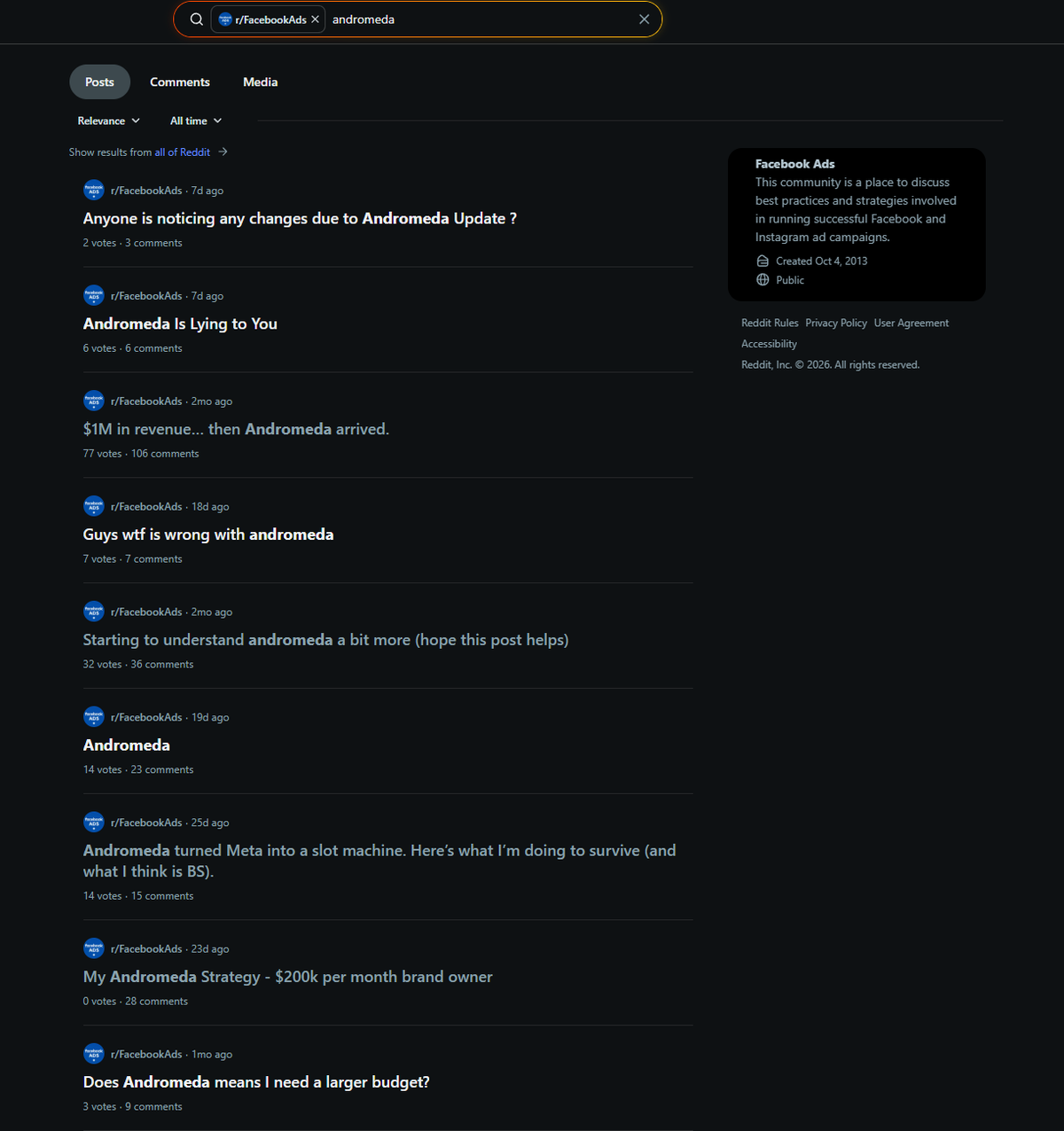
Over 12 posts discussing Andromeda failures on r/FacebookAds in just 2 months—showing how widespread the problem is
Andromeda Collapse
Meta's Andromeda algorithm update didn't just tweak the system—it fundamentally changed how Facebook Ads work. And most advertisers are still running 2023 playbooks in a 2026 game.
Here's the pattern every affected advertiser recognizes:
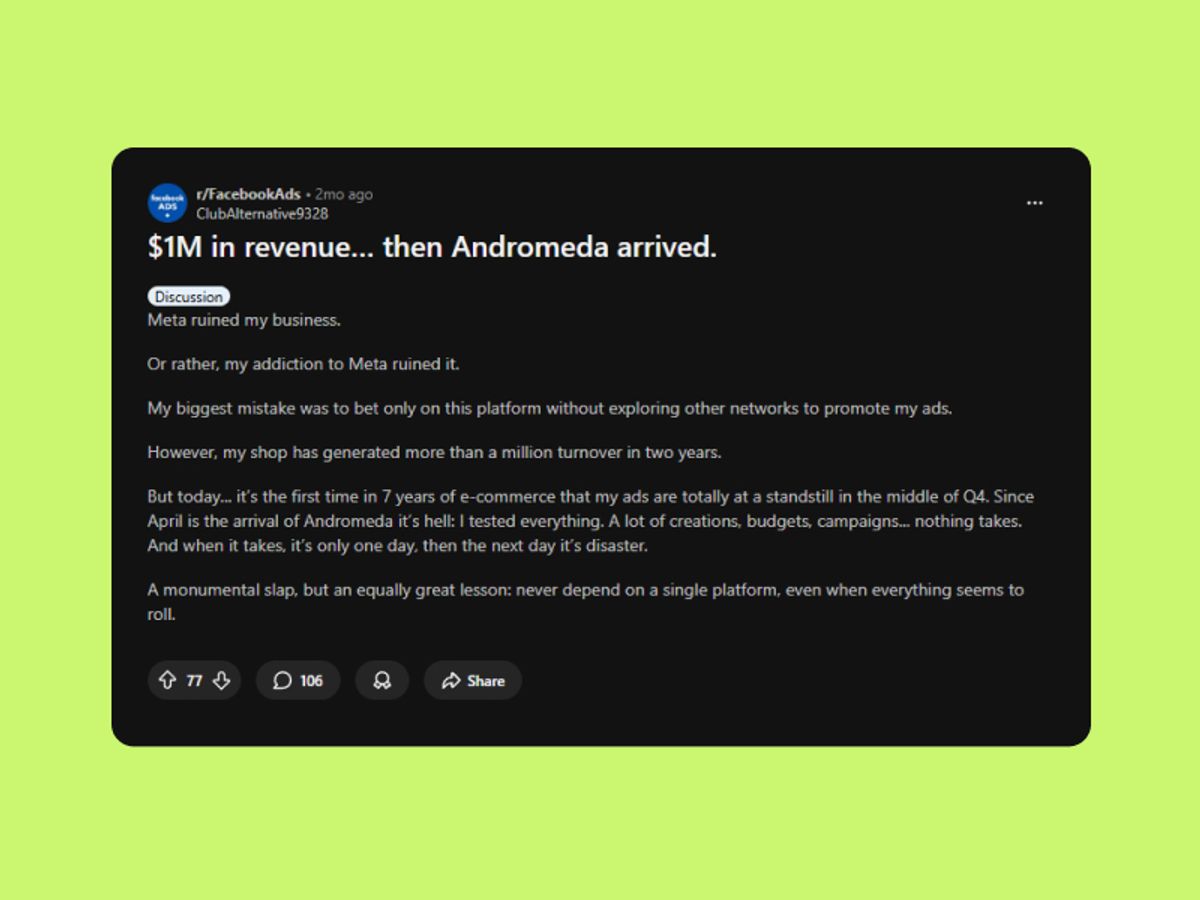
Real case from Reddit: Advertiser generated $1M+ revenue over 2 years, then experienced complete collapse post-Andromeda"
• Day 1-2: Insane performance. Cheap conversions. ROAS through the roof. You're convinced you've found your winning campaign.
• Day 3-4: Cliff drop. Nothing on your end changed, but conversions fall off a cliff. CPC stays normal (sometimes even improves), but intent vanishes.
• Day 5+: Your cost per add-to-cart and purchase metrics are 3-5x your targets. The algorithm is still spending your budget, but it's finding the wrong people.
This isn't a creative problem. It's not a landing page issue. It's how Andromeda fundamentally operates.
If you want to know more about Meta Andromeda update and how it works, read this guide.
Meta's goal with Andromeda was ambitious: optimize the entire funnel simultaneously. Instead of separate prospecting and remarketing campaigns, the algorithm now tries to understand and optimize awareness, consideration, and conversion all at once.
The result? A dramatically longer learning phase. Meta is processing exponentially more signals, testing more audience segments, and trying to predict full customer journeys—not just clicks.
Here's what changed:
• Learning phases extended from 5-7 days to 2-4 weeks due to increased optimization complexity
• Budget changes trigger complete learning resets (even 20% increases can send you back to day one)
• Small budget accounts (<$1K/day) experience severe volatility because the algorithm lacks sufficient volume to stabilize
• Niche products get hit hardest because the algorithm struggles with specialized audiences
• Signal quality matters exponentially more than before
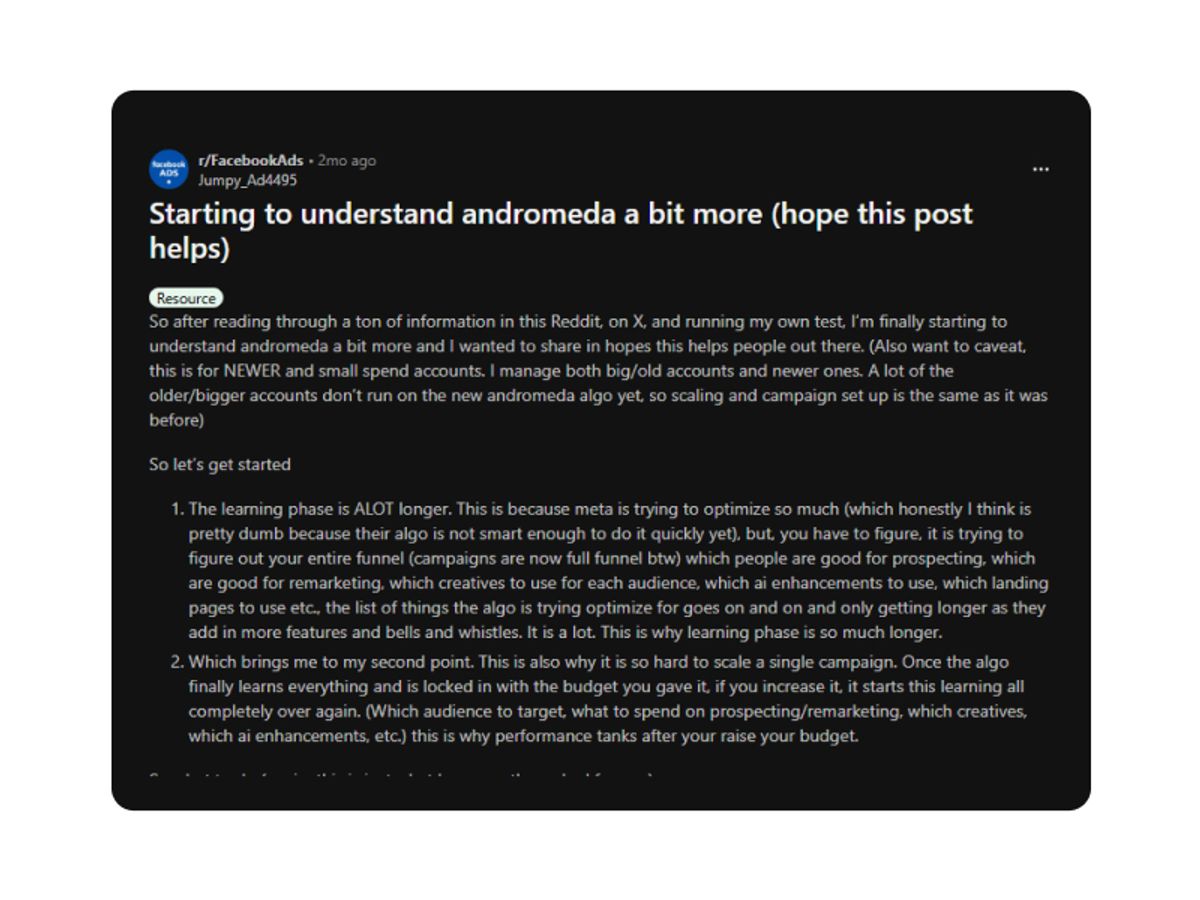
Advertiser breakdown: The actual day-by-day collapse pattern confirmed by multiple community members
One advertiser spending £40K/week put it perfectly:
"Andromeda punishes small advertisers harder, because we don't have enough volume to smooth out the algorithm's mood swings."
The Andromeda collapse isn't hitting everyone equally:
Extreme impact:
• Single-platform dependent businesses (90%+ revenue from Meta)
• Accounts spending <$500/day (insufficient volume for stability)
• Niche product sellers (algorithm can't find audiences efficiently)
• Brands with complex account structures (multiple campaigns, tight targeting)
Moderate impact:
• Diversified traffic sources (Google + Meta + email)
• Higher budget accounts ($2K+/day with proper structure)
• Broad-appeal products (algorithm finds audiences more easily)
The core lesson: If Meta represents more than 60% of your revenue, you're not running a business—you're renting one from Zuckerberg. And the landlord just raised the rent.
Before we get to what works, let's address what doesn't—because these are the tactics drowning advertisers right now.
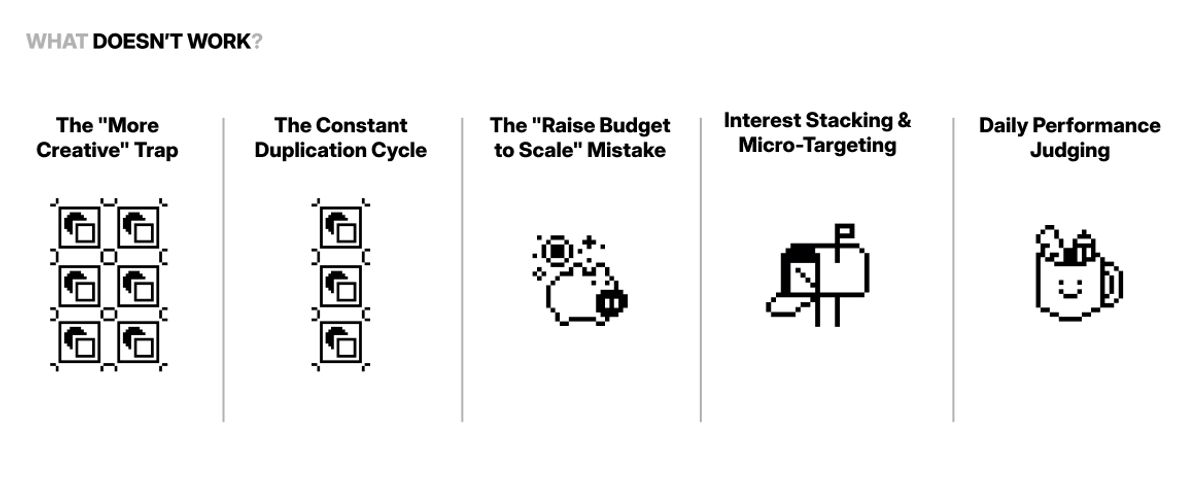
What Doesn't Work
Most advertisers see performance drop and immediately blame their ads. So they create 30 new variations with different hooks, opening lines, and thumbnails.
But they're all the same angle. Same promise. Same format. Same perspective.
Andromeda doesn't care if you changed "Stop wasting money on ads" to "Tired of burning ad budget?" It sees these as identical creative concepts. You're not providing diversity—you're creating noise.
Performance drops, so you duplicate the ad set. It works for 36 hours. Drops again. Duplicate again. Repeat weekly.
This prevents stabilization. The algorithm never exits learning phase because you keep restarting it. You're teaching the system absolutely nothing except that you panic easily.
Your ad set is performing at $500/day with 3.0 ROAS. You raise it to $1,500/day to capitalize.
Immediate collapse. The budget increase triggers a learning reset. Meta treats it like a new campaign and starts from scratch—except now with 3x the budget during the unstable learning period.
You're still running "interested in: yoga, meditation, wellness, organic food, sustainable living, mindfulness" with lookalike exclusions and detailed demographic targeting.
Andromeda hates this. You're suffocating the algorithm's ability to explore and find actual converting audiences. The tighter your targeting, the worse it performs in 2026.
You're checking performance every morning and making decisions based on yesterday's data.
Andromeda volatility means one day means nothing. Good days don't predict future success. Bad days don't predict failure. You need 3-7 day blocks minimum to see actual signal through the noise.
Here's the step-by-step framework that's actually working for advertisers who've recovered (and even scaled) post-Andromeda.
The single biggest mental shift: The learning phase is now 2-4 weeks minimum, not 5-7 days.
What this means operationally:
• Stop judging performance in 24-hour windows (start using 3-7 day blocks)
• Expect volatility for the first 14 days (it's normal, not failure)
• Meta needs 50 conversions per week for full stability (though 20+ gets you to "learning limited")
• Any account-level change (budget, targeting, creative refresh) resets learning to day one
The new success metric: Can you let campaigns run for 21 days with minimal intervention while tracking overall trend direction?
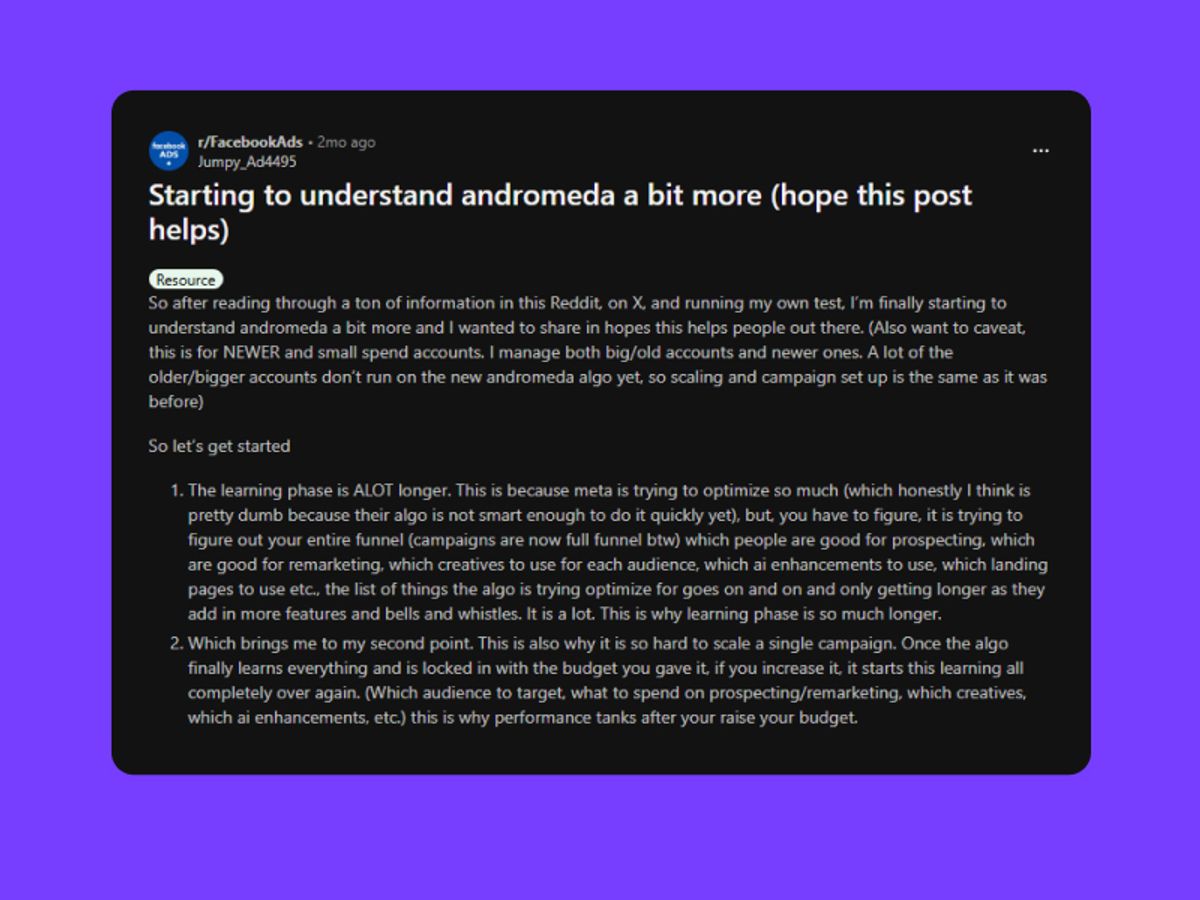
Confirmed by experienced advertiser: The learning phase is now 2-4 weeks minimum, not the old 5-7 days
One recovered advertiser explained: "One good day doesn't mean anything. One bad day doesn't mean anything either. This is the new reality. Judge on weeks, not days."
⚡ Quick Win: Set calendar reminders for 7-day check-ins. Force yourself to resist daily optimization impulses. Export 7-day performance blocks into a spreadsheet instead of reacting to Ads Manager's 24-hour view.
❌ Mistake to Avoid: Constant duplication and "fresh start" strategies prevent recovery. You're training the algorithm to fail. Only duplicate after 7-10+ days of data showing clear underperformance (3-5x target CPA).
Andromeda rewards simplicity. Complex accounts with 15 campaigns, 47 ad sets, and sophisticated targeting hierarchies are getting destroyed.
The structural simplification framework:
Campaigns: Run 2-3 maximum
• One primary prospecting campaign (broad)
• One retargeting/engagement campaign
• Optional: One testing campaign (when stable)
Ad sets per campaign: 3-5 maximum
• Each targeting a genuinely different audience temperature (cold, warm, hot)
• Broad targeting within each (no interest stacking)
Targeting approach: Broader is better
• Move away from: "Interested in X, Y, Z + 3 lookalikes + custom exclusions"
• Move toward: "Broad targeting, ages 25-54, USA" and let the algorithm find pockets
For scaling, use horizontal scaling (duplicate winning ad set with higher budget) NOT vertical scaling (raising budget on same ad set). The original keeps running at original budget. The duplicate stabilizes separately over 2-4 weeks.
💡 Pro Tip for Niche Products: Andromeda struggles with niche targeting. Paradoxically, broader targeting (18-65+, minimal interests) with highly specific creative works better. Let your ad copy do the targeting work—the algorithm will show niche-specific content to people who resonate with it.
❌ Mistake to Avoid: If you have 8+ campaigns, 20+ ad sets, or interest-stacked targeting, structure is your problem—not creative. Simplify first, then test creative.
This is where most advertisers are failing—and where the biggest recovery gains exist.
Creative diversity doesn't mean "same video with 10 different hooks." It means fundamentally different angles, personas, promises, and formats.
The essential creative mix for Andromeda stability:
2-3 Raw UGC-style videos: iPhone footage, authentic testimonials, casual speaking-to-camera style
1-2 Direct response ads: Clear problem → solution → CTA structure
1-2 Proof-based content: Before/after, demo videos, testimonial compilations
1-2 Contrarian/pattern interrupt: Challenge industry norms, unexpected angles
1 high-quality static: Professional image (genuinely different, not just the video's first frame)
Why this matters: Meta's full-funnel optimization needs content that resonates at different stages. Some people respond to raw authenticity. Others need polished proof. Others need their assumptions challenged.
Build these from customer insights: mine testimonials for exact language customers use, document actual pain points from support tickets, and capture objections from sales calls. Create ads directly from this real customer data for native feel and tone.
⚡ Quick Win: This week, create one ad in each of the 5 categories above. Don't launch yet—just create them. This forces true diversity thinking instead of "hook variation" thinking.
❌ Mistake to Avoid: Creating 30 variations of the same concept with different opening lines. The algorithm sees these as identical and you're wasting creative resources without providing actual diversity.
Andromeda is hypersensitive to signal quality. If Meta loses trust in your conversion data, everything downstream breaks—even if performance looks fine in Shopify.
Critical tracking requirements for 2026:
Event Match Quality (EMQ) above 6.0: Check Meta's Event Match Quality score in Events Manager. Low scores mean Meta can't properly attribute conversions.
Clean purchase event firing: No duplicate events, proper value parameters (actual purchase amounts, not placeholder "$1"), no weird value fluctuations.
Server-side tracking: Browser-only tracking is increasingly unreliable due to iOS privacy changes. Tools like Elevar or Tracklution solve the attribution gap and typically reveal 20-30% more attributed conversions.
One advertiser spending $40K/week explained: "If Meta loses trust in your conversion signals, everything downstream gets weird. CPC looks fine but conversions vanish because the algorithm doesn't believe your data."
⚡ Quick Win: Go to Events Manager → Data Sources → Your Pixel. Check Event Match Quality score. If below 6.0, this is likely your main problem—not creative or targeting.
❌ Mistake to Avoid: Ignoring tracking issues and blaming creative or audience. If your Event Match Quality is below 6.0, fix tracking first before changing anything else.
This is where most successful campaigns die. You hit performance targets, scale aggressively, and watch everything crater within 48 hours.
The Andromeda scaling protocol:
For horizontal scaling (recommended):
Original ad set performing at $500/day, 3.0 ROAS
Keep original running at $500/day budget (do NOT touch it)
Duplicate entire ad set with $1,000/day budget
Wait 2-4 weeks for duplicate to stabilize
Now you have $1,500/day total, both running
Never do vertical scaling (raising budget on active ad set):
• Triggers complete learning reset
• Algorithm treats it as new campaign
• Extremely high risk of collapse
Minimum viable spend for stability:
• Under $500/day: Expect extreme volatility (insufficient volume)
• $1K+/day: Volatility still exists but smooths over time
• $2K+/day: Starts stabilizing faster (if structure is correct)
Budget scaling isn't about percentage increases anymore. It's about creating parallel ad sets that independently stabilize while original continues performing.
❌ Mistake to Avoid: Raising budget 20-50% on an active performing ad set. This is the fastest way to trigger a learning reset and collapse your campaign.
Andromeda wants campaigns that contain full-funnel content from day one, not separate prospecting and remarketing campaigns.
ABO vs CBO strategy:
Testing phase: Use ABO (Ad Set Budget Optimization)
• Fill with 7-10 diverse creatives (mix proven + new)
• Broad targeting
• Gives you control during unstable learning
Stable phase: Can move to CBO (Campaign Budget Optimization)
• Only after 21+ days of stable performance
• CBO works best once algorithm understands your full funnel
• Think: ABO ad set = mini-funnel; CBO = full-funnel optimizer
Mix content temperatures in single campaigns:
• Don't separate "cold traffic only" and "warm traffic only" anymore
• Include top-of-funnel (awareness), middle (consideration), and bottom (conversion) content together
• Let the algorithm decide who sees what
This feels counterintuitive if you learned Meta ads pre-2024. But Andromeda's full-funnel optimization needs this content mix to function properly.
❌ Mistake to Avoid: Running only direct response "BUY NOW" ads in prospecting campaigns. The algorithm needs awareness, consideration, and conversion content in the same campaign to optimize the full funnel.
The right tools depend on your specific bottleneck:
For tracking and attribution:
Elevar | Ad Tracking
• Elevar or Tracklution: Server-side tracking solutions that fix iOS 14+ attribution gaps (expect 20-30% more attributed conversions)
• Cost: $50-200/month depending on scale
• Use when: Event Match Quality below 6.0 or mysterious conversion drops despite stable traffic
For competitive intelligence and creative strategy:
• Meta Ad Library: Free manual research, good starting point for understanding competitor activity
• Vibemyad: Agentic research platform with automated competitor tracking (monitors 25+ brands continuously), hook analysis, and gap analysis
• Use when: You need data-driven creative direction, want to know what's working before testing, or spend $10K+/month
• Provides professional stakeholder reports and identifies opportunities competitors are missing
• Best for: Brands needing competitive intelligence to inform creative strategy
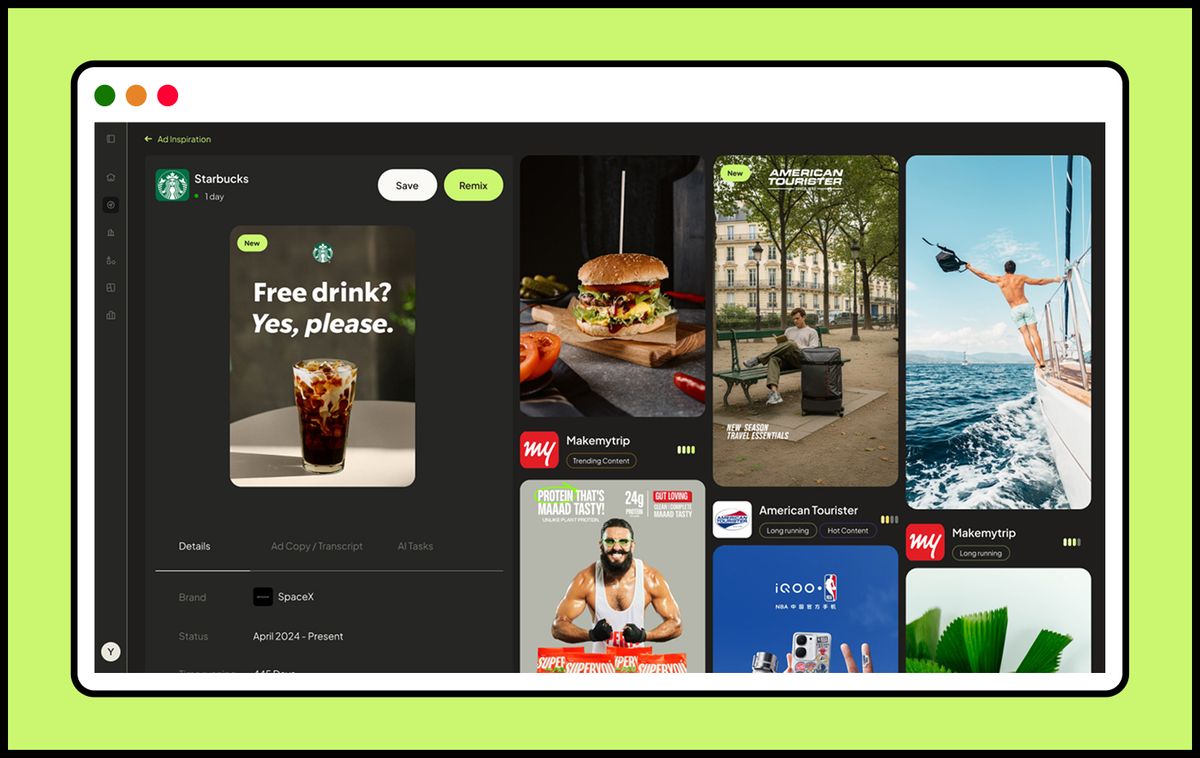
Vibemyad | Ad Library
For creative volume and diversity:
• In-house UGC: Most authentic but requires creator network and time investment
• Freelance designers: $500-1,500 per campaign batch, 5-7 day turnaround
• AI ad generators: Tools like Vibemyad Ad Gen help meet Andromeda's 15-50 ad volume requirements
• Remix winning competitor ads with your brand in minutes vs. 16+ hours manually
• Use when: You need volume fast but lack design skills or time
Complete workflow (research → creation):
• Vibemyad: Research competitors in Ad Spider to identify what's working → use those insights in Ad Gen to create your variations → launch validated concepts instead of guessing
• Cost: $199/month (free tier available)
• Best for: Teams needing both intelligence and execution in one platform
For insight database management:
Airtable
• Airtable or Notion: Organize customer testimonials, pain points, objections into searchable database (free tiers work fine)
For alternative traffic sources (diversification):
• Google Shopping ads: Essential for intent-based traffic (people actively searching)
• Email/SMS platforms: Klaviyo, Postscript for owned audience building
• TikTok Ads Manager: Emerging alternative, lower CPMs than Meta currently
Choose based on your constraints. If tracking is broken, fix that first. If you need creative volume, prioritize that. Don't buy tools you won't implement.
This Week (Days 1-7):
• Audit your account structure: Count campaigns, ad sets, targeting complexity. If you have 8+ campaigns or 20+ ad sets, simplification is priority #1.
• Check Event Match Quality in Events Manager. If below 6.0, implement server-side tracking immediately (Elevar or Tracklution).
• Analyze your creative diversity: Do you have 7-10 genuinely different angles, or 30 variations of the same concept? Create one ad in each of the 5 categories (UGC, direct response, proof, contrarian, static).
• Stop making daily optimization decisions. Set calendar reminder for 7-day check-in instead.
Weeks 2-4 (Stabilization Phase):
• Implement simplified structure: Consolidate to 2-3 campaigns with broad targeting.
• Launch diverse creative system (7-10 ads per ad set across different angles).
• Commit to 21-day hands-off period. No budget changes, no duplications, no panicking. Track 7-day blocks.
Month 2+ (Growth Phase):
Once stable for 21+ days, implement 80/20 budget allocation (70% proven creatives, 30% testing).
• Test horizontal scaling (duplicate winning ad set with higher budget, keep original running).
• Begin diversification strategy: Add Google Shopping or test TikTok with 10-20% of total ad budget.
• Set up automated competitor tracking (consider tools like Vibemyad Ad Spider if spending $10K+/month) to inform creative strategy with data rather than guesses.
Here's the truth most struggling advertisers don't want to hear: Andromeda isn't broken. It's a filter.
The algorithm rewards patience, structural simplicity, creative diversity, and proper signal quality. It punishes the old playbook: constant intervention, complex targeting, micro-management, and platform over-dependence.
Businesses that recovered from the Andromeda collapse made three fundamental shifts:
• Mental: Accepted 2-4 week learning phases and stopped judging daily performance
• Structural: Simplified accounts dramatically and moved to broader targeting
• Strategic: Diversified revenue sources so no platform has life-or-death control
The advertisers spending £40K/week and maintaining 1.8-2.2 ROAS post-Andromeda aren't lucky. They adapted. They built systems that work with the algorithm's full-funnel optimization, not against it.
Your recovery starts with accepting that this is the new Meta. The old playbook isn't coming back. The faster you adapt to Andromeda's requirements, the faster you stop hemorrhaging budget and start scaling again.
One recovered advertiser said it best: "Never depend on a single platform, even when everything seems to roll." Meta is now for discovery. Google is for intent. Email is for profit. Build the ecosystem.
Recovering from the Andromeda collapse isn't about working harder—it's about working differently. The advertisers thriving in 2026 adapted their structure, creative systems, and expectations to match how the algorithm actually functions. Start with the action plan above, commit to 21 days of stability, and stop fighting the algorithm's new requirements.
This guide is based on extensive research from r/FacebookAds community discussions:
1. "$1M in revenue... then Andromeda arrived"
See the Reddit post
106 comments from advertisers experiencing similar challenges
2. "Andromeda turned Meta into a slot machine. Here's what I'm doing to survive"
See the Reddit post
Real survival tactics from active advertisers
3. "Starting to understand andromeda a bit more (hope this post helps)"
See the Reddit post
33 upvotes, 16 comments with tactical implementation guides
4. "My Andromeda Strategy - $200k per month brand owner"
See the Reddit post
Real case study from high-spend advertiser maintaining profitability
Get notified when new insights, case studies, and trends go live — no clutter, just creativity.
Table of Contents


Ananya Namdev
Content Writer, Vibemyad


Rahul Mondal
Product, Design and Co-founder, Vibemyad

Rahul Mondal
Product, Design and Co-founder, Vibemyad