January 14, 2026 • 16 min read
January 14, 2026 • 16 min read
You launched six new ads last week. High engagement rates. Impressive hook percentages. Comments flooding in.
Then your ROAS collapsed from 1.4 to 0.7 overnight.
Your proven winner—the ad that had been printing money for three months—suddenly stopped getting impressions. Meta's algorithm decided your shiny new ads with 44% hook rates deserved all the budget, despite costing 60% more per conversion.
Welcome to the #1 mistake advertisers make with Meta ads testing in 2026: confusing engagement with performance.
This comprehensive guide reveals the exact testing framework that prevents algorithm chaos, audience cannibalization, and the budget death spiral that kills profitable ad accounts. You'll learn the proper ABO structure, the 60-30-10 budget allocation rule, and why one supplement brand recovered from $18K in losses to 2.5 ROAS in just 5 days by fixing their testing approach.
• Core principle: Test creatives inside one campaign with proper budget allocation—don't create separate testing campaigns
• The 60-30-10 rule: 60% budget to proven winners, 30% to winner variations, 10% to completely fresh concepts
• Why conventional testing fails: Separate campaigns cause auction overlap, learning resets, and audience cannibalization
• Judge tests correctly: Use CTR and CPC first (24-48 hours), then CPA/ROAS after 10+ conversions minimum
• Biggest mistake: Adding too many new ads at once—algorithm reallocates budget to high-engagement ads that don't convert
• The recovery protocol: Pause everything 24 hours, launch clean ad set with only proven concepts, let run 7+ days untouched
• Budget-specific structures: Low budgets ($20-100/day) need different testing approaches than high budgets ($500+/day)
Use competitor ads to identify messages worth investigating. Judge your own tests using your campaign results.
Most advertisers learn Facebook ads testing from 2019 tutorials. Create Campaign A for winners. Campaign B for test 1. Campaign C for test 2. Test everything separately. May the best ad win.
That playbook is dead. Andromeda killed it.
If you want to know about Meta Andromeda, read this here.
When you run multiple campaigns targeting the same audience, Meta's algorithm sees them as competitors fighting for the same auction inventory. Your campaigns bid against each other, driving up your own CPMs while fragmenting your budget across multiple learning phases.
Every new campaign triggers a fresh learning phase (now 2-4 weeks with Andromeda). When you create "Test Campaign B" while "Main Campaign A" is running, you're forcing the algorithm to start from scratch while your proven campaign continues burning budget.
The audience cannibalization disaster:
Your proven winner has been showing to your best-converting audience segment for weeks. You launch a test campaign with fresh creative. Meta immediately tests those new ads on your best-converting audience—because that's where it expects the highest probability of conversion.
Result: Your new ads steal impressions from your proven winner. They get shown to your hottest prospects first. If they don't convert as well, you've just burned money testing on your best audience while your proven winner stops getting budget.
One advertiser described it perfectly: "My profitable ad account collapsed from 1.38 ROAS to 0.75 ROAS overnight when I added new ads. Spent 30 days and $18K trying to 'fix' it... Finally did a full account reset with ONLY my original proven ad—recovered to 2.5 ROAS in 5 days with zero new creative."
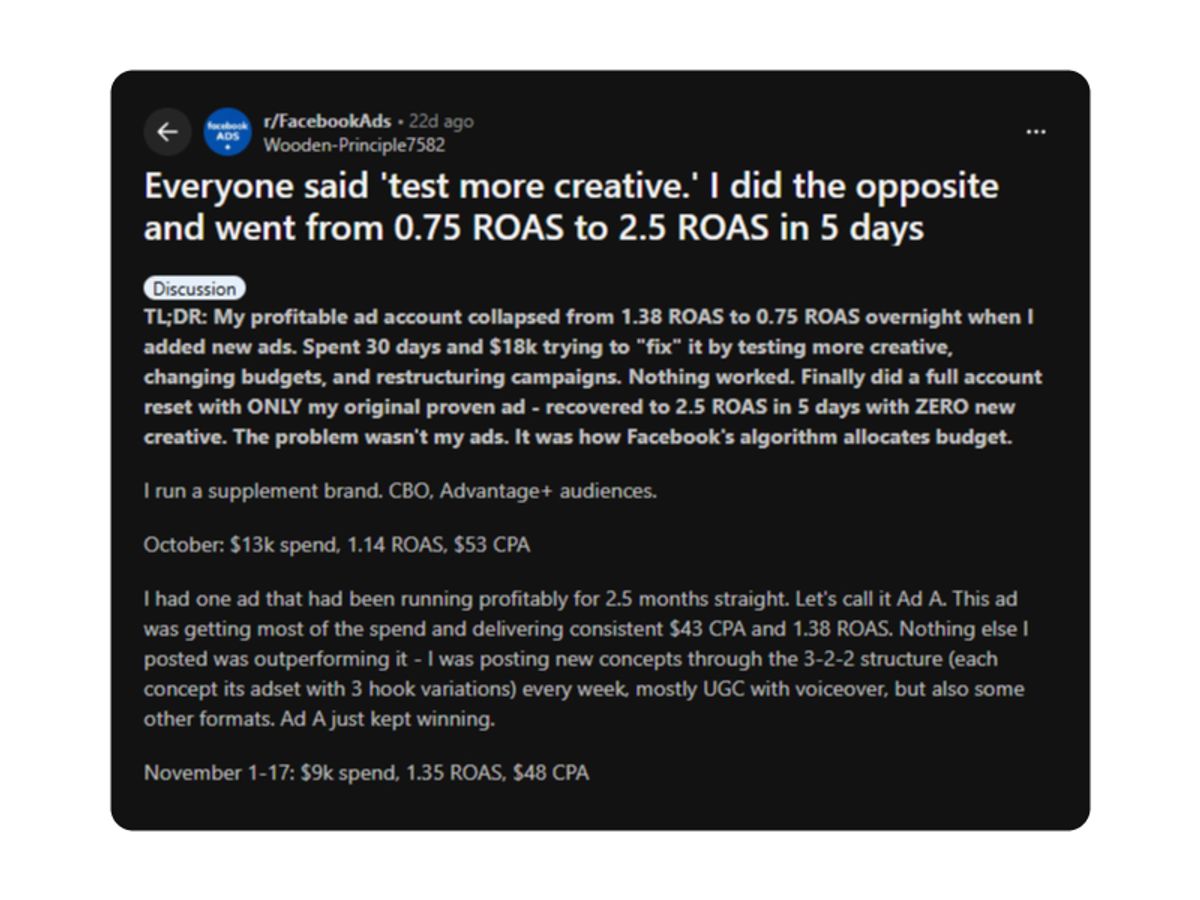
A supplement brand lost $18K testing conventionally. Here's how they recovered to 2.5 ROAS in 5 days.
Meta's algorithm in 2026 optimizes for predicted conversions, but it heavily weights engagement signals during learning phases.
The pattern that kills accounts:
Your proven winner has 41% hook rate, $43 CPA, 1.4 ROAS
You launch new test ad with 44% hook rate
Meta sees higher engagement and gives it priority
New ad delivers $68 CPA, 0.8 ROAS
Algorithm keeps pushing budget to it (high engagement = "potential")
Your proven winner gets starved of impressions
Account ROAS collapses while engagement metrics look great
The fundamental issue: High engagement ≠ high conversions. Meta can't distinguish "this ad gets clicks" from "this ad gets profitable sales" until it has conversion data. By then, you've burned thousands testing on your best audiences.
The ABO Creative Testing Framework (The Solution)
The answer isn't to stop testing. It's to test correctly using a single-campaign structure with proper budget allocation.
ABO (Ad Set Budget Optimization) means you set budgets at the ad set level, not campaign level. For testing, this is critical because it gives you control over how much each creative concept receives.
The correct testing structure:
• 1 Campaign (one objective, one core audience, one learning phase)
• Multiple Ad Sets within that campaign (one per creative angle/theme)
• Multiple Ads within each ad set (variations of the same angle)
This keeps all your testing under a single auction signal. Meta's algorithm sees your entire creative portfolio as one coordinated effort, not competing campaigns.
This is the framework that prevents algorithm chaos while maintaining innovation capacity.
60% Budget → Proven Winners
These are ads that have demonstrated:
• Profitable CPA (below your target)
• Stable ROAS (above your threshold)
• Minimum 25-35+ conversions
• Consistent performance over 7+ days
Allocate the majority of your budget here because these are known performers. They fund your testing.
30% Budget → Winner Variations
These are iterations of your proven winners:
• Same core concept, different hook
• Same angle, different format (UGC → polished, or vice versa)
• Same promise, different thumbnail/opening
• Same testimonial, different presentation
You're not testing new concepts—you're optimizing existing winners. Lower risk, incremental gains.
10% Budget → Fresh Concepts
Completely new angles:
• Different value proposition
• Different target pain point
• Different creative format entirely
• Different messaging approach
This is your innovation budget. Small enough that failures don't crater your account. Large enough that winners can show signal.
Why 10% for fresh concepts is crucial:
By keeping new concepts at 10%, you prevent them from stealing budget from proven winners during learning phases. Meta can test them on smaller audience segments without disrupting what's working.
If they show promise (higher CTR, lower CPC, positive early conversion trends), you can graduate them to the 30% tier. If they fail, you've only burned 10% of budget discovering it.
Scenario: $1,000/day ad budget
• $600/day → 2-3 proven winner ads (the ads generating 1.5+ ROAS consistently)
• $300/day → 4-5 variations of winners (same concepts, different execution)
• $100/day → One fresh angle (not 10 concepts—just one new test at a time)
One lead gen agency owner who implemented this explained: "60% of the budget goes to winning ads, 30% goes to variations of the winning ads/different creative styles of the same angle or hook, and 10% to completely fresh ads. This structure maintained stable performance while testing."
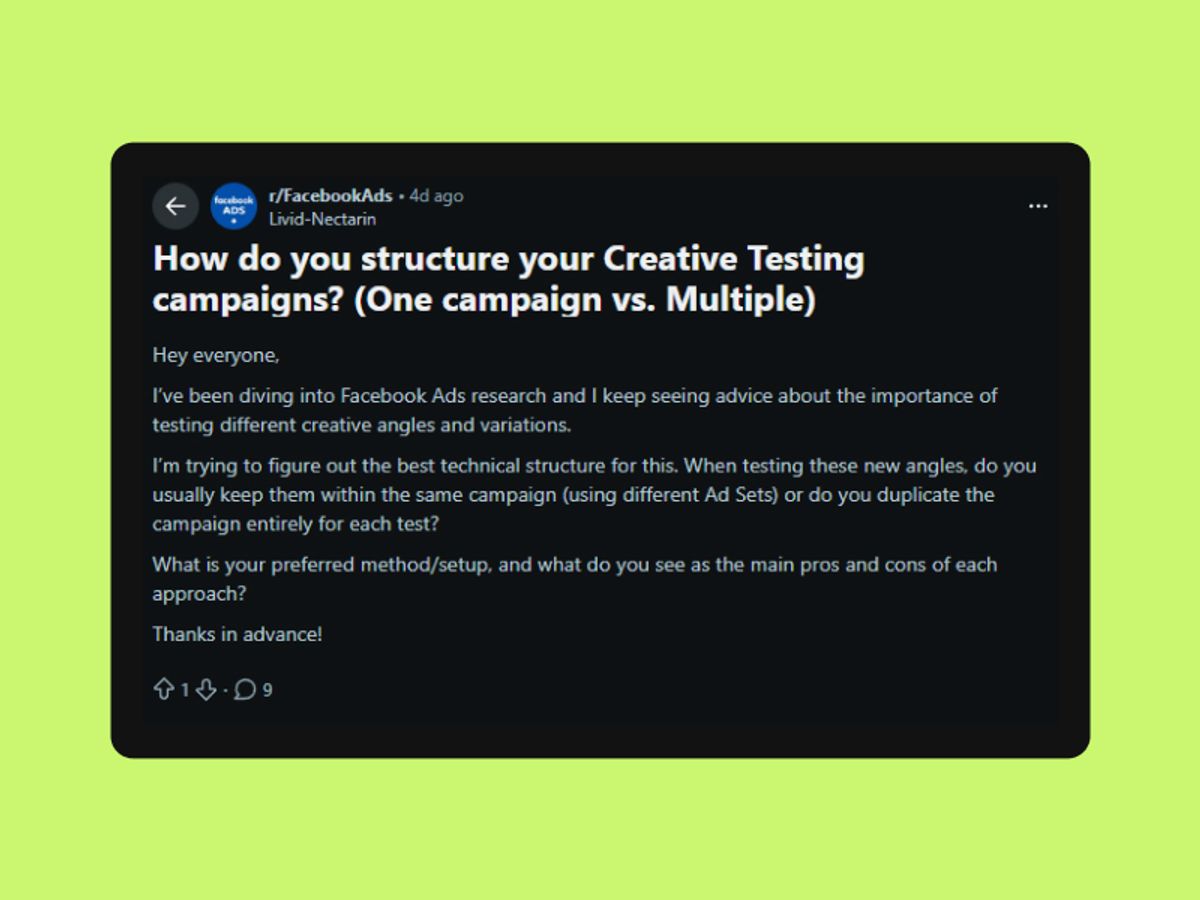
Expert testing strategy: consolidate into one campaign with separate ad sets, not duplicate campaigns
Here's exactly how to implement the creative testing framework, phase by phase.
Create ONE campaign (Conversions objective: Purchase, Lead, etc.)
Define ONE core audience (same targeting for all tests)
Create your first ad set with your proven winner ad (or test 2-3 angles if starting from zero)
Set budget to 100% of your daily spend
Let it run for 7 days to establish baseline metrics
Record these benchmarks:
• Average CTR (Click-Through Rate)
• Average CPC (Cost Per Click)
• Average CPA (Cost Per Acquisition)
• Average ROAS
• Frequency (should stay under 3.5)
These become your testing benchmarks. New ads must beat these to graduate.
Once your proven winner has 15-25+ conversions, introduce new creative:
Create three ad sets within the SAME campaign:
Winners Ad Set (60% budget): Your proven performing ads
Variations Ad Set (30% budget): 2-3 variations of your winner (different hooks, thumbnails, openings)
Fresh Concepts Ad Set (10% budget): ONE completely new creative angle
All use the same audience targeting. All run in one campaign. One learning phase.
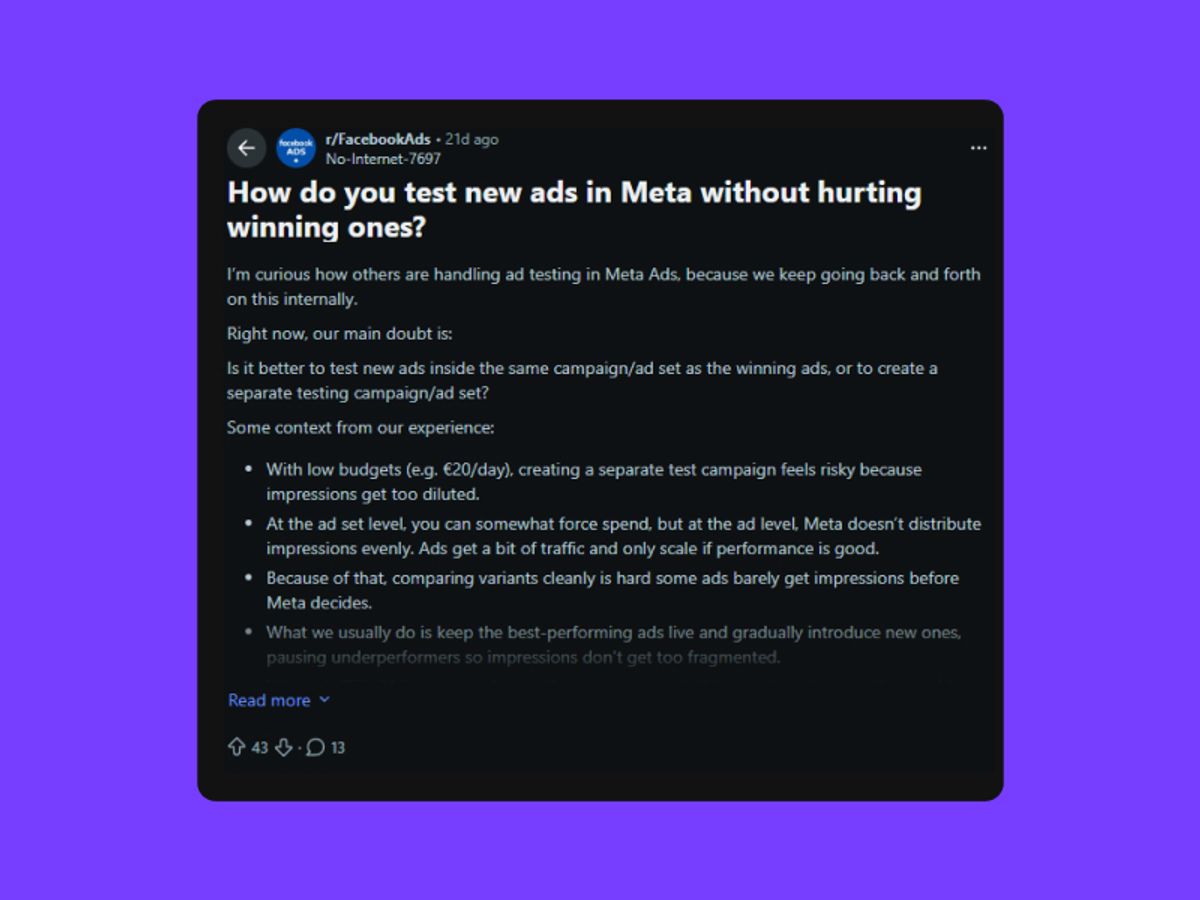
Track CTR and CPC first - use them to decide if an ad is worth the CPA it generates
Critical: Don't judge tests in the first 24 hours. Meta needs time to find the right audience segments.
Metrics to track (in priority order):
Within 24-48 hours:
• CTR: Is it 25-35% higher than baseline?
• CPC: Is it 15-20% lower than baseline?
• Video metrics (if video): Hook rate, hold rate, completion rate
• Engagement: Likes, comments, shares per impression
After 48-72 hours with 10+ conversions:
• CPA: Is it at or below your target?
• ROAS: Is it at or above your threshold?
• Purchase rate: Are clicks converting?
Key insight: Track CTR and CPC first to decide if a test ad is promising. High CPA in the first 48 hours with strong engagement signals often means the ad will optimize down as Meta finds the right audience.
An ad graduates to "Winner" tier when it shows:
• 25-35% HIGHER CTR than baseline
• CPC 15-20% LOWER than baseline
• Minimum 10-15 conversions with positive ROAS trend (1.5x+ for e-commerce)
• Consistent performance across 72+ hours
Action: Gradually increase its ad set budget toward the 60% tier.
An ad gets paused when it shows:
• CTR below baseline after 48-72 hours
• CPC higher than baseline with no improvement
• CPA 2x+ higher than target after 15+ conversions
• ROAS consistently below threshold after 7+ days
The continuous testing cycle:
Test new concepts in 10% budget tier (1-2 weeks)
Winners graduate to 30% tier (variations)
Sustained winners graduate to 60% tier (proven)
Fatigued winners (frequency above 4.0) get refreshed
Repeat continuously
This real account collapse and recovery illustrates what happens when you violate the testing framework—and how to fix it fast.
Starting point (October): $13K spend, 1.14 ROAS, $53 CPA—chaotic but profitable.
After consolidation (Nov 1-17): $9K spend, 1.35 ROAS, $48 CPA—proper structure improved performance by 18%.
Everything was working. Then they made the fatal mistake.
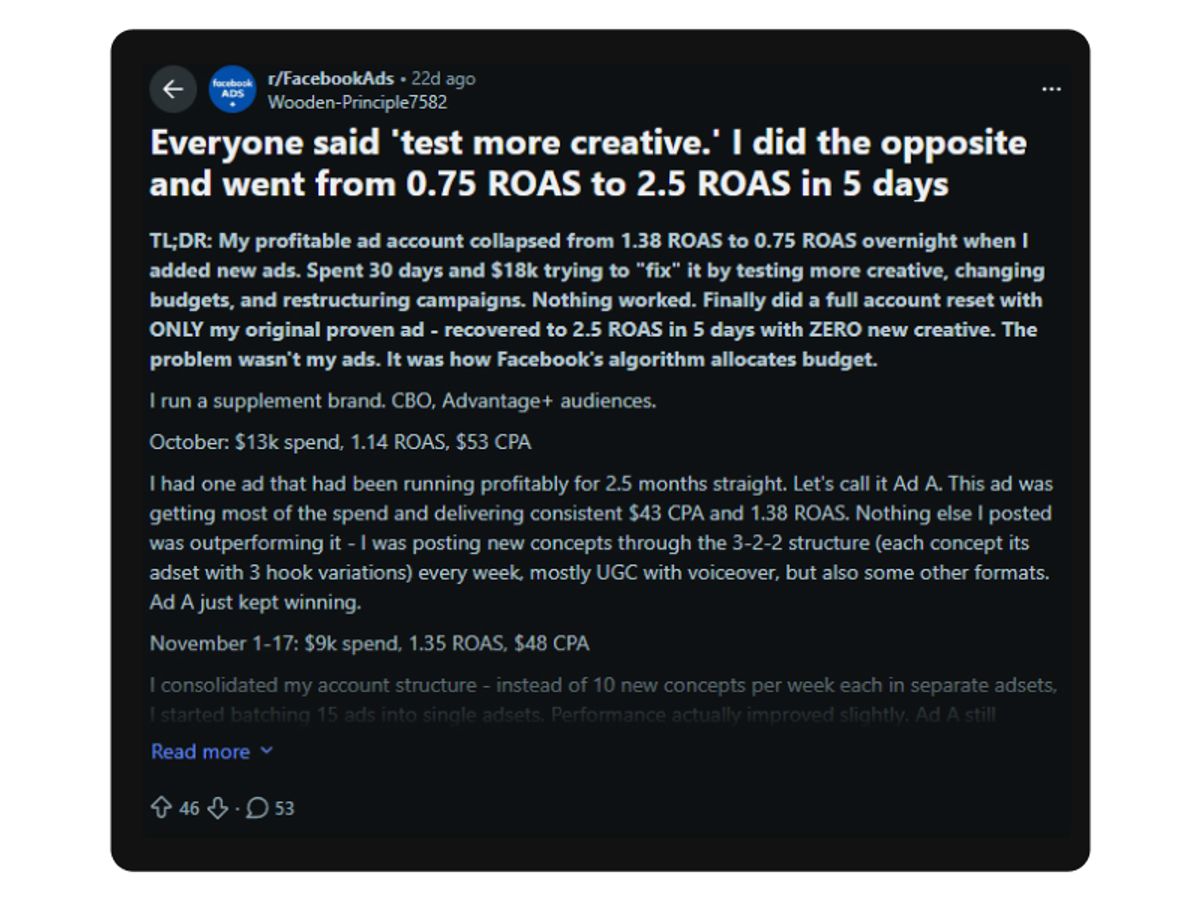
Here's exactly what went wrong: Testing 6 ads at once triggered the high-engagement trap
On November 18 (their best performance day), they launched 6 new ads all at once into the campaign.
What happened:
• Ad A (proven winner): 41% hook rate, $43 CPA, 1.4 ROAS
• Ad B (new test): 44% hook rate, $68 CPA, 0.8 ROAS
Meta's algorithm saw Ad B's higher engagement and prioritized it. Ad B got shown to the proven winner's best audiences first. Despite terrible CPA, the algorithm kept pushing budget to it because engagement signals suggested "potential."
The death spiral: Over the next 4 weeks, ROAS collapsed from 1.35 to 0.75 while CPA jumped from $48 to $87. The advertiser spent $18K trying to fix it through:
• Turning ads on/off repeatedly
• Creating more campaigns to "isolate" tests
• Increasing budget to $900/day trying to "push through"
• Making daily adjustments and pauses
Every change reset the learning phase. Every optimization made it worse.
"I tried everything... Every change I made seemed to make it worse. I spent $18K learning that Facebook will happily burn your budget on high-engagement ads that don't convert, while ignoring your proven winners."
The protocol:
Paused EVERYTHING for 24 hours (reset the algorithm's learned patterns)
Launched ONE clean ad set with ONLY 10 proven concepts (no new tests)
Used the existing historic campaign (not new—avoided auction reset)
Let it run completely untouched for 7 days (no daily optimizations)
The results: From 0.75 ROAS → 2.50 ROAS in 5 days. CPA dropped from $87 to $29. With zero new creative. Just proper structure and patience.
Key lessons:
High engagement ≠ conversions: 44% hook rate meant nothing when CPA was 58% higher
Algorithm needs clean signals: Multiple simultaneous tests create noise
Patience beats optimization: 7 days untouched > 30 days of daily changes
Proven concepts work: Sometimes the answer isn't new creative—it's proper structure
❌ What people do:
• Campaign A: Winners
• Campaign B: Test Group 1
• Campaign C: Test Group 2
Why it fails:
• Causes auction overlap (your campaigns bid against each other)
• Budget fragmentation across multiple learning phases
• Each campaign resets Meta's learning from scratch
• Impossible to cleanly compare results
✅ Better approach:
Test inside the same campaign using separate ad sets with controlled budgets (60-30-10). One campaign keeps signals clean and speeds learning. Duplicated campaigns only make sense when testing entirely different objectives (conversions vs. leads).
❌ What people do:
Post 10 new creative concepts per week, each in separate ad sets with equal budgets.
Why it fails:
• Dilutes impressions across too many variants
• Prevents any single ad from getting enough data
• Overloads algorithm with conflicting signals
• Proven winners get starved while tests burn budget
✅ Better approach:
Use the 60-30-10 budget allocation rule. If spending $1,000/day:
• $600 to 2-3 proven winners
• $300 to variations of winners (4-5 ads)
• $100 to ONE fresh angle (not 10 concepts)
Test ONE new concept at a time. Graduate it or kill it. Then test the next one.
❌ What people do:
Kill ads after 24 hours because CPA is high, even when CTR and engagement look promising.
Why it fails:
• Meta needs 10-15 conversions minimum to optimize delivery
• Early CPA is meaningless (algorithm still exploring audience segments)
• High-potential ads might have lower initial volume but better long-term performance
✅ Better approach:
Track CTR, CPC, and video retention metrics to decide if a test ad is promising in the first 24-48 hours. Only evaluate final CPA/ROAS after 48-72 hours AND a minimum of 10 conversions.
Your testing framework needs to adapt to your budget constraints. What works at $500/day doesn't work at $50/day.
Recommended structure:
• 1 Campaign
• 1 Ad Set (Advantage+ or standard broad targeting)
• Keep proven winners LIVE (2-3 ads maximum)
• Add 1 new ad per week maximum
• Pause underperformers immediately
Judge on: CTR + video metrics primarily. CPA data is unreliable at this spend level because conversion volume is too low.
Why this structure:
You don't have enough budget for sophisticated testing. Focus on finding ONE winner and scaling it before introducing complexity.
Recommended structure:
• 1 Campaign
• Separate ad sets for:
• (a) Winners (60% budget)
• (b) Winner Variations (30% budget)
• (c) Fresh Angles (10% budget)
Timeline:
Test fresh angle for 7-10 days
If it hits graduation criteria, move it to Variations ad set
If sustained winner, increase allocation toward Winners tier
Pull 10% from Fresh Angles and allocate to new test
This is the sweet spot for the 60-30-10 framework. Enough budget for meaningful tests without wasteful structures.
The right tools eliminate guesswork from testing.
For competitive intelligence:
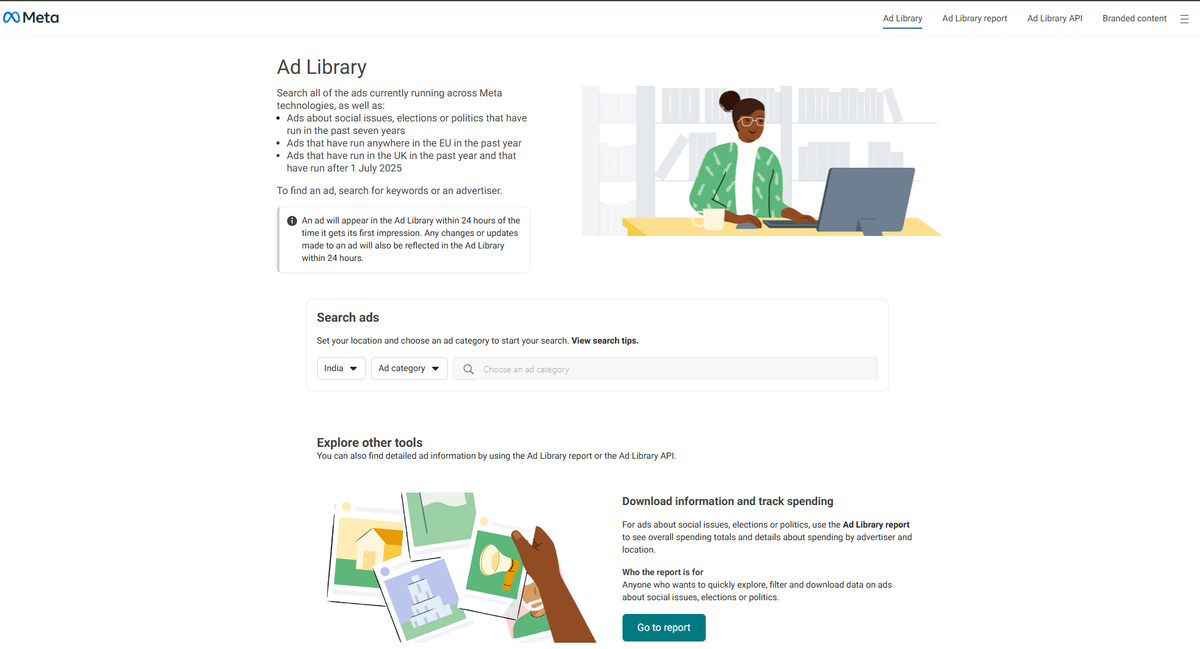
• Meta Ad Library: Free manual research to see competitor ads
Meta Ad Library
Vibemyad Marketing Agency offers competitor research, creative strategy and ad production. Bring your previous campaign results to the brief so the next creative batch answers a specific question.
A competitor's long-running ad can suggest a message to explore. Its duration does not establish the advertiser's ROAS or prove the same approach will work for your product.
For production, compare the capacity of your internal team, freelance specialists and an agency against the work required. Agree on concepts, formats, revisions and delivery dates. Evaluate costs from actual quotes for that scope.
For tracking and attribution:
• Google Analytics 4: Free, essential for cross-validating Meta's conversion data
• Triple Whale or Elevar: Server-side tracking for accurate attribution (critical for reliable testing data)
Week 1-2: Setup Phase
Review current account structure (How many campaigns? Is budget fragmented?)
Identify your current proven winner (best ROAS over last 30 days)
Create ONE main campaign (or consolidate existing)
Set up three ad sets:
• Winners (60% budget) - Your proven ad(s)
• Variations (30% budget) - 2-3 variations of winner
• Fresh (10% budget) - ONE new concept
Document baseline metrics: CTR, CPC, CPA, ROAS
Let run for 7 days without changes
Week 3-4: Optimization Phase
Check 7-day performance of each ad set
Identify winners using graduation criteria (25-35% higher CTR, 15-20% lower CPC, 10+ conversions)
Pause underperformers (2x+ target CPA after 10+ conversions)
Adjust budget allocation based on performance
Every 7-10 days, introduce ONE new fresh concept (10% budget)
Graduate proven winners: Fresh → Variations → Winners tiers
Refresh fatigued winners (frequency above 4.0)
Ongoing: Scale and Refine
Once you have 3-5 proven winners, increase total budget by 20%
Maintain 60-30-10 allocation as you scale
Consider competitive intelligence tools if spending $5K+/month for data-driven testing direction
Here's what most advertisers don't want to hear: More creative isn't the answer. Better budget allocation and structure is.
The supplement brand that lost $18K didn't have a creative problem. They had 6 new ads with high engagement. Their problem was structural—they added too many tests at once without proper budget isolation, and Meta's algorithm optimized for engagement instead of conversions.
The recovery wasn't new creative. It was proper structure: ONE campaign, proven concepts only, 7 days of patience.
The modern creative testing mindset:
Structure before volume: Get your framework right before adding complexity
Patience before optimization: 7 days untouched beats 7 days of daily changes
Data before assumptions: Test what's proven to work (competitive research) before testing random ideas
Conversions before engagement: High hook rates mean nothing if CPA is terrible
The advertisers who succeed with Facebook ads testing in 2026 aren't testing more. They're testing smarter:
• Using the 60-30-10 budget allocation to protect proven winners
• Judging tests correctly (CTR/CPC first, CPA after 10+ conversions)
• Testing inside one campaign to avoid auction overlap
• Adding one new concept at a time, not 10
• Researching what works before testing blind
Fix your Meta ads testing structure and budget allocation, and creative performance takes care of itself. Keep testing chaotically, and even great creative will underperform.
Meta ads creative testing in 2026 isn't about testing more—it's about testing smarter. Use the 60-30-10 budget allocation framework, judge tests correctly, and protect your proven winners while innovating. Proper Facebook ads testing structure beats volume every time.


Arpita Mahato
Content Writer, Vibemyad

Arpita Mahato
Content Writer, Vibemyad


Rahul Mondal
Product, Design and Co-founder, Vibemyad
Table of Contents