
February 04, 2026 • 10 min read

February 04, 2026 • 10 min read
Your design team just quit.
Well, not literally—but they might as well have. Three designers, tasked with producing 15-20 ad creatives every week, are running on fumes. The feedback loop is chaos: "We need this by tomorrow." "Can you make 5 variations?" "Change the hook again—it's not working."
Meanwhile, you're spending $20 on a creative, seeing no conversions, and killing it. Then spending another $25 on a different concept. Same result. Your testing budget is bleeding, your team is exhausted, and you still don't know what works.
Here's the truth: High-volume creative testing doesn't require more designers. It requires a better system.
Most teams fail because they're solving the wrong problem. They think they need to produce more creatives faster. But the real problem? They don't know which creatives to produce, how to test them properly, or when to kill them.
Here's what happens: Your designer creates 5 completely different concepts. You upload all 5 simultaneously. Meta picks a favorite within 2 hours (usually randomly). That creative gets 80% of your $100 daily budget. The other 4 get $5 each—not enough for meaningful data. After 3 days, nothing seems to work, so you kill everything and start over.
Result? Burned-out team, wasted budget, zero learnings.
The solution is systematic testing with controlled variables.

The Testing Framework
Objective: Find one winning concept out of 10-15 variations
What to test: Completely different hooks and angles
• "Here's my secret to [outcome]"
• "I tested 20 [tools] and this is the best"
• Problem-solution narratives
Structure: 1 campaign, 1 broad ad set (25-65, broad targeting), upload 2-3 new ads daily
Budget: $10-15 per creative minimum (15 creatives = $150-225 daily)
Kill rules:
• Spend >$100-150 with 0 conversions → Kill
• CPA >1.5× target with <5 conversions → Kill
• CTR <1% after $50 spend → Kill
Winner signals: CTR >2%, CPC <50% of average, 25%+ video completion, 3+ conversions at target CPA
Objective: Identify the 1-2 concepts that actually convert profitably
By day 7: 10-15 tested → 2-3 with promising metrics → 1-2 with actual conversions at acceptable CPA
Critical question: Which has conversions, not just engagement? High CTR with $150 CPA loses to lower CTR with $40 CPA.
Action: Kill everything except 1-2 creatives with best CPA and >5 conversions.
Objective: Create 10-15 variations of your winning concept
What to test (one variable at a time):
• Hook variations (same concept, different opening)
• Visual variations (colors, overlays, placements)
• Format variations (static → video → carousel)
• CTA variations
Key: Test ONE element at a time. Change multiple variables = can't identify what drove performance.
Expected outcome: 2-3 variations outperform original
Objective: Scale proven winners to maximum profitable spend
Once you have 2-3 creatives delivering target CPA with 15-50+ conversions:
• Move to separate "scaling campaign"
• Increase budget 10-20% weekly (not 50%+)
• Run until creative fatigue (4-8 weeks)
• Continue Phase 1 testing for new winners
Most advertisers make creative decisions with statistically insignificant data.
Common scenario:
• Spend $20 on Creative A → 0 conversions → "Kill it"
• Spend $25 on Creative B → 1 conversion → "Winner!"
Problem: Neither conclusion is valid. Sample size too small.
At $50 AOV: Minimum $100-150 spend per creative, 5-10 conversions before judgment
At $100+ AOV: Minimum $150-250 spend per creative, 3-5 conversions minimum
The math: If your target CPA is $40:
• $20 spend = 0.5 expected conversions (inconclusive)
• $100 spend = 2.5 expected conversions (getting closer)
• $150 spend = 3.75 expected conversions (now we can judge)
To properly test 15 creatives, you need $1,500-2,250 in testing budget.
Can't afford that? Test fewer creatives properly, not more improperly.
The problem: Meta's algorithm picks a favorite in the first 2 hours and starves everything else.
What happens: You upload 5 ads → Creative #3 gets 3 quick clicks → Meta allocates 80% of budget to #3 → Other 4 get $10 total over 3 days → Creative #3 has terrible CPA but got all the spend.
Instead of: Uploading 5 ads simultaneously on Monday
Do this: Upload 2 ads Monday, 2 ads Wednesday, 1 ad Friday
Why this works: Each ad gets initial "discovery phase" without competing. Algorithm tests each individually. You gather cleaner data on true performance.
If using CBO and algorithm keeps starving ads, set minimum spend per ad ($15-20/day) in campaign settings. Forces Meta to fund each creative minimally. Works better at higher daily budgets ($200+/day).
Your design team doesn't need to work harder. They need to work smarter.
Monday: Research & Planning (2 hours)
• Review last week's performance data
• Identify winning concepts (which hooks/angles worked?)
• Competitor research: What are top performers running? (Use tools like Vibemyad Ad Spider or manual Ad Library research)
• Extract 5-10 proven hooks from competitors
Tuesday-Thursday: Production Days (3-4 hours per day)
Batch approach: Create 5-7 variations of the same hook type per day
• Day 1: Hook Type A variations (different visuals, colors, overlays)
• Day 2: Hook Type B variations (same process)
• Day 3: Iterate on last week's winner (test one element at a time)
Friday: Upload & Setup (1 hour)
• Upload week's creatives in cadence (2-3 per day)
• Set up tracking, naming conventions
Total design time: 12-15 hours per week for 15-20 creatives
Key insight: Batch production of similar concepts is 3x faster than creating random different concepts. A designer can create 5 variations of the same hook in 90 minutes vs. 5 completely different concepts in 6 hours.
For teams that need higher volume (20+ creatives/week) or want to reduce production time from 12-15 hours to 3-5 hours:
Monday: Research (2 hours)
• Use Ad Spider to identify 2-3 winning competitor concepts
• Extract proven hooks, successful visual patterns, high-performing angles
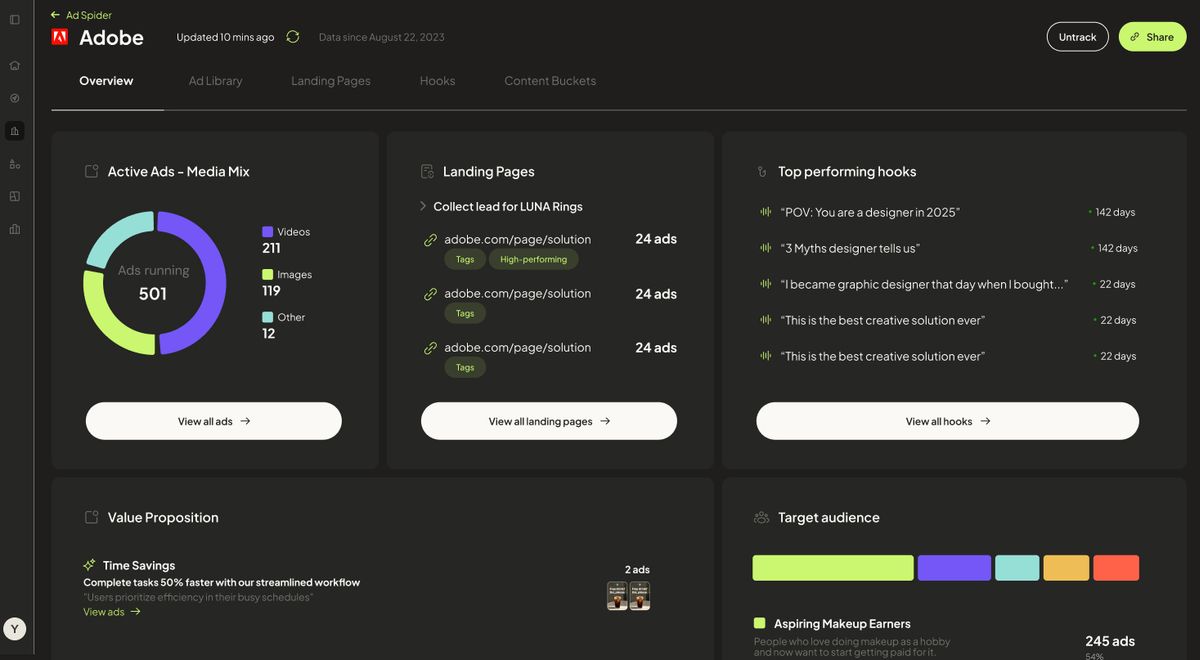
Vibemyad Ad Spider
Tuesday: Generate Variations (1 hour)
• Use Vibemyad Ad Gen to create 50+ variations of winning concepts
• AI generates: Hook variations, different colors/overlays, format changes (static → video → carousel), CTA variations
• System remixes competitor concepts with your brand elements
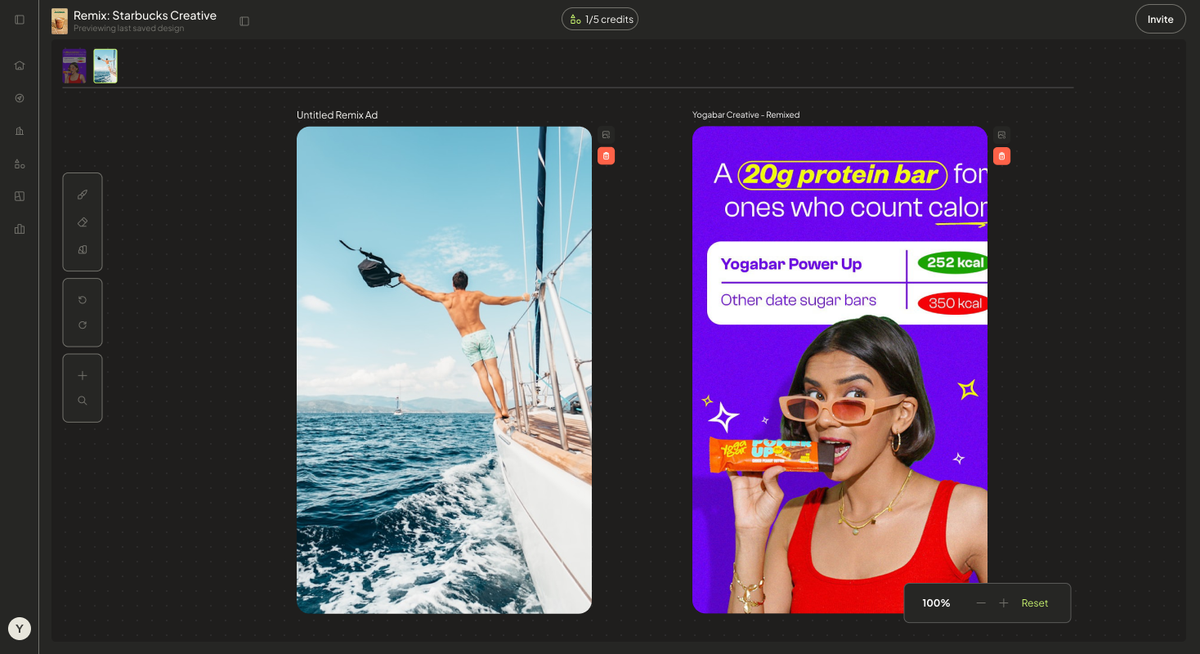
Vibemyad Ad Gen
Wednesday-Thursday: Review & Select (2 hours)
• Designer reviews AI-generated variations
• Selects best 15-20 that match brand standards
• Makes minor tweaks if needed
Friday: Upload (30 minutes)
• Upload selected creatives in cadence
Total design time: 3-5 hours per week for 15-20+ creatives
When this makes sense:
• Testing >20 creatives/week consistently
• Small design teams (1-2 people)
• High budget testing ($500+/day allows more volume)
• Need systematic variations of proven concepts quickly
The hybrid approach: Many teams use both methods—manual batch production for original concepts, AI generation for scaling variations of winners.
Single Testing Campaign Architecture:
Campaign: Creative Testing Lab
• Objective: Conversions (Purchase)
• Budget: CBO or ABO (both work, CBO slightly better at $200+/day)
• Daily budget: $150-250 (for 15-20 active creatives)
Ad Set: Broad Testing
• Audience: 25-65, All Genders, 1-2 Broad Interests (or completely broad)
• Placements: Automatic OR Manual (Facebook/Instagram Feed + Stories only)
Ads: 15-20 active creatives
• Upload 2-3 new ads every 2-3 days
• Let each run 3-5 days minimum
• Kill at ad level (don't pause entire campaign)
Why this works: One campaign = consistent learning, broad targeting = tests creative strength, ad-level kills = remove losers without disrupting winners.
Learning phase note: Matters for scaling, NOT testing. When testing, you want disruption. Learning phase is relevant when you have winners and want to scale them in a separate campaign.
Formula: Daily budget = $10-15 × number of active creatives
Examples:
• 10 creatives: $100-150/day
• 15 creatives: $150-225/day
• 20 creatives: $200-300/day
Can't afford this? Test fewer creatives properly.
Better: 5 creatives × $150 each = 5 valid tests Worse: 15 creatives × $50 each = 15 inconclusive tests
If you're running $10-20/day total budget: You cannot properly test 15-20 creatives per week. The math doesn't work.
Adapted strategy for small budgets:
Test 2-3 creatives per week, not 15-20:
• Week 1: Test Creative A, B, C ($70 each over 7 days)
• Week 2: Test Creative D, E, F
• Week 3: Test variations of Week 1-2 winner
Monthly capacity at $20/day: 8-12 creatives properly tested, 2-3 winners identified. Better than 40 creatives improperly tested with no learnings.
The principle: Depth over breadth at small budgets.
Kill immediately if:
• Spend >$150 with 0 conversions
• CPA >2× target with <3 conversions (likely won't improve)
Kill after 5-7 days if:
• CTR <1% (not stopping scroll)
• CPC >2× account average (expensive engagement)
• Video views <15% completion (hook isn't working)
Keep testing if:
• CTR >2% even with no conversions yet (strong hook, might need more time)
• CPA within 1.5× target with 1-3 conversions (promising, needs more data)
• Strong engagement (comments, shares) even without conversions (indicates interest)
Scale immediately if:
• 5+ conversions at or below target CPA
• CTR >2.5%
• Consistent performance over 5-7 days
Realistic expectations for 15-20 creatives/week testing:
• Week 1: 15 creatives tested → 12 killed (CTR <1%, no conversions after $100-150) → 3 promising (CTR >2%, 1-3 conversions)
• Week 2: 15 new tested → 2 from Week 1 become winners (8+ conversions, below target CPA) → 13 of Week 2 killed → 2 show promise
• Week 3: 10 variations of Week 2 winner tested → 3-4 outperform original → You now have 3-4 proven creatives
• Week 4: Scale the 3-4 winners → Continue testing 10-15 new concepts for next winners
This is sustainable high-volume testing: Not hoping all 15 work, but systematically finding the 2-3 that do through volume. Proven winners fatigue after 4-8 weeks, but continuous testing provides replacements.
Testing 15-20 creatives per week doesn't burn out your design team when you:
• Batch produce systematically (5-7 variations of same concept = 90 minutes vs. 6 hours for random concepts)
• Test with sufficient budget ($100-150 per creative minimum)
• Upload in cadence (2-3 per day to avoid algorithm favoritism)
• Use single testing campaign (1 broad ad set, ad-level kills)
• Follow the framework (Test Wide → Find Winner → Iterate Deep → Scale Hard)
• Kill decisively (>$150 + 0 conversions = move on)
The teams that win produce systematic variations of proven concepts, test properly, and scale winners ruthlessly. Your design team doesn't need 80-hour weeks. They need a system that tells them exactly what to create, when, and why.
High-volume creative testing in 2026 isn't about brute force—it's about systematic iteration. Test concepts broadly, find winners through proper statistical significance, iterate deeply on what works, and scale hard. That's how 15-20 creatives per week becomes sustainable instead of exhausting.
Get notified when new insights, case studies, and trends go live — no clutter, just creativity.
Table of Contents


Arpita Mahato
Content Writer, Vibemyad

Arpita Mahato
Content Writer, Vibemyad


Rahul Mondal
Product, Design and Co-founder, Vibemyad