February 21, 2026 • 9 min read

February 21, 2026 • 9 min read
This blog explores how AI in Advertising is evolving from automation-driven efficiency to AI creative intelligence that builds durable competitive advantage. It examines the rise of AI advertising generators, the growing risk of creative saturation detection, and how AI ad research tools and AI competitive ad analysis are redefining strategic positioning.
Readers will gain a forward-looking framework for building a differentiated, intelligence-led AI in ads stack for 2026 and beyond.
The world of advertising is shifting because AI in Advertising has moved from a performance enhancer to a structural growth engine. The data is no longer speculative.
The global AI in Advertising market was valued between $6.7-$8.6 billion in 2023 and is projected to reach anywhere from $28.4 billion to $81.6 billion by 2033, growing at a 28.4% CAGR. By the end of 2024, nearly 60% of digital ad spend is influenced by AI technologies, and AI-driven personalization has delivered up to a 45% increase in campaign effectiveness (Source: Market US).
Creative production time has reduced by approximately 30% through automation.
That level of capital allocation does not happen for incremental improvements. It happens when an industry model changes. And like everything else, advertising is evolving, changing and getting bigger than ever.
AI in Advertising
AI in Advertising is the transformation of marketing from manual execution to machine-led decision systems. It applies machine learning, predictive analytics, and generative models to automate targeting, optimize bidding, personalize messaging, and produce ad creatives at scale. In 2026, AI in ads operates across three strategic layers:
• Optimization AI – Predictive bidding, budget allocation, and audience modeling.
• Generative AI – Copy, image, and video creation through AI advertising generators.
• Creative Intelligence AI – Competitive analysis, pattern recognition, and creative saturation detection.
The first two layers drive efficiency, and third builds defensible advantage. This progression, from automation to AI creative intelligence, defines modern digital advertising strategy.
AI is restructuring digital advertising from audience discovery to creative iteration to competitive positioning. Planning, execution, and optimization are now machine-assisted, continuously learning, and data-driven. What was once periodic campaign management has become an always-on intelligence system.
Platforms such as Meta Advantage+ and Google Performance Max have transformed media buying from manual configuration into probabilistic forecasting. Machine learning models dynamically allocate budgets across campaigns, predict conversion likelihood at the user level, adjust bids in real time based on intent signals, and optimize performance across fragmented, multi-touch customer journeys.
Instead of relying on static rules and scheduled optimizations, advertisers now operate within adaptive systems that recalibrate continuously. Media buying has shifted from human-led control to algorithmic allocation, where efficiency is increasingly determined by predictive modeling rather than intuition.
AI advertising generators have fundamentally altered creative economics. Brands can now produce high-velocity headline and primary text variations, static and motion visuals, UGC-style formats, and localized creative adaptations at scale. What once required weeks of production cycles can now happen in days, dramatically expanding testing bandwidth.
However, this acceleration introduces a structural tension. When multiple brands rely on similar generative models trained on overlapping datasets, differentiation compresses. Hooks begin to resemble one another. Value propositions converge. Creative output increases, but distinctiveness declines.
Without strategic oversight, generative scale does not guarantee competitive advantage. It can instead accelerate creative saturation.
Most advertisers use AI to generate. Far fewer use AI to interpret the market.
AI ad research tools now enable automated competitor creative tracking, frame-by-frame hook and structure analysis, landing page messaging decomposition, cross-brand pattern clustering, and weekly monitoring of creative evolution. This is where AI ad monitoring software evolves from performance dashboarding into strategic intelligence infrastructure.
Rather than optimizing in isolation, brands can detect emerging messaging trends, identify saturation before performance decays, map creative whitespace, and validate positioning against observable competitive signals.
The result is a decisive shift, from reactive optimization to anticipatory strategy. Advertising decisions are grounded in real-time market behavior in 2026.
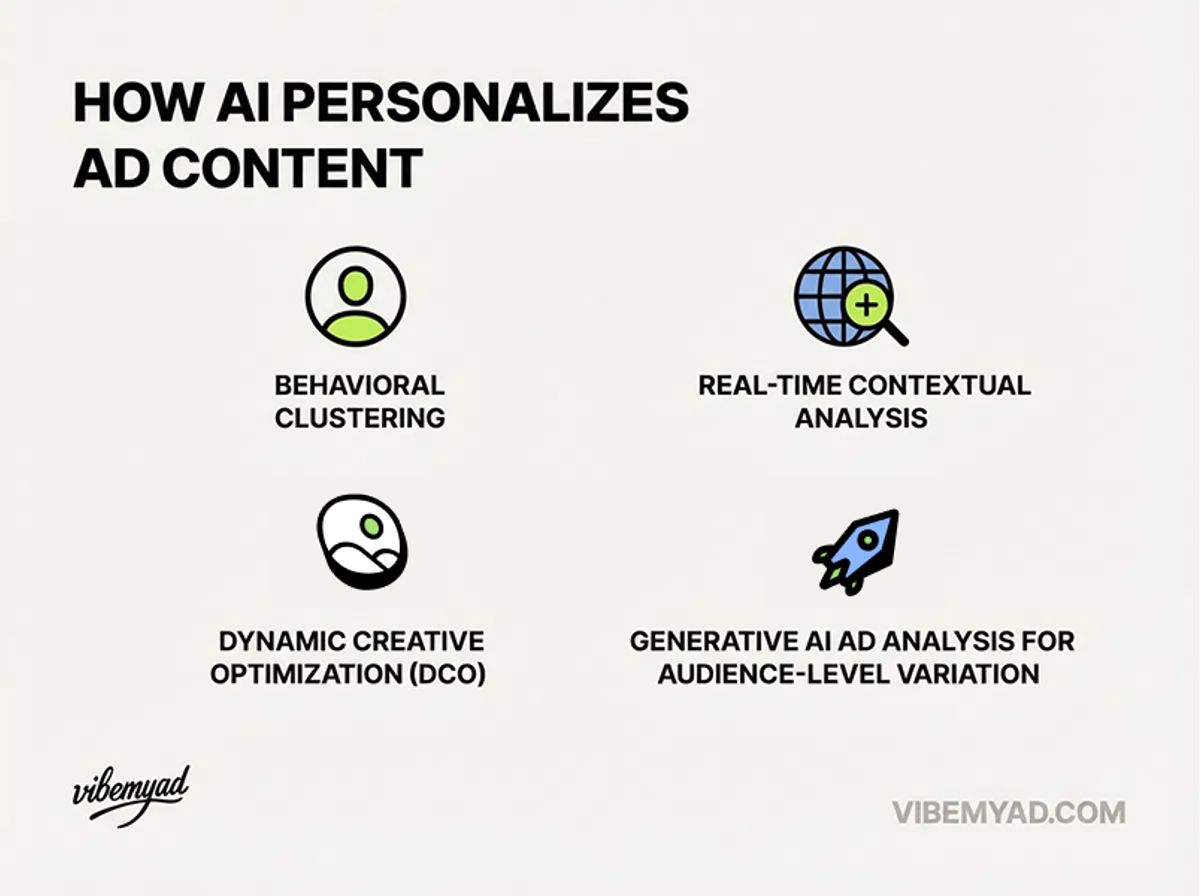
How AI Personalizes Ad Content
AI has transformed personalization from basic audience segmentation into adaptive, real-time creative orchestration. It determines who should see the ad, what version of the message they should see, when, where and in what competitive context. AI personalizes advertising through four interconnected mechanisms:
Machine learning models analyze browsing behavior, transaction history, engagement depth, device usage, and intent signals to group users into dynamic behavioral clusters. Unlike static demographic segmentation, these clusters continuously evolve as new data is ingested, allowing targeting models to adjust as user intent shifts.
AI systems evaluate contextual variables such as device type, location, time of day, content environment, and even scroll velocity. This enables ads to adapt messaging tone, creative format, and offer framing based on immediate situational relevance rather than historical assumptions alone.
DCO engines assemble ad components, headline, visual, CTA, social proof, offer, in modular form. Based on predicted conversion probability, the system serves the highest-likelihood combination to each user. This moves personalization from audience-level to impression-level optimization.
Generative systems now produce audience-specific creative variations informed by performance data. AI analyzes which hooks, emotional triggers, and value propositions resonate with each cluster, then generates aligned creative iterations at scale.
Traditionally, personalization meant showing the right offer to the right user. Segmentation was largely demographic, and success was defined by improved targeting accuracy.
Early pioneers demonstrated what scale could look like:
• Amazon operationalized personalization using browsing history, purchase patterns, and wishlists to dynamically tailor product recommendations.
• Netflix refined recommendation systems further, customizing not just content suggestions but even thumbnail imagery based on viewing behavior.
• Spotify transformed user data into cultural artifacts through Discover Weekly and its annual Wrapped experience, turning personalization into engagement.
• Coca-Cola extended personalization into the physical world with its “Share a Coke” campaign,
• Starbucks leveraged AI and geolocation inside its mobile app to deliver context-aware offers.
These brands moved beyond one-size-fits-all marketing toward scalable 1:1 interactions powered by data. In 2026, however, personalization also means protecting attention. As generative AI accelerates creative production across industries, audiences are exposed to increasingly similar hooks, structures, and value propositions.
AI creative intelligence introduces a competitive layer to personalization. It analyzes messaging patterns across brands, detects saturation signals early, and identifies creative whitespace before new variations are deployed.
Instead of optimizing only for user behavior, the system also optimizes for market context, ensuring that personalized ads remain distinctive. To learn better about AI-powered creative intelligence, you can also check out Ad Gen by Vibemyad and generate no-command ads within seconds.
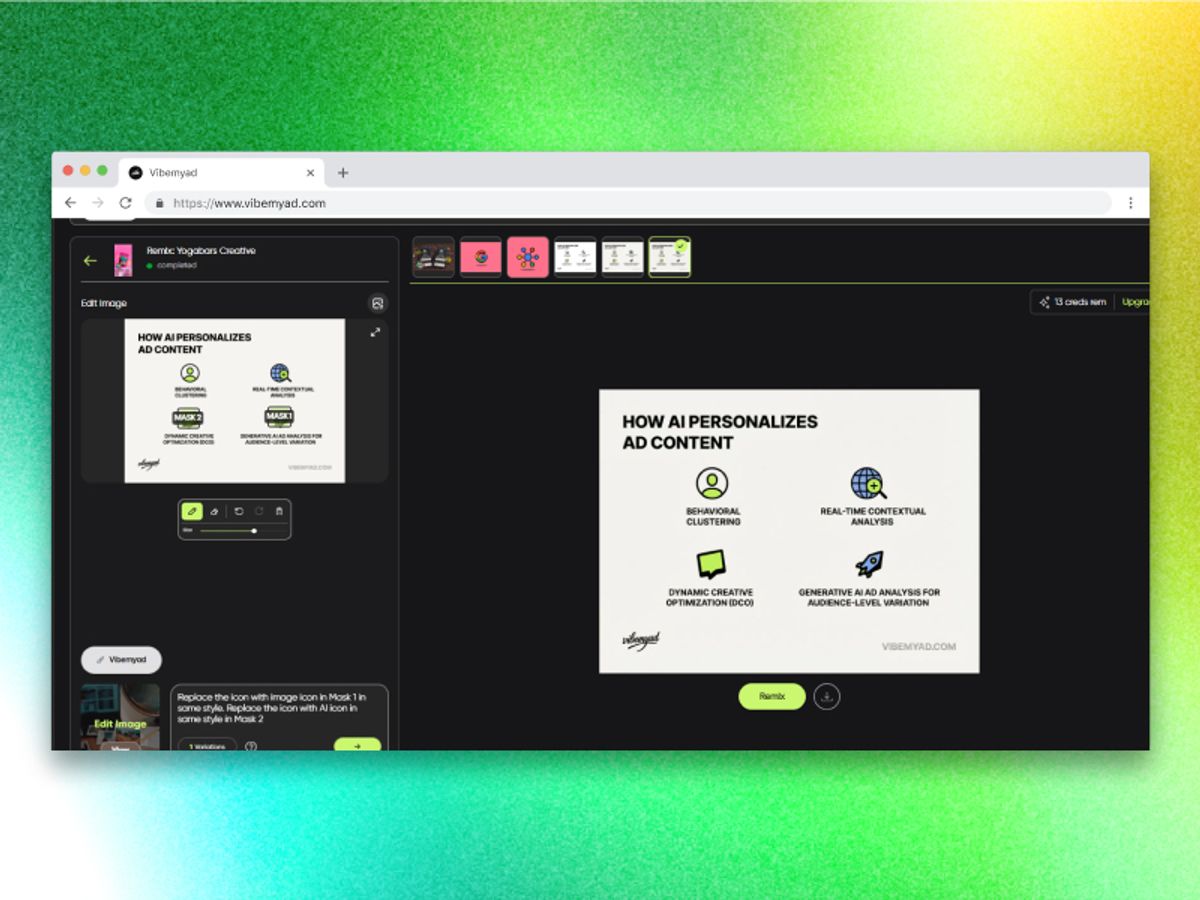
Vibemyad Ad Gen
Creative saturation occurs when multiple advertisers converge on structurally similar messaging, reducing differentiation even when targeting remains precise. It typically manifests through convergence in:
• Hooks: Opening lines and attention triggers begin to mirror each other across competitors.
• Value propositions: Core promises become interchangeable within the category.
• Visual structures: Ad layouts, pacing, and formatting follow repetitive templates.
• Psychological triggers: Emotional levers (urgency, social proof, scarcity) are deployed in near-identical patterns.
Generative AI accelerates this effect because models are trained on overlapping datasets. As more brands use similar AI advertising generators, output variance narrows and creative originality compresses. Early symptoms of saturation include:
• CTR decay despite stable targeting – Audience relevance remains, but attention weakens.
• Rising CPM and CPC – Platforms price in declining engagement efficiency.
• Reduced scroll-stopping impact – Ads blend into category noise.
• Increased frequency sensitivity – Performance drops faster as repetition becomes noticeable.
AI competitive ad analysis mitigates this risk by detecting pattern repetition across competitors before performance erosion becomes visible.
The AI in advertising ecosystem is multi-layered, with different companies leading across optimization, generation, and intelligence infrastructure.
Optimization platforms focus on predictive bidding, automated budget allocation, and cross-channel performance calibration.
• Google LLC (Performance Max) uses machine learning to automate distribution and maximize conversion probability across properties.
• Meta Platforms, Inc. (Advantage+) applies AI-driven audience expansion and delivery optimization across Facebook and Instagram.
• Amazon.com, Inc. (Amazon Ads AI) combines retail intent data with algorithmic media placement for closed-loop attribution.
Generative leaders concentrate on multimodal content creation and creative automation.
• OpenAI (ChatGPT, Sora) enables scalable text, image, and video generation.
• Adobe Inc. (Firefly) embeds AI-powered creative tools into enterprise workflows.
• Canva (Magic Studio) simplifies AI-assisted visual production for marketers.
• Jasper provides brand-aligned marketing copy at scale.
• Copy.ai automates messaging workflows for ads and sales content.
• Vibemyad integrates AI-powered ad generation with competitive pattern analysis to ensure creative output aligns with real-time market signals.
• AI ad spy alternative workflows
• Automated competitor tracking
• Cross-brand pattern clustering
• Creative saturation detection
• Hook longevity monitoring
• Are you using AI in advertising to generate more ads, or to generate more differentiated ads through AI creative intelligence?
• Do your AI ad research tools track competitor creatives weekly and surface actionable insights?
• Can your system detect creative saturation before performance metrics decline?
• Through AI competitive ad analysis, do you know which hooks persist 30+ days in your category?
• Are you leveraging AI ad monitoring software beyond an AI ad spy alternative to map messaging evolution and market shifts?
• Predictive creative modeling
• Competitive whitespace identification
• Automated creative fatigue detection
• Integrated creative + performance feedback loops
• AI-driven strategic reporting (SWOT, gap analysis, narrative clustering)
AI-powered creative intelligence platforms like Vibemyad are shifting marketing teams from reactive execution to strategic orchestration. They enable marketing teams to:
• Replace manual competitor tracking with automated AI ad research tools.
• Detect creative saturation before budget inefficiencies escalate.
• Align generative creative output with real-time market context.
• Shorten decision cycles from weeks to hours.
• Transform scattered ad data into structured strategic direction.
The next phase of AI in Advertising will move beyond automation and into fully integrated intelligence systems. As AI in ads matures, competitive advantage will increasingly depend on how well brands connect creative generation, market research, and performance feedback into a single loop.
If you want to move from AI-powered execution to AI-driven strategic advantage, it’s time to upgrade from generation to creative intelligence.
Get notified when new insights, case studies, and trends go live — no clutter, just creativity.
Table of Contents


Arpita Mahato
Content Writer, Vibemyad

Arpita Mahato
Content Writer, Vibemyad

Arpita Mahato
Content Writer, Vibemyad