August 14, 2026 • 9 min read

August 14, 2026 • 9 min read
Ads Manager stopped being the hard part in 2024. Meta's own AI now decides who sees your ad, which means the only thing left to get wrong is what the ad says, and that is the job an AI advertising agency is actually selling you.
• An AI advertising agency runs your paid media using its own software for research, creative production, and testing. You are buying campaigns, not seats.
• Three different things use the label: ad software, traditional agencies that added a tool, and agencies genuinely built on a platform. Only the third is what most people mean.
• AI transformed research and creative volume. It did not hand agencies control of delivery. Meta and Google own bidding and audiences now, and no agency beats them at it.
• What is left is the input: which angle, which hook, how many, how fast. That is where agencies actually differ.
• The fastest sort: any agency claiming its AI out-bids Meta is describing something that does not exist.
What Is An AI Advertising Agency?
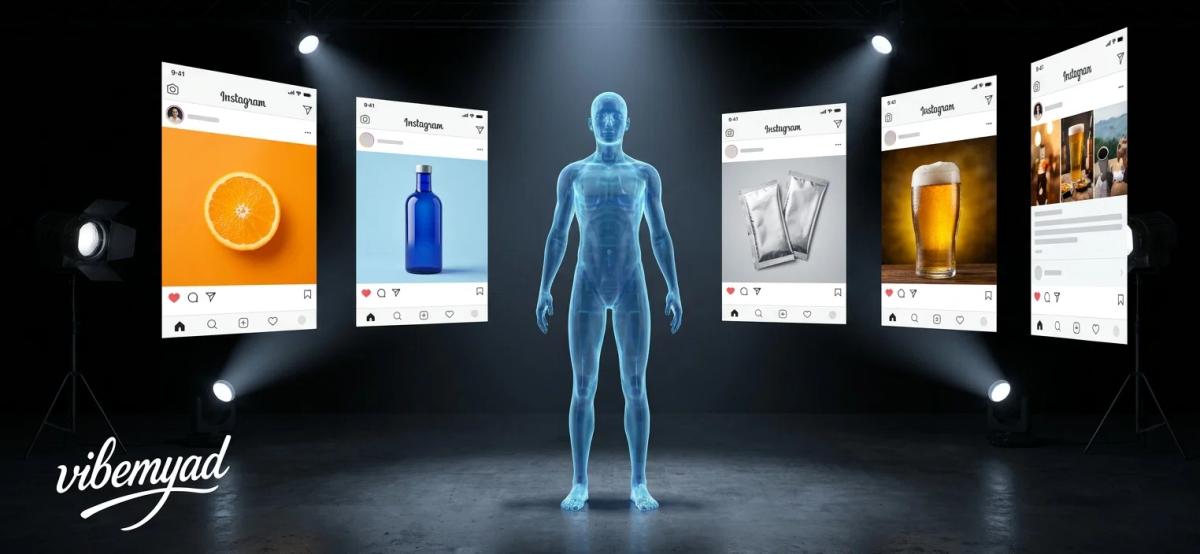
An AI advertising agency plans, produces, and runs paid advertising using artificial intelligence, usually its own software, across research, creative production, and campaign management. You hire it to run your ads. The AI is how the work gets done, not what you are buying. The label is slippery because three different kinds of companies use it.
Worth separating from its bigger sibling: an AI advertising agency works on paid media, so ad creative, campaign structure, media buying, and testing. An AI marketing agency covers that plus SEO, content, email, and brand. If your ad account has stalled, you want the first, which is how we structure our own e-commerce marketing agency engagements. If you have no acquisition engine at all, you want the second.
What Makes An Agency AI-Native
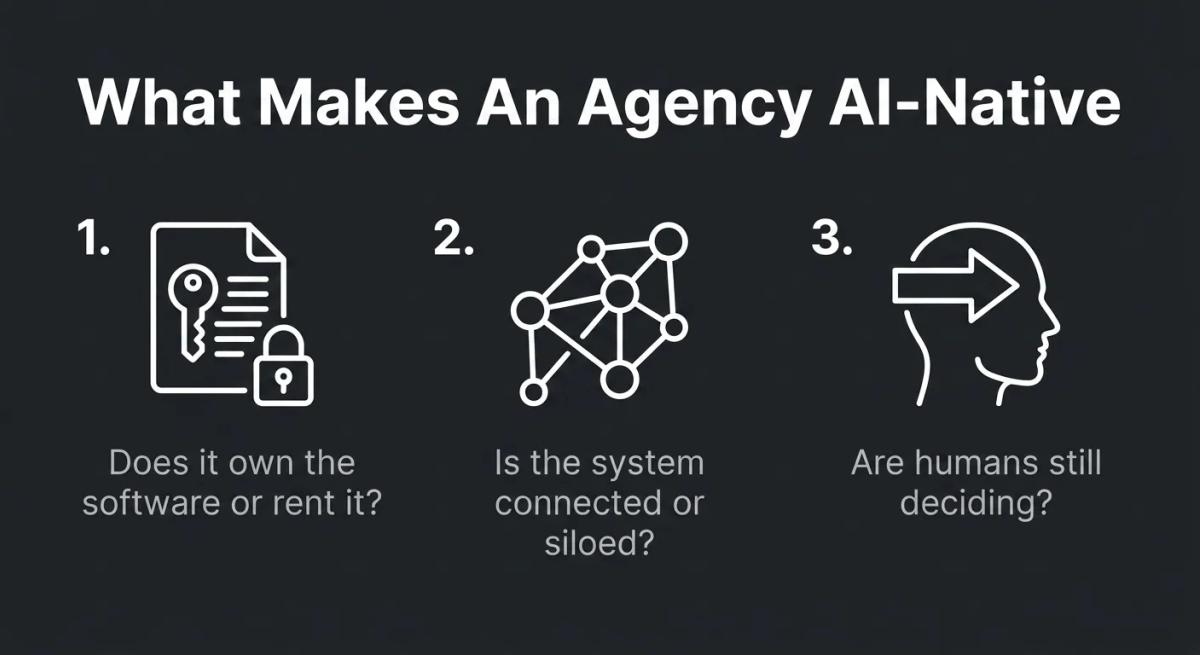
For a lot of firms, AI-native means one thing in practice: they generate creative with a subscription tool. That is a single tool, not a way of operating. Three questions separate the real thing from the rebrand.
Does it own the software or rent it? Renting means their capability is whatever their vendor shipped this quarter, and you could buy the same subscription yourself.
Is the system connected or siloed? Research that never reaches the creative brief is just a nicer report. In a genuinely AI-native shop, what the platform learns reading your category carries straight into what gets made.
Are humans still deciding? AI-native does not mean human-absent. An agency that hands the whole thing to the machine is not more advanced, it is less accountable.
Where Does AI Actually Help In Advertising?
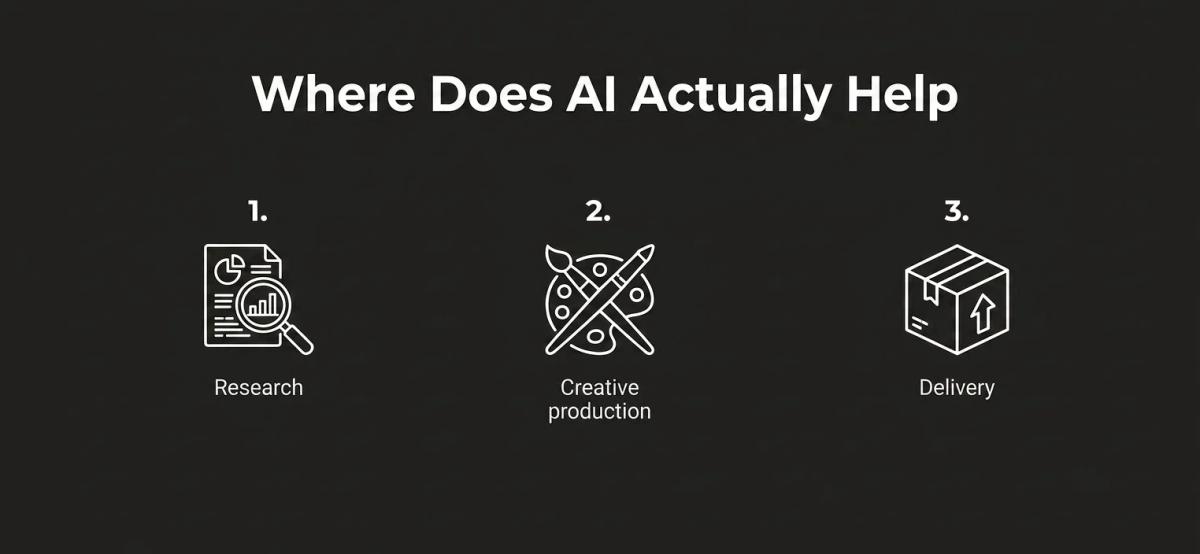
Not everywhere, and not evenly. There are two AI layers now, the platform's and the agency's, and they do different jobs.
How AI Help In Advertising
• Research: Reading a whole category instead of sampling thirty ads, classified by hook, format, and offer, tracked continuously. Longevity is the signal that matters, because an ad still running after 60 days was validated by somebody else's budget. When we pulled 47,392 ads from the Meta Ad Library, only 11.3% survived past 60 days. If nine in ten ads die inside two months, quarterly research describes a market that no longer exists.
• Creative production: Statics, video, motion, and UGC-style ads at a volume a human studio cannot match.
• Delivery, and this is the one to understand: Meta deployed Andromeda, a retrieval engine that decides which ads are eligible for a given person, then wrapped set-up in Advantage+. Google says Performance Max applies its AI across bidding, budgets, audiences and creatives, and that Smart Bidding sets a bid for every auction. So delivery is already automated, for everyone, including your competitors. The platform now reads your creative to work out who should see it, which is exactly why creative supply replaced audience construction as the lever. We covered the fallout in our breakdown of the Meta Andromeda update.
Which Parts Of Advertising Still Need A Human?
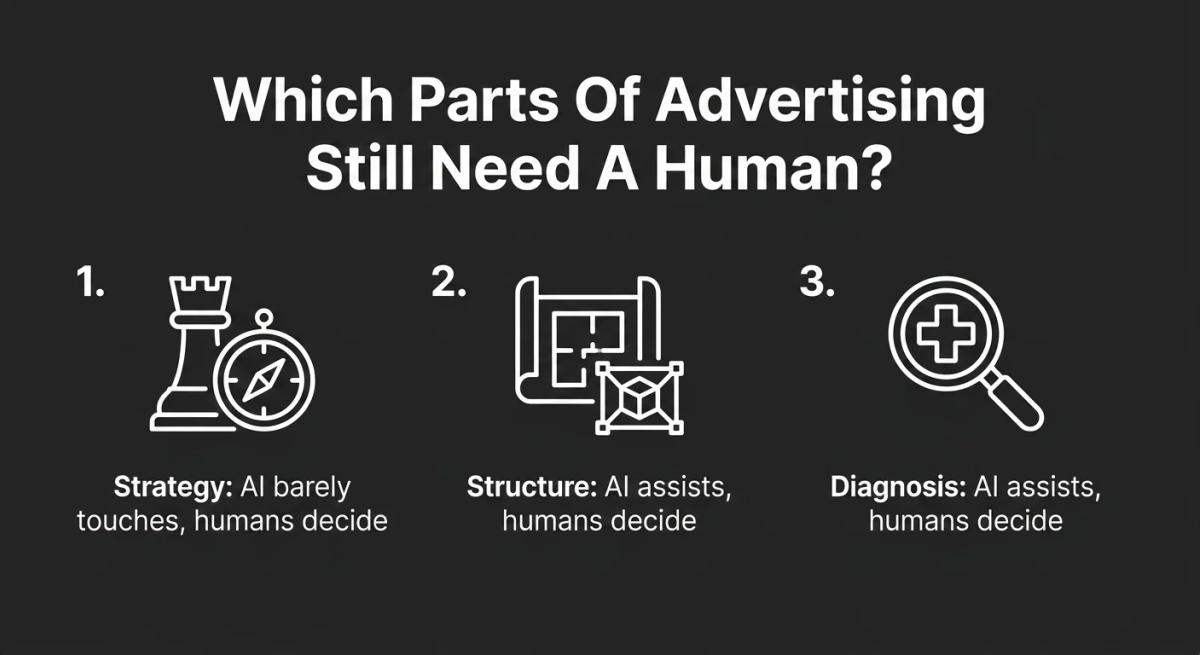
Two different cases here, and it is worth keeping them apart. Some work AI barely touches. Other work AI assists heavily but cannot decide.
AI barely touches strategy: Which customer, which objection, which price, what the brand stands for. No model has solved this, and the ones claiming to are pattern-matching on other people's positioning.
AI assists, humans decide, on structure: CBO versus ABO and budget floors are knowable arithmetic but human calls. We ran those numbers on Facebook ads cost per month, and the gap between the standard "start with $500" advice and the real minimum is roughly sixteenfold.
AI assists, humans decide, on diagnosis: AI is good at flagging that something moved. Working out whether the creative, the offer, the structure, or the account signal caused it still takes a person, which is why ads that look great and convert nothing stay a common failure.
How Does An AI Advertising Agency Actually Help You?
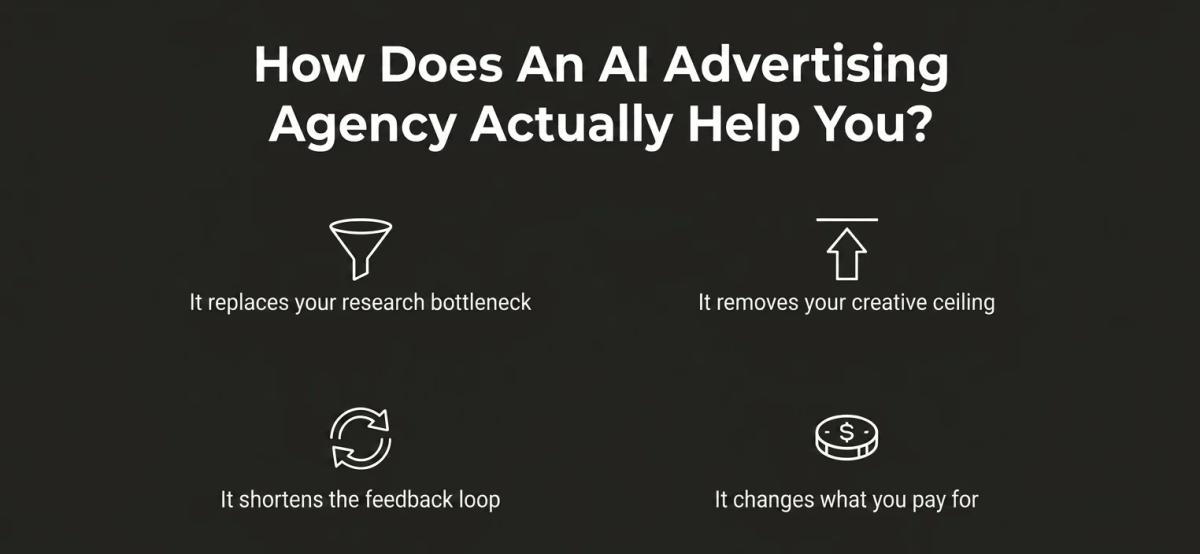
It replaces your research bottleneck: A continuous read of your category instead of an onboarding deck that ages for nine months, so the brief starts from what the market already validated rather than a moodboard.
It removes your creative ceiling: Most DTC growth is capped by how many concepts you can produce and test each week, not by ideas in the room. Four a month becomes dozens, which matters because the platform wants variety to test against. A brand supplying four ideas a month is starving it.
It shortens the feedback loop: Losers cut fast, winners scaled and remixed into the next batch. The discipline that has to come with volume is creative testing. Volume without a testing framework is noise.
It changes what you pay for: Faster and more measurable work makes outcome-based pricing viable instead of a fixed monthly retainer.
• Competitive and category research, continuous rather than quarterly
• Angle, hook, and offer strategy derived from what is already converting
• Ad creative production across static, video, motion, and UGC formats
• Campaign build and media buying on Meta, Google, TikTok and similar
• Creative testing programs with a defined cadence and kill criteria
• Landing page and conversion work, the one place scope reaches past the ad itself
• Reporting and diagnosis, live rather than a monthly deck
Usually outside scope: brand strategy, studio shoots, organic social, lifecycle marketing.
It also differs by channel. Meta is the most automated and most creative-hungry, so volume pays off most directly. Google is two games, because Search still rewards intent and offer clarity while Performance Max trades control for reach, and the two earn budgets differently. TikTok rewards native-feeling creative and fatigues faster, which raises the volume requirement again.
What Do People On Reddit Say About AI Ad Agencies?
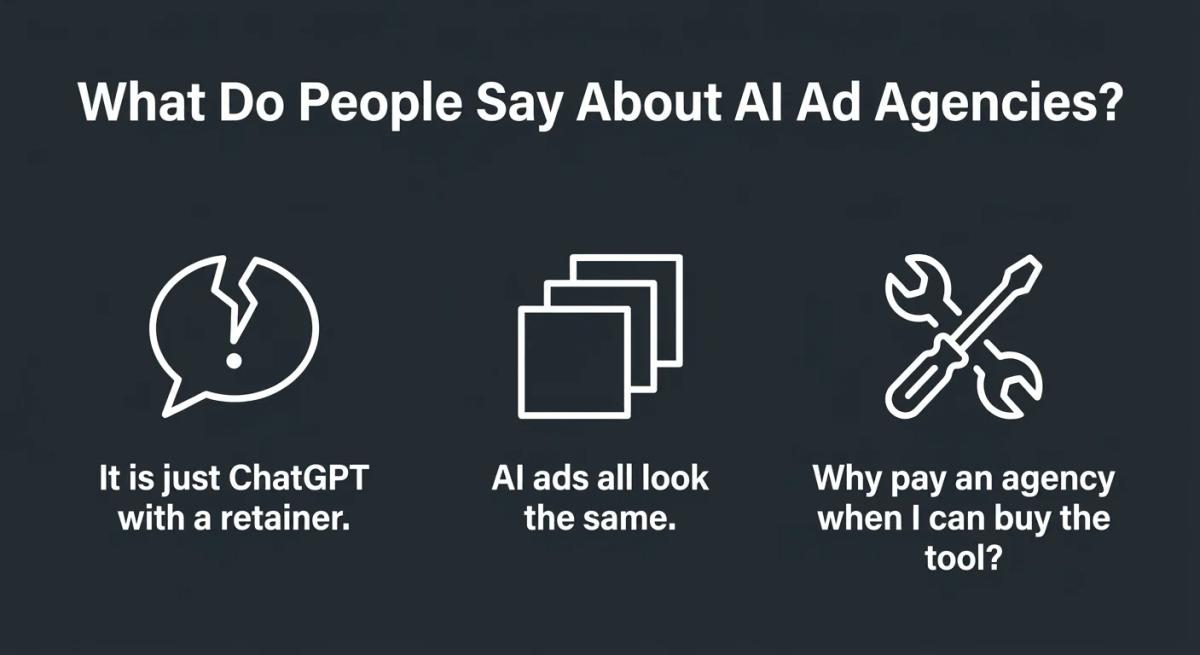
Search the term and a Reddit thread outranks every agency in the category, which tells you how much of this conversation is skepticism rather than shopping. The recurring objections are worth taking seriously, because most of them are correct.
"It is just ChatGPT with a retainer." Often true. This is the AI-washed row in the table above, and the rent-or-own question sorts it in about a minute.
"AI ads all look the same." Also often true, and it is a symptom of generating from a blank prompt instead of from evidence. That is a different failure from AI itself. Creative built from a real read of the category does not have this problem.
"Why pay an agency when I can buy the tool?" A fair question with a real answer: tools give you leverage if you already have the people and the plan. An agency gives you both when you do not. If you have a media buyer and a designer, buy the tool.
• Your offer is not proven: No amount of creative velocity fixes a proposition that is not landing.
• Your budget cannot support the testing: Below the learning threshold, results stay noisy and nobody reads them reliably.
• You need brand more than performance: Positioning is measured in years. Volume is the wrong tool.
• You want a named team on a fixed retainer: A legitimate preference, and a good traditional shop beats a badly matched AI-native one. We compared both in AI marketing agency vs traditional agency.
Vibemyad Agentic Ads Agency
Every agency in this category says the same three words, so here is ours stated in a way you can check.
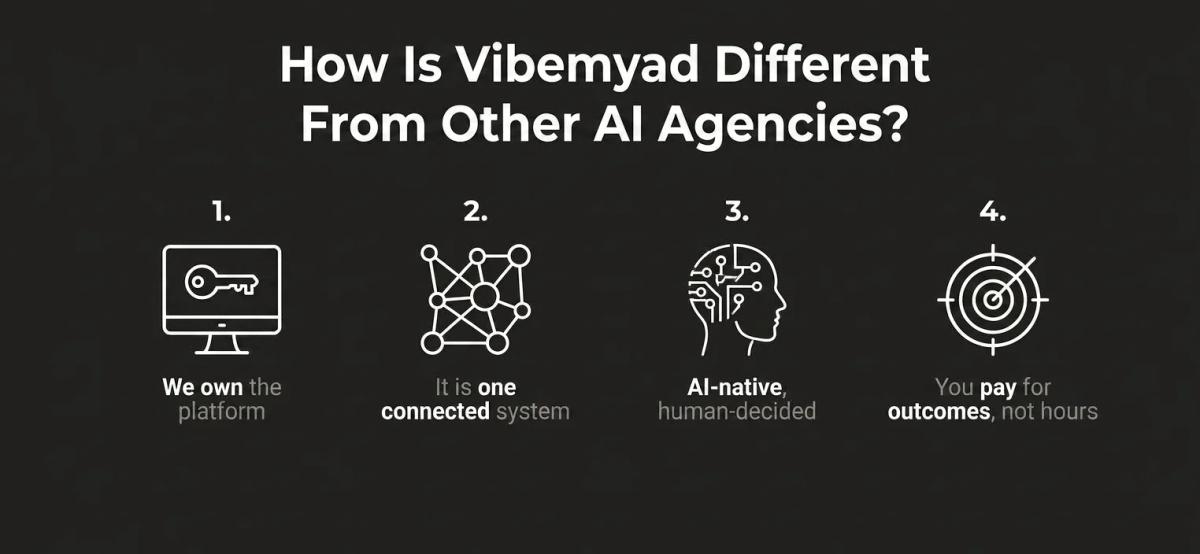
How Is Vibemyad Different From Other AI Agencies?
We own the platform, we do not rent one: Our own ad library of 12M+ Meta ads for category intelligence, gap analysis to find the angle nobody has claimed, deep ad analysis for why a specific ad works, and generation grounded in ads proven to work.
It is one connected system, not a drawer of tools: The same AI that reads your category feeds the brief, and the same workflow reaches across paid media, e-commerce SEO, and web. Intelligence carries from one deliverable to the next instead of being gathered again by hand.
AI-native, human-decided: The AI does the heavy lifting. People decide whether to act, what fits the brand, and when to overrule the model.
You pay for outcomes, not hours: Our pricing tracks the value of the work rather than the size of our team. It only works when both sides agree in advance what counts as a result.
Test us the same way you should test everyone:
What to take from all of this:
• The platforms automated delivery. That part is finished and available to everyone, including your competitors.
• What is left is the input: which angle, which hook, which format, how many, how fast.
• Research and creative volume are where AI genuinely changed the work. Strategy and judgment are where it did not.
• Judge any agency on what its system reads, what it recommends, and what happened the last time it was wrong.
Try Vibemyad Agency for better inputs, not better bidding. We read every ad in your category and build creative from what already converts. See how the e-commerce marketing agency works, end to end.
Get notified when new insights, case studies, and trends go live — no clutter, just creativity.
Table of Contents


Rahul Mondal
Product, Design and Co-founder, Vibemyad


Arpita Mahato
Content Writer, Vibemyad

Arpita Mahato
Content Writer, Vibemyad