August 09, 2026 • 7 min read

August 09, 2026 • 7 min read
An AI marketing agency is a marketing agency that uses artificial intelligence, often its own proprietary platform, to plan, produce, and optimize campaigns. Where a traditional agency runs on manual research and scheduled reporting, an AI-native one works from live data and generates and tests creative far faster. The AI is how the work gets done. The strategy and the people are still the point.
That definition matters because the label has gotten slippery. Search "AI marketing agency" and half the results are software: AI agents and tools you run yourself. This guide is about the other kind, the firm you hire to run marketing for you, where AI is baked into how they operate rather than sold to you as a subscription. If you're comparing specific firms, we ranked the best AI marketing agencies by specialty in a separate piece. Here, the goal is simpler: to explain what one actually is, what changes when you hire one, and how to tell a real one from a rebrand.
One boundary worth drawing early: marketing is the wider scope. If what you actually need is paid media alone, that is a narrower purchase, and we covered it separately in what an AI advertising agency is and how it works.
The services look familiar. It's the machinery underneath that's different. A genuine AI marketing agency uses AI across most of the workflow:
Research and competitive intelligence. Instead of a strategist manually pulling a handful of competitor ads, the agency's system reads the whole category and surfaces which hooks, formats, and angles are actually working right now.
Creative production. AI generates static, video, and UGC-style ads at a volume a human studio can't match, which turns creative testing from a bottleneck into a pipeline.
Media buying and optimization. Bids, budgets, and audiences get adjusted continuously against live performance data rather than in a Monday review.
Personalization and reporting. Messaging can be tailored closer to the individual than the broad segment, and results show up on a live dashboard instead of a monthly deck.
None of this removes the marketer. Someone still decides the strategy, judges the creative, and owns the outcome. AI changes the speed and the inputs, not the need for people who know what they're doing.
The clearest way to understand the category is to put the two side by side.
• Research — Traditional agency: Manual, done periodically. AI-native agency: Continuous, from live data.
• Creative — Traditional agency: Bespoke, slow, few variants. AI-native agency: Generated and tested at volume.
• Optimization — Traditional agency: Scheduled reviews. AI-native agency: Real-time.
• Personalization — Traditional agency: Broad audience segments. AI-native agency: Closer to the individual.
• Reporting — Traditional agency: Weekly or monthly decks. AI-native agency: Live dashboards.
• Pricing — Traditional agency: Retainer for a team's time. AI-native agency: Often outcome- or usage-based.
The honest caveat: plenty of "AI agencies" only differ from the left column in their marketing. Which brings us to the part that actually matters for you.
For a direct-to-consumer brand living and dying on paid social, the shift is concrete, not abstract.
Your creative testing stops being the constraint. Most DTC growth is bottlenecked by how many ad concepts you can produce and test each week. An AI-native agency can feed the algorithm dozens of variants, find the winners faster, and put budget behind them while a traditional shop is still briefing its second round.
Your decisions start from evidence instead of taste. When the agency can see every ad running in your category, the creative brief begins with what the market has already validated, not with a moodboard and a hunch.
Your cost structure can change. Because the work is faster and more measurable, some AI-native agencies price on outcomes rather than a fixed monthly retainer, so what you pay tracks the value delivered. That's the model we use on our own agency side, and it only works because the underlying platform makes the work efficient enough to stand behind.
What doesn't change: you still need a partner who understands your brand, your margins, and your customer. AI makes a good agency faster. It doesn't make a bad one good.
Here's where most of the category falls short. For a lot of firms, "AI agency" means one thing in practice: they generate creative with AI. That's useful, but it's a single tool, not a way of operating.
A genuinely AI-native agency runs on a connected platform instead of a drawer of separate point tools. The same system that reads your competitors' ads and researches your market also generates your creative, and the same AI-connected workflow can run a website build along with its SEO keyword research and domain research. Because everything is wired together, the intelligence carries from one deliverable to the next instead of being gathered again by hand each time. That connection is the real line between an agency that uses AI and one that's built on it.
"AI-native" also doesn't mean "human-absent." The AI does the heavy lifting, but people still make the calls: whether something needs action, whether a decision fits the brand, when to overrule the model. The AI moves fast, and the humans decide where it goes. An agency that hands the whole thing to the machine isn't more advanced, it's just less accountable. That's the model we built our own agency on: one platform doing the research and the creative, with our team owning the decisions.
This is the section most explainers skip, and it's the one that saves you money. The label is easy to claim, so judge the substance:
Ask what the AI actually is. A real answer names a specific platform, tool, or model and explains what it does, like "our system reads competitor creative and tells us which hooks to test." A vague answer about being "AI-powered" with nothing behind it is a rebrand.
Ask what changes because they have it. If the AI doesn't make the work faster, cheaper, or smarter in a way they can describe, it's decoration.
Ask for proof in your category. Case studies with real numbers beat adjectives. A ten-minute call with a current client tells you more than any deck.
Look at the pricing model. It quietly reveals the incentives. A retainer pays for time whether or not the work performs; outcome-based pricing ties the fee to results.
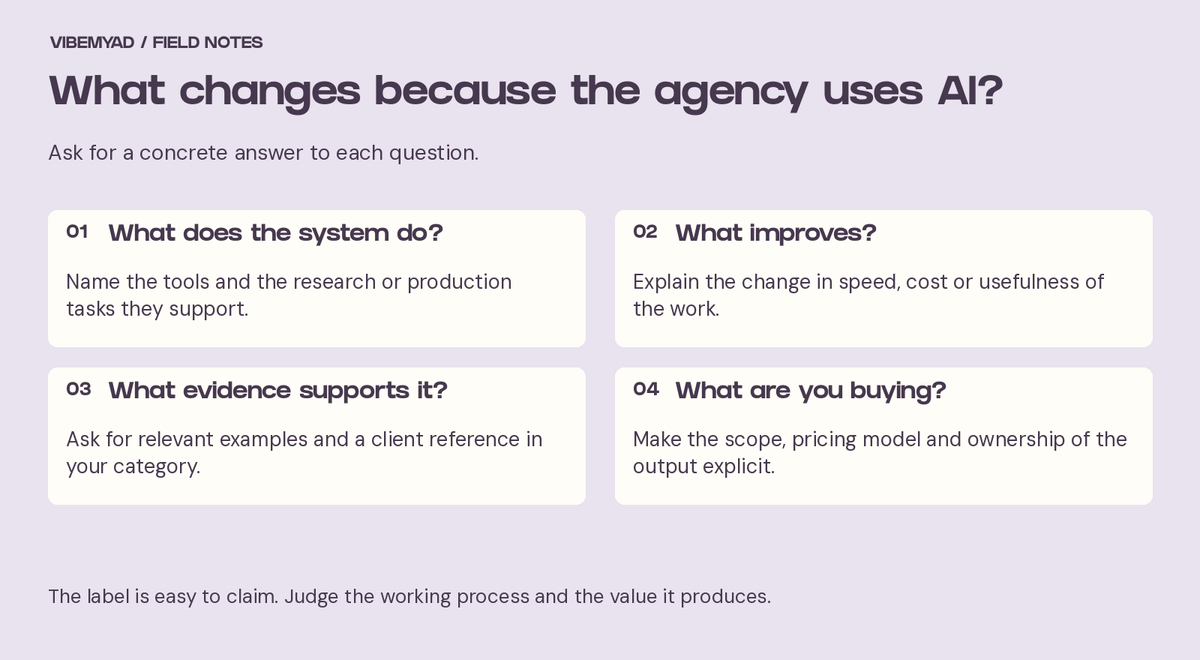
AI agency evaluation checklist: identify what the system does, what improves, the evidence and what the engagement includes.
It depends entirely on the model. Subscription-style agencies start around $4,000 a month, mid-market retainers commonly run $6,000 to $30,000 a month, and enterprise engagements go well beyond that. Some agencies, ours included, price on outcomes instead of a fixed retainer, so the cost tracks the value delivered rather than the size of the team. The efficiency AI brings is what makes outcome-based pricing viable in the first place.
Consider an AI marketing agency when creative volume is capping your growth, when you're spending enough on paid social that faster optimization pays for itself, or when you want category-level intelligence you can't produce by hand. Hold off if you're pre-product-market-fit and still figuring out your offer, since no amount of creative velocity fixes a proposition that isn't landing yet.
If that first description sounds like your brand, you can see how we structure strategy, creative, and paid media on our ecommerce marketing agency page, and compare it against the field in our rundown of the best AI marketing agencies.
An AI marketing agency isn't a different species of agency. It's one that has rebuilt the work around software, so research is continuous, creative is a pipeline instead of a bottleneck, and optimization happens in real time. For a DTC brand, the practical payoff is speed and evidence: more tested creative, decisions grounded in what's already working, and in the best cases a pricing model tied to results. Just make sure the AI is real. Ask what it is, what it changes, and what it has done for a brand like yours, and you'll sort the genuine article from the rebrand quickly.
Get notified when new insights, case studies, and trends go live — no clutter, just creativity.
Table of Contents


Arpita Mahato
Content Writer, Vibemyad

Arpita Mahato
Content Writer, Vibemyad

Arpita Mahato
Content Writer, Vibemyad