May 19, 2026 • 14 min read

May 19, 2026 • 14 min read
• The AI Meta ad generator category split into three layers in 2026: creative generation tools (volume-first), intelligence-first platforms (research-first), and autonomous campaign systems (optimisation-first). Choosing the wrong layer for your use case wastes Meta budget regardless of how good the individual tool is.
• Six criteria separate strong tools from weak ones in 2026: whether the brief starts from market intelligence or a prompt, whether generation is agentic or template-based, whether competitor tracking is continuous or one-time, whether brand book setup persists across sessions, whether iteration runs without re-briefing, and whether the tool is built specifically for Meta rather than multiple platforms.
• Five tools dominate D2C marketing team shortlists in 2026: Vibemyad (intelligence-first agentic generation), AdCreative.ai (high-volume static generation), Segwise (analytics-led intelligence), QuickAds.ai (rapid prompt-based generation), and Creatify (AI UGC video). Each fits a specific use case. This blog walks through which fits which.
An AI Meta ad generator is a software tool that automates the creation of advertising creatives for Meta platforms (Facebook and Instagram), using AI to handle some combination of brief writing, image or video generation, copy generation, and performance optimisation. The category looked like a single market in 2024. By 2026, it has split into three distinct layers, and choosing the wrong layer for your use case is the most expensive mistake a D2C brand can make at Meta auction prices.
The AI Meta ad generator market in 2026 is crowded. Two Minute Reports' 2025 Facebook Ads Benchmark found that 85 percent of D2C brands now use AI to generate ad creatives, up from 41 percent in early 2023, and dozens of tools have shipped to serve that demand. Most reviews of the category run through a feature-by-feature comparison without first establishing what the criteria for choosing should actually be.
This blog inverts that order. The criteria come first. The tools come second. By the time the comparison table renders, you should already know which dimensions matter for your use case.
The category looked uniform in 2024 because every tool was solving the same problem in roughly the same way: take a brief, generate creatives, output to Meta. The differentiation between tools was speed and template variety.
By 2026, the market has split into structurally different layers, and the most consequential split sits at the brief layer rather than the generation layer.
Creative generation tools are the legacy category. They generate static ads, video, hooks, and copy from a prompt or template. Speed and volume are the primary differentiators, and most tools in this layer can produce a finished Meta creative in under 60 seconds. AdCreative.ai, QuickAds.ai, and Creatify sit at this layer with different format emphases.
Intelligence-first platforms start the workflow before generation. They analyse competitor ads, surface validated patterns, classify hooks and creative archetypes, and feed that intelligence into the brief that the generator works from. Vibemyad and Segwise sit here, with different emphases on agentic generation depth versus analytics surface area.
A separate layer exists for autonomous campaign systems (Smartly.io, Madgicx) that generate creatives and then optimise the campaigns those creatives run inside. That layer is outside the scope of this comparison because the buying decision for an enterprise media-buying platform is not the same decision as choosing an AI Meta ad generator for a D2C team.
Choosing the wrong layer for your use case is the most expensive mistake. This blog covers the tools in layers two and three, but frames everything against the criteria that determine which layer you actually need.
These are the dimensions where strong tools and weak tools differ in 2026. Score each shortlist tool against all six.
This is the largest dividing line in the market. A prompt-first tool asks you to describe what you want and generates from your description. The output is grounded in your internal knowledge of your product, which is roughly the same internal knowledge every competitor in your category has. A market-intelligence-first tool starts from validated competitor signals - run duration data, hook patterns, creative archetypes that have sustained Meta budget for 30 or more days and feeds those into the brief.
The structural difference matters because Meta's auction in 2026 penalises convergence. Andromeda, Meta's algorithmic delivery system rolled out across 2024 and 2025, specifically rewards creative differentiation as a core ranking signal, according to Disruptive Digital's October 2024 analysis of creative performance under the new delivery system. Tools that start from internal knowledge produce convergent output that the algorithm itself penalises.
Template-based generators produce a single output per brief. Each refinement requires re-explaining the brief from scratch because the tool does not hold context across iterations. The cognitive overhead becomes the bottleneck, and 20 generations end up reading like 20 disconnected attempts at the same brief.
Agentic generators hold context across the conversation. Brand book inputs persist. Reference selections persist. Earlier variations stay in scope, so refinement compounds across the session rather than resetting each time. This is the difference between AI ad generation as a one-off and AI ad generation as a daily operating capability.
A one-time competitive scan is structurally inadequate in 2026. Disruptive Digital's October 2024 analysis of creative performance under Meta's Andromeda delivery system documented the compression of typical Meta ad lifespans across the past three years.
Brand book setup is a five-minute task that should happen once. Tools that require you to re-upload fonts, re-specify colour palettes, and re-describe brand voice with every generation are structurally inefficient at scale. Tools that persist brand book inputs across the entire session, and across future sessions, compress per-ad time materially as you scale beyond ten ads per month.
The output quality difference is also visible. Tools without brand book persistence default to a generic interpretation of whatever competitor reference fed the generation. The output ships looking like a competitor's ad with your product visually pasted in. At Meta CPM rates between $5 and $10 per Hootsuite's 2025 Social Media Benchmarks, that is an expensive structural error.
The first generation is rarely the launch-ready generation. Strong tools support refinement loops where you can ask for typography changes, palette adjustments, or aspect ratio swaps without re-explaining the brief. Weak tools treat each generation as independent, which means refinement multiplies your input time linearly with the number of variations you produce. For a marketing team running 30 or more Meta ads per month, this difference compounds significantly.
Most AI ad generators in 2026 are built to work everywhere. They export to Meta, but they also export to TikTok, LinkedIn, Google, and YouTube. The marketing pitch is breadth. The hidden cost is that none of the generation logic is calibrated for any one platform's specific dynamics. Meta is not a generic ad surface. Auction prices behave differently than other platforms. Hook patterns are calibrated to Meta's two-second scroll behaviour. A multi-platform generator that exports to Meta is not the same as a tool built around Meta's specific auction dynamics and Andromeda ranking signals.
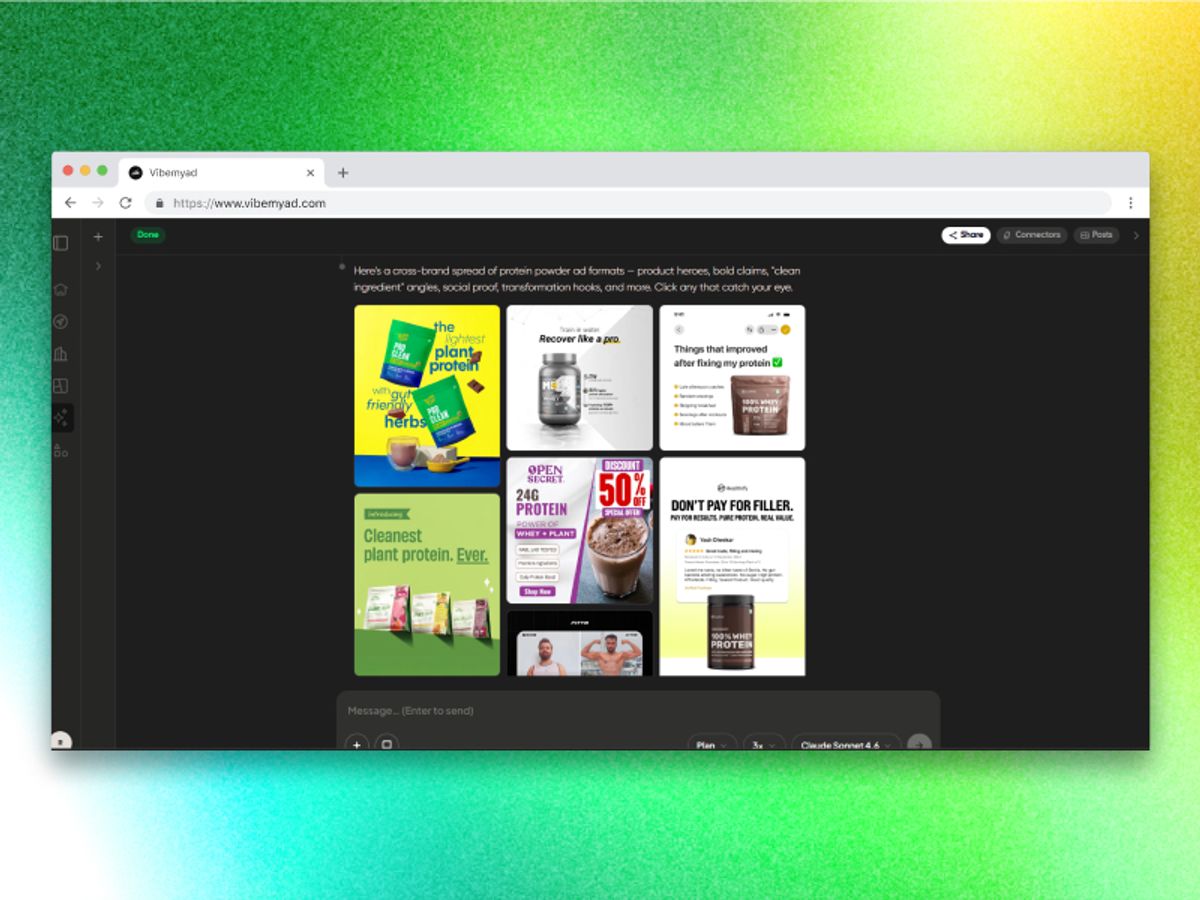
The Vibemyad Agent in Research Mode surfacing validated competitor Meta ads by run duration
Best for: D2C brands that want intelligence-first, agentic Meta ad generation as a daily operating capability.
Vibemyad is built around a three-product workflow that makes market intelligence the input layer of every brief. Vibemyad Ad Vault is a creative intelligence database indexing over 10 million Meta ads, classified across brand, run duration, hook technique, ad concept, visual style, funnel position, content bucket, industry, and aspect ratio. Vibemyad Ad Spider tracks up to 50 specific competitor brands simultaneously with weekly syncing, keeping the intelligence layer current as creative lifespans compress. The Vibemyad Agent connects these two intelligence layers to agentic creative production in a single conversation — Research Mode surfaces validated competitor references, and Edit Mode builds from them with the brand book applied at every generation step. The mode switches automatically based on what the user types.
Vibemyad's primary strengths are the intelligence-first brief construction, agentic generation with persistent context across the session, continuous competitive tracking through Ad Spider's weekly sync, full brand book persistence, and Meta-specific calibration throughout. The structural differentiator is that the research and the build happen in the same conversation without switching tools or rewriting a brief between them.
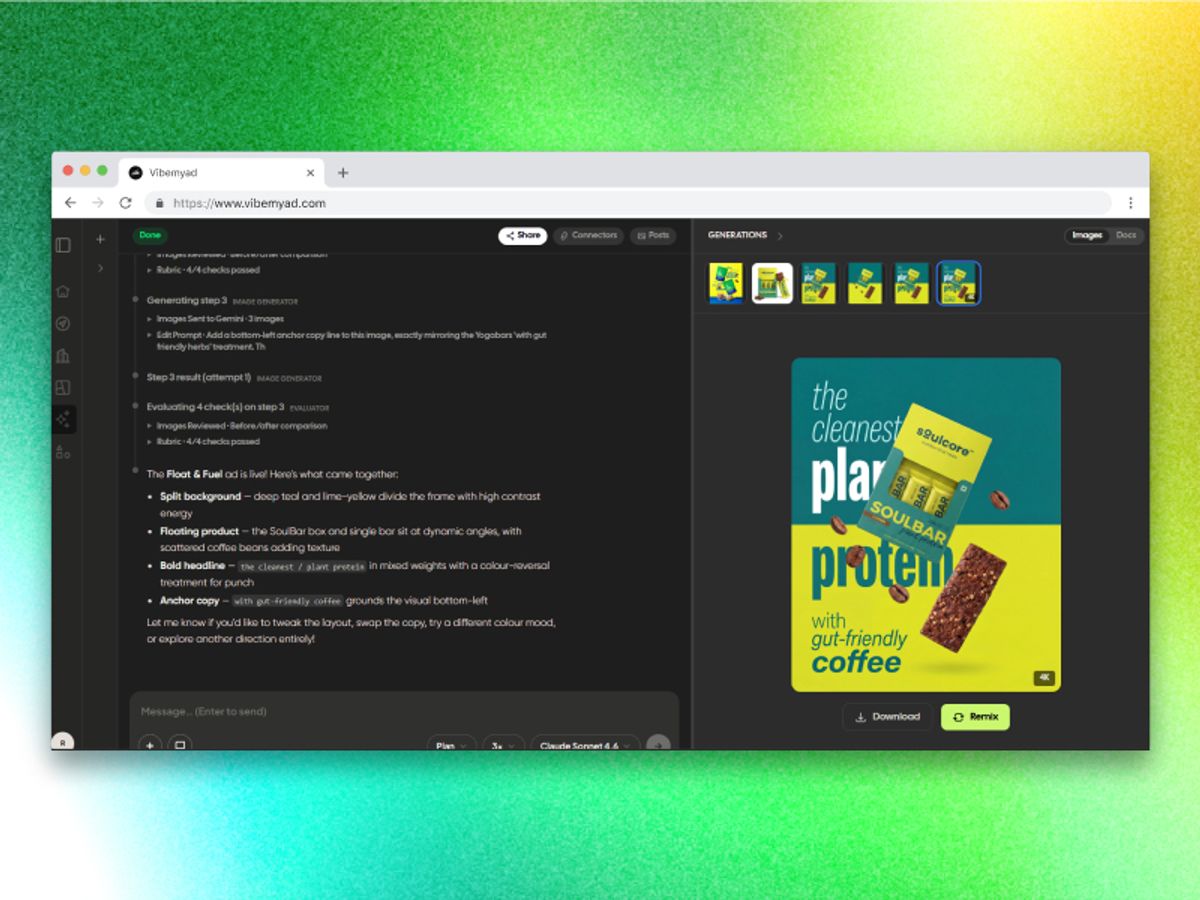
Edit Mode in the Vibemyad Agent building a Meta ad from a validated competitor reference with brand book applied
The primary limitation is first-time setup. Filtering Vibemyad Ad Vault for your category, configuring Vibemyad Ad Spider for your specific competitors, and setting up the brand book takes 25 to 45 minutes before the first ad generates. The infrastructure-first model rewards teams running ten or more ads per month consistently and is less suited for one-off creative needs.
AdCreative.ai
Best for: Agencies and high-volume creative testing programmes.
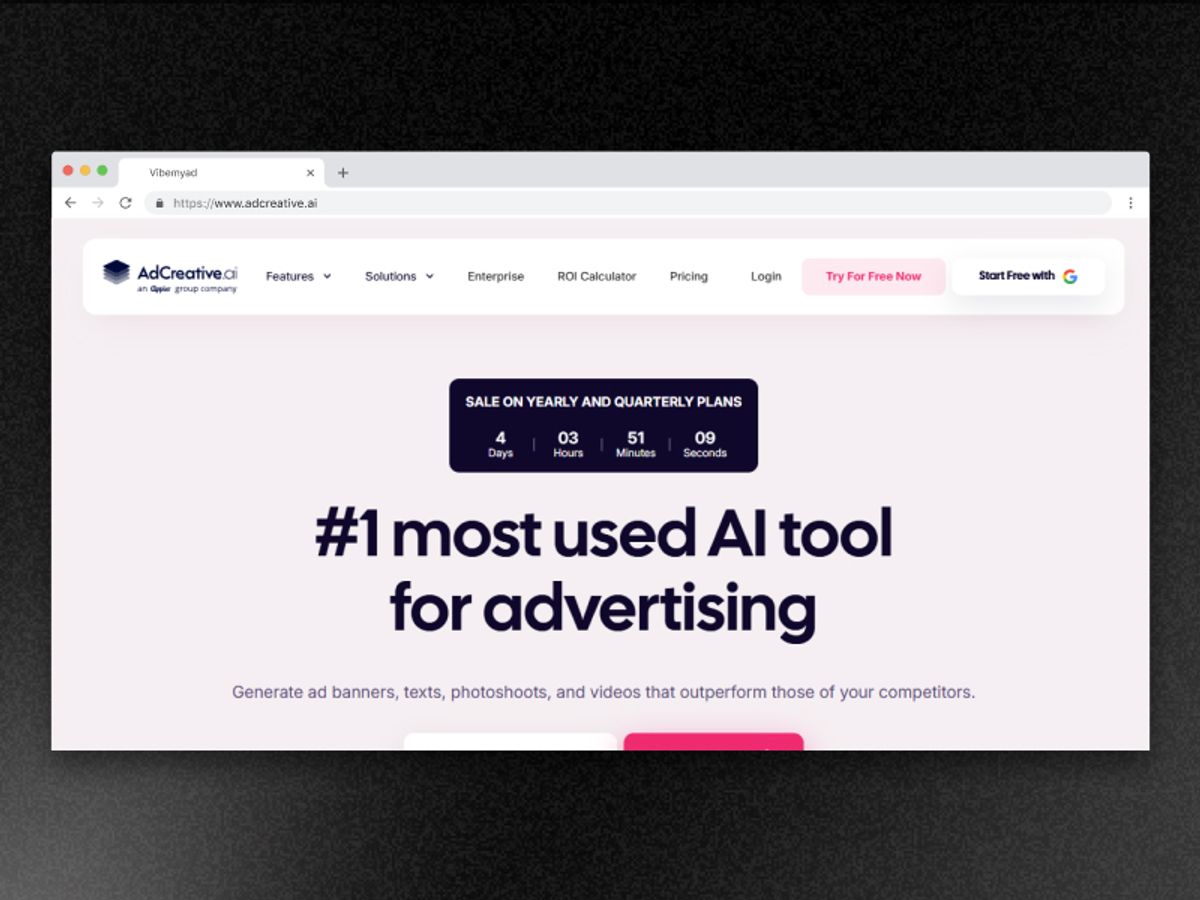
AdCreative.ai is the established volume leader in the static AI ad generation space. The tool is built around fast variation generation, creative scoring, and rapid testing workflows. The output volume is high, and the creative scoring layer provides signal on which variations are worth launching before media budget is committed.
AdCreative.ai's strengths sit in variation throughput, creative scoring, and fast testing iteration. The static ad generation handles volume well, and the scoring layer is genuinely useful for teams running high-frequency A/B testing programmes that need to prioritise which variations receive spend.
Several practitioner reviews note template fatigue setting in over time, with outputs becoming visually repetitive across categories. The core architecture is prompt-and-template based, which means the convergence problem covered in the criteria section applies here. AdCreative.ai sits structurally in the creative generation layer rather than the intelligence-first layer, so brief quality depends on what the user inputs rather than on validated competitor signals.
Segwise
Best for: Performance marketers who want intelligence-led analytics and creative insights on the same surface.
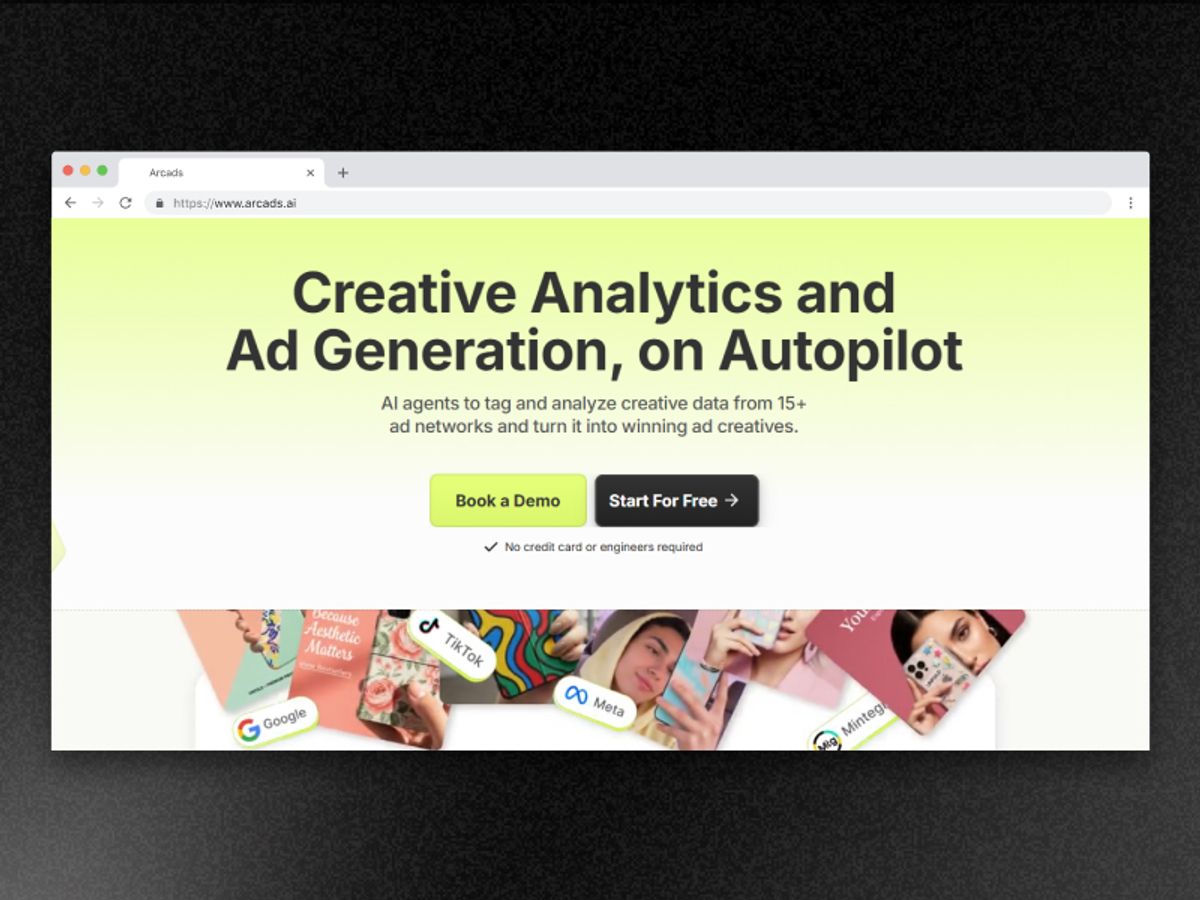
Segwise sits in the intelligence-first layer alongside Vibemyad, with different emphases. The platform leans toward analytics depth and creative insight reporting, surfacing performance patterns from the broader Meta creative landscape and translating those into briefs for generation workflows.
Segwise's primary strengths are the analytics depth and reporting layer. It takes an intelligence-led approach to creative briefs and is built around performance-focused workflow logic, making it the right choice when analytics surface area is the top criterion.
The generation side has less agentic depth than Vibemyad's pipeline architecture. Brand book persistence and continuous competitor tracking via dedicated brand-specific syncing are implemented differently. Segwise is best evaluated alongside Vibemyad rather than against the volume tools, and the choice between the two typically comes down to whether a team prioritises analytics surface area or agentic generation depth.
Quickads
Best for: Rapid prompt-based generation when speed is the only metric that matters.
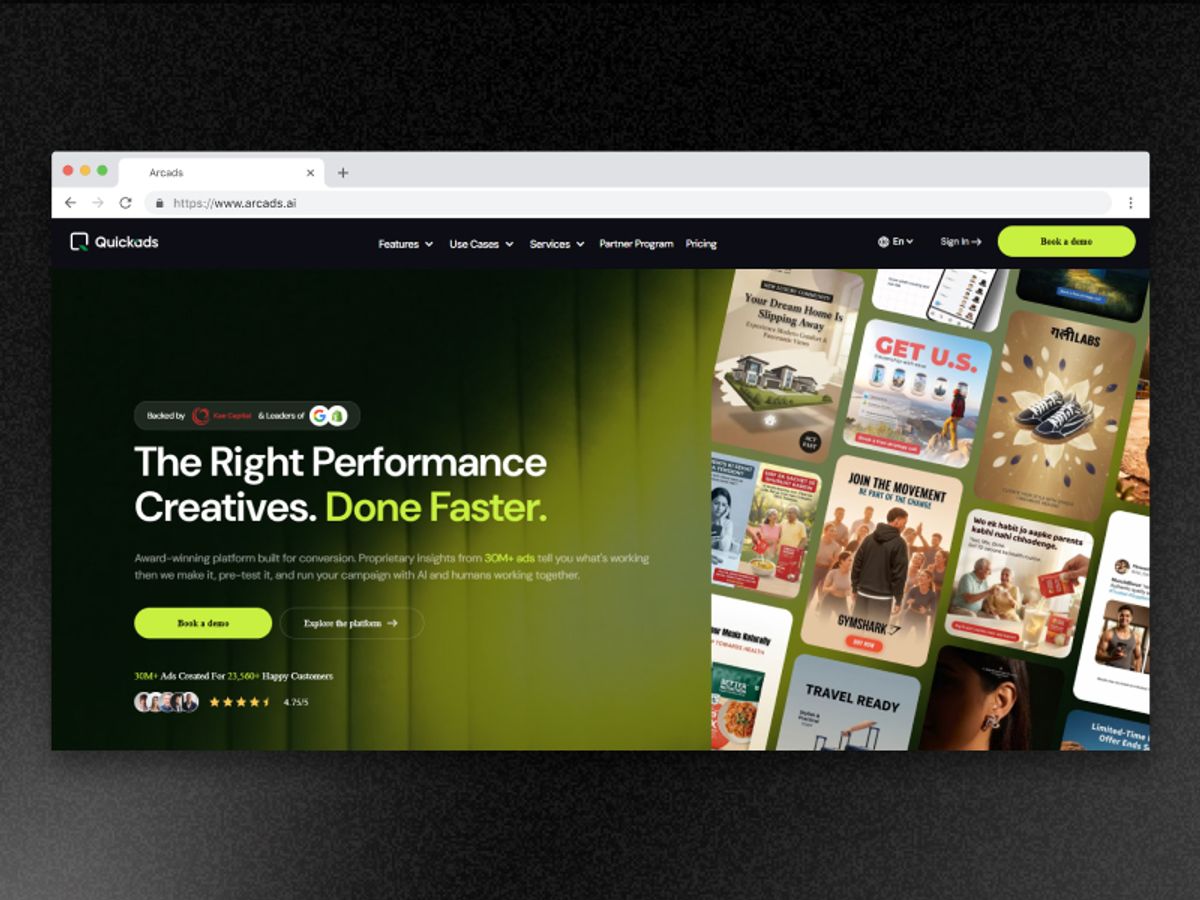
QuickAds.ai is built for speed. The interface is stripped down, the prompt-to-output cycle is fast, and the tool minimises setup friction for teams that need a creative in the next 60 seconds and have already done the strategic thinking elsewhere.
QuickAds.ai's strengths are speed, simplicity, and low onboarding friction. For teams that need a Meta creative immediately and have validated their creative direction through a separate intelligence layer, it delivers on that narrow promise without setup overhead.
The architecture is prompt-first, which means the convergence problem documented in the criteria section applies in full. There is no continuous competitor tracking, no agentic refinement loop, and no persistent brand book layer. This is a creative generation tool in the 2024 sense, repackaged for 2026 speed expectations. It does not address the brief quality problem that Andromeda has made the primary performance lever.
Creatify
Best for: Video-first brands and Reels-heavy advertising programmes.
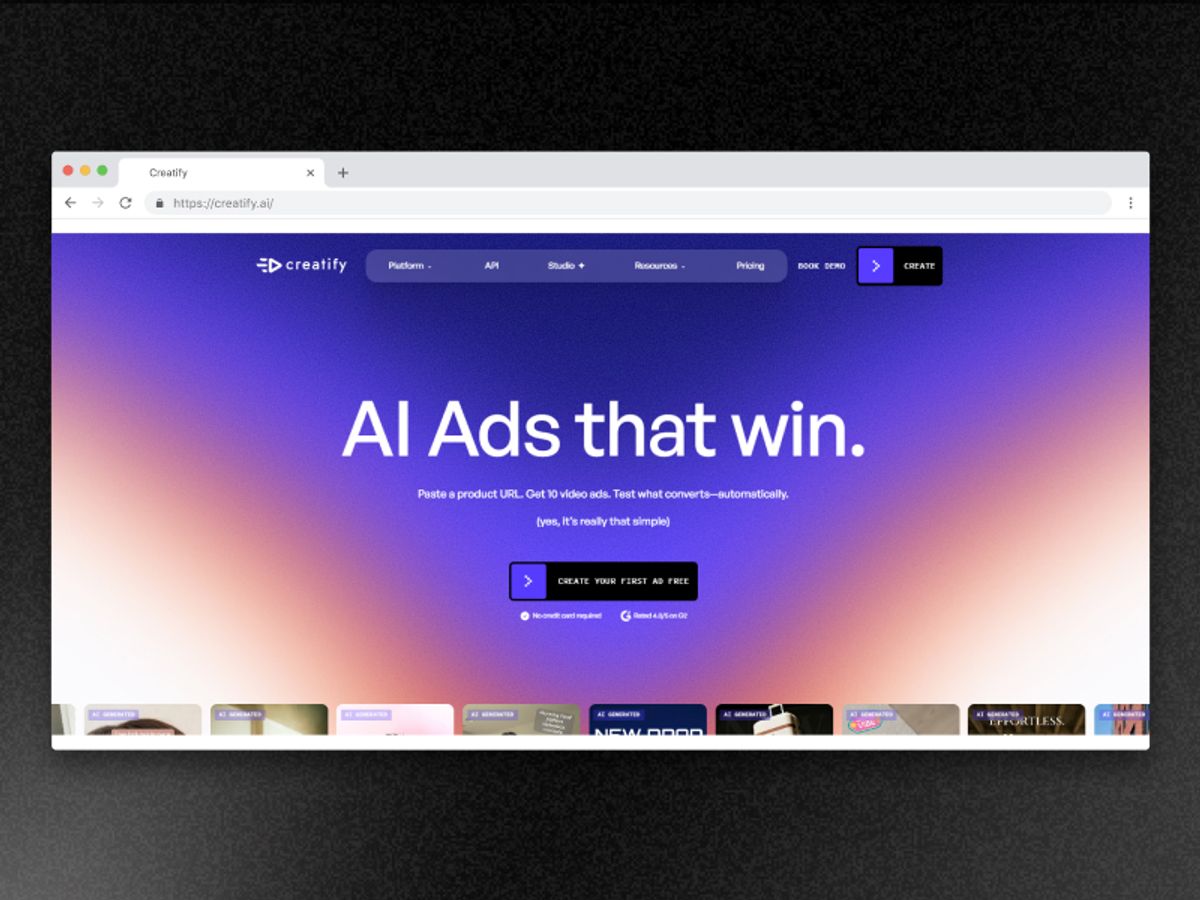
Creatify is the most differentiated tool on this list because it is the only one optimised primarily for video rather than static. The platform's core strengths sit in URL-to-video generation, AI avatar workflows, and hook testing for video creatives.
Creatify's strengths are concentrated in video: AI UGC generation, AI avatar workflows, URL-to-video production, fast video iteration, and hook testing for video creatives. For brands running Reels-heavy programmes, this is the deepest video-specific capability in the comparison.
The tool is less suited for static-heavy advertisers. The intelligence layer is lighter than Vibemyad or Segwise. Creatify is best paired with a separate static-focused tool rather than treated as a single-tool solution for a Meta programme running both static and video creative.
Most AI ad generators in 2026 are still solving the 2024 problem. They optimise for production speed, variation volume, and template breadth. The 2024 bottleneck was creative production. The 2026 bottleneck is creative differentiation under Andromeda.
Tools that ship convergent output, regardless of how fast or how high-volume, are not just commercially weaker. They are algorithmically disadvantaged. The CPM is the same. The conversion rate is not.
Meta's Andromeda delivery system actively rewards differentiated creative as a ranking signal and penalises convergence at the delivery layer. The brands winning on Meta in 2026 are not the ones with the fastest AI generators. They are the ones with the most differentiated creative output, generated from briefs grounded in market evidence rather than internal assumption.
Speed and volume are entry-level capabilities now. Brief quality is the only durable advantage.
A generation architecture where the AI tool runs as a conversational agent that holds context across iterations, supports refinement loops without re-briefing, and routes between research and creation automatically based on user intent. The opposite is template-based or one-shot generation, where each output is independent and context does not persist.
The tendency for AI-generated ads from different tools and brands in the same category to look structurally similar. Caused by structurally similar briefs being fed to similar foundation models. Creative convergence is penalised by Meta's Andromeda algorithm at the delivery layer.
Validated competitor signals like run duration data, hook patterns, creative archetypes are used as the starting point for an AI ad brief, rather than the brand's internal product knowledge. Market intelligence as a brief input produces structurally differentiated output where prompt-first generation produces convergent output.
A recurring structural pattern in advertising creative that signals category convention. Examples in the coffee category: Editorial Pack Shot, Origin/Ritual Frame, Benefit Stack, UGC/Lifestyle Integration. Identifying the archetypes a category audience has already validated is the foundation of intelligence-first ad generation.
The number of days an ad has been live on Meta. The primary publicly observable proxy for whether a competitor's ad is actually working, because brands stop running ads that lose money. Run duration is the load-bearing signal in market intelligence systems like Vibemyad Ad Vault.
Meta's algorithmic delivery system, rolled out across 2024 and 2025. Specifically rewards creative differentiation as a core ranking signal and penalises convergent creative at the delivery layer. Has compressed typical creative lifespans on Meta from 6 to 8 weeks (pre-2024) to 2 to 3 weeks (2026).
A tool architecture where brand-specific inputs (fonts, colours, voice, style) are stored once and persist across all subsequent generations and sessions. Eliminates per-ad re-input overhead and produces materially more consistent output at scale.
The AI Meta ad generator market split into three layers in 2026: creative generation tools (volume-first), intelligence-first platforms (research-first), and autonomous campaign systems (optimisation-first). Choosing the wrong layer for your use case is the most expensive structural mistake at Meta auction prices, regardless of how good any individual tool inside that layer is.
Six evaluation criteria separate strong AI Meta ad generators from weak ones: market intelligence versus prompt as the brief source, agentic versus template-based generation, continuous versus one-time competitor tracking, persistent versus per-session brand book inputs, iteration with versus without re-briefing, and Meta-specific versus multi-platform calibration. Score every tool on your shortlist against all six before deciding.
The brands winning Meta in 2026 are not the ones using the fastest generators. They are the ones using tools that produce the most differentiated creative, because Andromeda specifically rewards differentiation and penalises convergence. This shifts the tool selection criteria from production speed (the 2024 priority) to brief quality and structural differentiation (the 2026 priority).
Get notified when new insights, case studies, and trends go live — no clutter, just creativity.
Table of Contents


Arpita Mahato
Content Writer, Vibemyad

Arpita Mahato
Content Writer, Vibemyad

Arpita Mahato
Content Writer, Vibemyad