May 10, 2026 • 14 min read

May 10, 2026 • 14 min read
• A prompt is built from what you know. Market intelligence is built from what is already working. Those are not the same starting point and they do not produce the same output, regardless of which AI tool you use.
• The Vibemyad agent is fully agentic from research to design. You can search for what other brands are running, find the creatives that are winning, and remix them into your own - Meta ads, YouTube thumbnails, Instagram posts, LinkedIn banners, or any marketing collateral your team needs.
• The entire workflow happens in one conversation at Vibemyad agent. Search for inspiration, see what is winning in your category, pick a reference, and the agent builds your creative from there through conversation. No prompts, no templates, no separate tools.
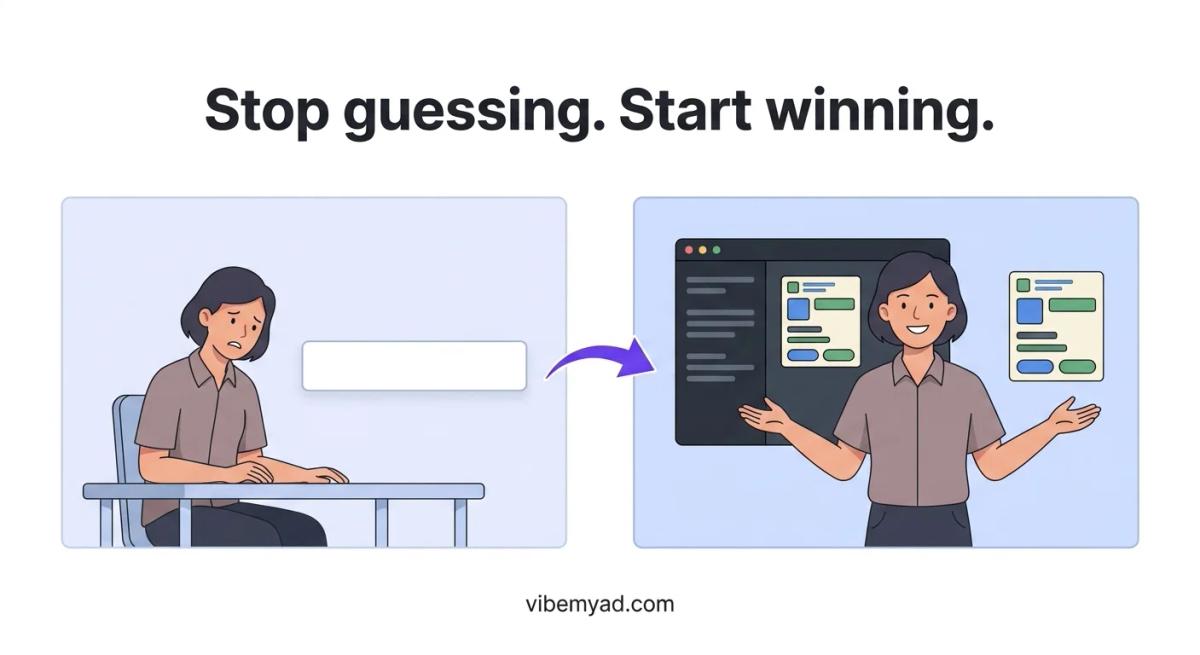
The difference between starting a marketing creative from a prompt versus starting from validated market intelligence.
You can generate a marketing creative from a prompt in under 60 seconds. You can also generate one from validated market intelligence in under 60 seconds. The outputs look similar on the surface. The thinking behind them is entirely different and on Meta, where audiences have been trained to scroll past anything that looks like what they have already seen, that difference is the performance gap.
This blog is about what separates those two approaches, why the starting point matters more than the tool, and how the Vibemyad agent runs the entire workflow - from finding what is winning in the market to producing finished creative without switching tabs, brief documents, or design tools.
A prompt is an instruction to an AI system built entirely from internal knowledge, what the brand knows about its product, what it assumes its audience wants, and what it believes makes its offer different. A creative brief built from market intelligence starts from the outside in: what competitors are spending behind, what creatives are sustaining performance, and where the gap in the competitive landscape currently sits.
Most marketers who have generated creative from a prompt at scale can describe the same experience. The brief felt solid. The output looked professional. The creative went live, spent budget, and produced nothing. They generated more variations from the same prompt. Same result. The instinct is to blame the AI. The actual problem is what the AI was given to work from.
When a marketer writes a prompt, they draw on everything they know about their product and their customer. That knowledge is real. The problem is that it is finite, internal, and untested against the actual market they are trying to reach. The market does not care what the brand knows about itself. The market has already voted with budget on which creative structures, which hooks, and which visual approaches it responds to. That vote is visible in run duration data across the competitive landscape. It is not visible inside the brand's own knowledge base.
The second problem is category convergence. Every brand in a given category has roughly the same internal knowledge about what their audience wants because the category defines the product attributes. Every D2C food brand knows they have clean ingredients. Every skincare brand knows they have an active ingredient story. Every fitness brand knows they have a transformation promise. When every brand in a category writes prompts from the same internal knowledge, they produce structurally similar output regardless of which AI tool they used. The audience has seen every version of this creative before and scrolls past all of them.
The third problem is the absence of a gap signal. A prompt tells the AI what the brand wants to say. It does not tell the AI which angles competitors have already exhausted, which formats are oversaturated in the category, or where the unclaimed position in the competitive creative landscape currently sits. Without that signal, the AI has no way to produce creative that is differentiated from the category rather than averaged from it.
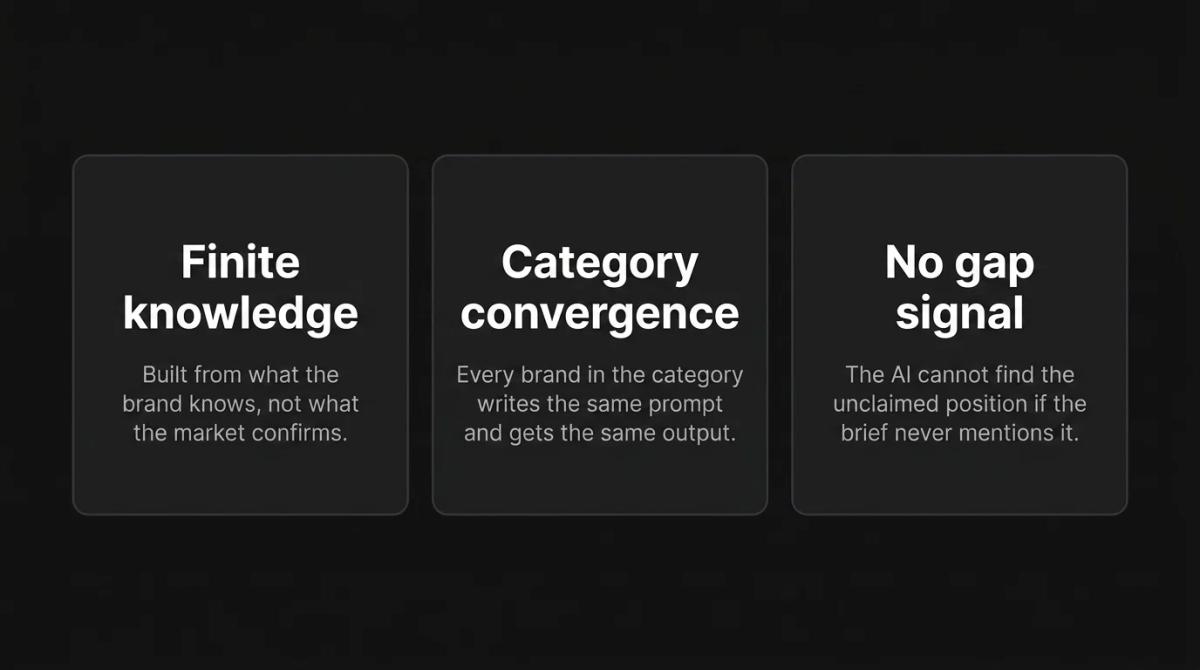
Three reasons why a prompt is not a creative brief for AI-generated marketing creative
Market intelligence in the context of AI creative generation is the set of validated signals derived from what competitors are actively spending behind right now. It is not a trend report, a customer survey, or a brand audit. It is evidence — specifically, which creatives have survived long enough on Meta to clear multiple internal budget review cycles at the brands running them.
The most important thing to understand about market intelligence for creative is that it is already publicly available. Every ad running on Meta is visible. What most brands cannot see without the right tool is how long those ads have been running and what that duration signals about performance.
Run duration is the signal that makes the difference. An ad that has been running on Meta for 30 days or more has cleared a specific kind of test that no internal brief can replicate. Someone at the brand running that ad looked at their performance data, weighed the cost of continuing to pay for impressions at Meta's auction prices, and decided the creative was still worth it. That decision gets made more than once across 30 days. Every time it gets made positively, the ad accumulates another layer of market validation. That validation is what a prompt cannot access and what market intelligence surfaces directly.
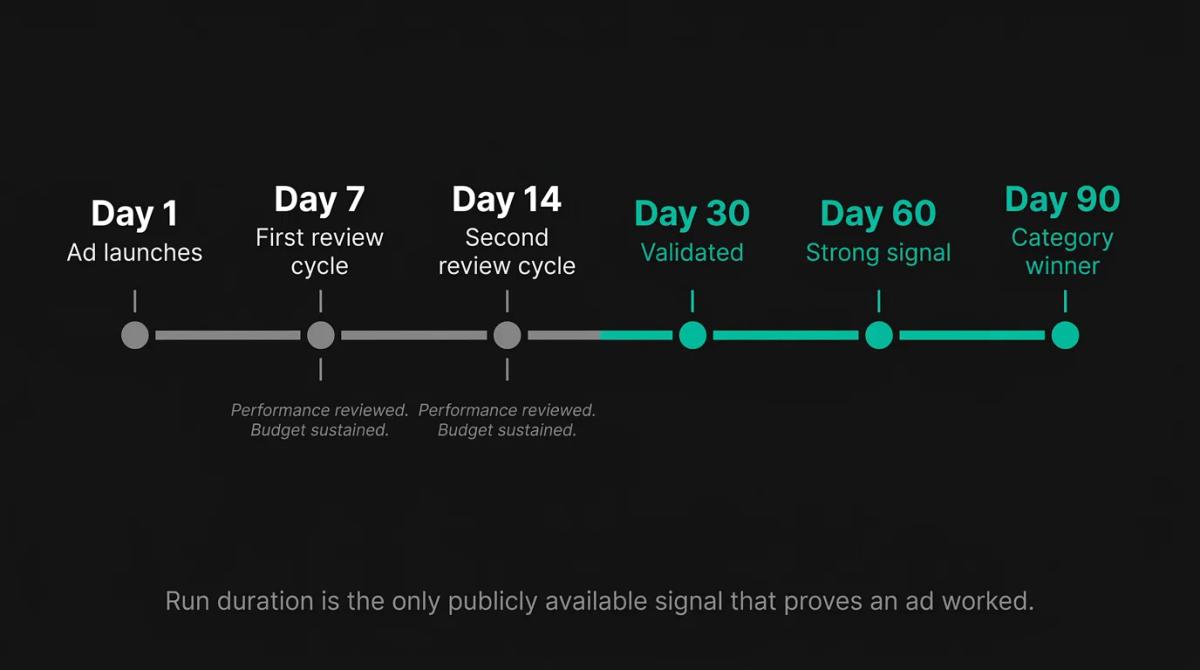
How run duration works as a market validation signal for Meta ads.
Run duration is what Vibemyad Ad Vault surfaces as a filterable, searchable signal across more than 10 million Meta ads. When you filter by your category and set run duration to 30 days or more, you are not looking at ads that looked good or got engagement. You are looking at ads that brands chose to keep paying for, repeatedly, after reviewing the numbers. That is market validation. That is what your creative brief should start from.
Beyond run duration, market intelligence includes funnel position data — where in the consideration journey a competitor is deploying a specific creative. It includes hook technique classification — which persuasion mechanisms are sustaining spend in your category right now. And through Vibemyad Ad Spider, which tracks up to 50 competitor brands simultaneously with weekly syncing, it includes a live record of which creatives competitors launched this week and which ones they quietly retired. That retirement signal matters as much as the run duration signal. When a brand pulls an ad, they are telling you something about what stopped working. That is intelligence too.
The gap between what competitors are sustaining and what none of them have claimed yet is the most valuable input any creative brief can have. A prompt cannot find that gap because a prompt does not know the competitive landscape. Market intelligence finds it because it is built from the landscape itself.
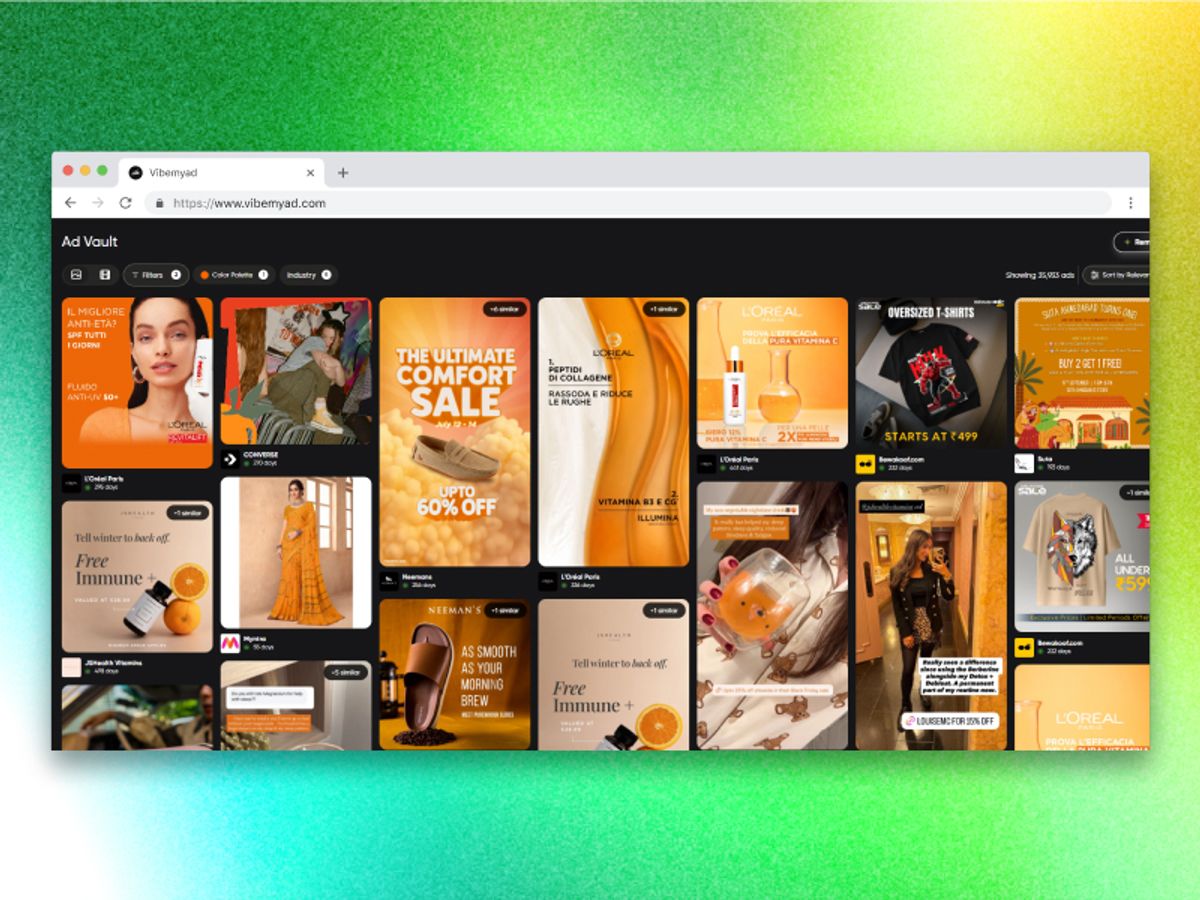
Vibemyad Ad Vault
The Vibemyad agent is a fully agentic creative intelligence system that runs from competitive research through to finished creative production in a single conversation at Vibemyad Agent. It operates across two modes - Research Mode for finding what is winning in the market, and Edit Mode for building creative from that foundation. The mode switches automatically based on what the user types. There is no manual mode selection and no separate brief document. The research and the build happen in the same conversation.
Most creative workflows have a gap between research and production. A team discovers what competitors are running, documents it somewhere, writes a brief from those findings, takes that brief to a designer or an AI tool, and produces the creative. Every handoff in that chain is a point where the intelligence gets diluted. By the time the brief reaches the generation stage, the validated signal from the research has been filtered through interpretation, assumption, and whatever the brief writer chose to include or leave out.
The Vibemyad agent closes that gap entirely. The research and the generation happen in the same conversation. What the agent finds in Research Mode feeds directly into what it builds in Edit Mode. Nothing is lost in translation because there is no translation step.
The session opens at Vibemyad Agent. The user types what they are looking for in plain language and the agent recognises the research intent and switches to Research Mode automatically. "Show me the best performing ads for plant-based food brands on Meta." "Find winning static ads in the premium coffee category." "What creatives have been running the longest for D2C snack brands right now." The agent searches Vibemyad Ad Vault and surfaces matching reference creatives with run duration data attached. These are real creatives that have been running with real budget behind them. The user reviews the results and selects the reference that best matches the creative direction they want to build from.
Once the user shifts from research to creation, the agent recognises the intent and moves into Edit Mode automatically. The user describes what they want - the product, the angle, the format, the mood and the agent generates creative concepts through conversation. The user refines, approves, or redirects through the same chat. When the direction is confirmed, the agent builds the creative in layers: base image first, then the hero element such as the product or model, then props and background, then copy. The agent reviews its own output at each step and retries automatically if something does not pass internal review. Only output that clears the agent's own quality check is shown.
Because the mode switches automatically, the conversation feels continuous. A user can move from "show me what competitors are running" to "now build me something inspired by that reference" without changing tools, opening a new session, or rewriting a brief. The agent holds the context and moves with the user.
How to add a Brandbook in Vibemyad
The brand book is added directly inside the agent before any generation begins. It contains the brand's logos, fonts, colours, and design guidelines. The agent draws on the brand book actively while building every layer of every creative not as a finishing filter applied after the fact, but as a design input baked into the generation itself. Every output looks like it came from the brand regardless of what format is being produced or which reference the creative was built from.
A prompt-first brief and a market intelligence-first brief can produce finished creative in the same amount of time using the same AI system. The difference is not speed or output quality at the surface level. It is structural — one is built from what the brand assumes, the other is built from what the market has already confirmed.
The brand is Soulcore, a D2C plant-based snack bar entering a crowded health food market on Meta. The marketing manager has one brief: create a Meta static ad for the new launch. Two approaches. Same brand. Same product. Same budget. Different starting points.
The marketing manager opens the Vibemyad Agent and types a detailed prompt directly into Edit Mode:
"Create a Meta static ad for Soulcore plant-based protein bars. Target health-conscious adults aged 25 to 35. Key messages: 20g of plant protein per bar, no artificial ingredients, available in five flavours. Clean modern look. Strong call to action to shop now."
The agent generates in under 60 seconds. The output arrives looking professional. Product centred and well lit. Headline: "20g Plant Protein. Zero Compromise." Subtext covers the five flavours. CTA says Shop Now. The brand book keeps Soulcore fonts and colours consistent throughout.
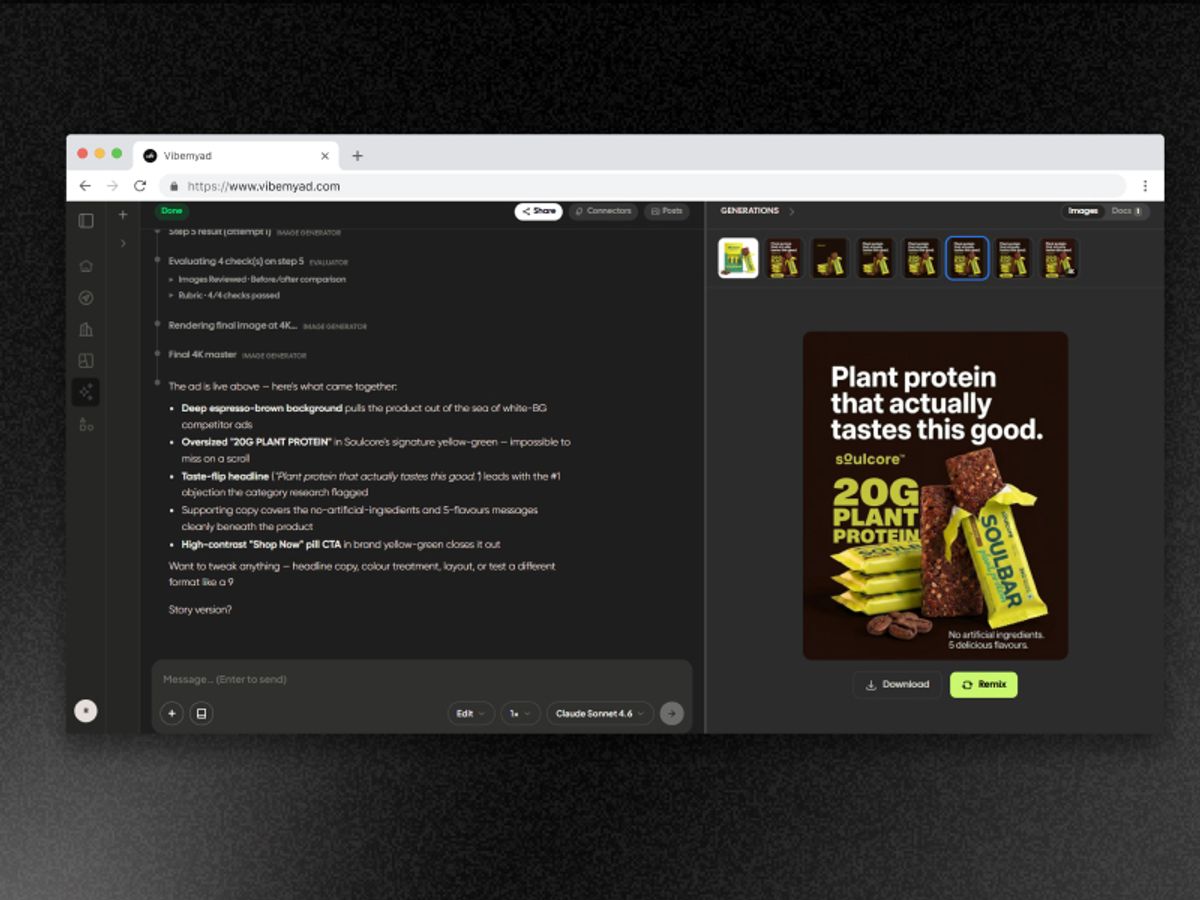
A prompt-generated Meta ad for Soulcore - clean, professional, and structurally identical to competitor output
The ad is technically correct. On-brand. Answers the brief completely. And it is nearly identical in structure to what every other plant-based snack brand on Meta is running right now. The 20g protein claim. The no-compromise language. The clean minimal aesthetic. These are the default outputs of internal briefs in this category because these are the things every brand in this category knows about their product. The audience has seen this ad before - not from Soulcore specifically, but from the twelve other brands that built the same prompt from the same internal knowledge and produced the same output with different logos.
The same marketing manager opens the Vibemyad Agent. This time they type: "Show me the best performing ads for plant-based and health food snack brands on Meta."
The agent recognises the research intent, switches to Research Mode automatically, and searches Vibemyad Ad Vault. A grid of reference ads surfaces with run duration data attached. Among the results, one stands out. A brand has been running a real customer testimonial format for 94 days across 11 active variants. It does not look like a protein bar ad. It looks like a screenshot of a real DM. The text reads like something a customer actually sent. The product appears almost as an afterthought. No hero shot. No clean typography. Just a real person's specific reaction to a specific result.
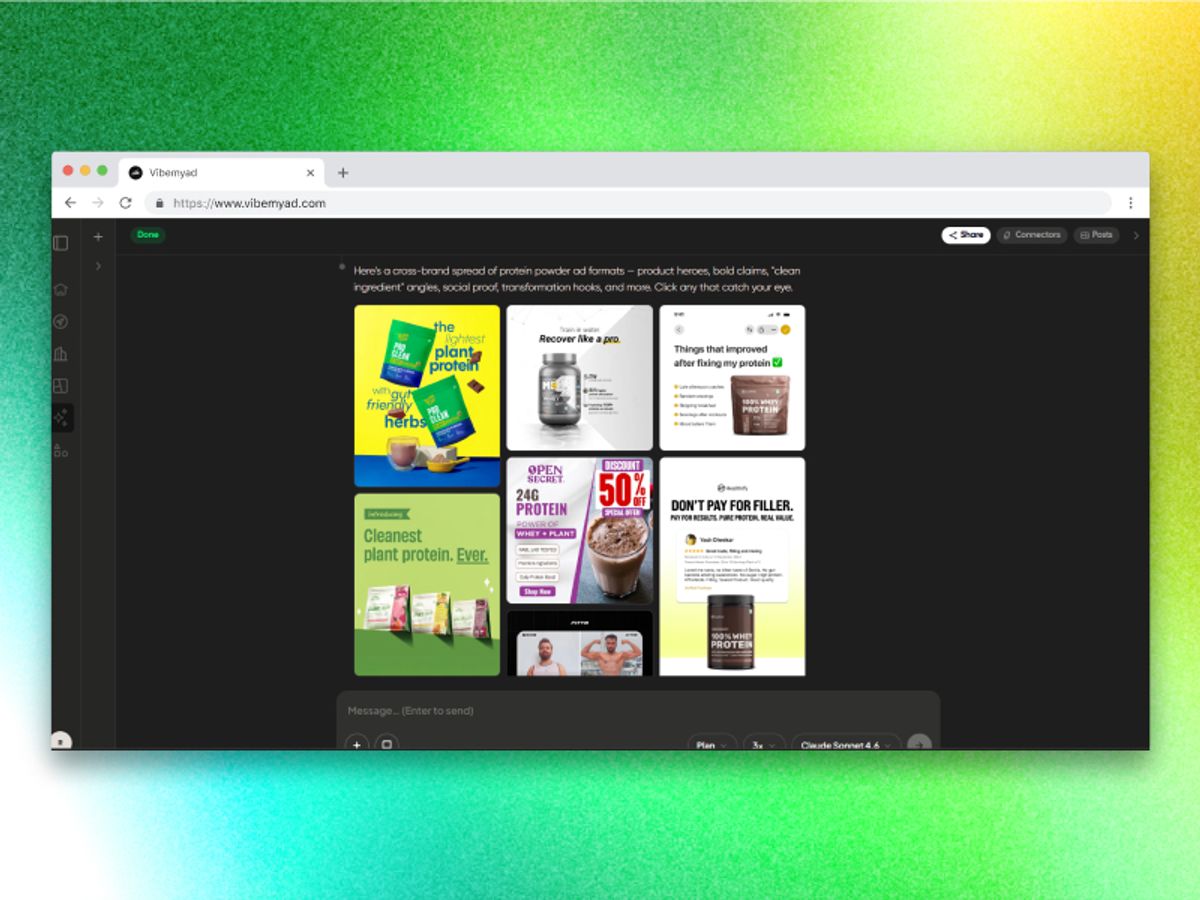
Research Mode in the Vibemyad Agent surfacing winning competitor reference ads for a plant-based snack brand category search
The marketing manager selects the testimonial reference. The agent holds the context. The manager types: "Build something inspired by this for Soulcore. Our customer is a busy millennial who has tried every protein bar and always goes back to something processed."
The agent recognises the creative intent, switches to Edit Mode automatically, and begins. It generates a concept: a real customer quote format, screenshot aesthetic, product held naturally rather than staged. The manager responds: "Love this direction. Go ahead." The agent builds in layers - base image, hero element with the Soulcore bar held in a real hand, background props giving a kitchen-counter feel, copy layer adding the customer text: "I have tried every protein bar on the market. Soulcore is the only one I actually finish." The brand book keeps the fonts, colours, and logo consistent throughout. The mode never needed to be switched manually. The conversation guided the entire build.
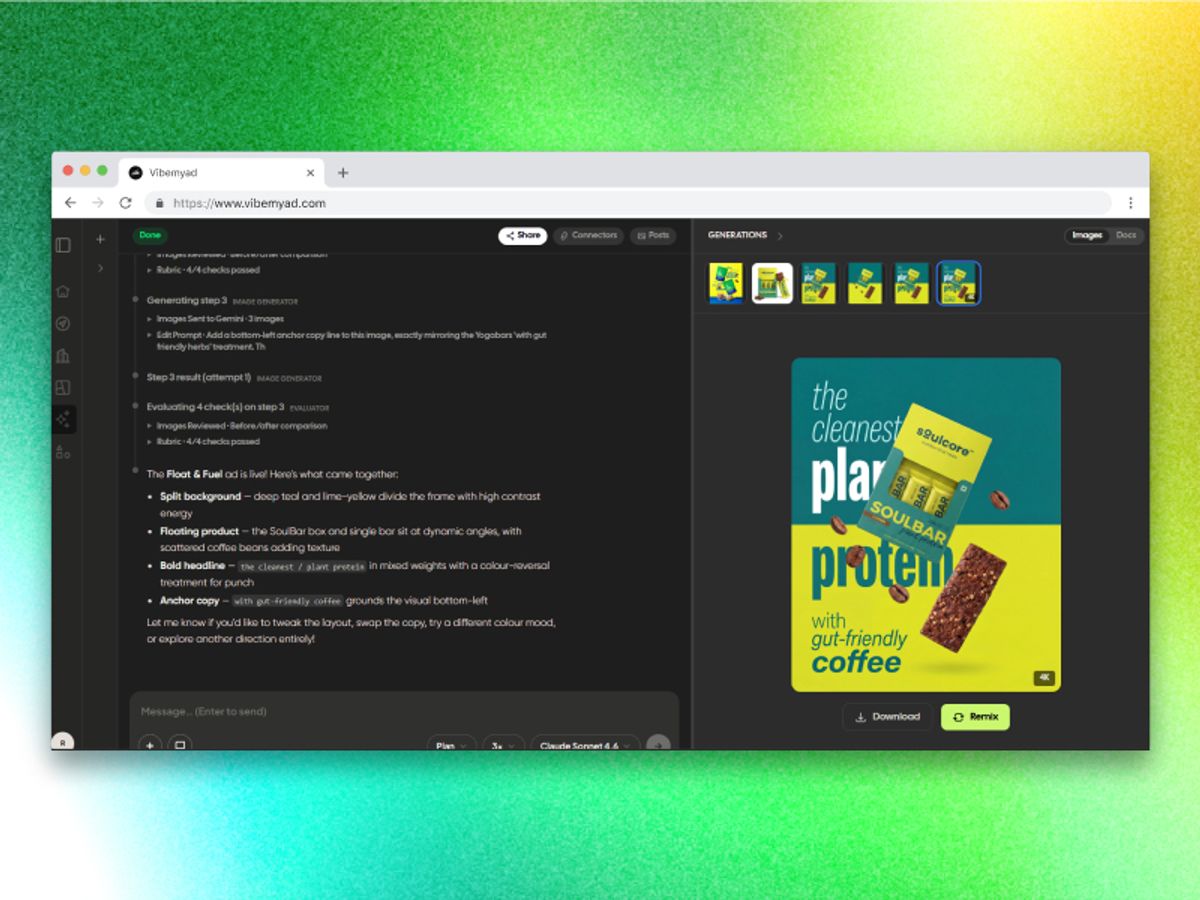
A market intelligence-generated Meta ad for Soulcore built from a validated competitor reference
The Soulcore prompt-generated ad is not a bad ad. A competent designer could have produced something similar from the same brief. The problem is not the output. It is the brief. "20g plant protein, clean modern look, strong CTA" is a description of what the brand wants to communicate. It tells the AI nothing about what the Meta audience in this category responds to with sustained budget.
The intelligence-generated ad is not just a different aesthetic. It is a different structural argument. It does not tell the audience that Soulcore has 20g of protein. It shows the audience a person who already tried the product and chose to keep buying it. Those are different claims. One is what the brand says about itself. The other is what a customer confirms with their own words.
The market validated the testimonial structure in this category across 94 days and 11 variants before Soulcore's marketing manager found it in the Vibemyad Agent. That validation cost the competitor 94 days of Meta budget. It cost Soulcore a search.
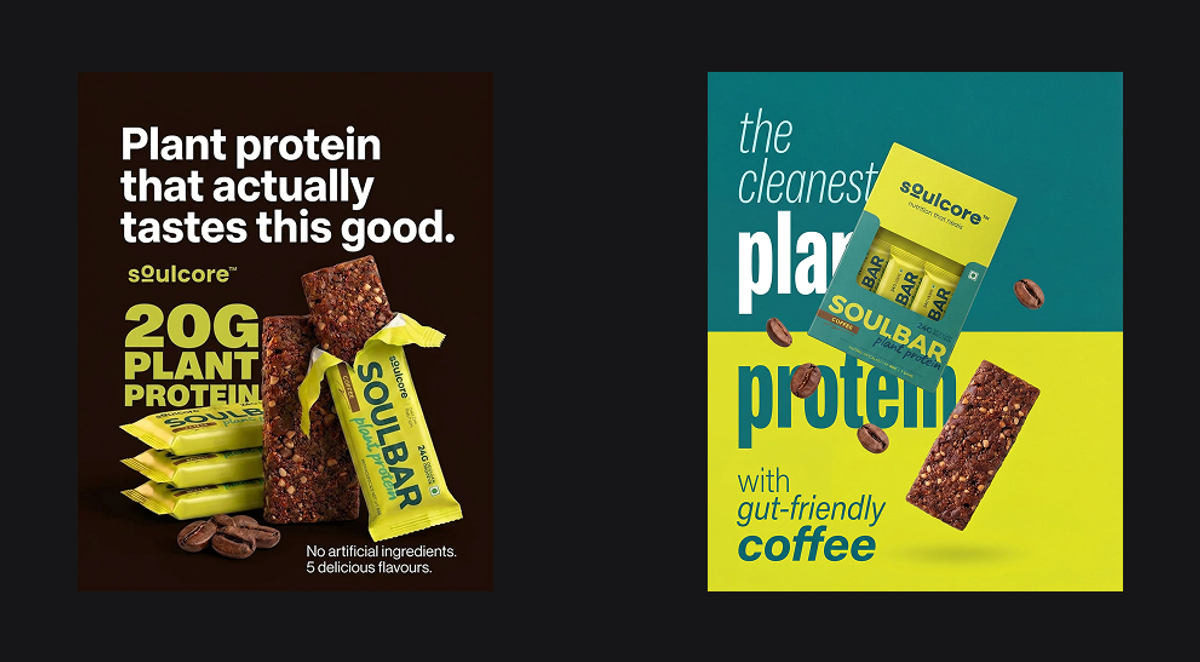
Side by side comparison of a prompt-generated Meta ad versus a market intelligence-generated Meta ad for Soulcore
A prompt is not a creative brief. It is an internal assumption built from what the brand knows about its product and what it believes its audience wants. On Meta, where every other brand in the category is feeding the same internal knowledge into the same AI tools, a prompt-first approach produces creative that looks finished and performs like a guess. The fix is not a better prompt. It is a better starting point.
Market intelligence is the starting point that changes everything downstream. Run duration is the signal that makes it actionable - an ad running for 30 or more days on Meta has cleared multiple internal budget review cycles at the brand behind it. Someone looked at the performance data and decided the creative was still worth paying for. That decision, made repeatedly across weeks of sustained spend, is the closest publicly available proxy for real performance data. Vibemyad Ad Vault surfaces this signal as a filterable, searchable input across more than 10 million Meta ads. It is the difference between starting from what you assume and starting from what the market has already confirmed.
The Vibemyad Agent runs the entire workflow from finding what is winning in your category to producing finished creative in a single conversation. Research Mode finds the validated reference. Edit Mode builds from it. The mode switches automatically based on what you type. The brand book keeps every output on-brand. And the output is not limited to Meta ads. Any marketing collateral your team needs be it YouTube thumbnails, Instagram posts, LinkedIn banners, blog images comes from the same session, the same brand book, and the same market intelligence.
Get notified when new insights, case studies, and trends go live — no clutter, just creativity.
Table of Contents


Rahul Mondal
Product, Design and Co-founder, Vibemyad


Arpita Mahato
Content Writer, Vibemyad

Arpita Mahato
Content Writer, Vibemyad