March 03, 2026 • 7 min read

March 03, 2026 • 7 min read
Most marketers use Claude for writing emails or summarising documents. The teams pulling ahead are using it to understand what's winning in their advertising category before they spend a dollar.
Claude is unusually good at analysing advertising - not just generating it. That single distinction is what makes it the strongest AI model currently available for ad research tasks.
Most AI models are capable text generators. Ask them to write ad copy, produce headlines, or generate fifty CTA variations - they'll do it competently. But ask them to look at a competitor's ad library and explain the strategic decisions being made - which pain points are being foregrounded, which positioning angle the brand is committing to, whether the creative strategy has shifted and what that shift signals - and the quality of reasoning drops significantly.
Claude doesn't drop. Its analytical depth and ability to reason about language at a strategic level make it the right tool for the research work that happens before any creative gets made. Understanding what to build and why - that's where Claude is currently ahead of every other model available.
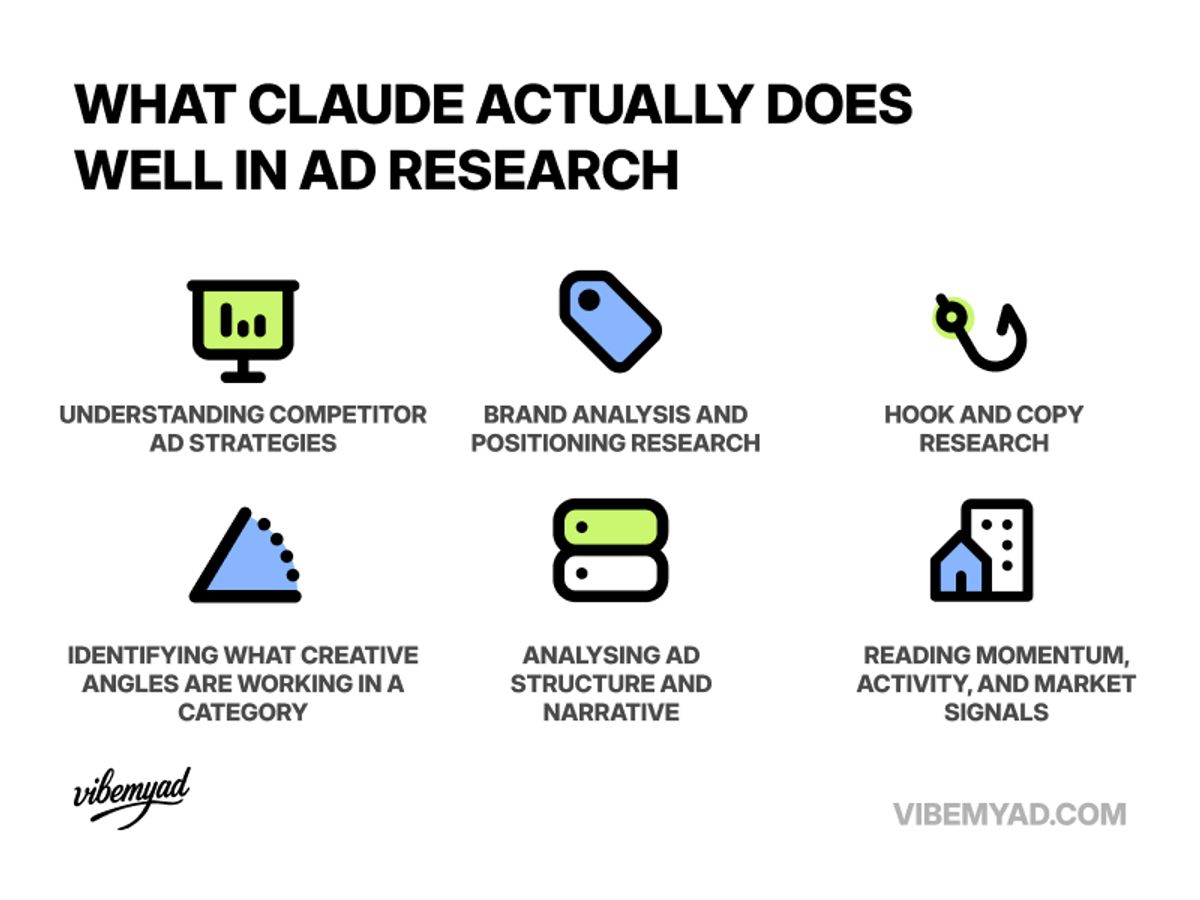
What Claude does in Ad Research
Give Claude a set of competitor ads and ask what strategic decisions are being made - and it surfaces things a human analyst might miss on a first pass.
Which customer pain points are being foregrounded. Which are being deliberately avoided. Whether the brand is positioning on price, quality, identity, or outcome. Whether the creative strategy shows signs of shifting - and what that shift suggests about what stopped performing.
Claude reads advertising the way a strategist reads it. Not as content. As a set of deliberate choices that can be decoded, understood, and responded to.
Understanding how a brand positions itself across its entire advertising output - not one ad, but the pattern across many - requires holding a large amount of information simultaneously and reasoning about what it means.
Claude's context window and reasoning capability make it strong here. Feed it a brand's ad history and it identifies the consistent positioning thread, spots where different angles have been tested, and flags where the strategy is shifting. Brand-level analysis that used to take a senior strategist several hours. Claude does it in minutes with the kind of precision that feeds directly into strategic decisions.
The hook is the most commercially important element in any ad. It determines whether the first three seconds earns the next thirty.
Claude is strong at identifying hook structures - the underlying formula being used, not just the surface copy. "Fear of missing out, plus social proof, plus specific outcome" is a hook structure. Claude identifies when a competitor is using it, explains why it works for that audience, and helps you understand whether the same structure transfers to your product and category.
This is different from generating hooks, which most capable models can do. It is understanding why specific hooks work in specific contexts. That analytical capability is where Claude stands apart.
Which creative angles appear repeatedly across multiple advertisers. Which formats are being tested and scaled. Where the category is converging and where genuine whitespace exists.
When the question is "what is the category doing right now and why" - Claude is the right model to answer it. Pattern recognition across a large set of ads, with the reasoning to explain what the patterns mean, not just what they are.
Every effective ad has a structure underneath the creative. Problem-solution. Before-after. Testimonial with specific proof point. Demonstration with outcome.
Claude deconstructs ad structure with precision - the narrative architecture, the persuasion logic, what the ad asks the reader to do and how it earns that ask. This is research that becomes immediately usable. Not interesting analysis sitting in a document. Structural understanding that tells your creative team exactly what to build.
Momentum signals show where a brand is in its creative lifecycle - scaling a concept, holding steady, or pulling back. Activity signals show how frequently a brand is publishing new creative and what that cadence suggests about their testing strategy. Market signals show whether a concept has earned real traction across the category - strong signal, high confidence - or whether it's one brand testing in isolation.
Being honest about this matters - because understanding Claude's limits is what determines when to use a different model.
The pattern is consistent: Claude is the strongest model currently available for analytical depth and strategic reasoning about advertising. It is not the right model for every task within an advertising workflow. And that distinction — knowing which tasks need Claude and which tasks need something else — is exactly what separates teams using AI strategically from teams defaulting to one model for everything.
Vibemyad's research infrastructure is built around one principle: use the best available model for each specific task.
For ad research - understanding competitor strategies, analysing brand positioning, identifying what creative angles are working in a category, deconstructing hook structures, reading momentum, activity, and market signals - Claude is currently the best model available. It is what Vibemyad uses for these tasks.
For visual creative generation - product replacement, scene generation, image variants - the best available image generation model is used instead. Currently that includes models from Google's Gemini family like Nano Banan 2 for tasks requiring world-grounded visual accuracy, and other specialised image models depending on what the specific output requires.
For high-volume copy generation where speed and output volume matter more than analytical depth — GPT-4o and other fast generation models handle this better.
The selection is automatic. When a user runs a research workflow in Vibemyad - analysing a competitor's ad strategy, identifying what's winning in their category, reading the signals on a tracked brand - Claude is doing that analysis. When the workflow moves to creative generation, the right image model takes over. The user doesn't choose the model. The system selects the best tool for each stage of the workflow.
This is a practical architecture decision, not a marketing position. One model for everything produces worse outputs than the right model for each task. The best advertising teams in 2026 are not loyal to one AI model. They are using whichever model produces the best result for the specific job in front of them.
Get notified when new insights, case studies, and trends go live — no clutter, just creativity.
Table of Contents


Rahul Mondal
Product, Design and Co-founder, Vibemyad


Arpita Mahato
Content Writer, Vibemyad

Arpita Mahato
Content Writer, Vibemyad