April 08, 2026 • 8 min read

April 08, 2026 • 8 min read
• AI ad generators have shifted from template-based output machines to intelligence-first systems that reverse-engineer what the market has already validated before a single creative is built.
• The gap between prompt-based and intelligence-first tools is measurable: intelligence-first platforms report hit rates of 24 percent versus 5 to 8 percent for template-based generators (Mckinsey).
• The quality of what comes out is entirely determined by the quality of what goes in. A validated competitor hook outperforms a generic prompt every time, with the same tool.
• Vibemyad Ad Gen turns validated competitor ad concepts into branded assets in seconds rather than weeks.
Most marketers using AI ad generators are producing more ads. The best ones are producing better briefs. There is a significant difference between those two outcomes, and it comes down to one decision made before any creative is built: what you feed the tool.
The shift is not about speed. It is about where creative decisions originate. Prompt-based AI starts from internal assumptions. Intelligence-first AI starts from market evidence: what competitors have spent money on, sustained, and scaled. The difference in starting point is what produces the 3x performance gap.
McKinsey estimates that generative AI could increase marketing productivity by 5 to 15 percent of total marketing spend, worth approximately $463 billion annually. For advertisers, that value shows up in testing velocity and the speed at which winning concepts reach the market, but only for teams feeding their tools the right inputs before a brief is written.
AI ad generators combine generative AI with data analytics to assemble platform-ready ad units from structured inputs. You provide seeds: product photos, brand voice guidelines, target goals, and audience data. The system synthesises these into hundreds of variations across formats and placements simultaneously. The workflow follows three stages.
• First, input and data ingestion: brand assets, campaign objectives, and contextual data are uploaded.
• Second, generative assembly: Natural Language Processing drafts headlines and body copy while diffusion models create or remix visual assets.
• Third, optimization and scaling: the system generates every required aspect ratio and ranks variations against historical performance data before any budget is spent.
The predictive scoring layer is where most AI ad generators overstate their capabilities. A confidence score built on data from other brands is a directional signal, not a guarantee. The most reliable performance signal still comes from market-validated competitor data: which ads in your category have sustained spend for three or more weeks.
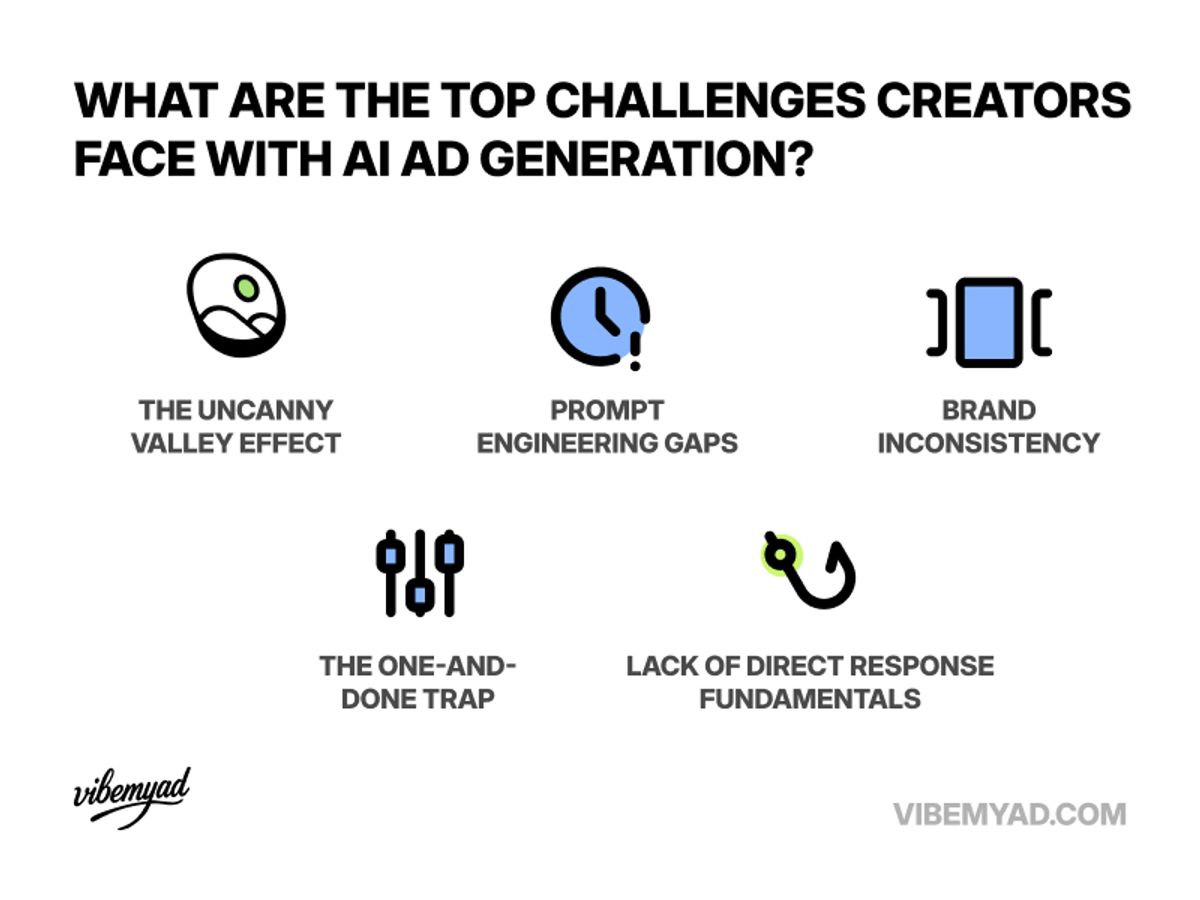
Challenged Creators Face while generating Ads
• The uncanny valley effect: AI images often look too perfect or too artificial, which triggers ad fatigue and lowers audience trust before a single word of copy is read.
• Prompt engineering gaps: Generic prompts produce generic output. "Cool shoe ad" gives you something that looks like every other shoe ad. The tool is only as specific as the input it receives.
• Brand inconsistency: AI tools frequently hallucinate colours, fonts, and product details that do not match actual brand guidelines, which erodes trust and creates compliance issues downstream.
• The one-and-done trap: First-time creators generate one ad, see it underperform, and conclude AI does not work. High-scale AI creative success requires testing hundreds of variations, not one. The tool is a testing engine, not a design shortcut.
• Lack of direct response fundamentals: Creators focus on visual polish instead of what actually drives conversion: hook clarity, scarcity signals, and a clear call to action. A beautiful ad with a weak hook will always lose to an average-looking ad with a proven one.
• AI copywriting generators focus on textual elements using large language models, matching a specific brand voice across headlines, captions, and calls to action.
• AI image and graphic generators create the visual hook of an ad, with capabilities including background removal, lifestyle scene generation, and product placement.
• AI video and avatar generators create motion content from text prompts without requiring film crews, including AI-generated spokespeople and automated video editing.
• All-in-one performance generators assemble copy, image, and layout into a data-backed ad with predictive scoring and bulk variation built in.
Vibemyad Ad Gen sits in this category, with one critical difference: where most all-in-one tools generate from prompts or historical performance databases, Vibemyad Ad Gen generates from live competitor intelligence, starting with what the market has already validated rather than what the user asks it to build.
• Start by defining the angle before opening any tool: problem and solution, social proof, or before and after.
• Generate the environment using a diffusion model to create a hyper-realistic lifestyle scene that matches your target demographic.
• Composite the real product into that scene with accurate lighting and shadows rather than having AI invent it.
• Layer copy by generating five variations of short, punchy headline options and overlaying the strongest using high-readability typography.
• Then run a low-budget creative sandbox campaign to identify which visual gets the lowest CPC before scaling.
The sequence matters. Most creators start at step two. The ones producing the best AI ad creatives start at step one and treat every subsequent step as a way to test the angle, not express a preference.
• Start by defining the angle before opening any tool: problem and solution, social proof, or before and after.
• Generate the environment using a diffusion model to create a hyper-realistic lifestyle scene that matches your target demographic.
• Composite the real product into that scene with accurate lighting and shadows rather than having AI invent it.
• Layer copy by generating five variations of short, punchy headline options and overlaying the strongest using high-readability typography.
• Then run a low-budget creative sandbox campaign to identify which visual gets the lowest CPC before scaling.
The sequence matters. Most creators start at step two. The ones producing the best AI ad creatives start at step one and treat every subsequent step as a way to test the angle, not express a preference.
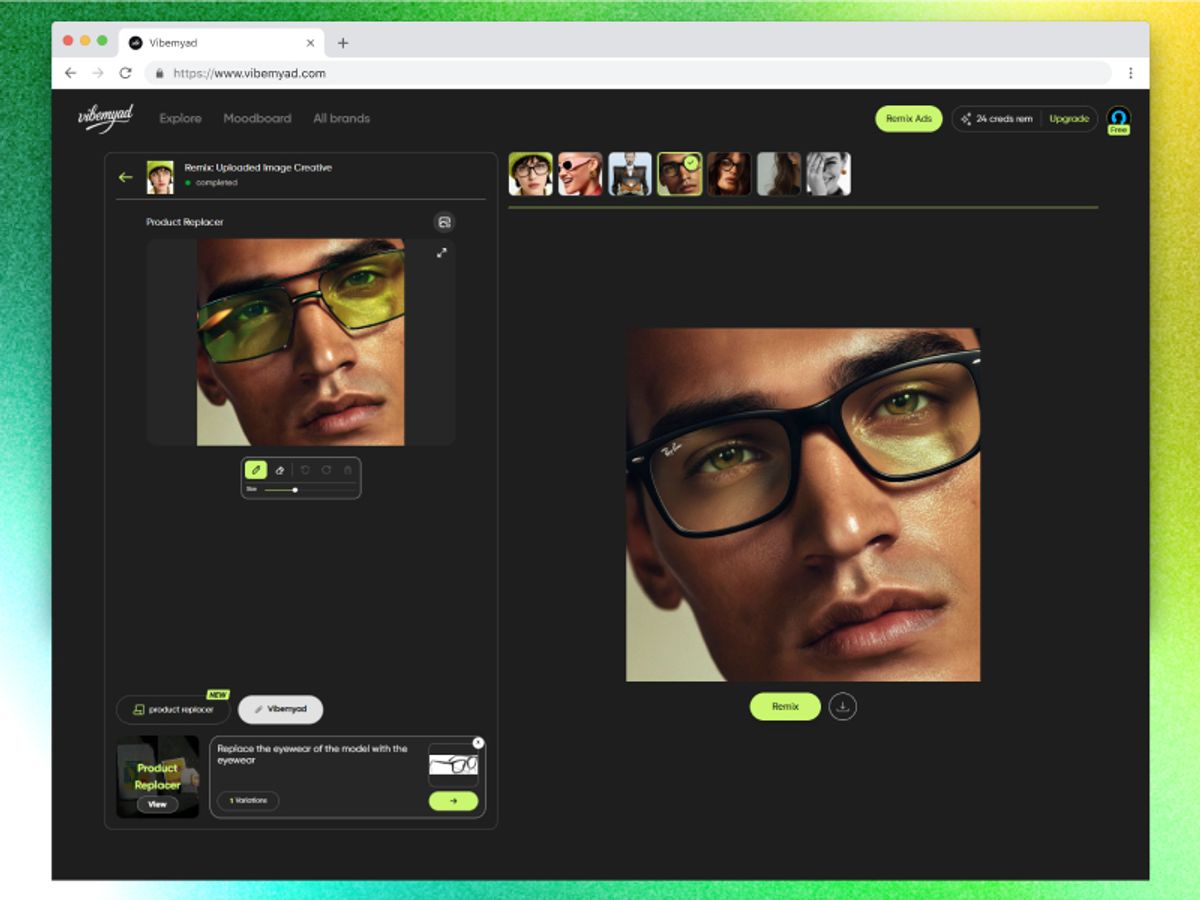
Vibemyad Ad Gen
Where enterprise tools like Typeface AI are built for Fortune 500 marketing teams with dedicated creative operations, Vibemyad is built for the solopreneur and small e-commerce brand where every test counts and wasted budget compounds fast.
• Vibemyad Ad Vault is a visual ad search engine featuring over 10 million ads pre-analysed by AI workflows.
• Vibemyad Ad Spider tracks up to 50 competitor brands simultaneously, identifying their winning hooks, top-performing ads, which content buckets they are targeting, and which audience segments they are actively spending behind.
• Vibemyad Ad Gen then takes any validated reference ad and transforms it into a branded version in under 60 seconds, without a designer, without a photoshoot, and without starting from a blank prompt.
The Vibemyad workflow runs in two phases, each feeding directly into the next. Unlike prompt-based AI ad generators that start from a blank brief, every phase here is grounded in what the market has already validated.
Vibemyad Ad Vault personalises search results to your brand context across 10 million+ pre-analysed ads, with filters covering ad groups, themes, and styles currently working in your category. This phase answers: what is actually working right now?
With validated intelligence from the first two phases, generation becomes the fastest and most reliable step. Vibemyad Ad Gen is an agentic creator that generates, analyses, and fixes in a loop. Brand book inputs ensure every output uses your exact fonts, styling, and brand voice.
Important: For teams that need to move fast: find an ad in Vibemyad Ad Vault running for 30 or more days, and remix it in Vibemyad Ad Gen. This skips the concepting phase entirely.
• The performance gap between AI ad teams is no longer about who has the best design tool. It is about who feeds the best intelligence into their generation process before a single brief is written.
• Template-based generators and intelligence-first tools are not the same category despite sharing the same label. One produces ads faster. The other produces ads that start from a validated market position.
• The 24 percent versus 5 to 8 percent hit rate gap is the difference between a creative process that compounds over time and one that stays expensive regardless of how much AI is added.
• The most durable advantage in 2026 is not better generation technology, it is better pre-generation intelligence.
Get notified when new insights, case studies, and trends go live — no clutter, just creativity.
Table of Contents


Rahul Mondal
Product, Design and Co-founder, Vibemyad


Arpita Mahato
Content Writer, Vibemyad

Arpita Mahato
Content Writer, Vibemyad