April 07, 2026 • 9 min read

April 07, 2026 • 9 min read
• Most brands generate Facebook ads from templates and hope something works — this approach wastes the majority of testing budgets
• Meta's Facebook Ads Library shows you what competitors are running but not what is actually working
• The 60-day rule: if a competitor's ad is still running after 60 days, it is working — that is your validation signal
• Vibemyad Ad Vault captures and organises competitor ads automatically, Vibemyad Ad Spider identifies which ones are validated, Vibemyad Ad Gen remixes validated concepts into your brand in seconds
• Intelligence-first creative generation consistently outperforms template-first because you start with concepts the market has already proven
Your competitor's Facebook ad has been running for 87 days. That duration alone tells you the concept is working — they would not keep spending on it otherwise. While you brief a designer to start from scratch, that validated concept is sitting in plain sight. Here is how to use competitor data to generate Facebook ad creatives instead of guessing.
Most brands generate Facebook ads by starting from scratch with templates, and this approach wastes 60% of testing budgets.
When asked "how to generate Facebook ad creatives using AI", most marketers describe the same process: Brief the designer, the AI ad generator creates from scratch using templates, test 50 variations, and hope 3-4 work. This template-first approach delivers 6-8% success rates and costs $3,000-$5,000 per winning ad.
Gartner's 2025 CMO Spend Survey found 71% of performance marketers plan to increase AI tool spending in 2026, but the highest ROI comes from tools that validate concepts through competitor data before creation, not from tools that simply generate faster from generic templates.
The problem? This ignores what 74K monthly searches for "Facebook ads library" are telling us. Marketers know competitor intelligence matters for creating engaging ad content, but they just don't know how to create Facebook ads using competitor data. They browse Meta's tool, screenshot ads, then ask their AI ad generator to "create something similar" from scratch. The validation data (ad duration, consistency) gets completely ignored.
The best AI ad creator isn't the one generating the prettiest templates. It's the one that starts with market validation. Every Facebook ad your competitor runs for 60+ days represents thousands of dollars, proving a concept works.
Meta Ad Library
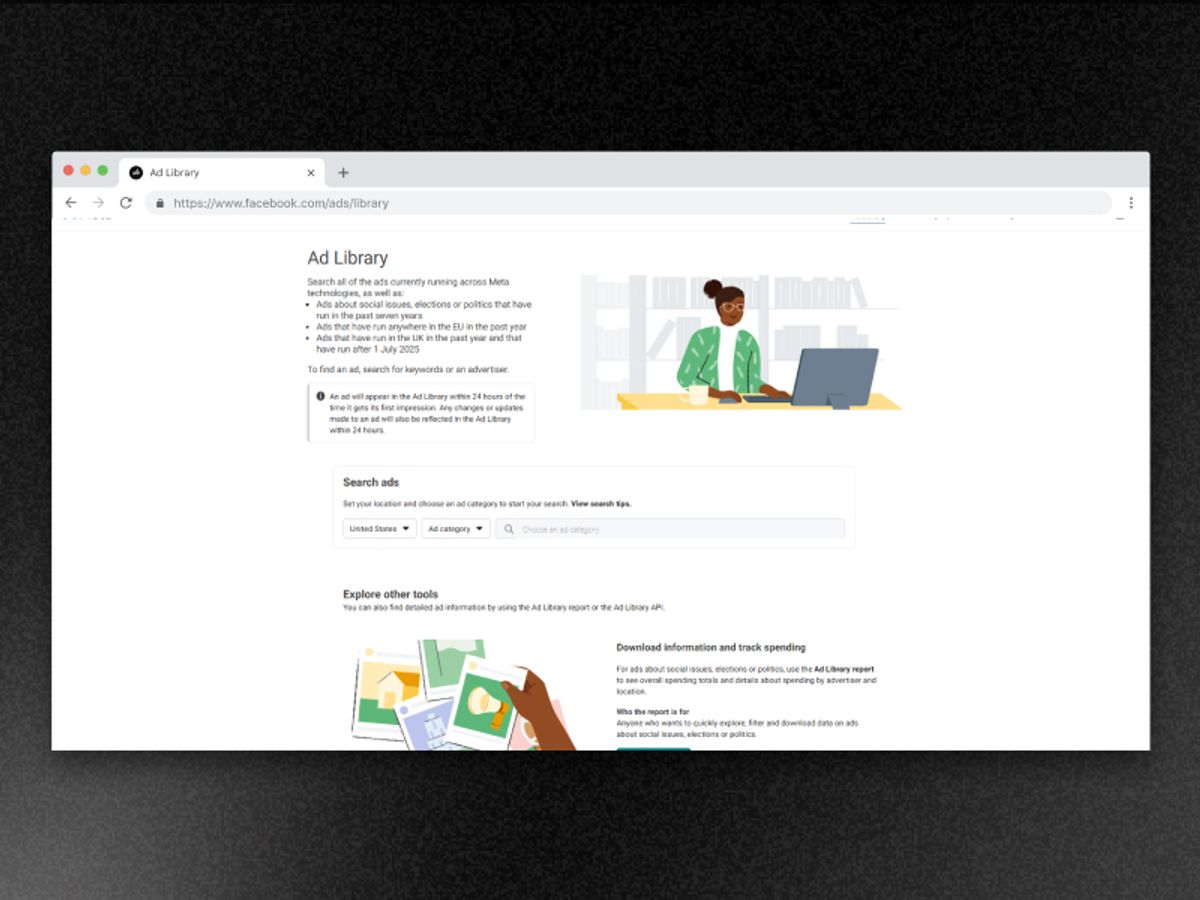
Meta's Facebook Ads Library is a free, publicly accessible database that shows every active ad running across Meta's platforms (Facebook, Instagram, Messenger).
Launched for transparency, the Facebook ads library allows anyone to search for any advertiser by name and see their currently running ads. With 74K monthly searches, it's become the go-to starting point for marketers conducting competitor analysis on Facebook ads.
You can access it at facebook.com/ads/library. Search any brand name, filter by country and ad category, and instantly see their active advertising campaigns. No login required, no cost, completely public. However, visibility doesn't equal intelligence. Seeing what's running is just the first step. Understanding what's actually working requires additional layers that Meta's Facebook ads library doesn't provide.
Meta's Facebook Ads Library shows you what competitors are running. It does not show you what is working, how much is being spent, or whether you are early or late to a concept.
What you can see: ad creative including images, videos, and copy; the date an ad started running; which platforms it is running on; and whether it is currently active or inactive.
What you cannot see is where the strategic gap lives. Actual spend data is completely hidden — you cannot tell whether an ad represents a small test or a heavily validated concept. Performance metrics like click-through rate, conversion rate, and return on ad spend are not available. Audience targeting is invisible. You cannot see the 40 variations a brand tested and killed before they found the one that stuck. And you have no way of knowing whether an ad is running because it is performing or because someone forgot to turn it off.
A performance marketer summarised the problem clearly: you can see what competitors are running but not what is working. You are doing competitor analysis without the most important variable. This is where the Facebook Ads Library hits its ceiling and why simply screenshotting ads and briefing a designer to create something similar leaves most of the intelligence value on the table. For a deeper comparison of the Ad Library and what alternatives exist, read our guide on Facebook Ad Library alternatives in 2026.
Vibemyad Ad Vault
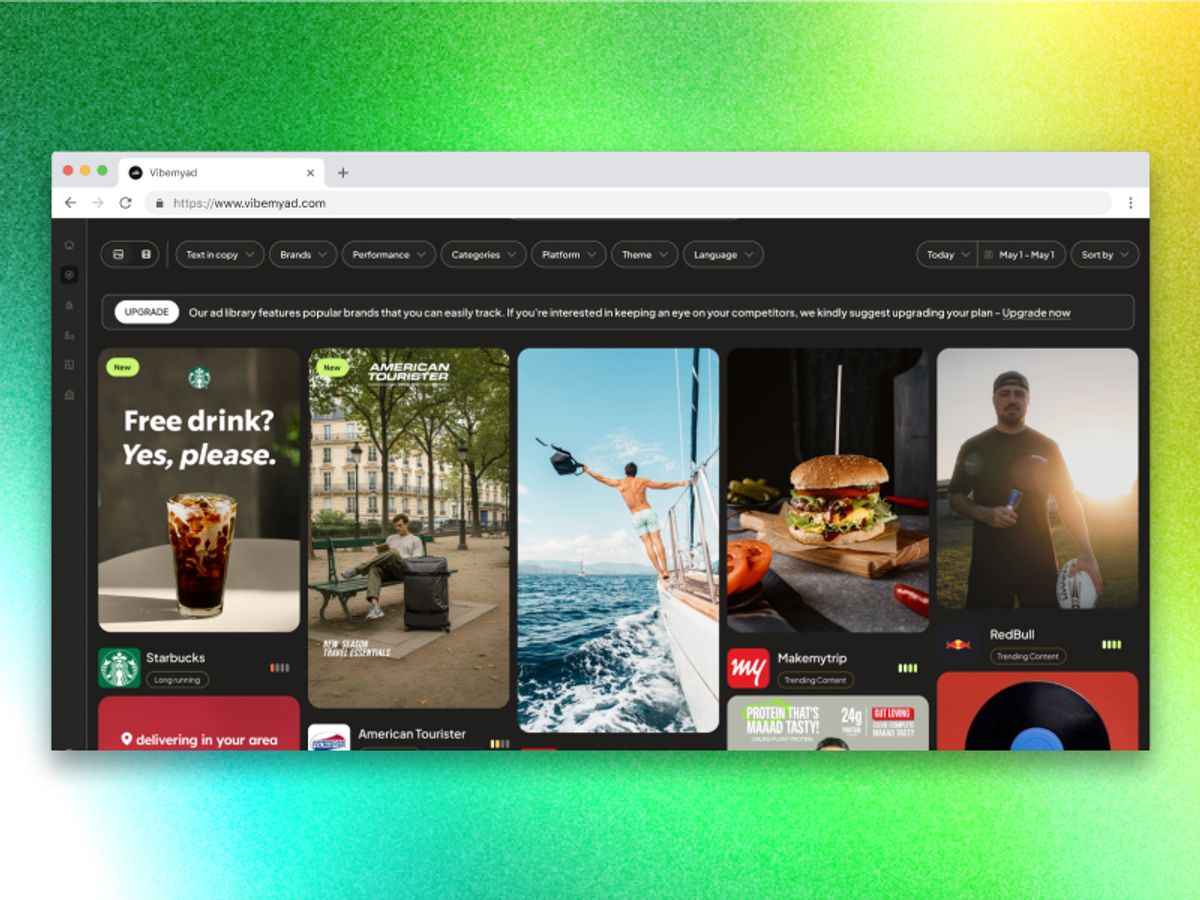
Vibemyad Ad Vault is your private organised ad library that automatically captures, stores, and organises competitor Facebook ads with complete metadata and historical tracking.
Rather than searching competitor by competitor in Meta's Ad Library and manually tracking changes over time, Vibemyad Ad Vault automates the entire monitoring workflow.
You add the brands you want to track and the system does the rest. It monitors up to 50 competitors simultaneously, automatically captures new ads when competitors launch them, stores complete ad creative including images, video, and copy, and organises everything by competitor and concept category with a full timeline view showing when each brand entered different creative directions.
The result is not just a faster version of what you were doing manually. It is a different kind of intelligence — a comprehensive, searchable archive of your competitive landscape that updates automatically and feeds directly into the validation and generation workflow.
The Facebook Ads Library is a search tool. Vibemyad Ad Vault is a strategic intelligence system.
The fundamental difference is what you can do with the output. The Facebook Ads Library gives you visibility into what a competitor is running today. Vibemyad Ad Vault gives you a historical record of what they tested, what they kept, what they killed, and how the competitive landscape has shifted over time. That history is what makes validation analysis possible.
The workflow has four steps. Each one feeds directly into the next.
• Add 5 to 20 competitors to your tracking list
• Vibemyad Ad Vault captures their ads automatically and organises them by brand, format, and duration
• Browse the library and identify ads that have been running the longest — these are the validated concepts competitors kept spending on because they work
• Save the validated ads that fit your brand direction into a moodboard inside Vibemyad Ad Vault
• Every ad in your moodboard represents a concept already proven by someone else's spend
• This moodboard becomes the creative brief for your Ad Gen session
• Take your moodboard into Vibemyad Ad Gen
• Upload your brand book — logo, colours, fonts, tone of voice, product details — so the AI creates ads that are on-brand from the first output
• Tell the AI agent what you want to create, your audience, and your objective
• The agent uses your moodboard as the creative foundation and your brand book as the execution guide
• Plan the concept together through conversation, refine the direction, then create
• Once your first concept is ready, generate as many variations as you want
• Different formats, copy angles, demographics, and aspect ratios for feed, story, and reels
• Every variation stays grounded in the validated concept and your brand guidelines
Starting with validated competitor concepts changes the risk profile of creative testing in two ways. First, you are testing fewer concepts because you have already filtered out the ones the market has rejected. Second, the concepts you are testing have already demonstrated they can sustain spend — which means your failure rate on testing is lower before you spend a dollar.
The improvement is not because Vibemyad generates better-looking creative. It is because the concepts being tested have already cleared the market's first filter. When Vibemyad Ad Spider flags an ad as validated, you know competitors made a deliberate decision to keep spending on it over an extended period. That decision reflects performance data you do not have access to directly — but the sustained spend is the evidence. You are not guessing whether transformation narratives work in your category. You know they work because competitors kept paying for them.
For a broader look at how ad intelligence tools compare and which ones are worth using alongside Vibemyad, read our guide on the best ad intelligence tools in 2026.
Meta's Facebook Ads Library is a useful starting point but an incomplete one. It shows you what competitors are running without telling you what is working, how long it has been running, or whether the concept has room left in the market. The 74K monthly searches for "Facebook ads library" reflect genuine demand for competitor intelligence — the gap is in turning visibility into something actionable.
The 60-day rule solves the validation problem by using duration as a proxy for performance. Systematically tracking duration across an entire competitive set is what Vibemyad Ad Vault and Vibemyad Ad Spider make possible at scale. And Vibemyad Ad Gen closes the loop — not by remixing templates but by letting you build concepts through conversation, grounded in a moodboard of ads the market has already validated.
The intelligence-first workflow does not replace creative judgment. It gives that judgment a better starting point — concepts the market has already filtered, timings you can see, and saturation levels you can act on before the window closes.
Get notified when new insights, case studies, and trends go live — no clutter, just creativity.
Table of Contents


Ananya Namdev
Content Writer, Vibemyad


Rahul Mondal
Product, Design and Co-founder, Vibemyad


Arpita Mahato
Content Writer, Vibemyad