July 01, 2026 • 10 min read

July 01, 2026 • 10 min read
We took one real product, Kettle Studio's Mature Cheddar and Red Onions chips, and asked two of the most popular AI image tools to put the pack in a lifestyle ad. Here is the real bag, followed by what ChatGPT and Gemini each did to it.
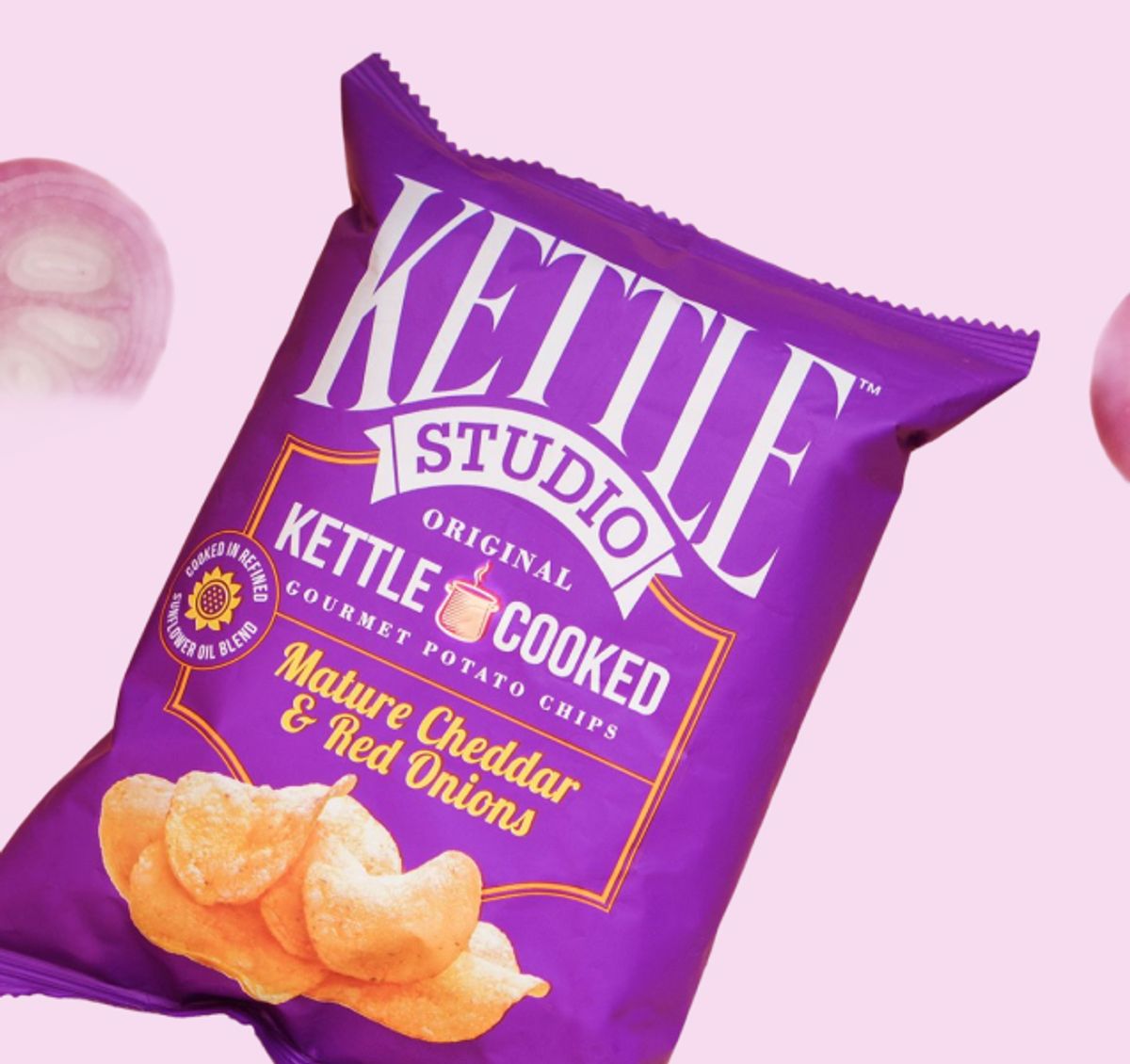
A pack of Kettle Studio Chips
The real bag is clear on every line: "KETTLE STUDIO" across the top, "ORIGINAL KETTLE COOKED,""GOURMET POTATO CHIPS," the flavor "Mature Cheddar & Red Onions" in a bordered panel, and a small "Cooked in Refined Sunflower Oil Blend" seal on the left.
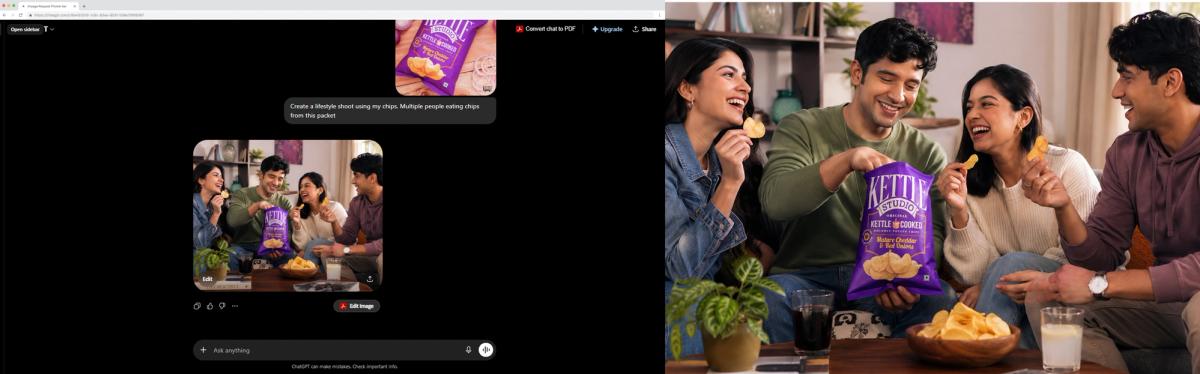
The receipt. ChatGPT, handed the real Kettle Studio pack and asked for a lifestyle shoot, keeps "KETTLE STUDIO" and "KETTLE COOKED" but lets the flavor descriptor and the sunflower oil seal soften into marks that no longer read.
ChatGPT held the big stuff and started losing the rest. "KETTLE STUDIO" survives and "KETTLE COOKED" mostly holds, but "gourmet potato chips" is going soft, the flavor descriptor loses its crispness, and the sunflower oil seal on the left has collapsed into marks that no longer spell anything. It is the familiar pattern: the largest text lives, everything smaller starts to drift.
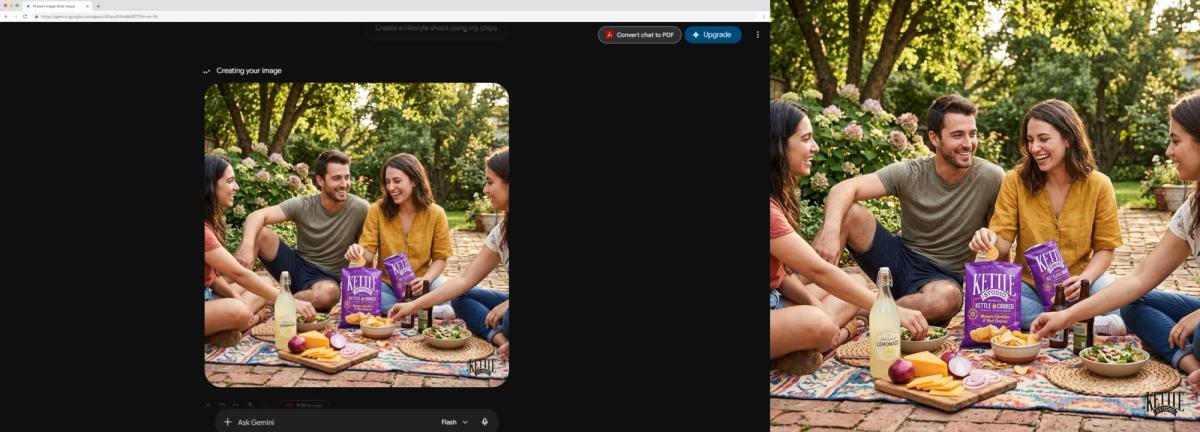
The same test in Gemini. "KETTLE" holds, but "STUDIO" garbles toward "STODIO," the flavor line smears, and the second bag and corner logo break down completely
Gemini broke further. "KETTLE" holds, but "STUDIO" garbles toward "STODIO," "KETTLE COOKED" is breaking apart, and the flavor line "Mature Cheddar & Red Onions" smears into something you cannot read. The second bag behind it and the small corner logo are pure gibberish, "KETTLE STODIO," "BEUDIO." The descriptor text, the part that tells a shopper what flavor they are buying, did not make it.
Both images look like real ads. The lighting is good, the people are convincing, the mood is right. And both are unusable, because a chips bag is sold on its flavor, and both tools turned "Mature Cheddar and Red Onions" into a smear. The prettier the shot, the more the broken text gives it away.
• Chips and snack packaging is one of the hardest things to render in general AI image tools, because the pack combines bold branding, a multi-line flavor descriptor, small seals and claims, and a dense ingredient panel, all on a reflective, wrinkled surface.
• General-purpose tools like ChatGPT and Gemini keep the largest text and break everything smaller, which means the brand name might survive while the flavor line, the seals, and the ingredient panel turn to gibberish, as they did to the Kettle Studio pack above.
• This is not a prompting mistake you can fix by asking more nicely. These tools reproduce the look of a label rather than its exact words, so the smaller and denser the text, the faster it falls apart.
• For a snack brand, that is fatal, because the flavor descriptor is the product. A gorgeous ad where the flavor name is smeared cannot run on Meta or sit on a marketplace listing where a shopper zooms in.
• The fix is to use a generator built for packaged products rather than a general art tool. Vibemyad Ad Gen grounds on your real pack, keeps the dense text legible, and offers a "Fix Product Text" button that regenerates with the actual label copy intact.
Both tools failed on the Kettle Studio pack for the same underlying reason, and it has nothing to do with how good the prompt was. General AI image tools are built to imagine pictures, not to reproduce a specific label. When you hand ChatGPT or Gemini a reference pack and ask for an ad, they do not copy your text letter for letter. They generate something that looks like your pack, and looking like text is a very different thing from spelling it.
That gap barely shows on some images and destroys others, and snack packaging sits at the worst end of the range. A chips bag is not one clean word on a plain background. It is a stack of competing text at wildly different sizes, a big brand name, a mid-size cooking style, a small "gourmet potato chips" line, a bordered flavor descriptor, a seal or two, and a dense ingredient panel, all fighting for room on one surface. Each of those is a separate thing the model has to get right, and the smaller and denser it is, the less likely the model lands it. On the Kettle Studio pack you can watch this happen in order: the big "KETTLE STUDIO" survives, "KETTLE COOKED" mostly holds, and everything below that starts to dissolve.
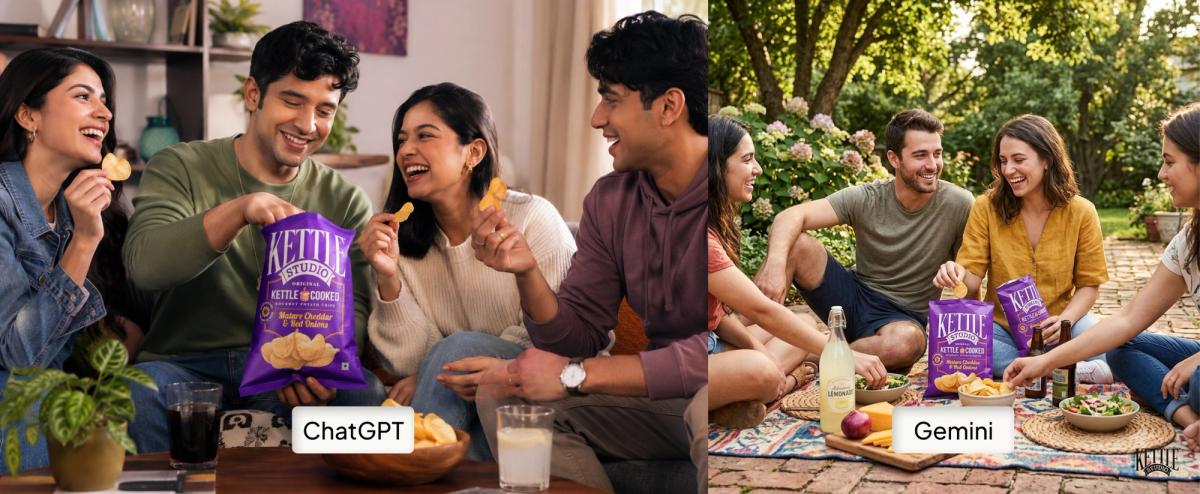
Comparison of Images generated using Gemini and ChatGPT
Then there is the surface itself, which snacks make harder than almost any other category. A chips bag is foil, it is glossy, it is wrinkled, and it never sits flat. The model has to keep the letters correct while also bending them around every crease and catching the light the way a metallic bag does, and those two demands pull against each other. The more realistic and ad-like the bag looks, the more the text has to distort to follow the surface, which is exactly when it stops being readable. The result is the cruel trade you saw above: a convincing, well-lit, genuinely appealing shot where the one thing that sells the product, the flavor, has smeared into nonsense.
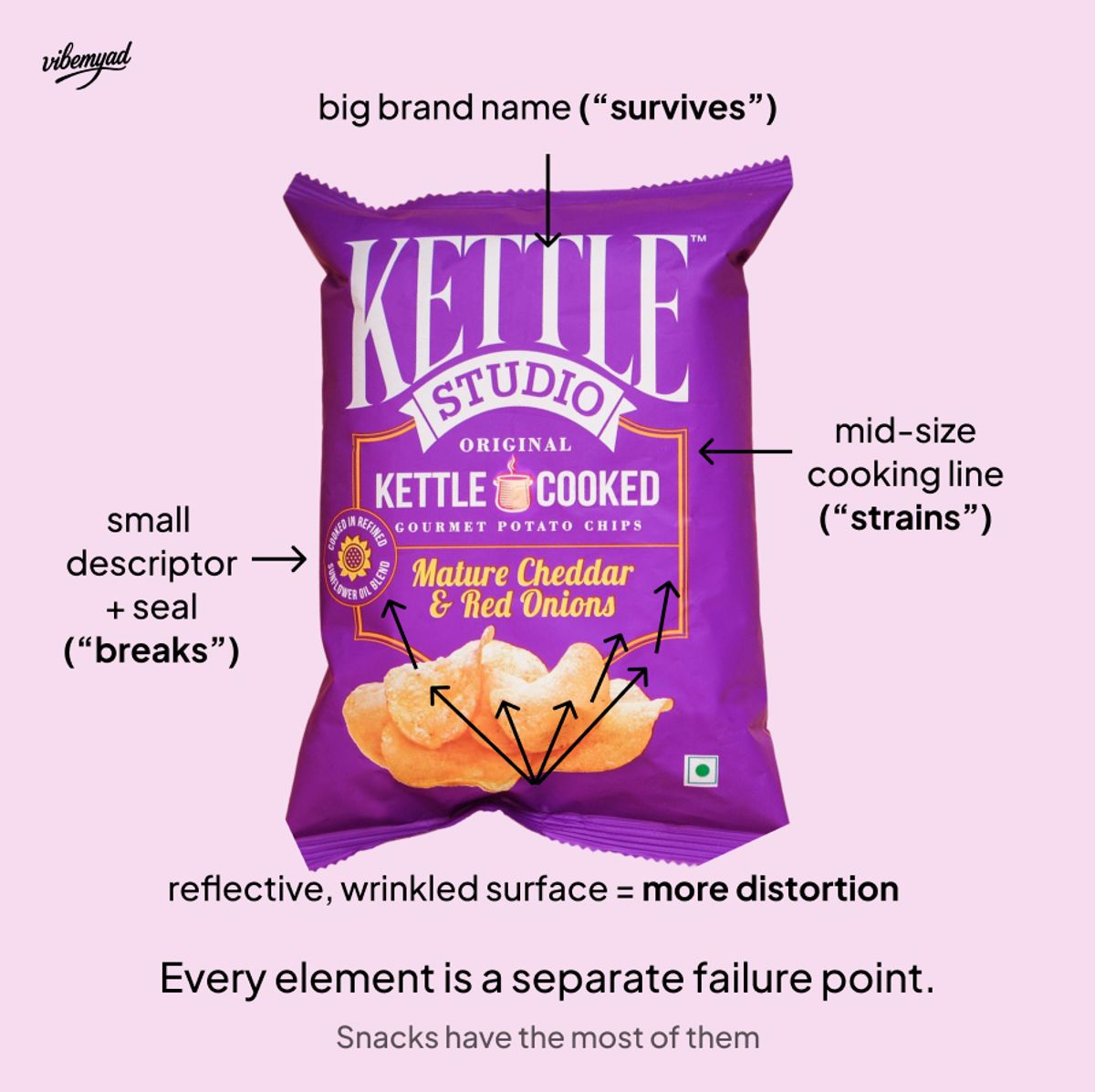
Why a chips bag is the hardest case
This is the part worth sitting with, because it explains why "just use ChatGPT" keeps letting snack brands down. The tool is not broken. It is doing exactly what it was built to do, which is generate a plausible image. Plausible is enough for a mood board or a background. It is not enough for a product whose entire job on the shelf is to say, clearly, what flavor is inside.
The pattern is predictable: the bigger and more isolated the text, the better it survives. The smaller and denser it is, the faster it turns to mush. Unluckily, the text that matters most tends to sit in the danger zone.
The brand name usually survives, it is the biggest, boldest line with the most room. One level down is where it breaks. The flavor descriptor, "Mature Cheddar and Red Onions," is smaller, multi-word, often in a decorative panel, the exact combination that garbles. And it is the most important line on the pack. Everything smaller than that, the seals, the net weight, the "gourmet potato chips" line, is almost always gone.
The worst zone is the back: the ingredient list and nutrition panel. Small, packed, multi-line text becomes total gibberish, the shape of a panel with none of the real facts. Most brands never catch this because they only prompt for the front, until they need a back-of-pack shot for a listing.
The failures land on exactly what a shopper uses to decide, the flavor, the claims, the ingredients, while the only thing that survives is the brand name they already recognized.
A near-miss like ChatGPT's makes you think one more try will fix the text. It won't, and here's why.
Tools like ChatGPT and Gemini are built to imagine, not reproduce. That is genuinely hard and they are great at it. But a product image needs the opposite: not "imagine my pack" but "copy my pack exactly," down to a flavor line that has to be spelled right because it is a real thing people order. A general tool is fighting its own design the moment the task turns to faithful copying.
That is why prompting harder does not help. The tool treats your label as a pattern to reimagine, not words to preserve, so every retry is a fresh guess. Twenty tries gets you twenty plausible bags, each misspelling the flavor a new way.
The tool treats your label as a pattern to reimagine, not words to preserve, so every retry is a fresh guess. The reason it behaves this way is stranger than a simple bug, and it is worth understanding before you trust any tool with your label, we broke down exactly why AI image generators can't spell and what's happening inside the model when your flavor name turns to gibberish.
There is also consistency. Even if you land one good bag, you need it in a feed ad, a Story, a banner, a back-panel flat-lay. A general tool has no memory of the pack it just made, so the flavor line that came out right in one shot comes out wrong in the next.
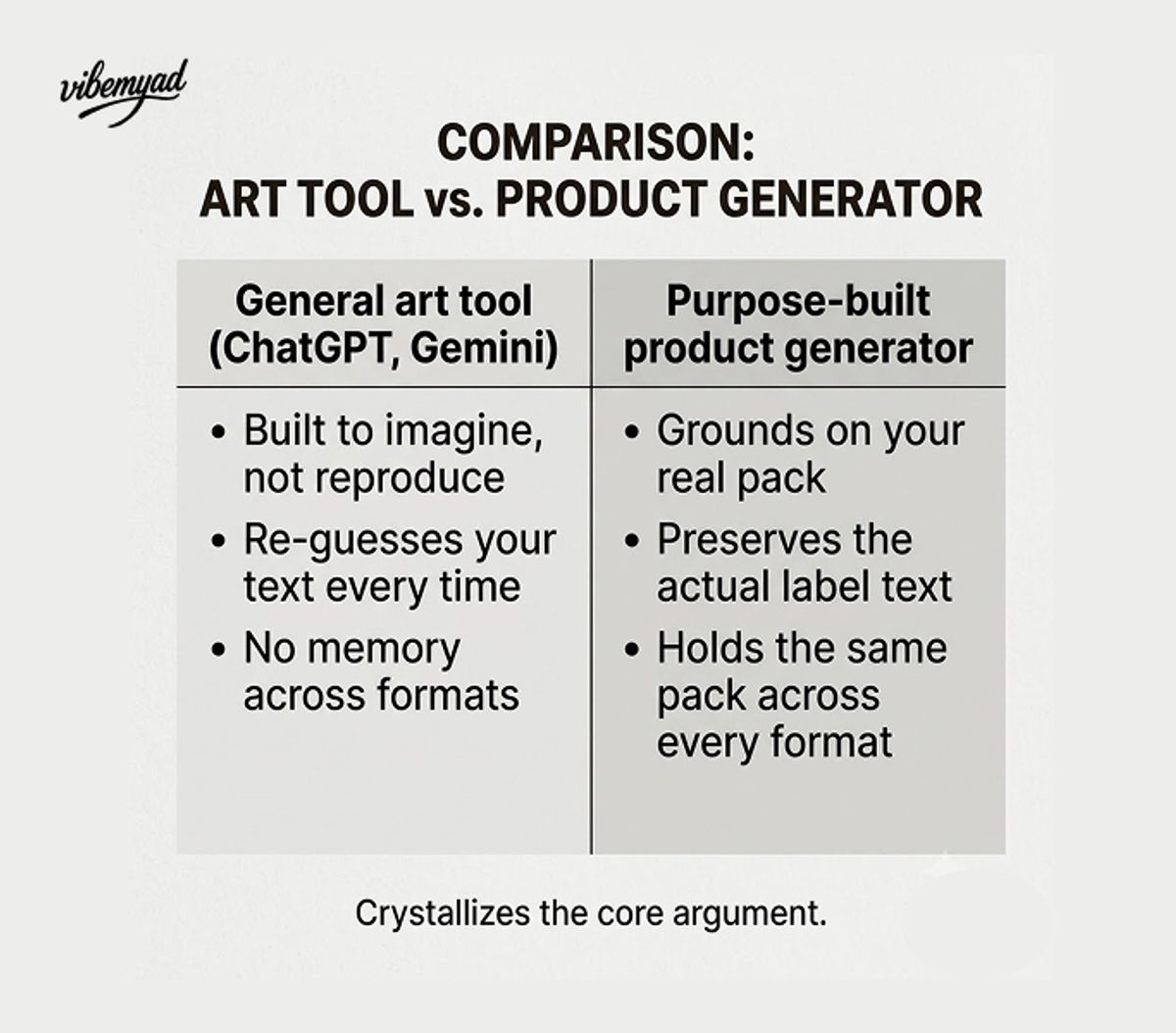
Wrong tool vs right tool
So the honest conclusion is not that ChatGPT and Gemini are bad tools. They are excellent general tools being asked to do a specialist job they were never built for. Snack packaging, with its dense text and its demand for exact reproduction across many formats, is precisely the job that needs a specialist.
Use a generator built to reproduce real products, not imagine new ones. That is the whole difference. It starts from your actual pack and preserves the label instead of reinventing it.
Vibemyad Ad Gen works this way. You give it a photo of your real chips bag, and it keeps the text legible, the brand lockup, and crucially the flavor line that sells the product, then exports at every Meta and marketplace spec in one session at vibemyad.com/sessions.
The part that matters most for snacks: when a first render misses a line, you click "Fix Product Text" and it regenerates with the real label copy intact. No re-rolling, no fighting the prompt. You lock the actual text, and it holds.
One honest boundary: Vibemyad Ad Gen makes static images and carousels. It does not manage your Pixel, targeting, or budget, which stay in your Ads Manager. It just removes the hardest part, getting an accurate, legible bag onto an ad-ready image.
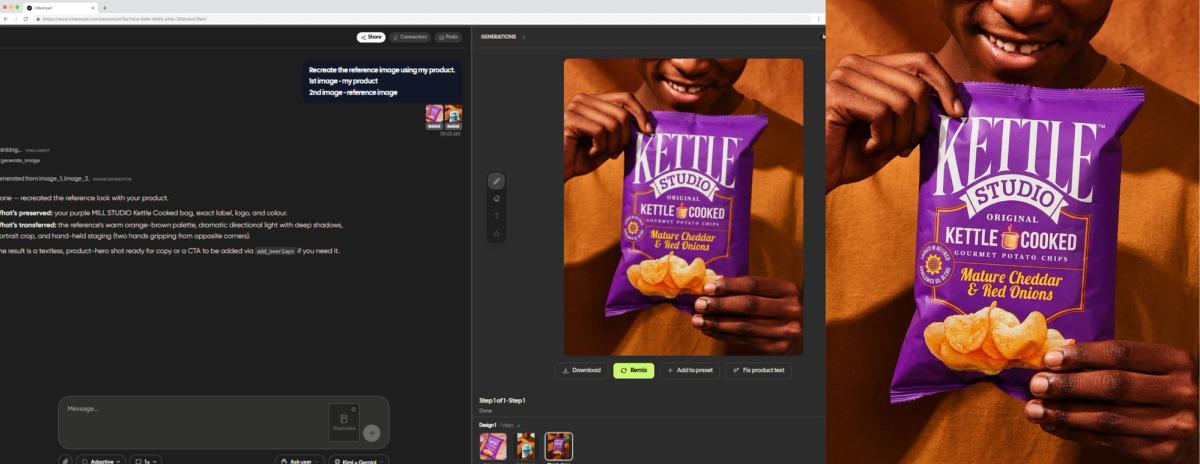
Kettle Studio, done right in Vibemyad Ad Gen
A traditional photoshoot gets you accurate text, because it is a photo of the real bag. The problem is cost and speed. Every new flavor, every format, every seasonal refresh means booking the shoot again, and snack brands change often.
AI generation flips that: fast, cheap, endlessly re-runnable. But only if the text survives, which is the whole problem with general tools. A purpose-built generator gives you both, the accuracy of a real-pack photo and the speed of AI.
• Snack packaging is one of the hardest things for general AI tools to render, because it stacks bold branding, a multi-word flavor line, small seals, and a dense panel onto a reflective, wrinkled bag.
• The failures land on the text that matters most. The brand name usually survives while the flavor line, seals, and ingredient panel break, exactly as they did to the Kettle Studio pack.
• Prompting harder does not fix it. General tools imagine your pack instead of reproducing it, so every retry is a fresh guess at your flavor name.
• Vibemyad Ad Gen grounds on your real bag, keeps the text legible, and offers a "Fix Product Text" button to lock the real label copy at Vibemyad.
Get notified when new insights, case studies, and trends go live — no clutter, just creativity.
Table of Contents


Rahul Mondal
Product, Design and Co-founder, Vibemyad

Rahul Mondal
Product, Design and Co-founder, Vibemyad


Arpita Mahato
Content Writer, Vibemyad