July 06, 2026 • 11 min read

July 06, 2026 • 11 min read
Food and drink are the highest-converting category on Meta and one of the cheapest to reach, so if your ads are flat, targeting was never the problem; creative volume was.
• Food and beverage is one of the cheapest verticals to reach on Meta and, in 2026 ecommerce benchmarks, the highest-converting one, at roughly 2% against a ~1.6% all-industry median (Triple Whale, 2026).
• If reaching your buyers is this cheap and your ads still fall flat, the problem is not reach or targeting. It is what you show people. Meta now reads your creative to decide who sees the ad, so creative volume is the lever. The median food and beverage brand runs 153 active Meta ads (Northbeam, Q1 2026). Most run five or six. Start from creative, keep targeting broad.
• Here is the loop most food brands get stuck in. Sales from Meta dip, so you open Ads Manager and rebuild the audience: new lookalike, tighter interests, another exclusion. It feels productive and changes nothing because, for a food brand, the audience was never the constraint. Creative is, and the mechanics of Meta's auction show exactly why.
What Is The Actual Constraint On A Food Brand's Meta Ads?
Not reach, and not the audience. Look at the numbers. Across 2026 benchmark panels, food and beverage sits among the lowest CPCs on Meta, around $0.42 to $0.52 against a roughly $0.78 average, and it posts the highest conversion rate of any vertical, about 2% (Triple Whale, 2026). Food is visual, broadly appealing, and strong in the formats Meta pushes hardest: Reels, Stories, and feed video. It is cheap to reach for you in a way it is not for a law firm, and the likeliest to convert once it is in front of someone.
If impressions are this cheap and your campaign still underperforms, the bottleneck is not the cost of reach, and it is not who you reached. Cheap, broad reach is already yours. The scarce thing is something worth spending on. That moves the problem out of the targeting tab.
So What Decides Which Food Ads Meta Shows?
• Two things decide it, and neither is your audience settings. The first is the auction. When a slot opens in a feed, Meta ranks eligible ads by roughly your bid, times how likely it thinks the person is to act, adjusted for quality. That middle term, the estimated action rate, is predicted per ad. A mouth-watering hero shot earns a higher predicted and actual rate than a flat logo card, so it wins more slots at a lower cost. You move it through the creative.
• The second, and more important, is retrieval. Before the auction runs, Meta narrows millions of ads to the few it will consider for each person, using a system it calls Andromeda that reads what is in your ad to decide who sees it.
In Meta's system, your creative is the targeting. For a food brand, the dish, the pack, the hook, and the on-screen text are what route your ad to the right feeds. Audience settings are loose guidance, not control.
In February 2026, Meta merged its manual and Advantage+ flows into one interface with automation on by default. The platform is telling you where the advantage sits.
Why Is Targeting The Wrong Place For A Food Brand To Start?
The audience is mostly automated away. Advantage+ Sales Campaigns, renamed from Advantage+ Shopping in early 2025, find buyers from your conversion data, not your interest lists. Your hand-built targeting becomes a suggestion the system can override.
Worse, segmentation starves the algorithm. An ad set needs about 50 conversions in a 7-day window to exit the learning phase. Split your budget across five neat audiences: parents, gym-goers, students, foodies, and deal-hunters. None of them clears the threshold, so all five sit in learning limited with higher, jumpier costs. There is a reason this held: since Apple's App Tracking Transparency in 2021, Meta lost reliable per-user data for opted-out users and leaned harder on the ad itself.
Then there is the honest reason: rebuilding an audience is tidying your desk while the real problem sits untouched. As one agency that audits the category puts it, most food brands run ads that look like every other food brand's and get clicks without building a business. If your monthly report leads with audience tweaks instead of creatives shipped, you are buying the comfortable work.
Detailed targeting still earns its place in retargeting. As the thing you build a scaled food campaign around, it is theater.
Creative throughput: a pipeline that produces distinct food ads faster than they fatigue. The right starting point for food brand Meta ads in 2026 is creative volume and variety. Distinct concepts, built from your real products, are the input the system rewards. Targeting you mostly leaves it broad.
Before you touch an audience control, ask how many genuinely different food ads you can ship this week. If the answer is two, that is the bottleneck, and no lookalike clears it. And distinct is the word. Five recolors of one photo are one idea. Five ideas are a slow-motion cheese pull, a customer's first bite, a price comparison against your rival, a morning-routine clip, and a limited-time bundle. That range is what lets Andromeda match you to more hungry people.
How Many Food Ads Do You Need, And How Fast?
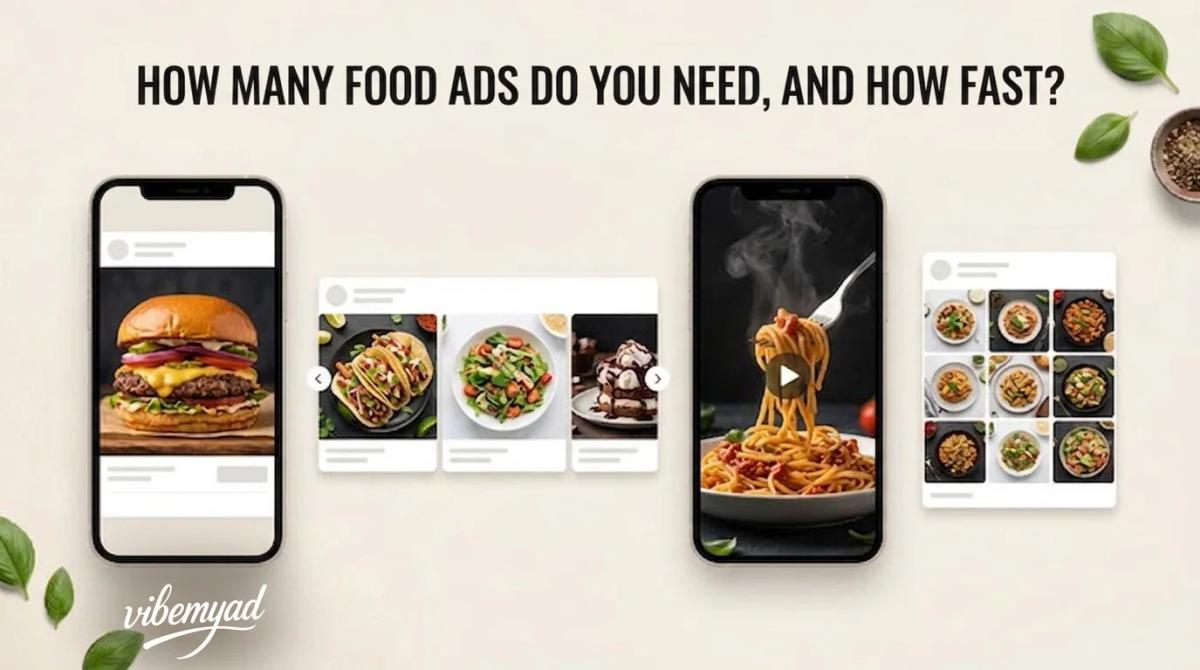
More than you are running, and refreshed faster than most brands manage.
Use the median as a floor. Northbeam's Q1 2026 data puts the average food and beverage brand at 228 active Meta ads and the median at 153. A brand running six is not in the weight class. A non-alcoholic beer audit this year made it concrete: Athletic Brewing ran 80 to 100 or more active ads while direct rivals ran close to zero. One of them owns the category. It is not the one running zero ads.
Now the clock. Food creative fatigues, and the fix is to refresh every two to three weeks. Do the math: a rotating pool of five to seven concepts, refreshed biweekly, is ten to fifteen new ads a month just to hold a position. Fatigue is a creative problem, not an audience one. As frequency climbs, click-through decays, the action rate falls, and cost per result rises. Fresh creative resets that curve. A new small audience does not.
What Food Creative Actually Works On Meta?
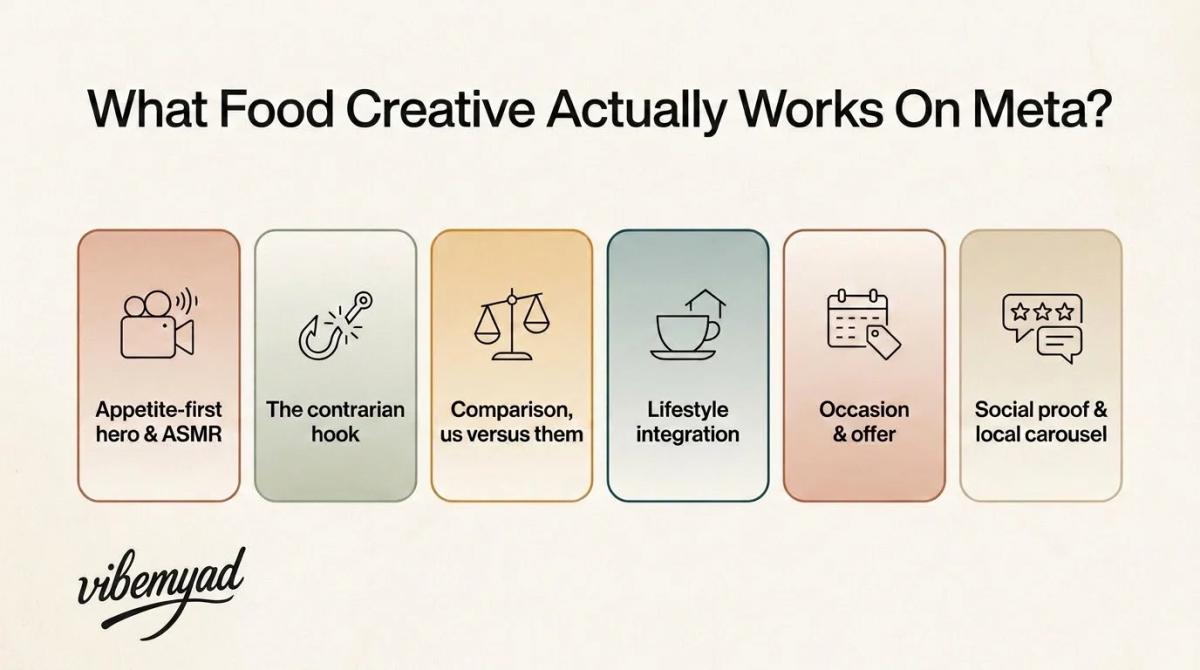
Winning food ads make you hungry or make you feel seen in the first second. Past that, a few formats recur in the Facebook Ad Library. Build several, since each pulls a different buyer.
Appetite-first hero and ASMR: Slow-motion cheese pull, syrup pour, a burger cross-section. Close, high-definition, often no dialogue. Food has this format; most categories do not.
The contrarian hook: Burger King's Moldy Whopper let a burger rot for a month to prove no preservatives. The lighter version is a fake one-star review over someone taking a bite. It breaks the pattern that every other food ad follows.
Comparison, us versus them: Misfits Market showed its price beside a rival's; HelloFresh and Huel set meal counts and nutrition against the alternative with real numbers. Numbers read as proof.
Lifestyle integration: MUD/WTR sold a calmer morning, not just mushroom coffee. The product sits inside a life the viewer wants.
Occasion and offer: Daily Harvest tied smoothies to summer and stacked a discount, answering why buy this and why buy it now.
Social proof and the connected local carousel: A testimonial or dietitian nod, or a carousel that reads as one image, opens with the city name, and closes on a real review.
None of these is five recolors of one photo. Then, structure for the machine: one consolidated Advantage+ campaign, broad targeting, many distinct creatives, and an adequate daily budget to clear roughly 50 conversions per week. Feed it and get out of the way.
Most "the ads aren't working" problems are one of five things, and only three are creative.
The honest row is the third. More creative does not fix a broken landing page or a double-counting Pixel. Diagnose first. When it is a creative problem, and for food it usually is, the fix is volume.
Creative is the start for both. The rest splits.
A cafe wants impulse: A Reel of the cold brew with a Get Directions button for mid-day footfall. Fine dining wants planning: a carousel of signature dishes promoting weekend tables, linked to the reservation system. A sensible local test budget is $35 to $70 a day before you scale the winner. Neither is won by hand-building an audience.
Why Do AI Image Tools Break On Food Packaging?
Because of how they generate images and what a food ad is made of.
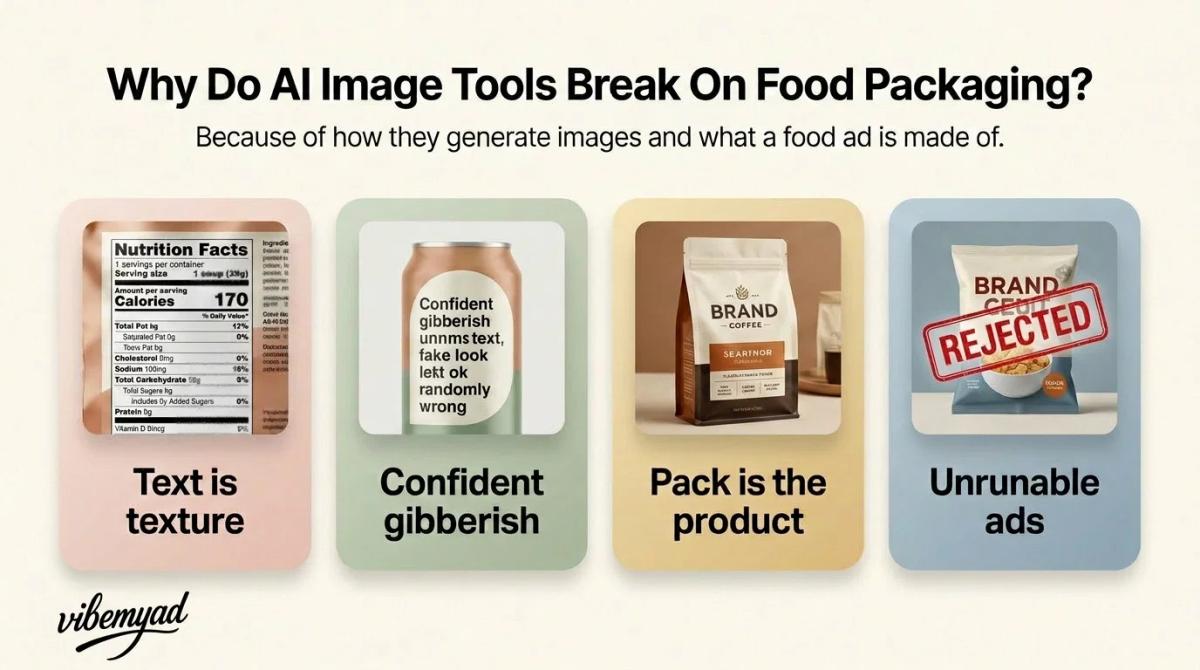
• Diffusion models denoise toward what your prompt describes and treat text on a package as a texture, not characters, so it comes back as confident gibberish, worst on small type, curved surfaces, and stylized fonts.
• For most categories, that is a croppable annoyance. For food, it is disqualifying because the pack is the product: the label carries your name, the flavor, and the claims that make the sale.
• A garbled label is an ad you cannot run because it spells your own brand wrong. That is why food brands abandon AI creative for expensive shoots, capping production right where the auction wants more.
And Meta is heading toward campaigns that take a goal, a budget, and one product image, so broken imagery will soon break the whole campaign.
How To Produce Food Ads Without A Studio?
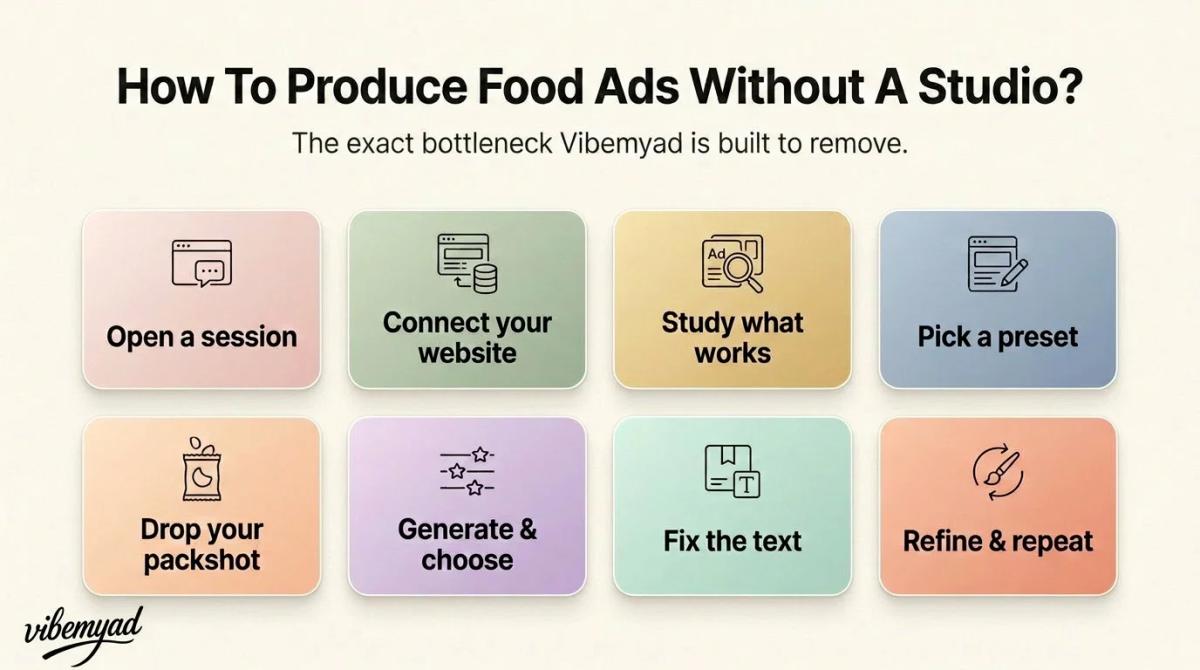
This is the exact bottleneck Vibemyad is built to remove. Generating a batch of food ads, start to finish, looks like this:
Open a session at vibemyad.com/home: The Vibemyad agent and the image generator share one thread, so you plan the concept and generate the image in the same place, not across three tools.
Connect your website to build the knowledge base: Vibemyad pulls your products, images, and brand details automatically, so every ad comes back on-brand instead of generic. Connecting your ad account is optional and sharpens grounding, but you do not need it to start.
Study what already works first: Vibemyad Ad Vault is a live library of running ads you filter by industry, platform, aspect ratio, and color; track a competitor to unlock funnel position, hook technique, and performance. Ad Spider goes deeper, breaking a rival into audience, content themes, hooks, and value props, then mapping the gaps against yours. Pull what wins in your category, then build your own.
Pick a preset or describe the ad: Presets are ready-made starting points grouped by category, from visual edits to beverages to food, with new ones added daily. Or skip them and tell the agent what you want in plain language.
Drop in your real packshot: The chips bag, the juice pouch, the jar of sauce. This is the step generic tools skip, and why their food ads look like stock photography instead of your product.
Generate and choose your model: Gemini Flash, Gemini Pro, Gemini 2.5 Flash, Seedream, or Kimi x Gemini. Explore on a faster model, then finish the hero cut on a higher-fidelity one.
Fix the packaging text in the canvas: Rather than re-rolling the whole image and hoping the letters land, use the Fix product text action to correct the label so the pack reads exactly as it does on the shelf.
Refine, remix, then repeat: Tune the image in the canvas with the brush, eraser, text, and shape tools, or mask and in-paint one region without touching the rest. When a version lands, hit Remix to spin it into fresh variations instead of starting over, and use Add to preset so the winning look becomes a reusable starting point. An afternoon of this produces the ten to fifteen distinct concepts a month the algorithm wants, not the one you started with.
For a food brand, fixing product text is the step that changes the economics. It is the line between AI creative you throw away and AI creative you can ship.
The parts that are not creative. Your Pixel and Conversions API, event deduplication, budgets, Advantage+ structure, and measurement live in Meta Ads Manager. Vibemyad's job is upstream: making sure you never run out of distinct food creative to feed the campaigns you already run.
You do not need a tighter audience or another lookalike to fix flat Meta ads; reaching food buyers is already cheap. You need a workflow that grounds on the products you already sell and turns out enough distinct, on-brand ads to keep the algorithm fed every week.
Get notified when new insights, case studies, and trends go live — no clutter, just creativity.
Table of Contents


Arpita Mahato
Content Writer, Vibemyad

Arpita Mahato
Content Writer, Vibemyad

Arpita Mahato
Content Writer, Vibemyad