July 09, 2026 • 9 min read

July 09, 2026 • 9 min read
The most useful ad in a stack of 200 is not the prettiest one; it is the one still running since last spring, because no restaurant keeps paying for an ad that does not sell.
• We read 200-plus live restaurant Facebook ads and sorted them by how long each had run, because longevity, not reach, is the honest signal that an ad works.
• Caption is half the ad: a real first line and the offer in words, not a blank box or a hashtag dump.
• Specifics beat adjectives: exact prices, dishes, times, and neighborhoods, not "delicious food, great prices."
• The offer needs a shape (a combo, a first-order hook, a time-boxed drop, or a loss leader), and the creative needs to look real, not polished.
• Targeting barely matters now. The creative and the offer are the lever, and you can produce that volume from one dish photo while the campaign lives in Meta Ads Manager.
How Did We Read 200 Live Restaurant Facebook Ads?
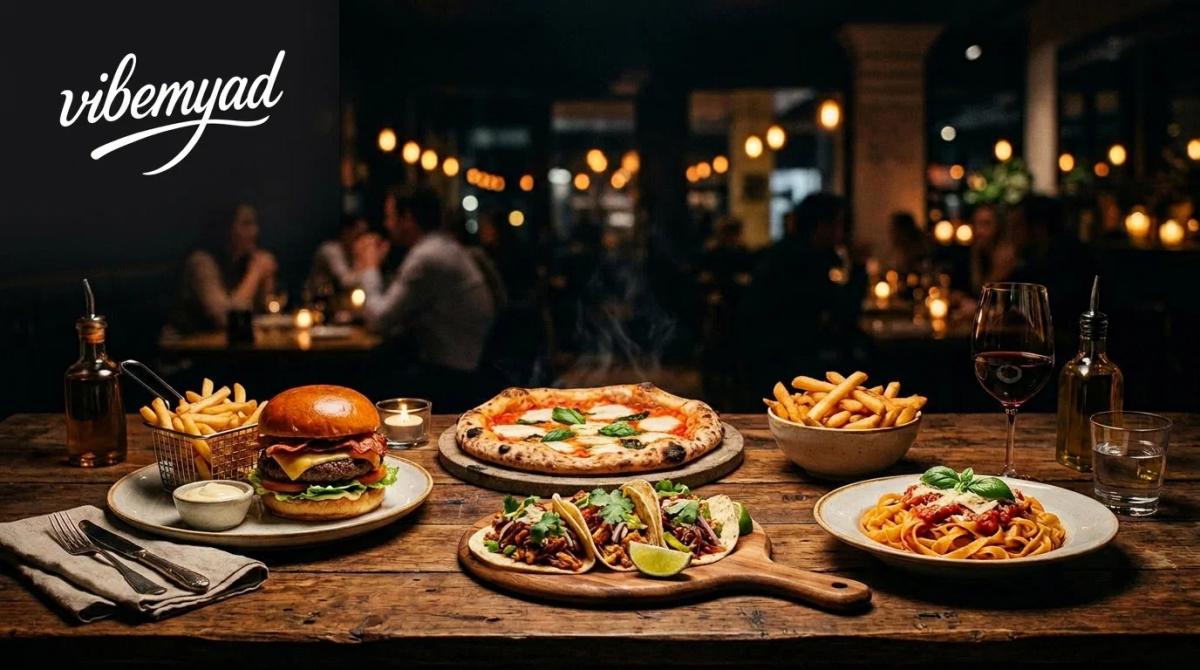
We pulled 200-plus live restaurant ads from the Facebook Ad Library, spanning quick service, delivery apps, casual dining, and fine dining, from national chains down to a long tail of independent rooms. Then we did one thing most teardowns skip: we sorted by how long each ad had been continuously live, and paid the most attention to the ones that had been running for months. The logic is simple. Impressions and reach tell you an ad was seen. Longevity tells you an ad was kept, and a business only keeps paying for creative that earns its keep.
One caveat up front, the same one worth stating every time. This is our read of the ads we pulled, not a third-party benchmark. But the survivors were consistent enough to build a real playbook on, and that playbook is not the one you have read before.
What Does Every Restaurant Ad Guide Already Tell You
You already know the obvious moves because every guide repeats them. Put the offer in big text. Shoot one dish, not a menu collage. Drop the price on fine dining. Ask for one specific action instead of "Learn More." All of it is true, and all of it is table stakes. It gets you into the game. It does not win it, because everyone already does it, which means it no longer separates the ads that survive from the ads that get killed in a week.
The interesting question is not what the winners and losers do differently at the obvious level. It is what the long-runners share that the two-week ads do not, even when both followed the standard advice. That is where the library gets useful.
What Do The Long-Running Restaurant Ads Do Differently?
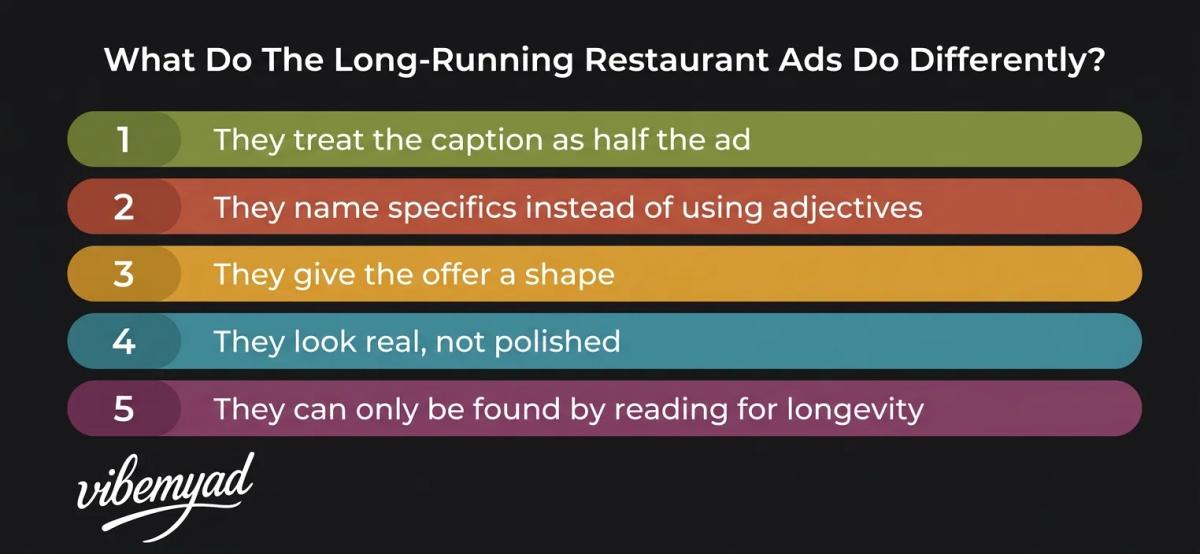
Five things, none of which show up in the usual listicle.
• They treat the caption as half the ad: Restaurant-ad advice is almost entirely about the image, so most operators leave the primary text blank or dump a paragraph with five hashtags. The survivors write the caption like it matters, because it does. A short first line that names the offer or asks a question, the offer restated in words and not only baked into the picture, and one link. The words above the plate carry as much of the sell as the plate.
• They name specifics instead of using adjectives: "Double Smash Combo, $6.99, today only" outlives "delicious food at great prices" every time. Adjectives are invisible in a feed. Numbers, dish names, times, and neighborhoods are not. This is also why the text on the image has to be correct to the character. A garbled price does not just look sloppy; it destroys the one concrete thing the ad had going for it.
• They give the offer a shape: The long-runners are not "running a special." They are running a recognizable offer architecture: the combo or bundle that lifts the ticket, the first-order hook that buys a trial, the time-boxed drop that manufactures a reason to act tonight, the loss leader that uses one cheap item to pull a full visit. The flame-outs almost always had vague "specials this week" with no shape and no reason to move now.
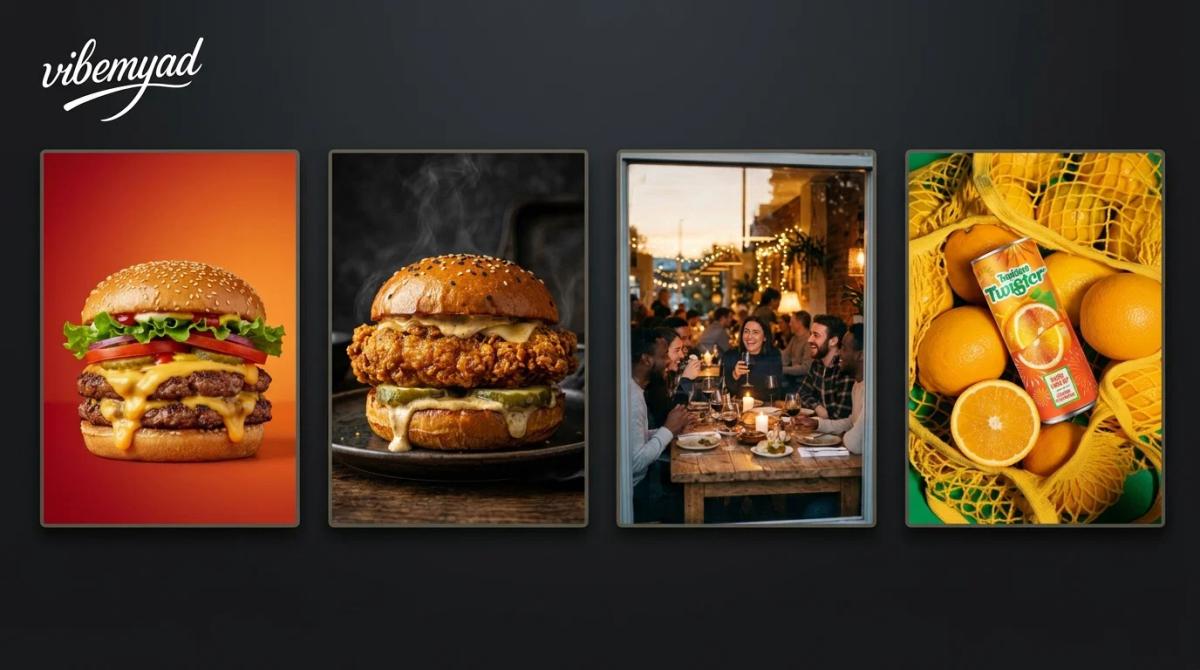
• They look real, not polished: The ads that keep running often look less produced, not more. A real room, real staff, the actual plate rather than a stock lookalike, the neighborhood named out loud. Over-glossy creative underperforms for local restaurants because it trips the quiet question every diner asks about a new place: Is this even real and any good? For a local business, looking local is a feature, not a flaw to retouch away.
• They can only be found by reading for longevity: This is the meta-move behind the other four. The ad you should copy is not the one that looks best in the library today; it is the one that has been live longest, because time is the only honest filter the library gives you for free.
Here is the same thing as a build sheet:
Notice what still is not on this list: a clever audience. The lever is the creative and the offer, not the targeting.
Why Did Last Year's Restaurant Ads Stop Working?
Because the crutch they leaned on got kicked out. A year or two ago, you could carry a vague, pretty ad on finely sliced targeting, letting a narrow audience do the work the creative did not. Meta's 2026 delivery reads the creative itself to decide who sees an ad and optimizes toward whoever is likeliest to act, so that crutch is mostly automated away. A vague ad with no specific offer, no real feel, and a dead caption now has nothing to fall back on. It is not that you got worse at ads. It is that the system stopped covering the parts you were skipping. We take the mechanism apart in the food brand Meta ads playbook; the short version is that specificity and volume are what the system rewards now, and both are creative problems, not targeting ones.
How Many Restaurant Ads Do You Need
More than one, and the mix matters as much as the count. The restaurants that own a local feed run two things at once: a small stable of proven long-runners they keep funding because the library-of-one that is their own account tells them these survive, and a constant stream of fresh tests feeding the algorithm new material before fatigue sets in. The mistake is treating every ad as disposable or treating one ad as permanent. You want a few survivors kept on, and a rotating test bench underneath them.
Generate Restaurant Ads with Vibemyad
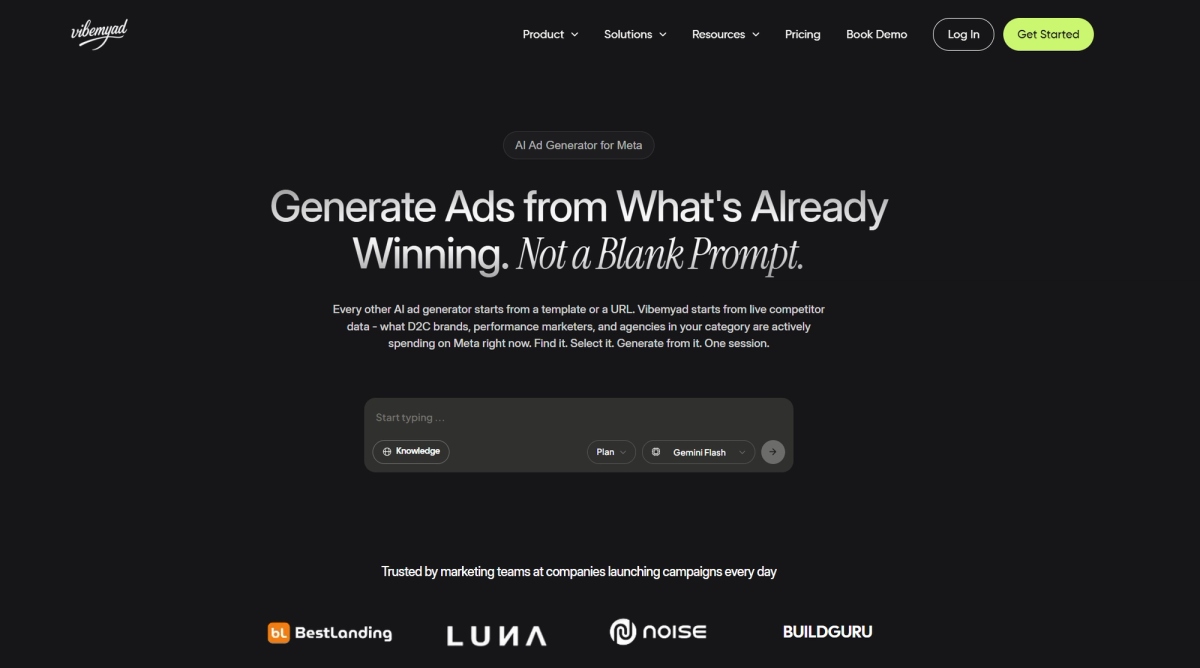
Two jobs sit inside this, and they are separate capabilities. One is research, reading the library the way we just did. The other is creation, turning what you find into specific, real creative that is yours. Vibemyad does both in one place.
For research, Vibemyad Ad Vault is a live library of the ads running on Meta right now, the same universe as the Facebook Ad Library, filterable by industry, platform, aspect ratio, and color palette, so you can surface the ads in your category and spot the ones that have clearly been live a while. Vibemyad Ad Spider goes deeper on a single competitor, breaking them into their audience, content themes, hook techniques, and value props, which is exactly how you reverse-engineer a rival's offer architecture and caption patterns. Reading ads is research, though. It does not make you a single design.
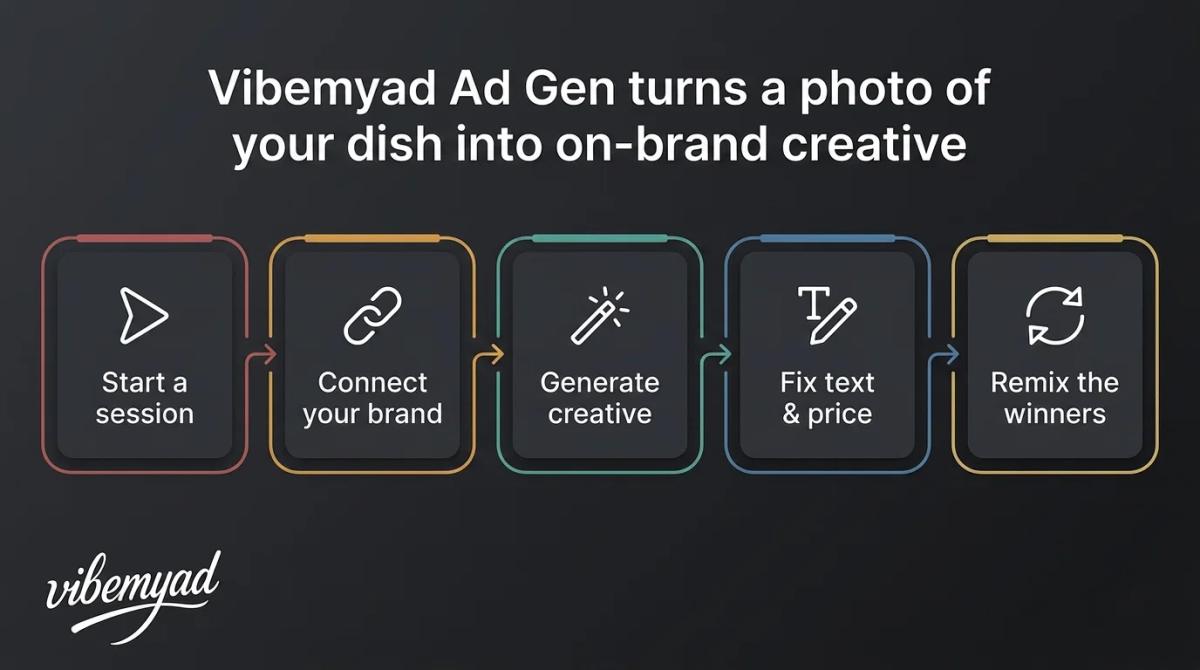
For creation, Vibemyad Ad Gen turns a photo of your dish into on-brand creative built for the moves above. Here is the flow:
Vibemyad Ad Gen
Start a session at vibemyad.com/home: Describe the campaign. The agent, the image generator, and the research tools share one thread, so you study the survivors and make your own without switching apps.
Connect your restaurant's website to the knowledge base: Vibemyad pulls your real dishes, your look, and your brand automatically, which is what makes the output look like your actual restaurant instead of a stock template. That is the realness move, handled for you.
Produce the creative from an approved brief and a photograph of your real dish. Check the finished image against the dish, verify every price and offer, and review the export at mobile size before launch.
Fix the price and the dish name on the image: Use the Fix product text action to correct menu names, prices, and any on-image text in the canvas, so a "$6.99" reads as $6.99 and not as garble. This is the specificity move, and it is the one most likely to break if you skip it.
Remix the winners: When a concept lands, hit Remix to spin variations, swap the dish, the offer shape, the neighborhood, and use Add to preset so the look becomes reusable. An afternoon of this is a stable of survivors plus a test bench, not one ad.
The honest boundary is the same as always. The campaign, your Pixel, your budgets, and your booking and ordering links live in Meta Ads Manager. Vibemyad handles the two jobs upstream of it, finding what survives and making your specific, real version of it. If you want the dish shot itself dialed in first, our food photography for ads blog covers it.
The five moves hold across all three. What changes is the shape of the offer and the specific detail that carries the ad.
A burger chain and a tasting room should never run the same ad. But both survive the same way, by shipping specific, real, well-shaped creative that Meta has something to work with.
Open the Facebook Ad Library, find five restaurants in your category, and sort by how long each ad has been running instead of by how nice it looks. Copy what the survivors do, not the plate: write the caption, name the exact price and dish, give the offer a shape, and let it look real. Then produce enough versions that you build a stable of keepers and a test bench underneath them. Reach was never the goal. A kept ad and a full room are.
Get notified when new insights, case studies, and trends go live — no clutter, just creativity.
Table of Contents


Arpita Mahato
Content Writer, Vibemyad

Arpita Mahato
Content Writer, Vibemyad

Arpita Mahato
Content Writer, Vibemyad