September 02, 2026 • 13 min read
September 02, 2026 • 13 min read
Meta ads agency pricing usually follows one of four models: a fixed retainer, a percentage of ad spend, an outcome-based fee, or a hybrid. None is automatically the cheapest or most aligned. The right model depends on what the agency owns, how results are measured, how much creative production the account needs, and which party carries the risk when performance changes.
Published agency pricing pages commonly quote management fees around 10% to 20% of ad spend, while retainers vary with scope, seniority, and creative volume. Treat those figures as examples, not a market rate. A $4,000 fee for media buying alone and a $4,000 fee covering strategy, production, tracking, and landing-page work are not comparable purchases.
The useful question is not, “What does a Facebook ads agency cost?” It is, “What operating system am I buying, what remains on my payroll, and what behavior does the contract reward?”
This guide compares the main agency pricing models, exposes the costs that disappear from proposals, and gives you a practical way to normalize competing quotes.
A Meta ads agency fee may pay for campaign strategy, account management, creative research, copywriting, design, video editing, tracking, reporting, landing-page recommendations, and meetings. Or it may pay for only campaign management.
That scope difference explains why published prices look chaotic. Two agencies can use the word “retainer” while selling entirely different teams.
Before comparing fees, divide the work into five ownership areas:
• Media: campaign structure, budgets, launches, optimization, and reporting.
• Creative: research, concepts, scripts, design, editing, creator sourcing, and usage rights.
• Measurement: Pixel, Conversions API, event quality, UTMs, dashboards, and attribution analysis.
• Conversion: offer strategy, landing pages, merchandising, and conversion-rate testing.
• Operations: approvals, project management, calls, documentation, and senior oversight.
If an agency owns media but your team still supplies every ad, fixes tracking, and builds every landing page, its invoice is only part of the Meta ads agency cost.
Our guide to digital marketing agency costs makes the same distinction across channels: convert a proposal into actual deliverables before comparing its headline number.
A retainer is a recurring fee for an agreed scope or amount of team capacity. The invoice is predictable, which helps finance teams budget. The agency can plan staffing without recalculating its fee every time spend moves.
A well-built retainer can include clear outputs such as eight new creative concepts, two landing-page tests, weekly account management, and monthly measurement reviews. A weak retainer promises “ongoing optimization” without saying who works on the account or what gets produced.
Retainers are often criticized as payment for attendance. That criticism is fair when the scope is vague. It is less fair when the client is buying a multidisciplinary team whose work cannot be credited to one conversion event.
The model works best when:
• The workload is reasonably predictable.
• The agency owns several functions, not one isolated metric.
• The client values stable monthly costs.
• Both sides can define outputs and decision rights.
The model becomes risky when a long contract protects low activity or when every useful task is declared out of scope.
In this model, the agency earns a percentage of the media budget, sometimes with a minimum fee. Published Facebook ads agency pricing pages frequently show 10% to 20% of spend as an example range. Stackmatix describes that range in its 2026 pricing overview, and Extuitive shows the same structure among common fee models.
The logic is simple: larger budgets can require more monitoring, reporting, creative, market coverage, and commercial responsibility. The fee also expands without renegotiating the contract.
But spend is an imperfect proxy for work. A Meta account spending $100,000 through a few consolidated campaigns may not require five times the labor of one spending $20,000. Meta's automation has reduced some of the manual work historically used to justify a spend-linked fee.
The incentive deserves scrutiny too. An agency paid more when the budget rises benefits from increasing spend, even when the next dollar produces weaker marginal returns. That does not make the agency dishonest. It means the contract rewards volume more directly than profit.
Percentage pricing fits when spend genuinely creates additional complexity, markets, reporting, or creative demand. It fits poorly when the scope stays fixed while the invoice grows automatically.
Outcome-based pricing links some or all of the agency fee to an agreed result. The result might be a qualified lead, booked appointment, new customer, incremental revenue, or revenue above a baseline.
This model sounds naturally aligned because the agency earns more when the client wins. In practice, alignment depends on the definition. A cheap lead is not valuable if sales rejects it. Platform-attributed revenue is not necessarily incremental revenue. A new customer can become unprofitable after discounts, returns, fulfillment, and support.
An outcome agreement needs to answer:
• What event triggers payment?
• Which system is the source of truth?
• Is the customer new, returning, or reactivated?
• Which attribution window applies?
• How are refunds, cancellations, fraud, and duplicate leads handled?
• Does the fee use gross revenue, net revenue, or contribution margin?
• What baseline separates existing demand from incremental growth?
• Are there floors, caps, or quality thresholds?
• Who controls the offer, website, sales process, inventory, and budget?
Without those definitions, “pay for results” is a slogan rather than a pricing model.
Outcome pricing works best when the result is observable, valuable, and influenced strongly by the agency. It becomes contentious when several teams control the outcome or the data can be interpreted in multiple ways.
A hybrid combines a base retainer with a variable fee. The base pays for essential capacity; the variable component rewards an agreed result. This can share risk more realistically than placing it entirely on one side.
Project fees are useful for bounded work such as an account audit, tracking implementation, creative sprint, or launch. They are easier to compare because the beginning, end, and deliverable can be specified. They are less suitable for continuous learning unless a project intentionally leads into an ongoing engagement.
Meta's overview of advertising agency pricing models also identifies flat fees, retainers, percentage pricing, performance arrangements, and combinations of these structures.
The best contract does not remove incentives. It makes them visible and adds guardrails.
An agency proposal can look affordable because major inputs sit outside it. Calculate the total non-media cost before making a decision.
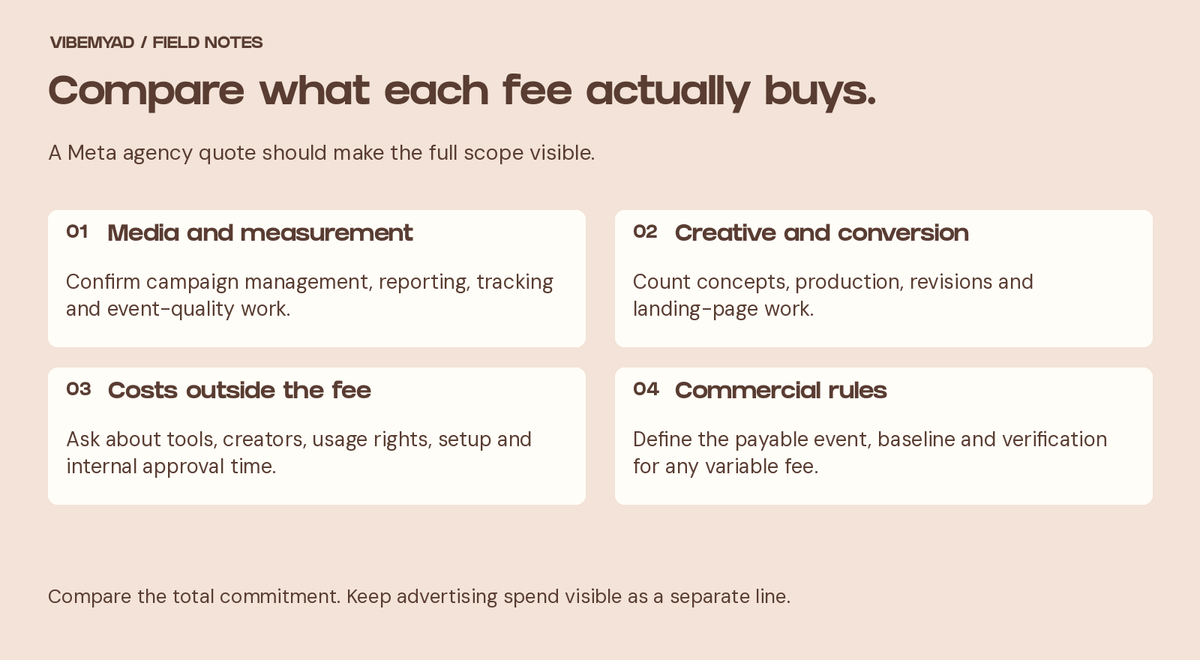
Meta agency fee checklist: media, measurement, creative, conversion, excluded costs and commercial rules.
Ask whether the fee includes research, concepts, copy, scripts, design, editing, revisions, shoots, creators, product samples, and content usage rights. “Creative strategy included” may mean briefs only. “Ten ads” may mean ten resizes built from two ideas.
Count new concepts, not exported files. Meta needs meaningfully different inputs, and a brand needs a production system capable of replacing tired winners.
Attribution tools, landing-page builders, feed apps, reporting platforms, call tracking, server-side tracking, and creative analytics may be billed separately. Setup work can also carry a one-time fee.
Tools are not inherently hidden markups. They become a problem when the sales proposal presents a complete solution while the implementation requires an undisclosed software stack.
Add the hours your team spends briefing, finding footage, approving scripts, fixing product pages, exporting CRM data, managing creators, and explaining margin. An inexpensive agency that requires heavy client coordination can be more expensive than a higher-fee team with operational ownership.
Agency fees generally do not include the amount paid to Meta. Confirm this explicitly. Also ask how taxes, currency conversion, creator payments, usage rights, and travel or production expenses are treated.
Slow approvals and unclear ownership reduce the number of learning cycles completed each month. Delay is not a line on the invoice, but it affects what the fee can produce. A contract with fast decision rights can be more valuable than one with a slightly lower rate.
Examples make the incentive differences easier to see. These are illustrations, not Vibe My Ad quotes or universal market prices.
A brand pays a $6,000 monthly retainer.
• At $20,000 in media spend, the fee equals 30% of spend.
• At $100,000 in media spend, the same fee equals 6% of spend.
The agency becomes cheaper as a percentage when spend rises, but only if the scope still supports the account. If greater spend requires more markets, reporting, and creative, the agency may need to reprice capacity.
A brand pays 15% of media spend.
• At $20,000 in spend, the management fee is $3,000.
• At $100,000 in spend, the management fee is $15,000.
The second fee may be justified if the work expands materially. If campaign complexity and outputs remain similar, the client should ask what the additional $12,000 buys.
A lead-generation company pays for sales-qualified opportunities above an agreed baseline. CRM status, rather than Meta's lead count, triggers the fee. Duplicates, existing opportunities, spam, and leads outside the service area are excluded. The contract caps the monthly variable fee and defines which team owns follow-up speed.
This is more aligned than paying for every form submission. It also requires cleaner CRM data and more operational cooperation than a retainer.
Do not compare proposal totals until each agency answers the same questions. Put the answers into one sheet.
• Total non-media monthly cost: Include management, production, tools, tracking, and expected expenses.
• Fee as a share of spend: Divide non-media cost by planned working media. This exposes when overhead crowds out testing.
• New concepts per month: Separate original hypotheses from variations, cutdowns, and resizes.
• Cost per concept: Divide the relevant creative fee by distinct concepts, while accounting for production quality.
• Ownership: Record who owns tracking, landing pages, creator sourcing, approvals, and reporting.
• Team: Identify the strategist, buyer, creative lead, editors, analysts, and actual senior involvement.
• Terms: Compare minimum commitment, notice period, pauses, IP ownership, account access, and exit support.
• Outcome rules: Record the event, data source, attribution window, baseline, exclusions, quality controls, and fee cap.
This process turns agency pricing models into operating choices. It also prevents a broad service proposal from being compared with media management alone.
Our guide to choosing an ecommerce marketing agency goes deeper into output counts, account access, team structure, and proof.
A retainer is sensible when the agency owns interdependent work across media, creative, measurement, and conversion. Not every valuable action can be assigned cleanly to one sale, and the team needs stable capacity to keep learning.
Require a visible operating cadence: research, briefs, concepts, launches, reviews, and next decisions. Predictability should not mean passivity.
Spend-linked pricing can work when higher budgets add markets, accounts, product lines, reporting requirements, or genuine commercial responsibility. Use fee tiers or declining percentages so cost does not rise indefinitely faster than workload.
Ask what changes at each spend threshold. “More optimization” is not a sufficient answer.
Outcome pricing fits best when the payable result lives in a trusted system and is economically meaningful. Qualified appointments, verified new customers, or contribution after refunds are stronger bases than clicks, leads, or platform-reported revenue.
The client must also give the agency enough control. It is unreasonable to place all performance risk on an agency while the client controls inventory, pricing, website speed, approvals, sales follow-up, and budget interruptions.
A base fee plus a capped variable component can protect the essential work while keeping commercial upside connected to results. The base should not secretly pay for the same outcome twice. Define what it covers and why the variable fee exists.
As our comparison of AI marketing agencies and traditional agencies notes, a fixed invoice can legitimately suit finance teams, while outcome pricing brings more variance. The decision is an operating preference, not a moral judgment.
• The proposal promises performance but never defines the payable outcome.
• The fee rises with spend but deliverables and staffing do not.
• Creative is “included” without concept counts, formats, revisions, or usage terms.
• The agency reports Meta-attributed revenue as if it were proven incremental revenue.
• A long minimum term starts before tracking, access, or production is ready.
• The agency withholds account ownership, raw data, creative files, or documentation.
• A performance fee rewards lead volume without sales-quality controls.
• The retainer lists activities but no outputs, cadence, or responsible people.
• Media spend, tools, production expenses, and creator rights are not separated.
• The agency cannot explain what happens when inventory, pricing, or approvals disrupt results.
Red flags are prompts for clarification, not automatic disqualifiers. The answer and the contract language matter more than the label.
Vibe My Ad positions its agency service around outcomes rather than a conventional retainer lock-in. That structure is meant to connect the commercial relationship to results while combining competitor research, creative production, campaign management, and conversion work.
Outcome-based does not mean measurement is effortless or that every business should use the same contract. A serious engagement still needs a defined result, reliable data, agreed responsibilities, and protection against factors neither party controls.
The model is most useful when both sides can answer three questions before launch:
• What business result are we trying to create?
• Which system will verify it?
• What must each team control for the result to be achievable?
You can review the current service structure on the Vibe My Ad agency page.
Meta ads agency pricing is not a contest between good outcome fees and bad retainers. Each model creates a different allocation of capacity, measurement burden, predictability, and risk.
A retainer is defensible when it buys explicit outputs and reliable expertise. Percentage pricing is defensible when workload and complexity genuinely grow with spend. Outcome pricing is defensible when the result, data source, exclusions, and control are precise. A hybrid can be the cleanest compromise when essential work must happen before performance is visible.
Normalize the full cost, inspect the incentive, and read the operational scope. The cheapest headline fee is rarely the cheapest system.


Arpita Mahato
Content Writer, Vibemyad

Arpita Mahato
Content Writer, Vibemyad

Arpita Mahato
Content Writer, Vibemyad
Table of Contents