August 19, 2026 • 11 min read

August 19, 2026 • 11 min read
A flat $6,000 retainer is 30% of your media budget at $20,000 a month in spend, and 6% at $100,000. Same fee, same agency, completely different deal, and nobody tells you which side of that line you are on.
• Nobody publishes a rate card for e-commerce marketing because the work genuinely is not the same twice, so the number you compare should be the pricing model rather than the headline fee.
• A retainer and an outcome-based fee can start at the same figure and end a year apart, because a retainer stays flat whatever happens while an outcome fee rises and falls with your results.
• The most expensive thing in any agency quote is not the fee, it is the deliverable count that nobody wrote down.
There is no single answer, and any page that gives you one is quoting an average across engagements that have nothing in common. A brand that needs twenty ad concepts a month and a company rebuilding its organic traffic are not the same job, and pricing them the same way would be worse, not better.
What you can pin down is the structure. Four models cover almost everything in the market, and we set out what each one is in our guide to what an e-commerce marketing agency is. This post is about the two that dominate e-commerce, retainer and outcome-based, and specifically about where they stop behaving the same. If you are still deciding whether to hire at all rather than how to pay, start with AI marketing agency vs traditional agency.
That distinction is worth more to you than any price range, because two quotes with identical first-month numbers can diverge by tens of thousands of dollars over a year.
Three reasons, and only one of them is self-serving.
The scope genuinely varies. Paid media on one channel at $20,000 a month in spend is a different operation from paid media on three channels at $200,000, even though both get described as "managing ads".
The inputs are yours, not theirs. An agency inherits your offer, your margins, your site and your existing account. Two brands with the same budget can need completely different amounts of work depending on what is already there.
And the self-serving one: a published rate card invites line-by-line comparison against agencies doing less work for less money, so most firms would rather have the conversation than lose it on a page.
The practical consequence is that you cannot shop this by price. You can only shop it by model, scope and what happens when things go wrong.
A retainer buys a team's time for a month. You agree a fee, the agency assigns people, and the fee stays the same whether the work performs or not.
What it rewards. Predictability. You can budget it, your finance team can approve it, and the agency can staff against it. For work with a long payback, like SEO or brand, that stability is genuinely useful.
What it does not reward. Efficiency. If the agency finds a way to do the same work in half the time, the fee does not move. If your revenue doubles, the fee does not move either, which is good for you. If your revenue halves, the fee still does not move, which is not.
The question to ask. How many deliverables are in the scope, in writing? A retainer without a stated output count is a payment for attendance. Most disputes we hear about start there.
An outcome-based fee ties what you pay to a result you both agreed in advance. That result has to be defined precisely enough to settle an argument, which is the whole difficulty and the whole value.
What it rewards. Performance, in both directions. A month where the work lands costs more than a month where it does not, and the agency carries some of the risk it is asking you to take.
What it does not solve. Attribution. If you cannot agree what counts as a result, or how to measure it, outcome pricing becomes a monthly argument instead of a monthly invoice. It works when the metric is unambiguous and both sides can see the same dashboard.
The question to ask. What exactly is the result, who measures it, and what happens in a month where the market moves against us both? An agency that has thought about the bad month has done this before.
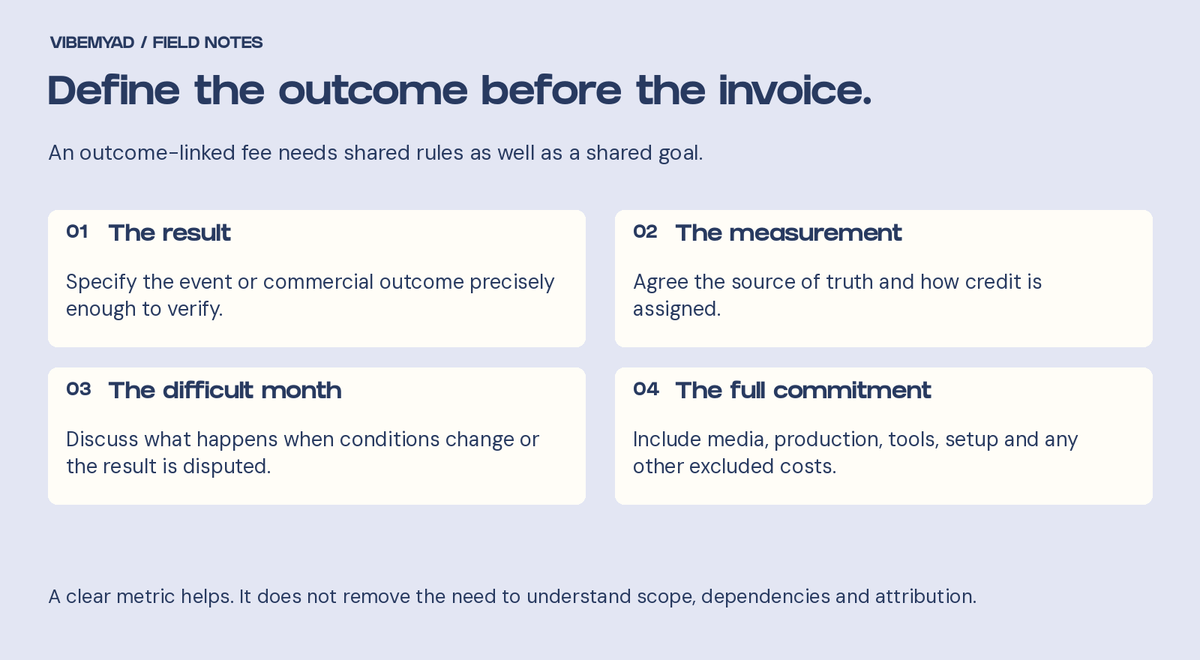
Outcome-fee checklist: define the result, measurement rules, difficult-month treatment and full costs.
Here is the part nobody publishes. Take one brand, run it under three pricing models at three spend levels, then add one bad quarter.
Illustrative figures, not survey data and not our rates. The outcome column assumes a 2.5x return on spend and a fee of 10% of revenue above a 2.0x baseline. Swap in your own baseline and the shape holds.
Four things fall out of that table.
A retainer gets cheaper as you scale. At $20,000 in spend it is 30% of your media budget. At $100,000 it is 6%. If you are growing fast, a flat retainer is the friendliest structure in the market, and agencies know it, which is why most reprice at renewal.
A media percentage gets more expensive as you scale, and it rewards the wrong thing. The agency earns more by spending more, which is not always the same as earning more. That is not a claim about anyone's integrity, it is just what the incentive says.
Outcome pricing is the only one that moves in the same direction as your business. It costs more in a good month and less in a bad one. Whether that is better for you depends entirely on how tightly the outcome is defined.
Look at the last row. In a quarter where returns fall below the baseline, the retainer still costs $6,000 and the percentage still costs $15,000. The outcome fee costs nothing. That is the entire argument for the model, and it is also why agencies are slow to offer it.
The honest summary: at low spend a percentage is usually cheapest, at high spend a retainer usually is, and outcome pricing is the only structure where a bad quarter costs you less.
Fees are meaningless without the scope attached, and this is where most comparisons fall apart. Three brands paying three different numbers are usually buying three different jobs, not three different qualities of the same job.
Illustrative scopes based on how engagements are commonly structured, not a rate card.
Two things worth knowing about that ladder.
The jump from tier one to tier two is the one that matters most. Below roughly $3,000, you are typically buying a fraction of one person's attention, and the output is capped by their week rather than by any system. That is fine if your needs are small. It is the wrong purchase if production volume is the reason you are hiring.
Above $8,000 the differences stop being about capability and start being about capacity. Most competent agencies can do the work in that band. What separates them is how much of it they can produce, how fast they decide what to make, and whether senior people are actually on your account.
If you are trying to place your own budget on this ladder, start from your output requirement rather than your budget. Work out how many new ad concepts a month your category demands, then find the tier that delivers it. Choosing the tier first and hoping the output follows is the most common way brands end up disappointed by an agency that did nothing wrong.
Six things, roughly in order of impact.
• Output volume. Twenty ad concepts a month is a different price from five. Usually the single biggest lever in any quote.
• Number of channels. One channel run well is far cheaper than three run adequately.
• How much exists already. An account with clean tracking, a working offer and an asset library costs less to run than one being rebuilt from nothing. A read of the Meta Ad Library will tell you what your category is running before anyone quotes you.
• Speed. Compressed timelines cost more everywhere, and agencies price urgency whether or not they say so.
• Seniority on the account. The people in the pitch are not always the people doing the work. Ask who, by name.
• Whether production is included. Some fees cover strategy and media buying but not the making of the assets, which arrives later as a separate line.
Every one of those six is a reason a quote moves. None of them tells you whether the quote is fair, and for that you need something outside the agency market to measure against.
The obvious benchmark is hiring. According to the US Bureau of Labor Statistics (May 2024), the median annual wage for a graphic designer is $61,300, roughly $5,108 a month in base pay before payroll tax, benefits, software and management time. So a $6,000 retainer is priced at about one loaded junior hire. Whether that is good value depends entirely on whether the agency ships more than one person's worth of work, which is the arithmetic we ran in are AI marketing agencies worth it.
Five costs that rarely appear on the first page.
• Media spend itself. Usually excluded from the fee. Confirm it, because a $6,000 fee on top of $40,000 in spend is a $46,000 monthly commitment.
• Production. Video, photography and anything physically shot are often quoted separately.
• Tooling. Some agencies pass through their software costs. Some absorb them. Ask which.
• Setup or onboarding fees. One-off, sometimes substantial, and easy to miss in a proposal's second half.
• What leaving costs. If your assets, accounts and research do not travel with you, the exit price is the real price. This is the one that catches people.
On the last point, the cheapest test is a direct question: if we stop in month three, what do we keep? An agency that answers that comfortably has designed for it.
We are an e-commerce marketing agency for DTC brands on Shopify. We price against outcomes rather than hours, for the reasons set out above, and the operating model behind it is covered in what an AI advertising agency is.
So there is no rate card here either. Here is what we can tell you concretely instead.
• The scope and the number come together on the first call. A 30-minute conversation, no deck, and the figure is built from your funnel, your category and what the audit finds rather than from a package.
• Month to month, no lock-in. We would rather earn the next month than hold you to six.
• You keep everything. Every asset, account and insight stays yours and travels with you if you leave, which removes the hidden exit cost above.
• You can start with one service. Usually paid media or search, rather than all six. What that covers is on the e-commerce marketing agency page in full.
And where we do publish exact numbers, we publish them to the cent. If you would rather run the platform yourself, our pricing page lists per-action costs: half a cent to pull an ad into your library, seven cents to classify one, ninety-nine cents for a generated image. Credit packs start at $20 and never expire. That is the same system our own team works in, sold directly.
What to take from all of this:
• Compare models, not quotes. Two identical first-month numbers can diverge by tens of thousands over a year, and the model tells you which direction.
• Get the output count in writing. A fee without a deliverable count is a payment for attendance, and it is where most disputes begin.
• Price the exit, not just the entry. Ask what you keep in month three if you stop.
The fastest way to judge any proposal is to know what your category already demands. Send us two competitors and we will pull their ads apart for free, so you can see the production volume you are actually buying against, using the same category intelligence our own team runs on. If the honest answer is that you do not need an agency yet, we will say that instead.
Get notified when new insights, case studies, and trends go live — no clutter, just creativity.
Table of Contents