August 24, 2026 • 16 min read

August 24, 2026 • 16 min read
US digital marketing agencies commonly quote between $2,500 and $20,000 a month for ongoing engagements. Scope determines where in that range a proposal lands, and advertising spend is usually separate from the fee. No public dataset verifies those figures, so treat them as an observed range rather than a benchmark.
The sections below cover what services typically cost, what the fee includes, which costs sit outside it, how the four pricing models compare, and how to evaluate two proposals against each other.
• US digital marketing agencies commonly quote between $2,500 and $20,000 a month, but no public dataset verifies that range and the label covers work that varies enormously.
• The fee is a fraction, not a figure. A $5,000 retainer against a $15,000 monthly working budget means a third of that money buys coordination rather than reach.
• Convert before you compare. Two quotes at the same headline number can differ enormously in what they ship, and only a deliverable count exposes it.
Monthly engagements in the US commonly fall between $2,500 and $20,000, with project work priced separately and enterprise scopes running above it. Treat that as an observed range rather than a benchmark. No credible survey publishes verified agency rates, which is itself part of the problem described below.
The spread is enormous because the label covers almost nothing. "Digital marketing agency" describes a firm that might run one paid social account, or might run paid media, SEO, email, creative production, and analytics across four channels simultaneously. Those are not the same purchase and they are not priced by the same logic. We set out what the category actually includes in our guide to what a marketing agency does.
So the headline fee tells you very little on its own. The number that means something is the fee expressed as a share of what you have to spend, and almost nobody quotes it that way.
The monthly fee varies considerably by channel. Paid media management commands higher fees because of the technical complexity and media accountability. SEO and content are typically lower per month but require a longer runway before results compound. Creative production is often priced per asset rather than per month. The figures below reflect a single-channel engagement; bundled multi-channel retainers are usually discounted from the sum of parts.
Illustrative ranges based on observed US market practice. Figures are not from a verified survey. Actual quotes depend on scope, creative volume, and agency tier.
Bundled retainers covering multiple channels typically range from $3,000 to $15,000 a month, depending on the number of channels, the creative volume required, and whether the agency is running media or simply advising on it. The exclusions column is the one most buyers do not read carefully enough. Ad spend, platform fees, and creative assets frequently sit outside the retainer and add meaningfully to the total monthly outlay.
A retainer covers the agency's time and judgment. What that translates to in actual deliverables is something every proposal should state explicitly, and many do not. Before signing, ask for the following in writing.
• Strategy and planning. Channel strategy, quarterly planning sessions, and the time allocated to it each month. Ask for a number of hours or a named deliverable, not a description.
• Setup and onboarding. Account configuration, pixel installation, audience builds, and creative templates. Some agencies charge this separately as a one-time setup fee. Confirm which.
• Creative production. The number of assets per month, the formats covered, and the number of revision rounds. This is the line most proposals leave vague and the line that causes the most disputes.
• Optimization and management. Frequency of bid adjustments, audience refreshes, and copy testing. Ask whether this is handled by a dedicated manager or rotated across a team.
• Reporting. Cadence, format, and which metrics are tracked. Weekly reporting is standard at most retainer levels above $3,000 a month. Monthly-only reporting at higher fees is worth questioning.
• Meetings and communication. Number of scheduled calls per month, expected response time on ad hoc questions, and the point of contact. Some agencies include a dedicated account manager; others route everything through a shared inbox.
Any deliverable not specified in the contract is a candidate for an out-of-scope conversation later. The cleaner the list is upfront, the fewer of those conversations you will have.
The retainer is rarely the total cost of working with an agency. The following items commonly sit outside it. Contracts differ, so verify each one before signing.
• Advertising spend. Paid directly to Meta, Google, or other platforms by you or through the agency. This is separate from the management fee in most retainer arrangements and is the largest additional cost for paid media clients.
• Setup or onboarding fees. A one-time charge covering account audits, pixel configuration, and initial creative builds. Common at agencies that do not fold setup into the retainer. Typically $500 to $3,000 depending on the complexity of the account.
• Software and platform tools. Analytics platforms, reporting tools, SEO software, and scheduling tools are sometimes billed through the agency and sometimes charged separately. Ask which tools the engagement requires and who pays for them.
• Creative production above the retainer limit. If the retainer includes four ad assets per month and your campaign needs twelve, the difference is usually billed at a per-asset rate. Know the rate before you need the assets.
• Landing pages and conversion rate work. Frequently excluded from paid media retainers even when the agency is running traffic to the pages. Development and design work on destination pages is usually a separate project quote.
• Extra revisions. Most retainers specify a revision allowance per asset or per month. Revisions beyond that allowance are billed at an hourly rate or a flat per-round fee.
A useful exercise before signing any proposal: total the retainer, the estimated ad spend, the tool costs, and the likely additional creative volume. That combined number is your actual monthly outlay, and it is the figure to compare across proposals rather than the headline retainer.
Before you can judge a fee, you need a denominator.
The Gartner 2026 CMO Spend Survey, published 11 May 2026, puts marketing budgets at 7.8% of company revenue, up slightly from 7.7% the year before. Gartner surveyed 401 CMOs and marketing leaders across North America, the UK, and Europe, with fieldwork running from January to March 2026.
That figure needs a warning label attached to it. The vast majority of Gartner’s respondents run companies above $1 billion in revenue, which is a different weight class from most brands reading this. The percentage is also of total revenue and covers everything, including internal salaries. It is a mature-company equilibrium, not a target, and growth-stage brands commonly run well above it.
What it is genuinely useful for is establishing that a denominator exists at all. Whatever your own number is, the agency fee is a slice of it, and the slice is the thing to evaluate.
Three steps, and they take about ten minutes.
Separate the working budget from the total. Your total marketing budget includes salaries, tools, and overhead. Your working budget is what is left to spend on media and production. Agency fees come out of the working budget, so that is the denominator that matters.
Express the fee as a percentage of the working budget. A $5,000 retainer against a $15,000 working budget is 33%. The same $5,000 against $50,000 is 10%. Same fee, same agency, entirely different deal, and the proposal will not tell you which one you are signing.
The same three fees, against three working budgets. Arithmetic, not market data.
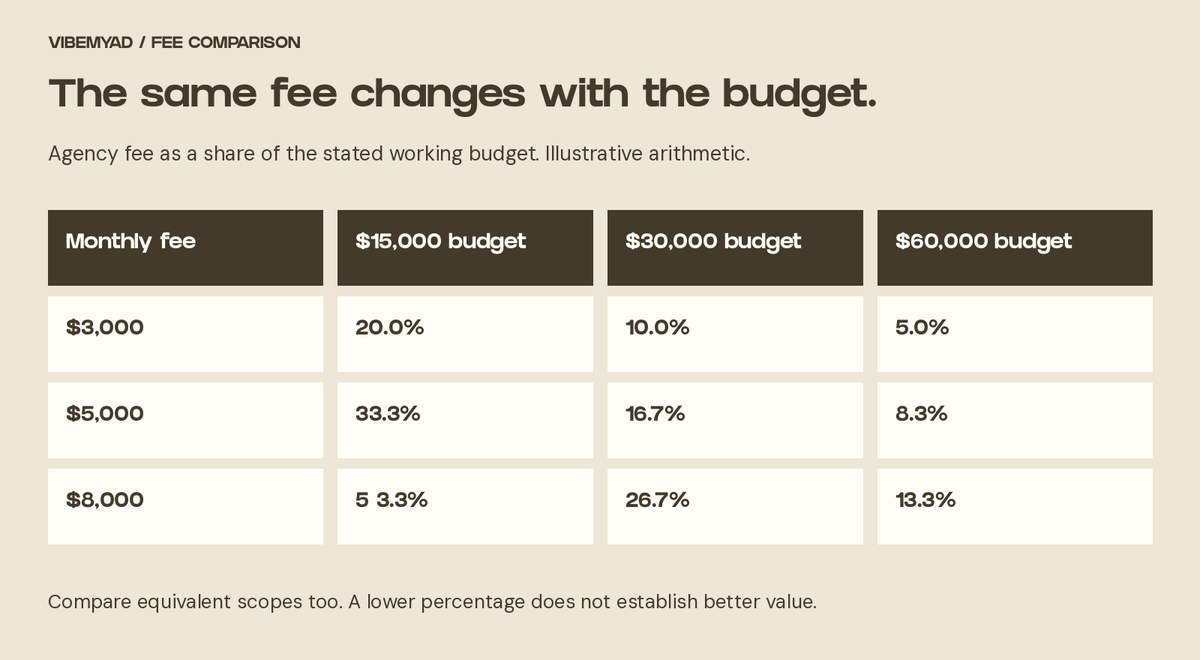
Illustrative fee percentages for monthly fees of $3,000, $5,000 and $8,000 against working budgets of $15,000, $30,000 and $60,000.
Nothing in that table is a claim about anyone. It is division. But it is the division almost no proposal does for you, and the row that should stop you is the last one: at a $15,000 working budget, an $8,000 retainer spends more on the agency than on the advertising.
Get the deliverable count in writing. Assets per month, channels managed, strategy hours, reporting cadence, revision rounds. This is the line that separates two agencies quoting identical fees, and it is the line most proposals leave vague. If you want a reference point for what your category actually produces, a read of the Meta Ad Library will show you the volume competitors are running before anyone quotes you.
Run those three steps on every quote and you can compare proposals to each other rather than to your own anxiety.
The three illustrative scenarios below separate the agency fee from media spend, tools, and setup so you can see the full monthly outlay rather than just the retainer. These are constructed examples, not client quotes or market averages.
Scenario A: Single-channel paid social support.
Scenario B: Paid media plus creative production.
Scenario C: Broader growth engagement across multiple channels.
The agency fee percentage lands in a similar range across all three scenarios because the fee and the working budget tend to scale together. What changes is the total size of the commitment. Scenario A is a test of whether the channel works for you. Scenario C is a full growth infrastructure. Running the same percentage calculation on any proposal tells you where it sits on that spectrum.
Two proposals at the same headline fee can differ substantially in what they deliver. The worked comparison below uses two illustrative proposals at $5,000 a month to show what those differences look like in practice.
Agency A costs less in month one, runs one channel, and gives you more creative and more revision rounds for that channel. Agency B runs two channels, which sounds like more value, but the setup fee adds $1,500 to month one, the revision allowance is lower, and the contract locks you in for three months. Neither proposal is obviously better. The right choice depends on whether you need two channels or one managed well.
Before signing any proposal, get answers to the following in writing.
• What is included in the retainer and what is billed additionally?
• What is the total cost in month one including setup?
• Who owns the creative assets, ad accounts, and audience data if the engagement ends?
• What is the notice period and cancellation process?
• How is performance measured and against what baseline?
An agency that resists putting any of those answers in writing before you sign is answering the question without intending to.
Each model answers one question: who absorbs the risk when the work underperforms?
Illustrative. The percentage band reflects commonly observed practice, not survey data.
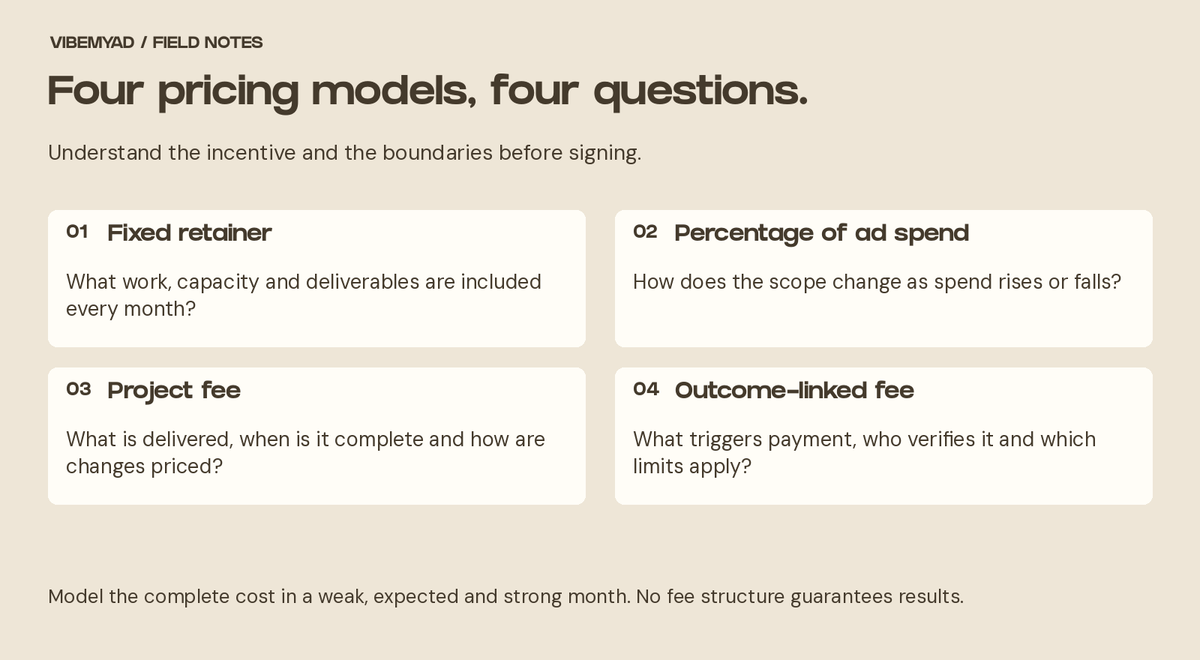
Four agency pricing models and the questions to ask about scope, spend, project completion and outcome verification.
The percentage model deserves more scrutiny than it usually gets. It is sold as alignment, on the logic that the agency grows only when your spend grows. But spend and return are different things. An agency paid a percentage of media has a structural reason to recommend more media and no structural reason to recommend less, including in the month when less is correct.
Outcome-based pricing inverts that, which is why fewer firms offer it. It requires the agency to believe its own forecast, and it requires both parties to agree in advance on what counts as the outcome. That second part is where most of these arrangements fail.
For the mechanics of those two models in depth, we have written a fuller comparison of retainer versus outcome pricing for e-commerce brands.
Two agencies can quote very different numbers for what appears to be the same brief. The gap is almost always explained by one of six factors, and knowing which one is driving the difference tells you whether the higher quote represents more value or more margin.
• Channel count. An agency quoting for paid social, SEO, and email simultaneously is running three separate workstreams. An agency quoting for paid social only is not. Comparing their fees without accounting for scope difference is comparing two different purchases.
• Creative volume. Producing four ad assets a month and producing twenty are not the same retainer. Agencies quoting high creative volume into a fixed fee are either pricing it in or planning to absorb it at the expense of quality. Ask for the asset count and the per-asset rate for anything above it.
• Account complexity. A single ad account with one product and one audience is simpler to manage than a multi-SKU catalog running across five countries with separate creative for each market. Complexity is priced in whether or not the proposal names it.
• Seniority and expertise. A boutique agency staffed by people who ran large accounts in-house commands a higher fee than a generalist shop that applies the same playbook to every client. The fee difference is real, but so is the question of whether you need the expertise or whether a competent generalist gets you 80% of the result at half the cost.
• Location. US agencies in major markets (New York, Los Angeles, San Francisco) typically price above agencies in smaller markets and significantly above agencies operating remotely from lower-cost locations. The output quality does not always reflect the price difference.
• Service level. A dedicated account manager, weekly calls, and 24-hour response time costs more than a shared account manager, monthly calls, and 48-hour response time. Both may be described as full-service in the proposal.
None of these factors automatically make a higher quote better or a lower quote worse. A higher price with more scope is a different calculation than a higher price for the same scope. The deliverable count is the only number that tells you which one you are looking at.
Increasingly, agencies price AI capability into the fee. It is worth asking what you are paying for.
There is no public dataset on agency AI maturity, so anyone who tells you what share of agencies genuinely run on AI is guessing. What we do have is the client-side picture, and it is instructive. Gartner’s 2026 survey found CMOs allocating an average of 15.3% of marketing budgets to AI initiatives, while only 30% reported mature or fully developed AI readiness capabilities. Notably, the organisations that did report readiness were spending more on AI, not less, at 21.3% of their budgets against the 15.3% average. We looked at whether that premium pays for itself in are AI marketing agencies worth it.
Read carefully, that is not a story about waste. It is a story about AI spend and AI capability rising together, with most organisations still early on both. Those figures describe in-house marketing teams rather than agencies. But they describe the market agencies are selling into, and a market where 70% of CMOs call AI leadership a critical goal is a market where "AI-powered" sells regardless of whether it is true.
So the test is not whether an agency uses AI. Nearly every firm now claims to. The test is whether it changed anything you can measure. Genuine compression of research and production shows up in exactly three places: more output at the same fee, faster turnaround, or a willingness to price against results instead of hours. If none of those three moved, the AI is in the pitch rather than the production. What actually changes under the hood is set out in AI marketing agency vs traditional agency.
One thing to be clear about upfront. Our agency does not publish a rate card either. Everything in the Reddit section above applies to us as much as to anyone else, and it would be dishonest to run that critique and then exempt ourselves from it.
What we do differently is narrower than claiming transparency. Engagements are scoped and priced after one call, put in writing together, and run month to month with no lock-in. You still do not get a number before speaking with us. You get it earlier than most agencies provide it, attached to a defined scope, with the option to leave the following month.
The platform is different in a specific way: it sells units rather than judgment, and units can be listed:
• Pulling a live competitor ad into your ad vault: $0.005
• Classifying that ad by hook, CTA, funnel stage, and visual approach: $0.07
• Generating an image: $0.30
It is the same system our own team works in, sold pay-as-you-go with no subscription, and the full price list is public to the cent. Credits never expire. Start free with $5, no credit card required. If you would rather not hire an agency at all, that is the honest alternative.
What to take from all of this:
• Convert every quote to a percentage of your working budget before comparing it to anything, including your instinct about what feels expensive.
• Compare models before prices. A $5,000 retainer and a 15% share of spend are identical at one budget and wildly different at another.
• Ask what changed, not what is used. On AI specifically, the answer should be visible in output volume, turnaround, or pricing structure. If it is not visible in one of those three, it did not happen.
The fastest way to price a proposal is to know what your category already produces. Send us two competitors and we will pull their ads apart for free, so you can see the production volume any quote is really being measured against, using the same ad intelligence our own team runs on. If the honest answer is that you do not need an agency yet, we will say that instead.
Get notified when new insights, case studies, and trends go live — no clutter, just creativity.
Table of Contents