August 24, 2026 • 9 min read

August 24, 2026 • 9 min read
Most agency pitches are indistinguishable. Everyone is data-driven, everyone is a partner rather than a vendor, everyone has a case study where revenue went up and to the right. You leave three calls with the same impression and no way to rank them.
The way out is not a better instinct. It is a better question list. The nine below are the ones where a strong agency and a weak one give visibly different answers, which is the only property that makes a question worth asking.
• Ask about process, not results. Any agency can show you a good outcome. Only a good one can explain the decision that produced it.
• The three highest-signal questions are what they do before making anything, who does the work by name, and what you keep if you leave.
• Ask the uncomfortable ones before you sign, not after. Month-one exit terms and asset ownership are negotiable in week one and fixed in week five.
Not talent, most of the time. In any given price band, most agencies can execute competently, a point we made when working through what an e-commerce marketing agency does. What separates them is how they decide what to make, how much they produce, and what happens when a month goes badly.
All three are process questions, and process is what a pitch deck is designed to hide. So the questions below are built to get underneath it. Each one has an answer that is easy to give if the agency has a system, and hard to give if it does not.
Here is the whole list at a glance, before we take each one apart.
This is the single highest-signal question on the list, and it should be the first thing you ask.
A strong answer describes inputs. Something like: we pull every live ad in your category, classify them by hook, format, and funnel stage, and find the angle nobody is running. That is a process you can picture, and it produces a different creative brief than guessing. If you want to sanity-check their answer yourself, the Meta Ad Library is public and free.
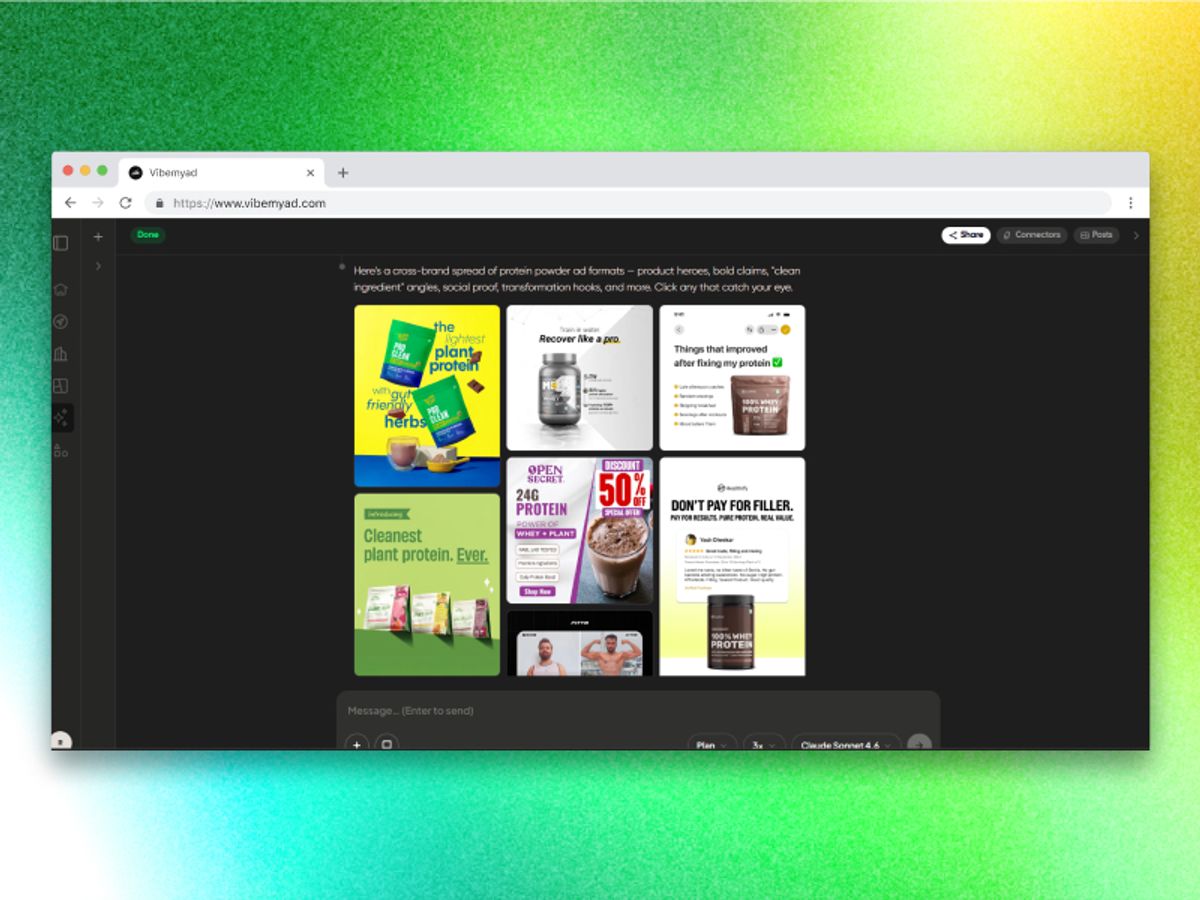
What a real answer to question one looks like: named inputs, counted.
A weak answer describes attitude. "We are data-driven." "We start with your brand DNA." "We do a deep dive." None of these tell you what happens on a Tuesday. Ask what specifically gets looked at, and how many of them.
The first question covers where they start. This one covers what they do in month four, when the initial ideas are spent.
A strong answer names a trigger. A concept gets retired at a defined threshold, a new angle gets tested when a competitor introduces one, the next batch is chosen from what the last batch showed. There is a rule, and the rule can be stated.
A weak answer is "we iterate based on performance." Everyone says that. Ask what number tells them to stop running something, and who makes that call. An agency without a stopping rule keeps spending your money on an ad that stopped working three weeks ago.
The people in the pitch are frequently not the people on the account. This is not usually deception. It is just how agencies staff.
A strong answer is specific. Names, seniority, how many other accounts each person carries, and who you talk to when something breaks. An agency that answers this comfortably has nothing to hide about it.
A weak answer is a team structure diagram. If you cannot get a name, assume the senior person in the room is selling, not delivering. Ask directly whether the people presenting will be on your account in month two.
Two agencies quoting the same fee can differ enormously in output, and nothing in a proposal reliably exposes that except a number.
A strong answer is countable. Assets per month by type, channels managed, revision rounds included, reporting cadence. Written into the scope, not described on a call. We went through how much this changes the real price in our breakdown of e-commerce agency costs.
A weak answer is adjectival. "A robust creative pipeline." "As much as it takes." A fee without a stated output count is a payment for attendance, and it is where most agency disputes begin.
Every agency has a good month one story. Fewer have thought about the bad one, and the difference tells you a great deal.
A strong answer has already been designed. Month-to-month terms, a defined review point, an honest description of what "not working" looks like this early given the data available. Some will tell you month one is too early to judge anything, which is a good answer if they say what they will judge instead.
A weak answer is reassurance. "That will not happen." "Give it six months." Six months is sometimes the right answer, but it should come with a reason and an interim checkpoint, not as a way of ending the question.
This is the question that catches people, because it costs nothing to ask in week one and cannot be fixed in month seven.
A strong answer is everything. Ad accounts in your name, creative assets delivered in source files, audience and research data exportable, tracking configured under your own properties. The agency operates inside your infrastructure rather than its own.
A weak answer involves their platform. If the research lives in a tool you lose access to, or the ad account is theirs, or the assets arrive only as flattened exports, then leaving costs you the work as well as the notice period. That is the real switching cost, and it rarely appears in the fee.
Anyone can supply a happy reference. The useful call is the other one.
A strong answer is yes, with a name. Agencies lose clients for ordinary reasons: budgets move, a brand hires in-house, the fit was wrong. An agency confident in how it behaved on the way out will connect you, and that conversation is worth more than three glowing ones.
A weak answer is deflection. If nobody has ever left, either the agency is very young or the answer is not true. Ask a current client in your category as well, and ask them one specific thing: what took longest to get right.
An agency that will take any client is telling you something about how it plans to serve you.
A strong answer is a real boundary. Budgets below a threshold where the work cannot succeed, categories they do not understand, a product with a conversion problem that advertising will not solve. Firms that have said no before can describe when.
A weak answer is enthusiasm. If every scenario you describe is one they can help with, they are selling capacity rather than judgment. This question also tests honesty cheaply, since the truthful answer is mildly against their interest.
Ask for a picture, not a projection. You are testing whether they have done this before, not whether they can forecast.
A strong answer is concrete and hedged. By month three you should have this many concepts tested, this much learned about which angle works, this decision made. Notice that a good answer commits to activity and learning rather than to a revenue number, because the revenue number depends on things outside their control.
A weak answer is a revenue guarantee. Anyone promising a specific return by a specific month either does not understand attribution or is counting on you forgetting. We looked at how to evaluate those claims in are AI marketing agencies worth it.
Not all nine belong on the first call. Spreading them across the process tells you more, because you get to see whether the answers stay consistent.
The last three are the ones people skip, because by then they have decided and the questions feel adversarial. They are not adversarial. They are the only ones whose answers you cannot renegotiate later.
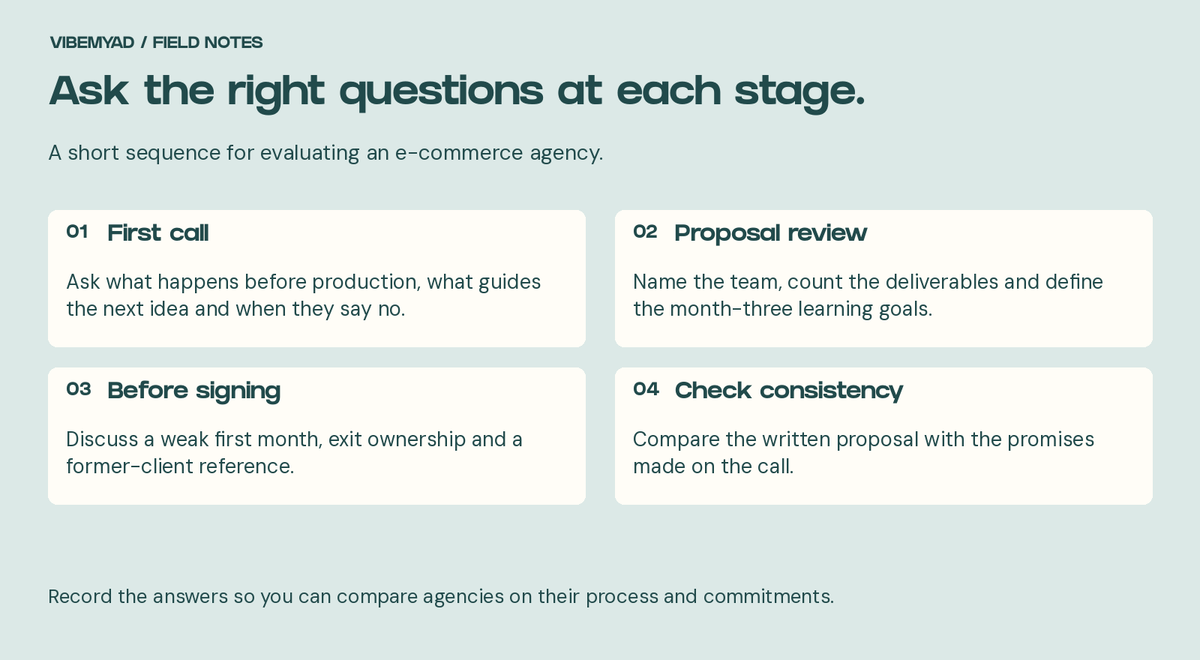
Agency selection sequence: first-call process questions, proposal details, exit terms and consistency checks.
It would be strange to publish this list and not answer it. Here is where our agency stands on the ones that matter most.
• Before we make anything, we pull and classify every live ad in your category by hook, format, and funnel stage. That is not a description of our attitude, it is a product you can buy separately as ad intelligence.
• You keep everything. Accounts, assets, and research stay yours and travel with you. There is no version of leaving where you lose the work.
• Month to month, no lock-in. The scope and the number are written down together after one call, and you can stop at the end of any month.
• We say no. If the honest read is that your conversion problem is on the site rather than in the ads, or that you are better off running the platform yourself for now, that is what you will hear.
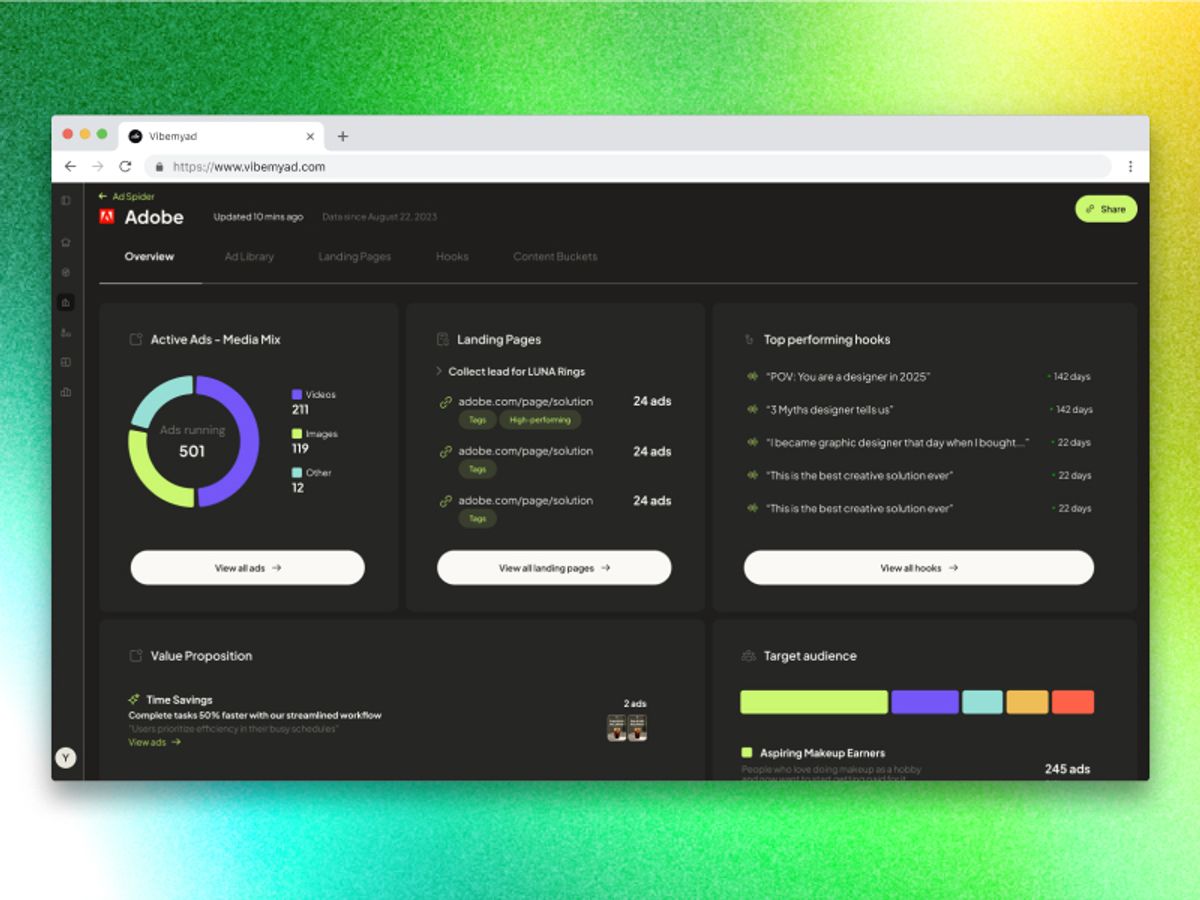
The category research that answers question one, sold as a product on its own.
Ask us the other five directly. If you would rather form your own view first, an ad audit will show you what your category is producing before you talk to anybody.
What to take from all of this:
• Ask about process, not outcomes. Results prove something happened once. Process predicts whether it happens again.
• Get the countable things counted. Deliverables, names, and notice periods belong in writing, not in a conversation you will remember differently later.
• Ask the exit questions before you sign. What you keep and how you leave are cheap to negotiate in week one and impossible in month seven.
The fastest way to judge any answer to question one is to know what your category is actually running. Send us two competitors and we will pull their ads apart for free, so you walk into the next pitch already knowing what good research looks like. If the honest answer is that you do not need an agency yet, we will tell you that instead.
Get notified when new insights, case studies, and trends go live — no clutter, just creativity.
Table of Contents