
February 10, 2026 • 16 min read

February 10, 2026 • 16 min read
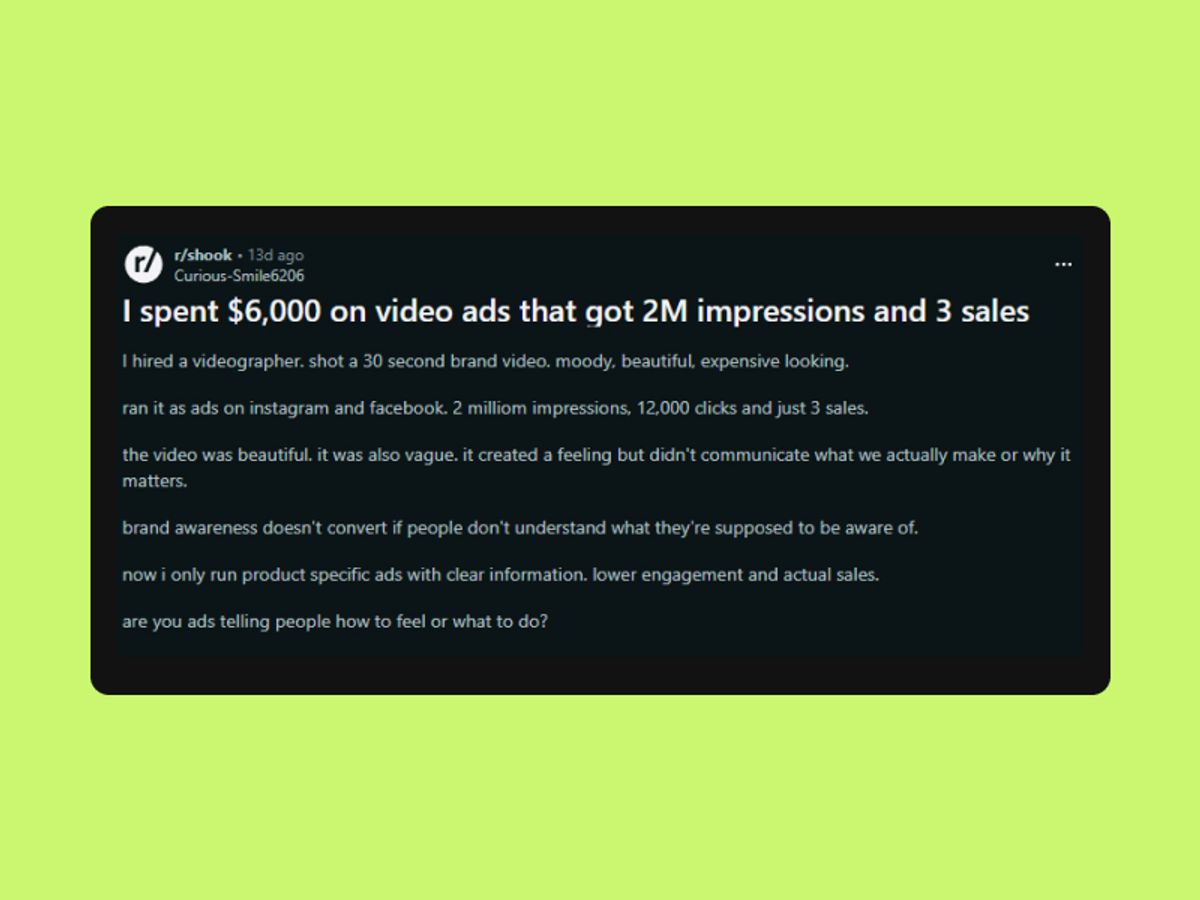
You just spent $6,000 on video ads. Two million impressions later, you've made exactly three sales.
The creative wasn't bad—professional filming, clear messaging, solid call-to-action.
The problem? You uploaded the exact same video to TikTok, Instagram, and Facebook, expecting it to work everywhere.
It didn't. And now you're in the weekly meeting trying to explain to your boss why the same ad that's crushing it on TikTok is getting 0.9% CTR on Facebook. "Platform differences" sounds like an excuse when you say it out loud, not a strategy.
Here's what nobody tells you:
Your cross-platform advertising approach isn't just underperforming. It's actively destroying your credibility and bleeding your budget. And the worst part? You probably don't even realize how much money you're leaving on the table.
A recent discussion on a Reddit subreddit r/shook revealed something shocking: 68% of marketers use the same content across multiple platforms, but only 23% see consistent results. The math is brutal. More than two-thirds of advertisers are doing exactly what you're doing, and three-quarters of them are failing.
This guide is going to show you exactly why platform-specific strategies aren't optional anymore—they're the difference between profitable campaigns and expensive lessons. You'll see real data, real failures, and the framework that actually works.
Let me paint you a picture of what's actually happening to your ads right now.
They give you maybe 8-12 seconds before their thumb moves. They want raw, authentic content that feels like their favorite creator made it, not like an agency produced it. Your polished studio ad with perfect lighting and professional voiceover? They're scrolling past it in 3 seconds.
They're there for inspiration and aesthetics. They expect higher production value than TikTok, but they'll reject anything that feels too corporate or sales-heavy. They want to be shown beautiful things, not told what to buy.
They'll watch a 45-second video explaining how your product works. They want details, social proof, and reasons to trust you before they click.
Same product. Same target customer. Completely different psychological states.
When you post identical content across all three platforms, you're not optimizing for any of them. You're creating mediocre middle-ground content that underperforms everywhere.
One advertiser on r/shook discovered this the painful way. They were creating one piece of content and distributing it across every platform. Performance was all over the place, and they couldn't understand why. TikTok would occasionally pop off. Instagram would be mediocre. Facebook would bomb completely. There was no pattern because they weren't playing by any platform's rules—they were hoping the algorithm would somehow make it work.
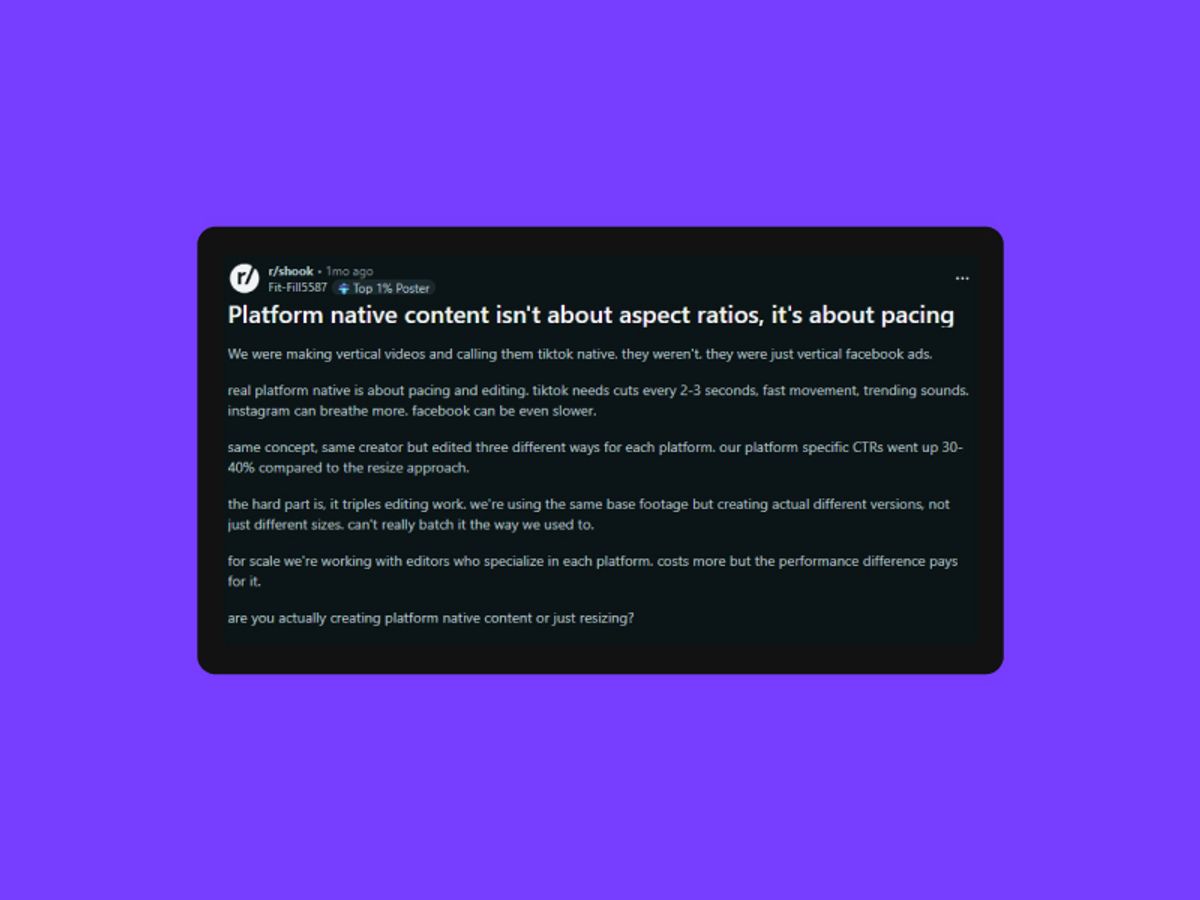
It never does.
Here's the real cost: When your TikTok ad uses a polished, professional style, the algorithm sees people scrolling past it quickly and shows it to fewer people. When your Facebook ad is too short and casual, users don't trust it enough to click. When your Instagram ad tries to be everything to everyone, it ends up being nothing to anyone.
You're not just getting lower CTRs. You're getting algorithmic penalties you can't even see. Each platform is designed to reward native-feeling content, and when you upload identical videos everywhere, you're actively fighting against what the algorithm wants to promote.
Let me tell you about the most important ad test I've seen anyone run.
An advertiser on r/shook was frustrated with their TikTok performance. They'd invested in professional video production—studio lighting, professional crew, scripted voiceover, the works. The ad looked incredible. It was getting decent impressions but terrible conversion rates.
So they tried something desperate. They shot an ad in a parking lot. iPhone quality. Bad lighting. No script, just talking naturally about the product. They fully expected it to bomb.
It crushed. 3.9% CTR compared to the professional ad's 2.1%. More importantly, 6.2% conversion rate compared to 2.8%. The parking lot ad, which cost nothing to produce, outperformed the $5,000 studio production by nearly 3X on actual sales.
Why?
Because TikTok users have developed complete immunity to polished advertising. When they see professional production quality, their brain immediately categorizes it as "ad" and scrolls past. When they see someone in a parking lot talking about a product like they're texting a friend, it feels real. It feels like content, not advertising.
This is the fundamental truth about platform-specific strategies: What looks "better" isn't what performs better. What performs better is what fits the platform's native content style.
But here's where most advertisers get stuck after learning this lesson. They know TikTok wants raw content. They know Instagram wants polished visuals. They know Facebook wants detailed explanations. But they don't know what "raw" or "polished" or "detailed" actually looks like for their specific product and audience.
This is where competitive intelligence becomes critical. You can't just guess what platform-native means for your niche. You need to see what's actually working.
Use Vibemyad's Ad Spider to track your top 25 competitors across all platforms. You'll immediately see patterns. The TikTok ads winning in your space all use a specific hook style—maybe it's problem-statement opens, maybe it's "I tried 20 products and this is the only one" angles. The Instagram ads emphasize certain visual approaches. The Facebook ads lead with specific benefits.
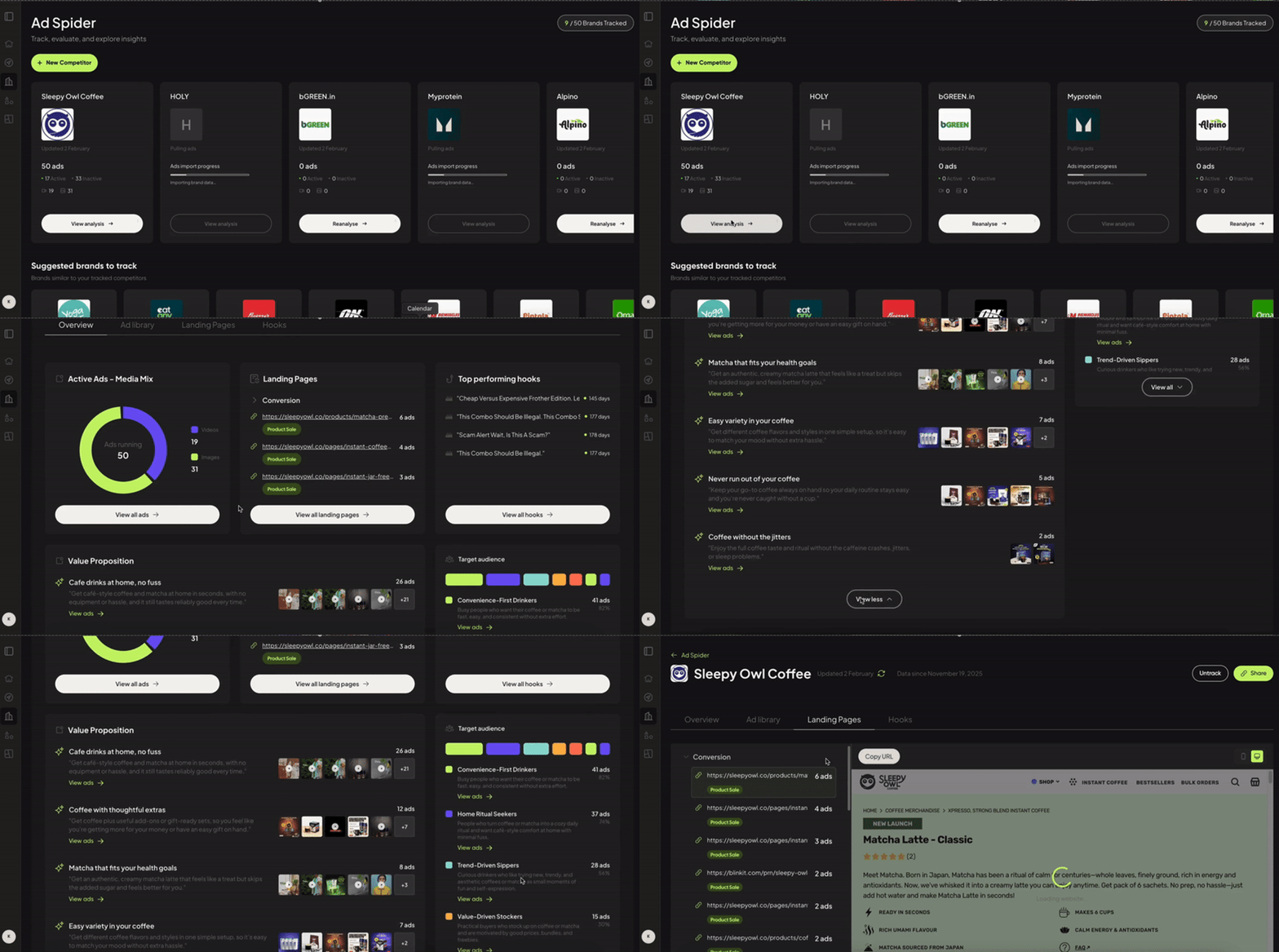
Vibemyad Ad Spider
You're not copying their ads. You're identifying the platform-specific conventions that audiences in your niche respond to. Once you know those patterns, you can create content that feels native while still being uniquely yours.
Let's talk about metrics for a second, because this is where the copy-paste strategy reveals its true cost.
You launch an ad across TikTok, Instagram, and Facebook. Same creative, same targeting, same daily budget of $50 per platform. After a week, here's what you see:
TikTok: 1.2% CTR, $3.80 CPC, 2.1% conversion rate. Okay performance.
Instagram: 2.8% CTR, $2.10 CPC, 0.8% conversion rate. Great engagement, terrible conversions.
Facebook: 3.4% CTR, $1.90 CPC, 0.4% conversion rate. Amazing CTR, almost no sales.
What's happening?
Your fast-cut, text-heavy TikTok style is generating clicks on Facebook and Instagram because it's different and eye-catching. But the people clicking aren't buyers. They're confused or curious, and when they land on your product page, they bounce immediately because the ad didn't prepare them properly.
Meanwhile on TikTok, your ad is performing okay but not great because it's professional enough to be taken seriously but not raw enough to feel authentic. You're in no-man's-land.
This is the hidden cost of cross-platform content recycling. You're not just missing conversions—you're generating expensive, worthless traffic. Every Facebook click at $1.90 that doesn't convert is pure waste. That adds up fast.
But there's an even deeper problem. When you're running the same ad everywhere and seeing wildly different results, you can't learn anything useful. Is the hook bad? Is the offer wrong? Is the targeting off? You have no idea because the variable isn't your ad—it's the platform mismatch.
You're spending money without gaining knowledge. That's the definition of bad advertising.
One advertiser discovered something fascinating about this. They were running retargeting ads with copy that acknowledged the retarget: "Still thinking about it?" That ad got 2.1% CTR. When they changed the approach and treated retargeting like a fresh ad with no acknowledgment of previous views, CTR jumped to 3.4%.
The lesson? Even small platform-specific decisions—like whether to acknowledge you're retargeting—can swing performance by 60%. Imagine what happens when your entire creative strategy is platform-agnostic.
Here's what you're thinking right now:
"Okay, I get it. Platform-specific is important. But I can't afford to create three completely different ads for every campaign. That triples my production costs."
Fair concern. Wrong conclusion.
You don't need three separate shoots. You need one shoot with platform-specific editing. This is what real social media ad optimization looks like—matching content to platform behavior, not just throwing the same creative everywhere and hoping.
Let me show you how this actually works.
When you're shooting creative, capture everything you need for multiple formats in a single session. Shoot vertical (9:16) for TikTok and Instagram Reels. Shoot square (1:1) for Instagram feed and Facebook. Get extra B-roll footage that you can edit different ways. Total shooting time? Maybe 15% longer than shooting for just one platform.
Now here's where the magic happens. You edit that same footage three different ways:
Fast cuts every 2-3 seconds. Text overlays with the key message. Keep the raw feeling—don't color grade it to perfection, don't smooth out every awkward moment. Add trending audio or high-energy music. Length: 15-25 seconds max. The goal is stopping the scroll and delivering value fast.
Smooth transitions between shots. Color grade for visual appeal. Add polished motion graphics if they fit your brand. Original high-quality music, not trending sounds. Length: 20-40 seconds. The goal is being aspirational and thumb-stopping without being salesy.
Longer takes with more explanation. Add text captions because 85% watch on mute. Include customer testimonials or social proof elements. Length: 30-60 seconds. The goal is building trust and explaining value thoroughly.
Same shoot. Three edits. Each one optimized for how that platform's audience actually behaves.
But here's where most teams get stuck: They don't have time to manually create 15-20 platform-specific variations per week. If you're testing at volume, editing three versions of every concept becomes a bottleneck fast.
This is exactly why we built Ad Gen. Once you've identified winning patterns with Ad Spider's competitive research, Ad Gen can generate 50+ platform-specific variations in under an hour. Same core concept, automatically optimized for each platform's format, pacing, hook style, and visual approach.
You're not choosing between platform-specific and high-volume testing anymore. You can do both.
If you want to know about the Meta framework to test ads, here's another guide for you.
Here's something most advertisers completely overlook: It's not just about content style—dimensions and creative specs matter just as much.
TikTok demands 9:16 vertical format.
Instagram uses 1:1 square for feed posts and 9:16 for Reels.
Facebook gives you flexibility with 1:1 or 16:9, but each performs differently depending on placement.
When you shoot once and carelessly crop for different platforms, you're wasting screen real estate and looking amateur.
The Facebook Ads Creative Hub actually shows you all these specs, along with preview tools for how your ads will look across placements. But here's what I see constantly: Advertisers ignore these guidelines and wonder why their ads feel cramped or poorly composed.
Here's the reality:
A 16:9 landscape video cropped to 9:16 vertical loses 60% of your visual space. Your product gets cut off. Text overlays disappear. The composition falls apart. That's not platform-specific—that's platform-lazy.
The fix is simple: When you're shooting creative, compose for vertical first (TikTok/IG Reels), then adapt to other formats, not the other way around. Keep critical elements in the center 4:5 safe zone so nothing important gets cropped regardless of platform.
This is basic production planning that most teams skip because they're thinking "shoot once, use everywhere" instead of "shoot once, optimize for each platform."
Let me save you some expensive mistakes I've seen repeatedly.
TikTok's algorithm loves entertainment. Dance trends, comedy, relatable memes—these get millions of views. So advertisers see that and think "We need to make viral-style content!"
Here's the problem: Entertainment content attracts entertainment seekers. When you make an ad that looks like viral TikTok content, you get views from people who have zero intent to buy anything. Your metrics look incredible—2.5% CTR!—and your conversion rate is 0.3% because you attracted the wrong people.
One advertiser tested this directly. Their viral-style TikTok ad got 2.4% CTR. Their direct product demo ad got 2.2% CTR. Almost identical engagement. But conversions? Viral-style: 0.9%. Direct demo: 1.8%. The "worse" performing ad on vanity metrics was making twice as many sales.
Save the trendy, viral-style content for brand awareness campaigns. When you're trying to drive conversions, use direct product-focused content that attracts people actually interested in your solution.
There's a painful moment that happens to every advertiser eventually. You spend $900 on a content creator to make Instagram Reels. They deliver technically perfect videos—trending audio, fast cuts, smooth transitions. Everything the algorithm supposedly wants.
And you don't post any of it because they made you look exactly like every other brand chasing the algorithm.
This happened to one advertiser on r/shook. The creator delivered everything the brief asked for, but it had zero personality, zero unique perspective, zero reason for anyone to care. It was algorithm-optimized content with no soul.
Here's the fix: Brief for platform-specific, not algorithm-specific. TikTok wants raw content, but "raw" doesn't mean "generic creator style." It means authentic to your brand. Show your actual founder, your actual team, your actual customers. Let imperfections through. That's what builds trust.
Platform-specific doesn't mean you need 40 different ads running simultaneously. It means the ads you do run need to be optimized for their platform.
I see this constantly: Advertisers launch massive campaigns with 40+ ads because they read somewhere that "you need volume to find winners." So they create 40 mediocre ads instead of 10 excellent ones. Then they look at their analytics and realize 5 ads are driving 80% of results.
The solution isn't more ads. It's better platform targeting of the ads you create.
Analyze your current performance by platform. If Facebook is driving 60% of your conversions but only getting 30% of your budget, that's your first optimization. If TikTok has high engagement but low conversion rates, your creative isn't matching buyer intent on that platform.
Pause the bottom 80%. Reallocate budget to proven winners. Create variations of what's working, not new random concepts.
Let me give you a realistic timeline for fixing this, because 30-day plans always sound great and never actually get done.
Export all your current ad performance data. Break it down by platform, not just overall campaign performance. Calculate your actual ROAS per platform. Most advertisers discover they're profitable on one or two platforms and losing money on the rest, but they only look at blended ROAS so they never notice.
Spend a few hours on Vibemyad studying successful ads in your niche. Filter by platform and see what's actually working. You're looking for patterns, not individual ads to copy. Do TikTok winners in your space all open with questions? Do Instagram winners all use customer testimonials? Do Facebook winners all lead with specific benefits?
This is reconnaissance. You're gathering intelligence before you commit budget.
Pick one product or offer to test. Write three completely different creative briefs—one for TikTok, one for Instagram, one for Facebook.
TikTok brief: What's the hook that stops the scroll in 3 seconds? What's the product demo that proves value in 15 seconds? What's the CTA that's direct enough for someone who makes decisions fast?
Instagram brief: What's the visual that makes people stop scrolling? What's the story that makes them watch for 30 seconds? What's the soft-sell that makes them want to learn more without feeling pitched?
Facebook brief: What's the problem you're solving? What's the detailed explanation they need to trust you? What's the social proof that overcomes skepticism?
Don't shoot yet. Just write the briefs and get feedback from your team or other advertisers.
Now you shoot. One session, multiple formats captured. Vertical for TikTok/IG Reels. Square for IG Feed/FB. Landscape if you're also running YouTube.
Edit three versions following your briefs. TikTok: fast, raw, direct. Instagram: smooth, polished, aspirational. Facebook: detailed, trustworthy, informative.
If you're using Ad Gen, this is where you create 10-15 variations of each platform's core concept. Hook variations, visual variations, CTA variations. You're not testing completely different approaches—you're testing refinements of a platform-specific strategy.
Launch all three with equal budget. $50/day per platform is enough to get meaningful data in 5-7 days.
After a week, you'll have real data on platform-specific performance. One platform will likely be crushing it. One will be mediocre. One might be terrible.
Here's what you don't do: Panic and change everything.
For the winner: Scale budget by 20%. Create 5 new variations testing different hooks or visuals.
For the mediocre performer: Review your competitive research. Is your platform-native concept actually matching what winners in your niche are doing? Adjust and retest.
For the loser: Don't immediately assume that platform doesn't work. Assume your platform-specific approach needs refinement. Test a completely different angle.
The goal isn't perfection in 30 days. The goal is understanding. After one month of platform-specific testing, you'll know more about what actually drives conversions on each platform than you learned in the previous six months of copy-paste campaigns.
Look, here's what it comes down to.
Every platform has its own language. TikTok speaks raw authenticity. Instagram speaks aspirational aesthetics. Facebook speaks detailed trust-building. When you use the wrong language, you're not just being ignored—you're being actively penalized by algorithms that reward native content.
The copy-paste approach feels efficient. One creative brief, one shoot, one edit, deployed everywhere. But efficiency doesn't matter if it's efficiently producing bad results.
Platform-specific feels expensive. Three briefs, three edits, more strategic thinking required. But it's not about spending more—it's about spending smart. One platform-optimized ad that converts at 3.2% is infinitely more valuable than three copy-paste ads that convert at 0.8%.
You don't need to triple your production budget. You need to think differently about how you create and deploy creative. Shoot once with multiple formats in mind. Use competitive intelligence to understand platform-specific patterns. Edit strategically for each platform's audience behavior.
And when you're ready to scale platform-specific testing without burning out your team, that's when tools like Ad Spider for research and Ad Gen for production make the difference between theory and execution.
Your competitors are still copy-pasting. While they're wondering why the same ad performs completely differently across platforms, you'll be the one who actually understands how to speak each platform's language.
That's not a small advantage. That's the entire game.
Platform-specific advertising in 2026 isn't about best practices—it's about platform fluency. Learn each platform's language, respect each platform's culture, and watch your conversion rates climb while your competitors keep copy-pasting and hoping.
Get notified when new insights, case studies, and trends go live — no clutter, just creativity.
Table of Contents


Arpita Mahato
Content Writer, Vibemyad

Arpita Mahato
Content Writer, Vibemyad

Arpita Mahato
Content Writer, Vibemyad