April 22, 2026 • 13 min read

April 22, 2026 • 13 min read
• Prompt-based ad generators have a structural ceiling that better prompting cannot fix, the output is only as good as the input, and the input is always an internal assumption with no market validation behind it
• Anthropic built their own prompt generator specifically to address what they call "the blank page problem" — the challenge users face when attempting to create prompts that obtain high-quality responses from AI Generative AI Pub, but a prompt that begins from internal assumption does not eliminate the blank page, it fills it with a more elaborately worded version of what you already thought
• The core failure of every prompt-based ad generator is the starting point — internal assumption produces generic AI ads, while validated market intelligence produces creatives with a proven structural foundation before a single dollar is spent testing
• Vibemyad replaces the blank prompt with competitor intelligence validated by run duration — Vibemyad Ad Vault surfaces what is actively working in your market, Vibemyad Ad Spider tracks what competitors are scaling, and Vibemyad Ad Gen produces a branded creative through a single agent conversation in under 60 seconds
Every prompt-based ad generator on the market today starts from the same place. You describe what you want. The tool generates something that resembles an ad. You launch it and hope the market responds. The entire output is only as good as the input, and that input came from what you thought might work, not from what the market has already confirmed does work.
Anthropic's own prompt generator was designed to solve what they call "the blank page problem" - the common challenge users face when attempting to create prompts that obtain high-quality responses from AI.
By allowing users to generate prompts simply by describing their desired task, the tool removes the need for extensive knowledge in prompt engineering. Generative AI Pub The phrase is revealing. The blank page is the problem. But a prompt that begins from internal assumption does not eliminate the blank page. It fills it with a more elaborately worded version of what you already thought.
The core issue is that the tool and the user are working from entirely different information sets. The user has a general sense of what they want to communicate. The generator has a broad training set of language patterns and advertising principles. Neither has access to what is actually working in a specific market, in a specific category, right now.
For any marketing team running Meta ads, this is not an abstract distinction. Ad creative is the single most impactful element in any Meta campaign - with 56% of all auction outcomes attributable to creative quality, more than bid strategy, audience targeting, and placements combined. Superads
That quality cannot be manufactured from a prompt. It has to come from what the market has already validated with sustained spend. A prompt-based ad generator, however sophisticated, can only arrange your assumptions more fluently. This is why teams running prompt-based AI ads consistently produce high creative volume alongside low hit rates. The volume is real. The tool is fast. But fast and validated are not the same thing, and ad platforms do not reward speed. They reward creative quality and creative quality is determined by the starting point, not the generation engine.
The blank page problem is not a design flaw that better prompting resolves. It is a structural limitation of the entire prompt-based approach, and in 2026, that limitation has a measurable cost.
There are six distinct failure modes in prompt-based ad generation, and they compound on each other in ways that make the problem progressively worse over time.
This is the most frequently experienced failure and the most costly. You write a prompt describing your product and audience. The generator produces something technically responsive to your words but misses the intent entirely. For a marketing team with a specific hook, a specific audience, and a specific offer, this miss is not recoverable without starting again from zero.
You write a prompt. The output is not right. You revise the prompt. The output improves marginally. You revise again. By the time the output is usable, you have spent more time correcting the generator than you would have spent producing the ad creative yourself. The tool was supposed to save time. The correction cycle consumed it — and this pattern directly contradicts the core promise of every prompt-based tool on the market.
Prompt generators routinely turn simple inputs into overcomplicated outputs. A straightforward creative brief becomes a multi-layered execution involving angles, claims, and structural choices the team never asked for. For marketing teams, this appears as AI ads that are technically detailed but creatively hollow. They have information but no hook. They have copy but no angle. The generator inflated a simple brief into a complex output that serves nobody.
A prompt-based ad generator is trained on general language patterns and broad advertising principles. It has no access to what competitors in your category are currently running, how long they have been running it, which formats are sustaining spend right now, or which hook structures the market is actively rewarding. Every AI ad it produces is context-blind by design. It cannot know what is working in your market because it has never looked at your market.
Generated outputs are not guaranteed to be optimal - they are a starting point, not a standard. For a marketing team testing multiple creatives per week, a starting point that requires significant iteration before it is usable is not a productivity tool. It is an additional layer of work added before the actual work begins. The ceiling is baked into the architecture, not the prompt.
When a team routes every ad brief through a prompt-based generator, the ability to evaluate whether the output is any good diminishes gradually and invisibly. The long-term risk is not that the tool produces bad ads. It is that the team loses the ability to recognise a bad ad when the tool produces one, which is a more dangerous position than not using the tool at all.
The prompt itself is not the problem in isolation. The problem is that the prompt is the only input. When an ad brief is built entirely from internal assumption — from what the team believes the audience wants, from what a previous campaign suggested, from what a competitor's ad vaguely implies — the creative starts from a hypothesis with no external validation behind it.
An intelligence-first approach changes the starting point before generation begins. Instead of asking the team to brief from assumption, it provides validated market data. Which ads in the category have been running for 30 or more days. Which competitor concepts are actively being scaled with real budget. Which hook structures the market is currently rewarding with sustained spend. The brief is then built from that intelligence, and the AI ad generation follows from it.
This shift matters because the output of any generation engine is entirely determined by its input. A prompt generator given an assumption produces an assumption in ad form. A generation engine given validated competitor intelligence produces a creative with a proven structural foundation. The engine is the same. The starting point is different. And the starting point is what determines whether the ad earns its spend or burns it.
Analysis of 847 DTC campaigns across 23 platforms using AI creative testing in Q1 2026 found that AI creative automation delivers 67% better ROAS than human-only creative processes, but only when used strategically rather than as a replacement for human creativity. Attnagency
The strategic element is the intelligence layer. Volume without a validated starting point does not produce that improvement. The brands achieving it are the ones whose generation process begins from market evidence rather than internal assumption.
Intelligence-first is not a feature. It is an architectural decision about where the creative process begins - and it is the decision that separates AI ad generators that produce volume from ones that produce results.
Small businesses and growing marketing teams operate under three specific constraints that make prompt-based generation particularly costly. They do not have the historical performance data of an established brand. They cannot absorb the wasted spend that comes from briefing from assumption. And they are competing against brands that have been running and testing creative long enough to know exactly what works in the category.
Intelligence-first generation levels that asymmetry directly. When a small business can see every ad a market leader has been sustaining for 60 or more days — including the hook structure, the visual format, the messaging angle, and the market signal behind it — they are no longer briefing from zero. They are briefing from the same market evidence that larger competitors have spent real budget to generate.
The practical advantage is straightforward. The testing has already happened. The advertisers who ran those ads and kept paying for them have already provided the validation. An intelligence-first generator surfaces that validation and makes it the foundation of the next creative, rather than an afterthought discovered after the budget is spent.
The result is a shorter path from brief to performing creative, a higher hit rate on the first test, and an ad generation process that compounds over time — because each week's intelligence informs the next week's brief rather than resetting to a blank prompt.
Vibemyad is the only AI ad generator built on an intelligence-first architecture. It does not start from your prompt. It starts from what competitors have already proven works — validated by run duration, activity signal, and market signal —and uses that as the foundation for every creative it produces.
Vibemyad Ad Vault
Vibemyad Ad Vault is a dynamic ad library where you track competitor brands and view every ad they are running on Meta, continuously updated as new creative goes live. The feed is personalised to your industry from day one and supports extensive filters - brands, ad intent, content bucket, industry, platform, aspect ratio, colour palette, funnel position, hook technique, ad concept, and visual style.
The first thing to do inside Ad Vault is identify which ads are actually winning. The clearest signal is run duration. If a competitor's ad has been running for 60 or 90 days, that brand reviewed the data multiple times and kept paying for it. That is a winning ad. They do not spend money running something that is not converting. Apply the filters that match your category and look for ads with the longest active runtime, those are your reference points before you write a single word of copy.
Once you have found the ads worth learning from, save them. These become your creative reference going into the next step.
This step is optional but worth doing if you want more creative range. After identifying winning ads in Vibemyad Ad Vault, you can create a mood board - a collection of your favourite ads and reference creatives that represent the direction you want to take. This might be a mix of competitor ads that have proven run duration, formats you find compelling, or visual styles that fit your brand. The mood board gives you a structured creative brief to bring into Ad Gen rather than relying on a single reference ad.
If you are in a hurry and have one strong reference ad, you can skip this step and go directly to Ad Gen with that single ad as your input.
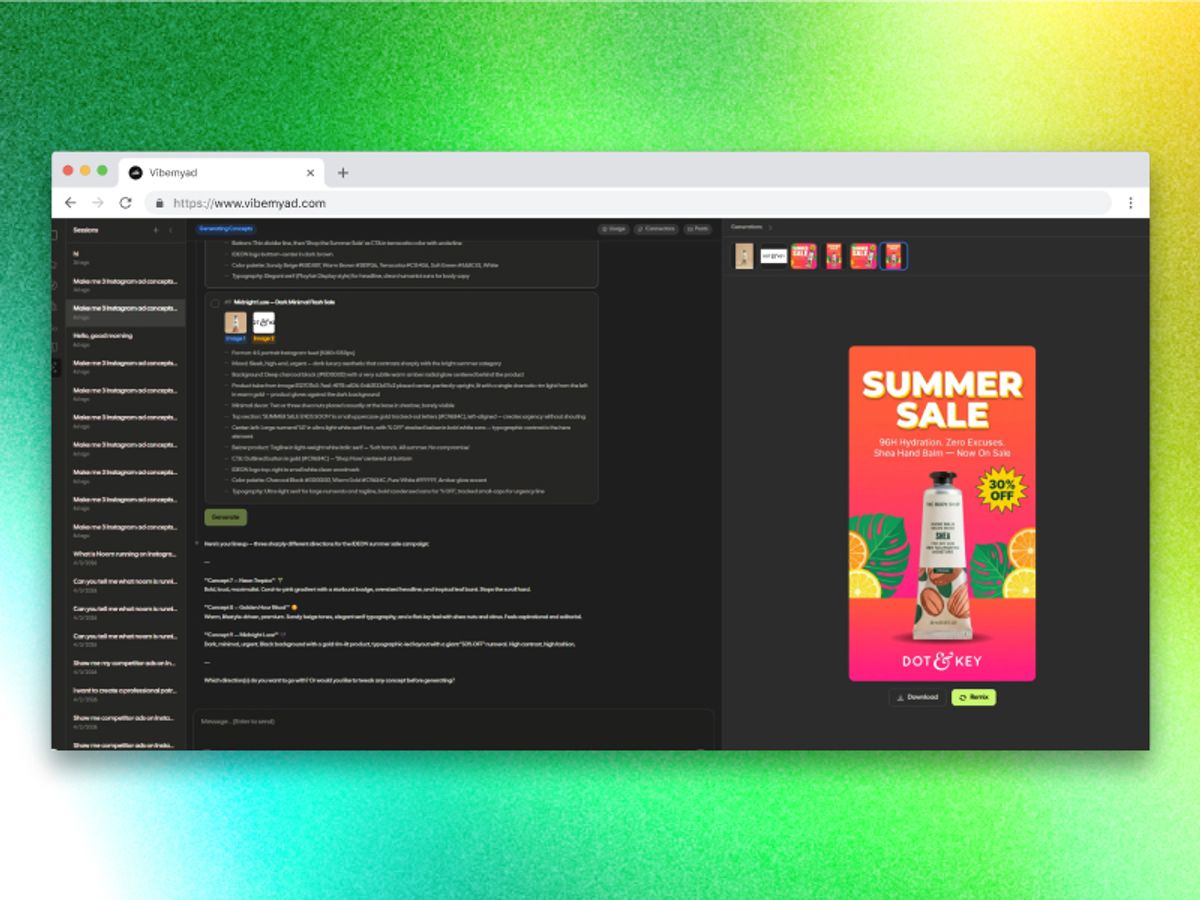
Vibemyad Ad Gen
Open Vibemyad Ad Gen and add the winning ads or mood board you collected from Vibemyad Ad Vault. Then write a simple prompt or basic text describing what you want — something as straightforward as "I want to create this ad for my brand" is enough to get started. You do not need elaborate prompt engineering. The intelligence you brought in from Ad Vault is doing the heavy lifting.
Before you hit enter, add your Brand Book. This is where you upload your logo, brand fonts, and brand colours. Adding the Brand Book means every output Vibemyad Ad Gen produces will be built in your brand's visual language from the start — no manual corrections needed after the fact.
Once you submit, the agent takes a short time to generate your ads. Inside Ad Gen there are two modes to choose from depending on what you need.
Edit Mode is for direct creation. The agent produces ads immediately based on your input and you can refine from there.
Plan Mode is for conceptual exploration. The agent works with you to develop multiple creative concepts first — presenting them for your review and approval before any ads are produced. If you want to explore several creative directions before committing to execution, Plan Mode gives you that thinking layer before anything is built.
Prompt-based ad generators solve the wrong problem. The blank page is not the obstacle — the assumption behind the brief is. Every prompt reflects what the team thinks the market wants, not what the market has already demonstrated it will sustain spend on. Vibemyad Ad Vault and Vibemyad Ad Spider replace that assumption with live competitor intelligence before Vibemyad Ad Gen produces a single creative.
Vibemyad is the only AI ad generator where intelligence and generation are architecturally separated. Prompt-based tools have a quality ceiling — they are a starting point, not a standard. Vibemyad removes that ceiling. Ad Vault identifies winning ads by run duration. Ad Spider tracks what competitors are actively scaling. Ad Gen transforms that intelligence into a branded creative through a single agent conversation. No prompt. No blank brief.
The intelligence gap is the only defensible creative advantage in 2026. Every marketing team has access to the same prompt-based tools, and every team briefing from the same blank prompt is producing the same generic outputs. The ones that compound are the ones that start from validated market evidence — and that is the structural difference between a system that gets sharper every week and one that resets to zero with every new brief.
Get notified when new insights, case studies, and trends go live — no clutter, just creativity.
Table of Contents


Rahul Mondal
Product, Design and Co-founder, Vibemyad


Arpita Mahato
Content Writer, Vibemyad

Arpita Mahato
Content Writer, Vibemyad