May 08, 2026 • 11 min read

May 08, 2026 • 11 min read
• A prompt is not a creative brief. It is a guess built from internal assumptions about what your audience wants. Every other brand in your category is making the same guess with the same tools and producing the same output.
• The right starting point is the market itself. Other brands have already spent real budget finding out what works. The ads still running after 30, 60, 90 days on Meta are the ones that won. That is market intelligence. That is where your brief should start.
• This blog walks through two approaches using the same fictional D2C food brand. The first starts from a prompt. The second starts from winning competitor ads found inside the Vibemyad agent. The difference in output tells you everything about why the starting point is the only thing that matters.
There is nothing wrong with using AI to generate Meta ads. The technology is ready. The output quality is competitive. The speed is real. The problem is not the tool. It is what most brands feed the tool before generation begins.
A prompt is a description of what you want. It is built from what you know about your product, what you assume your audience responds to, and what you believe makes your offer different. All of that is internal. None of it has been tested against the actual Meta audience you are trying to reach. The AI generates exactly what the prompt asks for, which is a well-produced version of an untested assumption.
This is why most AI-generated Meta ads look finished and perform poorly. The output is not the problem. The brief is.
This blog shows the difference between two approaches to generating a Meta ad for the same fictional D2C food brand. The first starts from a prompt. The second starts from the ads that are already winning in the category on Meta right now. One takes internal assumptions and produces creative from them. The other takes validated market signals and builds from those instead.
A prompt-first approach to AI ad generation is one where the creative brief is constructed entirely from internal knowledge the brand's product attributes, assumed audience preferences, and internal positioning before any external market signal is consulted. The AI generates from this brief without any reference to what is actually performing in the competitive landscape.
Most marketers who have run prompt-generated Meta ads at scale can describe the same pattern. The brief felt solid. The output looked professional. The ad went live and spent money and produced nothing. They generated five more variations from the same brief. Same result. The instinct is to blame the AI. The actual problem is what the AI was given to work from.
The core problem is not the prompt itself. It is the information available to the person writing it.
When a marketer sits down to write a prompt, they draw on everything they know about the product and the customer. That knowledge is real. The problem is that it is also finite, internal, and untested against the actual Meta auction environment. The market does not care what the brand knows about itself. The market has already voted with budget on which creative structures, which hooks, and which angles it responds to. That vote is visible in run duration data. It is not visible inside the brand's own knowledge base.
Market intelligence for Meta ads is the set of validated signals derived from what competitors are actively spending behind on the platform right now. The primary signal is run duration: how long an ad has been running with a sustained budget behind it. An ad running for 30 or more days has cleared multiple internal budget review cycles at the brand behind it. It was working. Market intelligence-first ad generation uses those validated signals as the creative brief rather than internal assumptions.
The most important thing to understand about market intelligence in the context of Meta advertising is that it is already publicly available. Every ad running on Meta is visible. What most brands cannot see without a tool like Vibemyad Ad Vault is how long those ads have been running and what that duration signals about performance.
Run duration is the proxy for performance data that no brand will ever share publicly. A brand that is still running an ad after 90 days on Meta made that decision deliberately, across multiple review cycles, based on performance data only they can see. The ad's survival is the signal. Vibemyad Ad Vault indexes over 10 million Meta ads and surfaces this signal as a filterable data point, which means any brand can see which competitor creatives have survived in their specific category without having access to the competitor's internal analytics.
When you start a creative brief from that signal rather than from internal assumption, the brief is grounded in what the market has confirmed rather than in what you believe the market wants. That is the structural difference between a prompt and a market intelligence-first brief.
Finding winning competitor ads does not require manually browsing an ad library or building a spreadsheet. The Vibemyad agent handles the research through a natural language search that runs directly against Vibemyad Ad Vault.
Open a session at Vibemyad agent and switch to Research Mode. Type what you are looking for in plain language: "Show me the best performing ads for plant-based snack brands on Meta" or "Which food and beverage brands have ads that have been running the longest on Meta" or "Find winning static ads in the health food category." The agent searches Vibemyad Ad Vault and returns reference ads with run duration data attached. You can see which creatives are sustaining spend in your category right now, what structures they are using, and how long they have been running.
Select the reference that best represents the creative direction you want to build from. That selection replaces the prompt as your starting point. Everything the agent generates in Plan Mode from that point forward is built on top of a validated market signal rather than on top of an internal assumption.
This is the step most brands skip entirely because they do not know it is available to them. Once they run it, they rarely go back to a blank prompt.
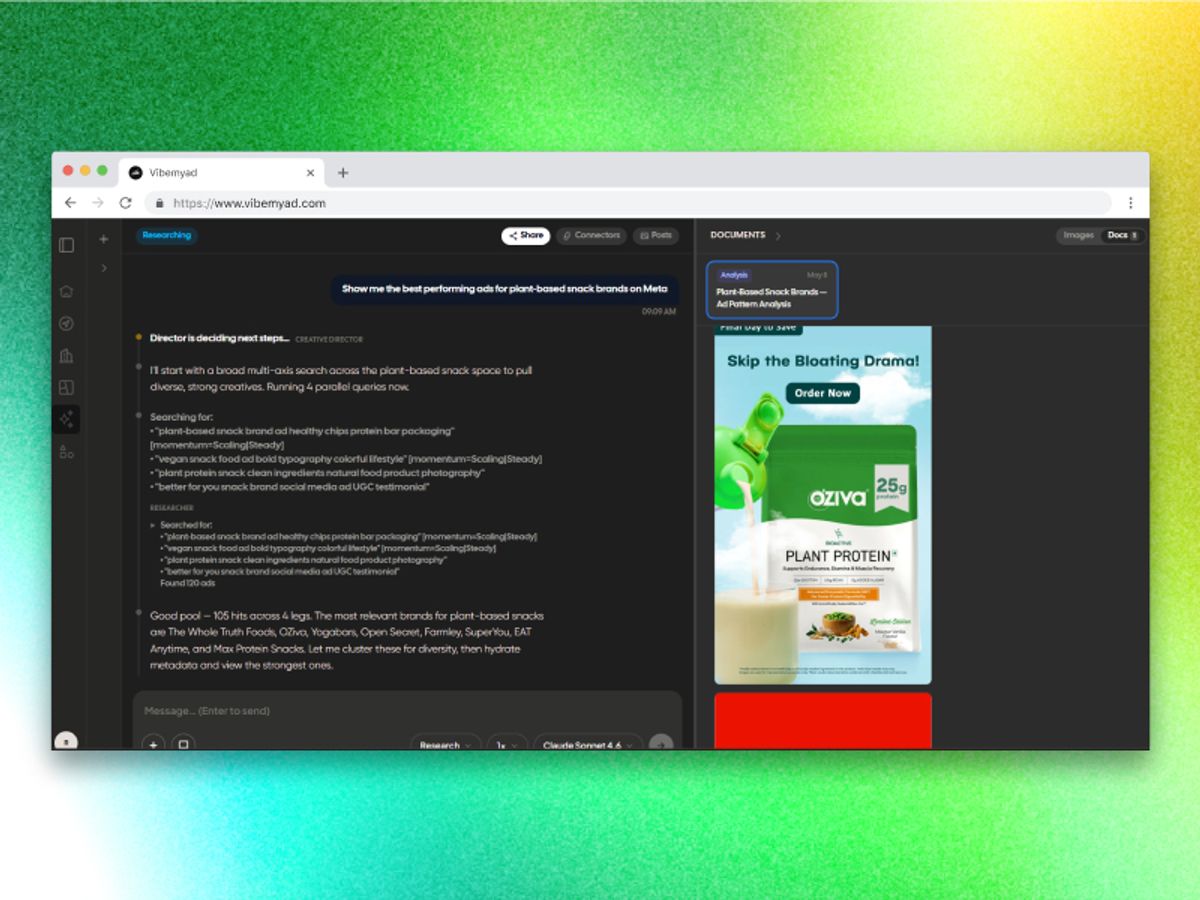
Find the winning ads in Vibemyad Agent
The brand is Soulcore, a D2C plant-based snack bar brand selling in a crowded health food market on Meta. The marketing manager opens the Vibemyad agent, selects Edit Mode, and types the following:
"Create a Meta static ad for soulcore plant-based protein bars. Target health-conscious adults aged 25 to 35. Key messages: 20g of plant protein per bar, no artificial ingredients, available in five flavours. Clean, modern look. Strong call to action to shop now."
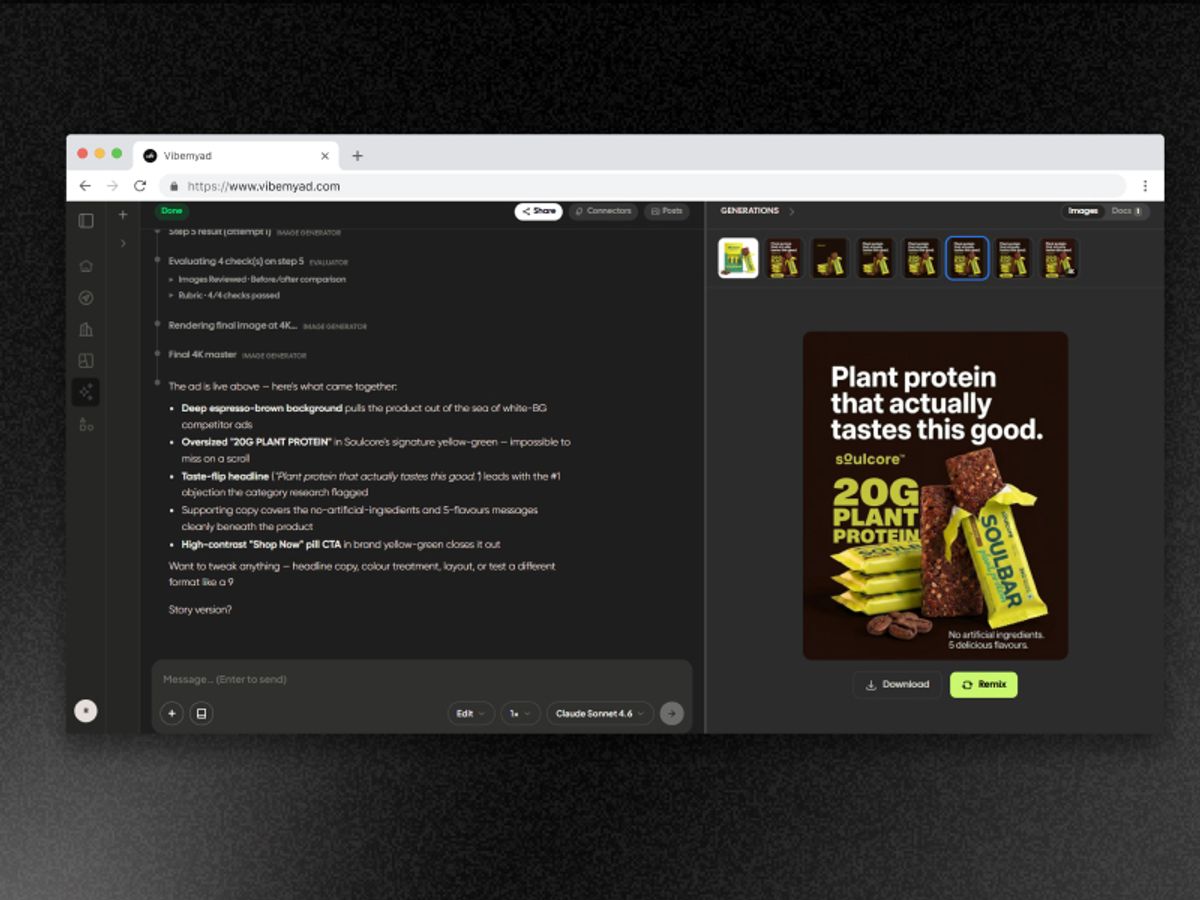
Vibemyad Agent generating a Meta ad from generic prompt
The agent generates from this prompt. The output arrives in under 60 seconds. It looks like a professional ad. The product is centred and well-lit. The headline reads something close to "20g Plant Protein. Zero Compromise." The subtext covers the five flavours. The CTA says Shop Now. The brand book keeps the Soulcore fonts and colour palette consistent throughout.
The ad is technically correct. It is on-brand. It answers the brief completely. And it is almost identical in structure to the ads that every other plant-based snack brand is running on Meta right now. The 20g protein claim. The no-compromise language. The clean minimal aesthetic. These are the default outputs of internal briefs in this category because these are the things every brand in this category knows about their product and assumes their audience wants to hear.
The audience has seen this ad before. Not from Soulcore From the twelve other brands in the health food category that built the same prompt from the same internal knowledge and produced the same output with different logos. This ad does not stop the scroll because it looks exactly like what the audience expects a protein bar ad to look like.
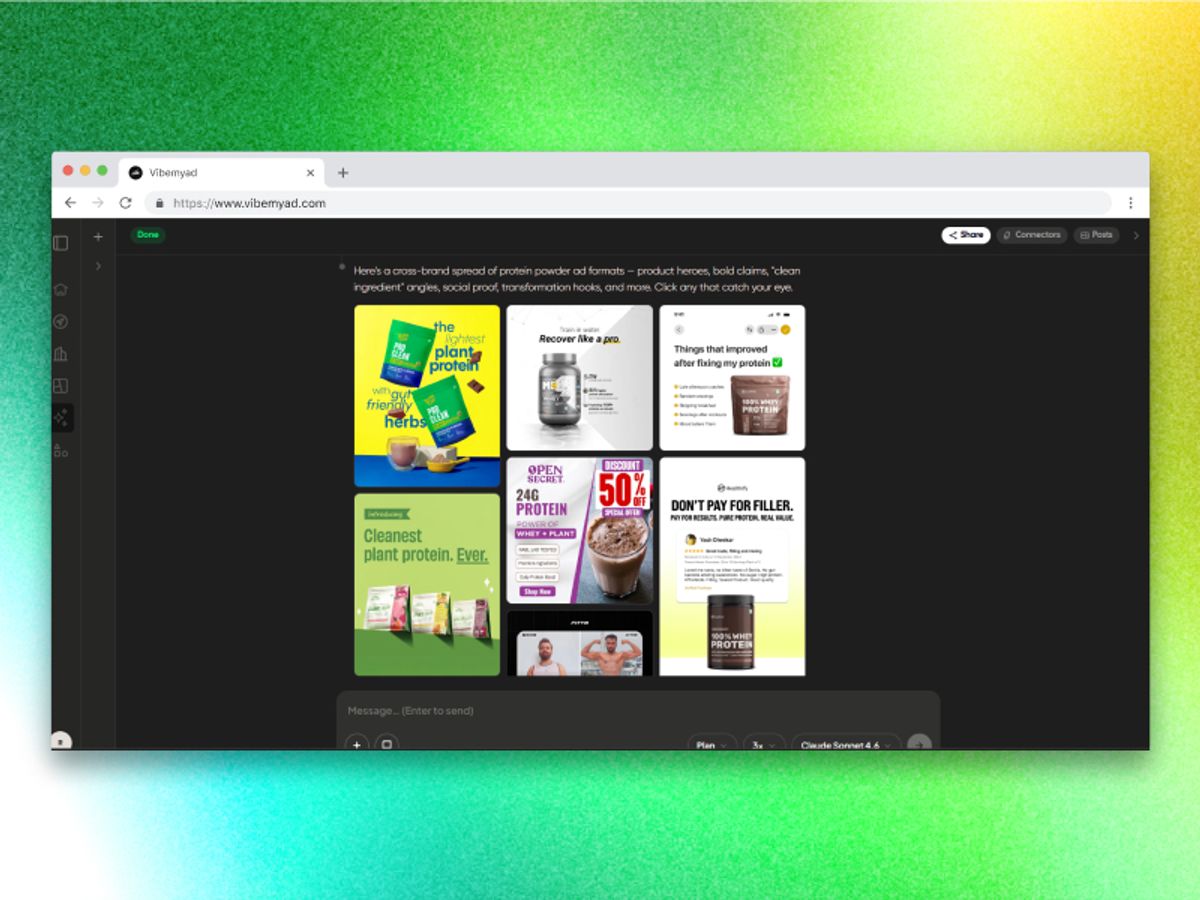
The Vibemyad agent in Research Mode showing a natural language search for "winning ads for plant-based snack brands on Meta" with a grid of reference results
The same marketing manager at Soulcore opens a new session at Vibemyad agent. This time, instead of typing a prompt, they switch to Research Mode and type: "Show me the best performing ads for plant-based and health food snack brands on Meta."
The Vibemyad agent searches Vibemyad Ad Vault and returns a grid of reference ads from the category. Run duration is visible on each card. Among the results, one ad stands out: a brand has been running a real customer testimonial format for 94 days across 11 active variants. The creative is not polished in the conventional sense. It looks like a screenshot of a real DM. The text reads like something a customer actually sent, not a marketing line. The product appears at the bottom. No hero shot. No clean typography. Just a real person's reaction to a specific result.
The marketing manager selects this as the reference. The agent identifies the structure: testimonial format, social proof as the primary hook, product as the supporting element rather than the hero.
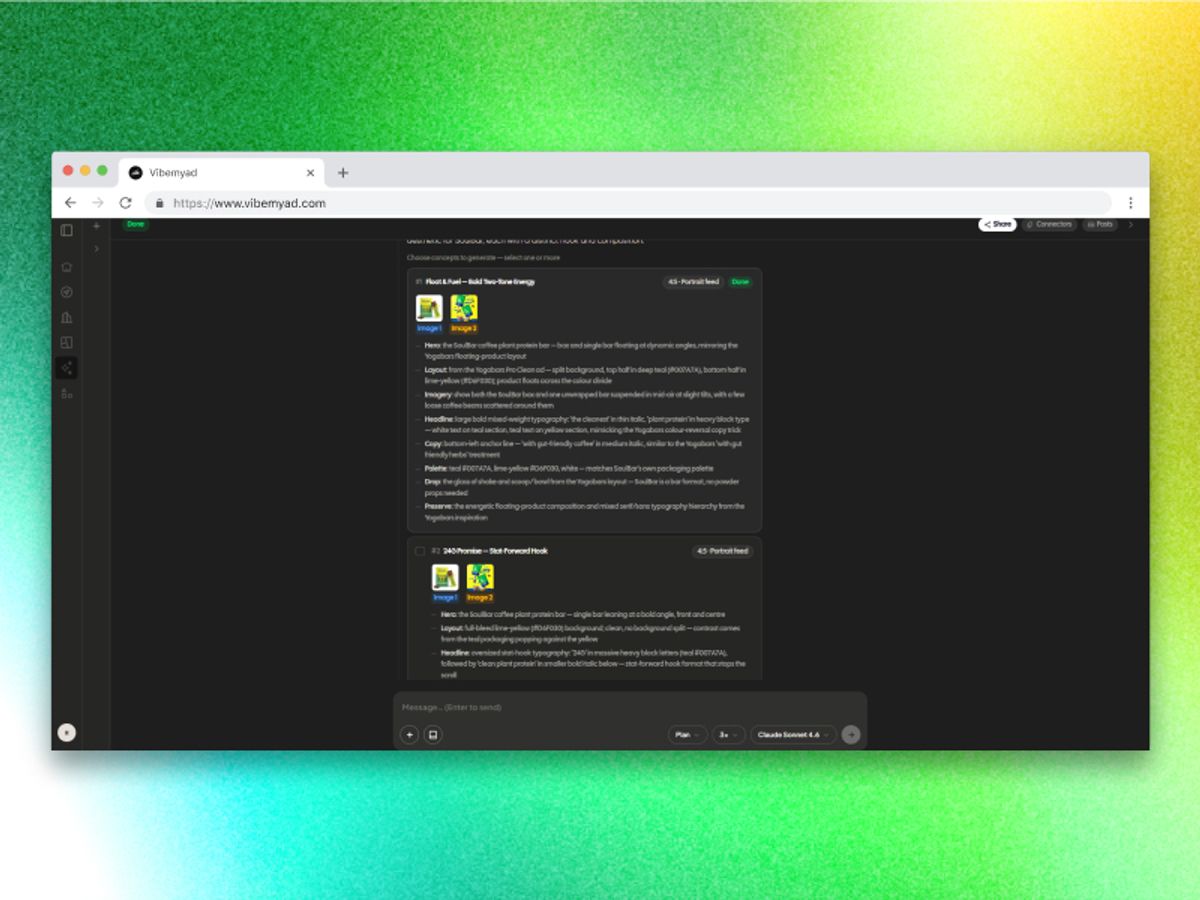
Plan Mode in the Vibemyad agent showing two concept cards generated from the selected reference and the Soulcore brand book
The marketing manager switches to Plan Mode and selects two variations. The agent generates two creative concepts based on the testimonial reference and the Soulcore brand book. Concept one uses a real customer quote format. Concept two uses a screenshot-style DM aesthetic. The marketing manager reviews both and approves concept one.
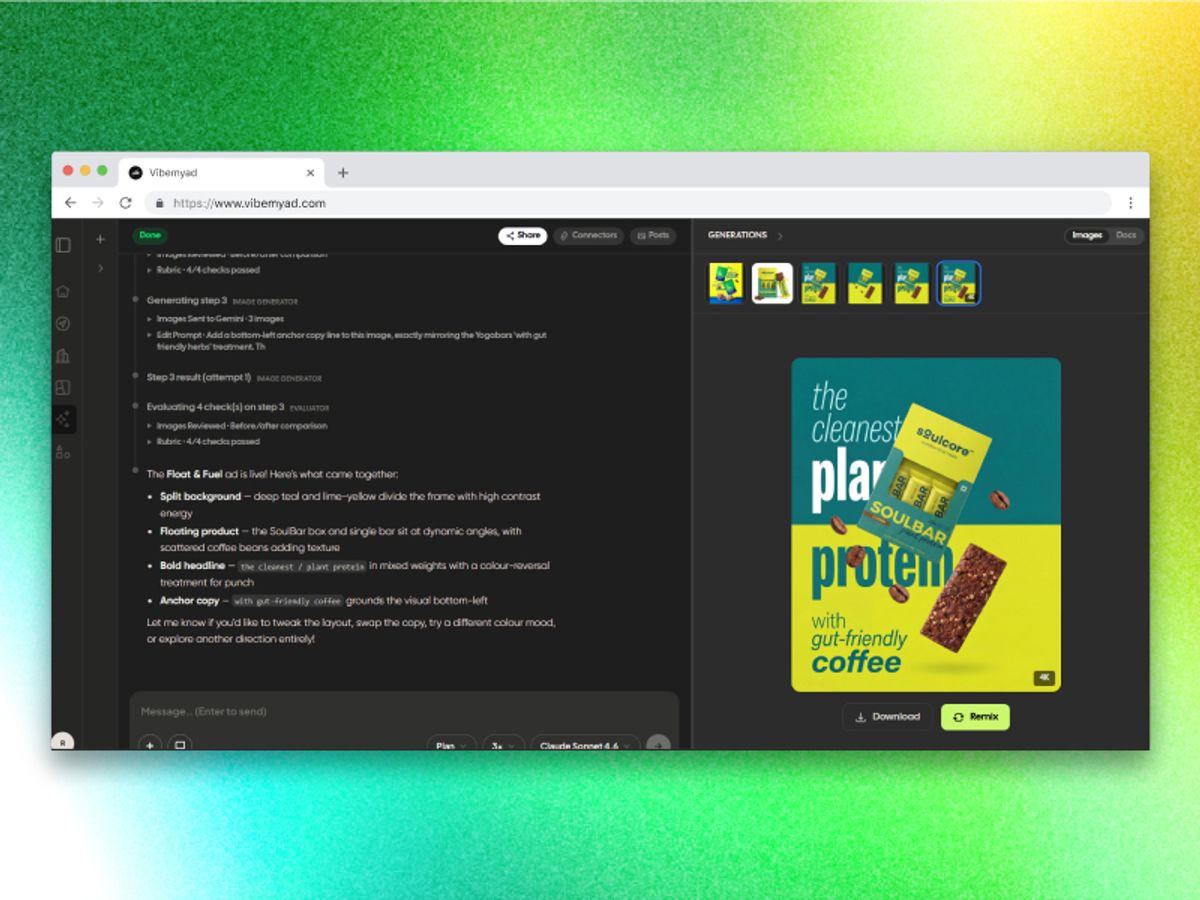
Final finished Meta ad generated by Vibemyad Ad Gen using the reference and Soulcore brand book
The output looks nothing like a protein bar ad. It looks like something a friend sent you. It uses a structure that the market in this category has already confirmed it responds to with 94 days of sustained budget, not an internal assumption about what health-conscious millennials want to read.
The brief gap is the structural difference between a prompt-generated Meta ad and a market intelligence-generated Meta ad. It is not a quality gap at the output level, both outputs arrive in under 60 seconds and both are production-ready. It is a gap at the input level: one brief starts from what the brand knows, the other starts from what the market has already confirmed.

Soulcore Prompt Generated Ad
The Soulcore prompt-generated ad is not a bad ad. A competent designer could have produced something similar from the same brief. The problem is the brief itself. "20g plant protein, clean modern look, strong CTA" is a description of what the brand wants to communicate. It is not a validated signal about what the Meta audience in this category responds to with sustained budget.
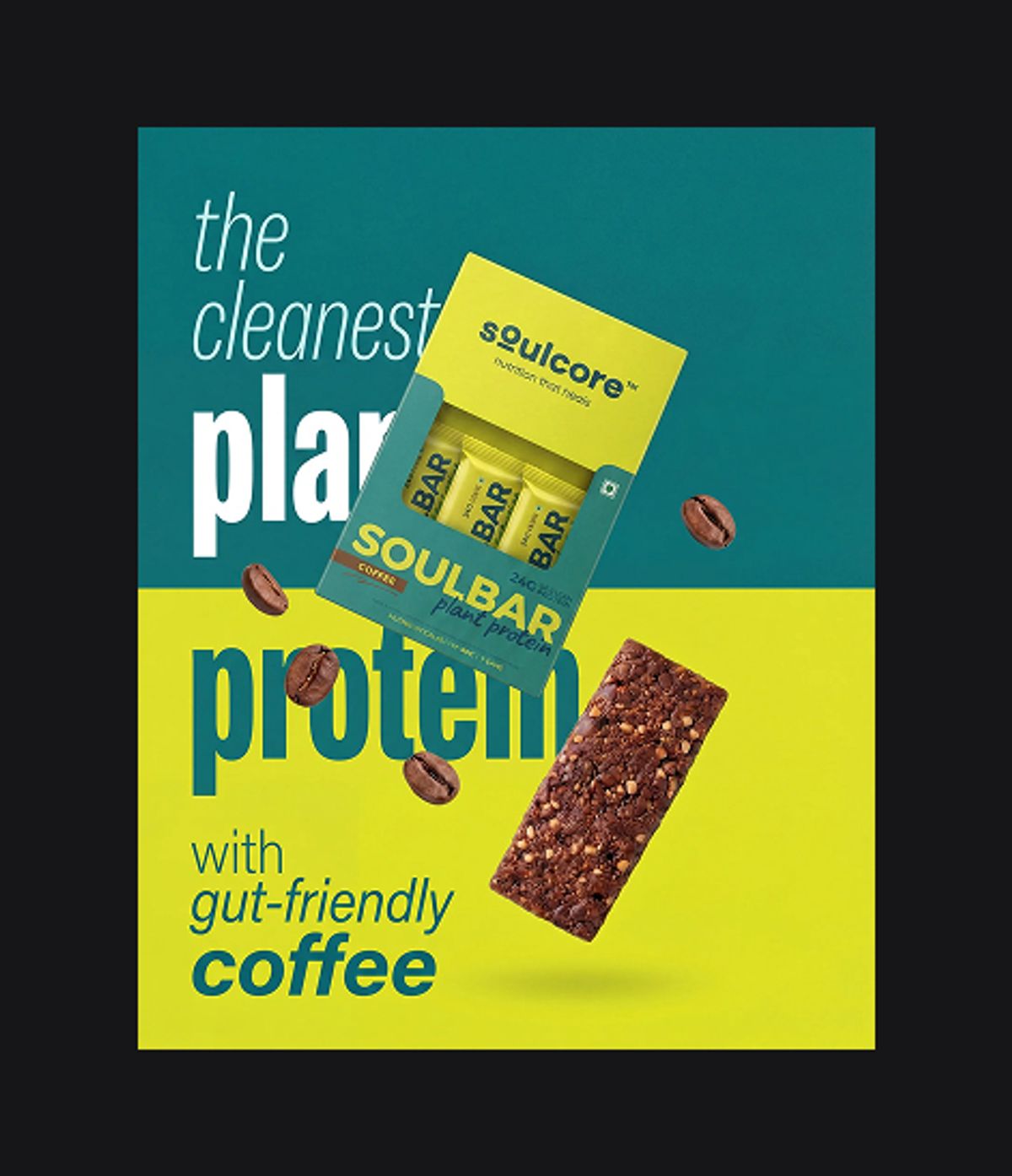
Ad generated from market intelligence
The Soulcore market intelligence-generated ad is not just a different aesthetic. It is a different structural argument. It does not tell the audience that Soulcore has 20g of protein. It shows the audience a person who already tried the product and chose to keep buying it. Those are different claims. One is what the brand says about itself. The other is what a customer confirms with their own words. On Meta, where the scroll decision happens in under two seconds and the audience has been trained to identify and skip promotional content, the structural difference between those two claims is the performance difference between an ad that interrupts and an ad that stops the scroll.
That is what market intelligence means as a starting point for Meta ad generation. Not a better prompt. A fundamentally different starting point for the brief that every prompt in the world cannot reach because the information it is built from does not exist inside any brand's own knowledge base.
A prompt is not a creative brief. It is an internal assumption built from what the brand knows about its product and what it believes its audience wants. On Meta, where audience attention is won or lost in under two seconds and where every other brand in the category is running the same internal assumption through the same AI tools, a prompt-first approach produces creative that looks finished and performs like a guess.
The market has already validated which creative structures, which hook types, and which angles work in any given category. The ads still running after 30, 60, or 90 days on Meta are the ones that won. That validation is visible through run duration signals in Vibemyad Ad Vault. It costs the competitor who ran the test their budget. It costs you a search in Research Mode.
Starting from a validated competitor reference rather than a prompt does not mean copying what a competitor is doing. It means building your creative from the structural logic that the market has already confirmed it responds to, then making it your own through your product, your brand book, and your positioning angle. The structure is borrowed from the market. The creative is yours.
Get notified when new insights, case studies, and trends go live — no clutter, just creativity.
Table of Contents


Arpita Mahato
Content Writer, Vibemyad

Arpita Mahato
Content Writer, Vibemyad

Arpita Mahato
Content Writer, Vibemyad