February 12, 2026 • 6 min read

February 12, 2026 • 6 min read
Blog Summary: Most ad creatives fail not because they are poorly designed, but because they are deployed into high-frequency, algorithm-driven environments without research, rotation, or intelligence. In today’s platforms, exposure compresses faster than creative lifecycles can naturally sustain.
This blog explains why ad creatives die within seven days, the structural reasons ads stop performing, how AI-powered ad creatives change the mechanics of creative decay, and why researched ad creatives consistently outperform intuition-led campaigns. It also examines how platforms like Vibemyad help marketers analyze competitor ads, detect fatigue early, and sustain performance through evidence-based creative systems.
According to Search Engine Land (SEL), healthy ad performance decays gradually, typically by 20–30% week over week, as a creative approaches the natural end of its lifecycle (Source).
When performance collapses faster than that, the issue isn’t creative quality; it’s exposure mechanics. In modern digital ecosystems, ads rarely fail because they are bad; they fail because they are consumed too fast, too often, by the same users.
On platforms like Meta, TikTok, and YouTube, a single creative can reach the same user 3-5 times per day. Once frequency crosses the 3-5 impression threshold, engagement drops sharply, CTR declines, CPAs spike, and algorithms suppress delivery by labeling creatives as fatigued or limited. In high-spend, niche campaigns, frequency can exceed 8-12 within a week, compressing months of traditional exposure into days. Ad creatives don’t expire naturally; platform mechanics kill them, which is why platforms like Vibemyad focus on predicting creative fatigue early, analyzing what’s already working in-market, and enabling rapid, data-backed creative refresh before ad performance collapses.
Audiences scroll faster than ever. Repetition creates creative blindness, not recall. As ads feel familiar, users subconsciously ignore them, and platforms reduce reach to protect user experience. Without rapid refresh cycles, even high-performing ads die quickly.
If an ad doesn’t communicate a clear pain point or value proposition within the first three seconds, it’s skipped. Many ads fail by leading with brand stories, over-explaining features, or delaying the hook. Relevance must precede branding, not the other way around.
Running the same creative across TikTok, Instagram Stories, YouTube Shorts, and Meta Feeds is a critical mistake. Polished ads look like ads and get ignored. UGC-style, vertical, fast-cut content outperforms, while aspect ratio, pacing, and tone must match platform context. Creatives that ignore context fail regardless of budget.
If users don’t instantly understand why it matters, what problem it solves, or what action to take next, the ad fails. Views without clarity do not convert. Ad performance depends on singular focus, not layered messaging.
This is the root cause behind why most ads stop performing. When creatives are built on intuition instead of ad research, competitor analysis, and structured testing, campaigns rely on luck. When creative strategy in marketing is disconnected from data, performance becomes inconsistent, expensive, and unscalable.
Platforms like Vibemyad operationalize ad creation as a continuous, research-driven creative-intelligence system.
Yes, and in 2026, AI-powered ad creatives are becoming essential to sustain ad performance as attention cycles compress and platforms penalize fatigue faster than ever. AI shifts creatives and marketing from reactive execution to predictive, research-led optimization.
• Early Performance Decay Detection: AI continuously monitors micro-signals such as rising CPC, declining CTR, and frequency spikes, flagging when ad creatives are starting to die before performance visibly collapses.
• Predictive Fatigue Modeling: By learning from historical ad research and platform dynamics, AI anticipates when ads stop performing, allowing teams to refresh or rotate creatives before ROI erodes.
• Automated Creative Refresh at Scale: AI-powered ad creatives enable rapid generation of new hooks, headlines, visuals, and CTAs, maintaining freshness without slowing campaign velocity or overloading creative teams.
• Dynamic Creative Optimization (DCO): Winning creative elements are recombined and adapted across audiences and formats, improving relevance while stabilizing ad performance as spend scales.
• Smart Audience and Budget Rotation: AI limits overexposure by dynamically shifting spend across creatives, audiences, and placements, reducing saturation and extending the effective life of top-performing ads.
Platforms like Vibemyad apply AI as creative intelligence, grounding AI-powered ad creatives in real-world ad research, competitor benchmarking, and performance diagnostics.
Researched ad creatives outperform because they replace assumptions with evidence. In modern creatives and marketing, ad performance is driven by insight, not instinct. High-performing ad creatives are built on:
• Proven hooks: Ideas are sourced from ads already converting in-market, not brainstorms that haven’t been validated.
• Validated emotional triggers: Messaging is built on real audience motivations and pain points, not assumed preferences.
• Tested formats and angles: Creative structures are selected based on platform-specific performance data, not creative convenience.
• Competitive benchmarking: Ads are designed with full awareness of category norms, saturation, and white space.
• Higher relevance and faster attention capture.
• Stronger emotional resonance and trust.
• Reduced waste from failed concepts.
• More predictable, measurable ROI.
• Scalable ad performance with lower creative risk.
Vibemyad Ad Spider
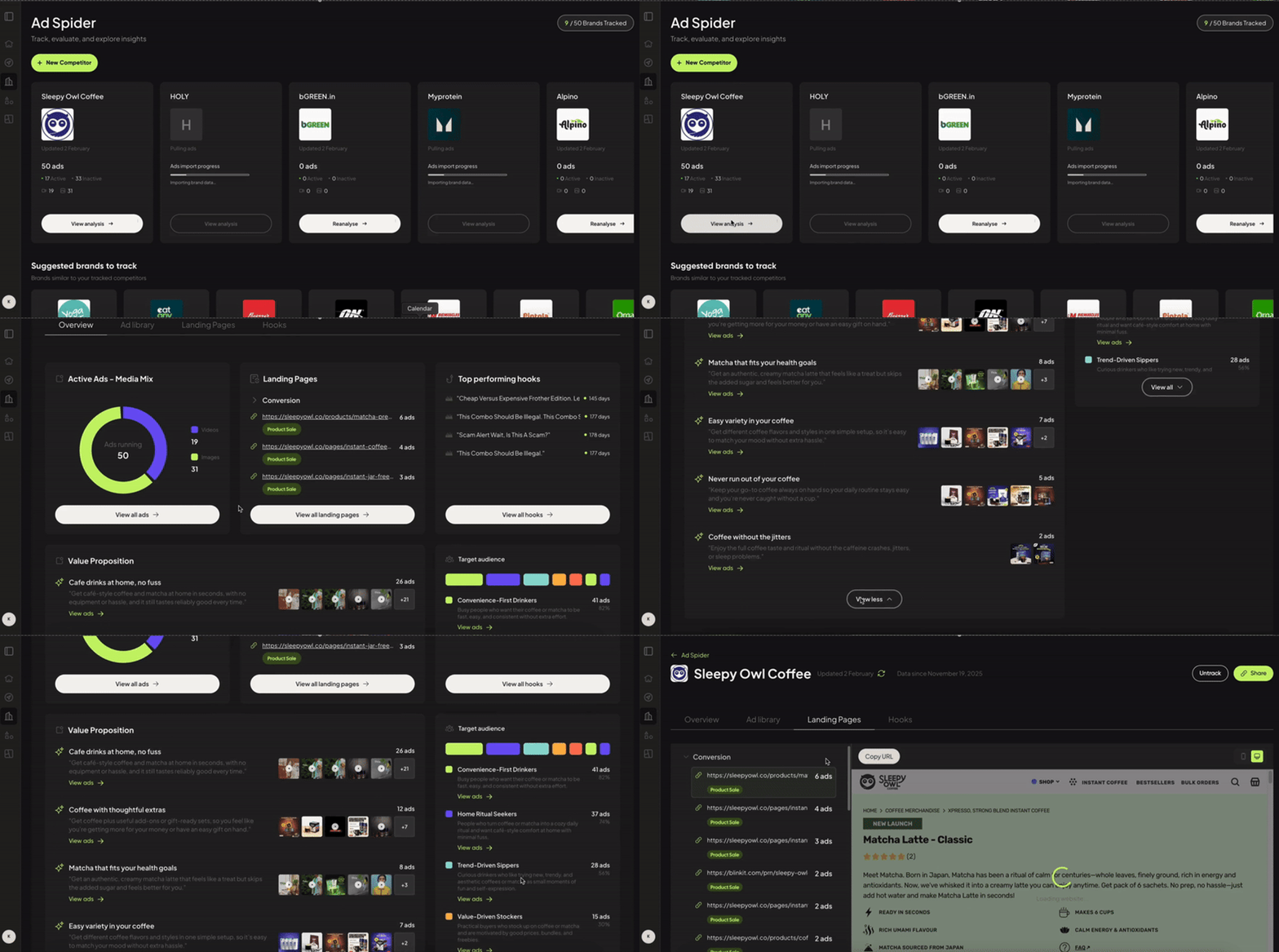
AI-powered ad creatives platforms like Vibemyad enable marketers to move beyond surface-level ad spying to structured competitive intelligence. Instead of manually scrolling ad libraries, teams gain a systemized view of how top competitors design, test, and scale their ad campaigns. Here’s how it works in practice:
• Cross-platform ad research: Competitor ads across Meta, TikTok, and YouTube are analyzed in one interface, eliminating fragmented research and blind spots.
• Identification of winning creatives: Long-running ads are flagged as performance signals, revealing which hooks, formats, offers, and creative structures sustain engagement over time.
• Creative pattern and angle analysis: Ads are broken down into messaging angles, emotional triggers, CTAs, and visual structures, showing why certain campaigns outperform, not just what they look like.
• Competitive benchmarking: Campaigns are evaluated against category norms to identify saturation, differentiation gaps, and creative white space.
• AI-assisted remixing and validation: Proven competitor concepts are transformed into brand-safe, differentiated variations, reducing ideation risk while accelerating execution.
If you are looking for an AI-powered ad creative platform like Vibemyad that connects ad research, competitive intelligence, and AI-powered creation into a single workflow. Book a demo and get your first 3 trials free.
• Creative failure is nonlinear: Without continuous research, testing, and rotation, ad performance degrades abruptly rather than gradually.
• Creative advantage is now systemic: AI-driven ad research and experimentation frameworks consistently outperform intuition-led decision making.
• Sustainable performance is intelligence-led: Researched, adaptive, AI-supported creativity, enabled by platforms like Vibemyad, converts competitive intelligence into durable growth.
Get notified when new insights, case studies, and trends go live — no clutter, just creativity.
Table of Contents