October 26, 2026 • 8 min read
October 26, 2026 • 8 min read
Some of the people who stopped using Vibemyad came back when we started working with them directly. That was one of the clearest reasons we shifted our focus from a software platform to an agency.
That says a lot about why we changed the business.
We originally built Vibemyad as a platform. We wanted people to discover it, use it in their work and keep coming back. But we ran into a problem: getting someone to try a new platform was much easier than getting them to commit to it.
We were an unfamiliar name. People had to decide whether we were worth their time before they had much experience with us.
We eventually changed what we were offering. We started focusing on the work customers wanted done and the outcomes they cared about. Some customers became direct agency clients. Some users who hadn’t been returning came back.
That experience led us to make Vibemyad an AI-native marketing agency in 2026. The earlier platform remains part of our story and our internal systems, but today customers hire a team to deliver the work.
When you build a platform, you spend a lot of time thinking about what people can do with it.
You can see the possibilities because you know the product inside out. You understand where it fits into someone’s work and why they might find it useful.
A new user doesn’t have that context.
They have to learn enough about your product to decide whether it deserves a place alongside the tools they already use. When your name is unfamiliar, that decision gets harder.
That was how I came to understand the hesitation we were seeing.
At the time, it felt as though people only wanted to commit to platforms they already knew. I wouldn’t turn that into a rule for every software business. New platforms earn customers every day. But for us, familiarity and trust were real obstacles.
People tried Vibemyad. Some didn’t return. We had to take that seriously.
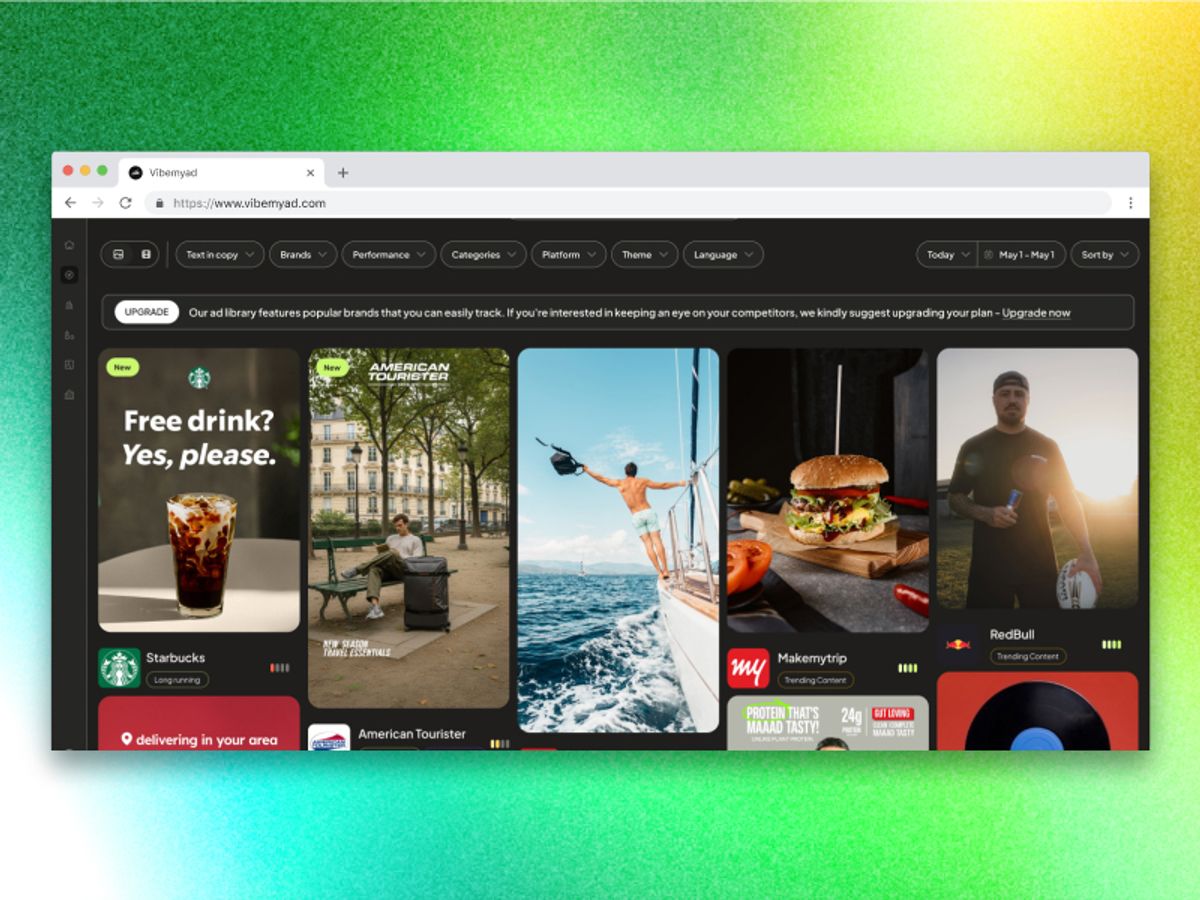
An archived view of Vibemyad’s Ad Vault, from our platform-focused content.
We were already working with some customers, so the agency business grew out of relationships we had.
Those relationships gave us a different way to approach the work. We could discuss what someone needed, understand their brand and work with them directly.
For a D2C founder, the immediate problem might be an ad that isn’t explaining the product clearly. It might be a shortage of creative to test, or uncertainty about what to change in a campaign.
Learning a platform is another task on top of that.
We began to focus more closely on those problems. What needed to be made? What needed to be tested? Where could our team help?
Existing customers became direct clients. The relationship became about delivering agreed work and learning from what happened next.
That gave us a clearer purpose for the business.
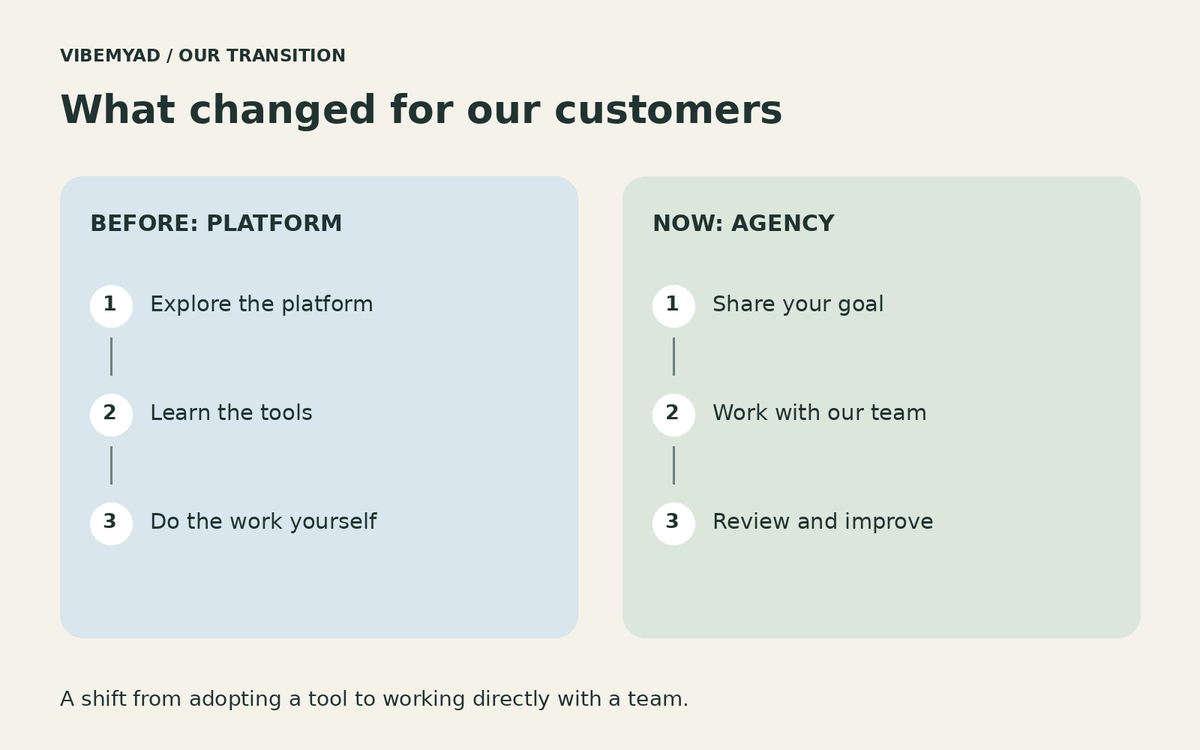
How the customer relationship changed as we moved from a platform to an agency.
The returning users were particularly important to me.
These were people who had already encountered Vibemyad. Some had stopped coming back to the platform. When we began working as an agency, some returned to work with us directly.
I don’t want to overstate what that proves. We can’t assume everyone stopped using the platform for the same reason.
But it changed how I interpreted their absence.
Someone who didn’t keep using our product could still see value in working with our team. The way we delivered that value mattered.
It would have been easy to treat every inactive user as someone who had lost interest in what we did. The agency relationships showed us that the picture was more complicated.
That was a useful lesson to learn from our own customers.
The word outcomes can become vague very quickly in marketing.
For us, it means starting with what the brand needs to accomplish, then deciding what work supports that goal.
Take an ad creative. Producing a finished image or video is part of the job. We also need to think about what the customer will understand from it.
Can they tell what the product does? Is the benefit clear? Is there a reason to believe the claim? What are we trying to learn by running this version?
Our problem-solution ad examples explore one way to approach that: connect a recognisable frustration to something the product can genuinely help with.
But choosing a structure doesn’t settle the question of performance. Different brands, offers and audiences need different tests. The work continues after the first creative is finished.
That is the responsibility we wanted to take on more directly.
An outcome-focused approach also requires honesty about results. We can decide what to produce, how to test it and how to respond to the evidence. We still have to earn the result through the work.
The earlier work taught us how to build software. The agency model asks us to be judged on the work we actually deliver, the quality of the choices behind it and how those choices improve over time. That is a much more direct relationship with a brand.
We did not abandon the research and creative systems we had built. They now help our agency team understand categories, generate and revise campaign assets, coordinate feedback and connect production with the results that follow.
The distinction is who owns the work. Before, a customer had to learn a platform, make choices and assemble the campaign. Today the agency is the service: our team handles the agreed research, creative production and campaign work, with AI supporting the process rather than replacing accountability.
That is important for anyone who remembers the old Vibemyad. We are not asking brands to buy an ad-generation credit package in order to receive agency help.
Working with Vibemyad means scoping a business problem and agreeing on what the team will research, create, run, test and report. Client approvals and product context still matter, and clients retain ownership of their core advertising accounts.
AI helps us study more advertising evidence and move faster through production, while people remain responsible for product accuracy, the customer message, creative direction, claim review and the decision to change a campaign.
Vibemyad is an AI-native marketing agency for US DTC and ecommerce brands. Our current work includes video and static ad production, Meta ad management and AI-search/SEO support. The right scope depends on the problem, not a one-size-fits-all package.
If you want to understand the broader category rather than our history, our guide explains what an AI marketing agency does and when a managed service may be more useful than operating separate tools.
The main service areas are:
For a founder or marketing team considering us, the starting questions are straightforward: what needs to improve, what can the business measure, and what is preventing the current team from moving faster? Sometimes that calls for one creative pack, sometimes a managed Meta engagement, and sometimes SEO and AI-search support.
The scope should follow from those answers. We do not need to sell the entire service menu to be useful.

Luna creative featured in Vibemyad’s portfolio. An example of our agency work, not a claim that Luna was a former platform user.
The biggest lesson was to pay attention to how customers were willing to work with us.
We had an idea of the business we wanted to build. Customers helped us understand a different way to deliver its value.
Some were willing to become direct clients. Some returned after they had stopped using the platform. Those were concrete reasons to take the agency model seriously.
Moving to an agency brings its own demands. There are briefs to understand, decisions to explain, revisions to make and results to review. Being closer to the work means being closer to those responsibilities.
That is the direction we chose.
If you knew Vibemyad as a platform, this is why it looks different today. We listened to how customers actually wanted to work with us and built an agency around doing the research, production and marketing work alongside their teams.
I want the next reason someone comes back to Vibemyad to be the work we’ve done together.
For paid acquisition, review Vibemyad's Meta ads agency service and the AI advertising agency guide for what research, creative production, campaign management and measurement should cover.


Arpita Mahato
Content Writer, Vibemyad


Rahul Mondal
Product, Design and Co-founder, Vibemyad

Arpita Mahato
Content Writer, Vibemyad
Table of Contents