June 10, 2026 • 15 min read

June 10, 2026 • 15 min read
Your food looks better in real life than it does in your ads. Your customers know it, you know it, and hiring a photographer every time you launch a new menu item is not the answer.
The gap between how your dish looks at the table and how it looks in your DoorDash listing is the single largest leak in restaurant marketing in 2026. A customer scrolls past your listing in three seconds because the chicken biryani photo looks dull. Two doors down, the same dish would have made them stop. That gap is closing your conversion rate, hurting your Meta ad efficiency, and erasing the work your kitchen team does every shift.
This blog breaks down why your food looks worse in photos than in real life, what AI food photography actually does to fix it, and exactly how restaurants are generating professional food photos without booking a single photoshoot.
Vibemyad
AI food photography is the use of artificial intelligence to create or improve visual content of food for restaurant menus, delivery app listings, packaging, lifestyle scenes, and Meta ad creative. It splits into two technical categories. AI enhancement edits an existing phone photo to improve lighting, color, texture, and background while preserving the actual dish served. Agentic AI generation produces new images from a real product asset reference, using multi-agent pipelines that research category creative, propose a creative direction, generate the image, and audit for brand consistency before any output ships. Both are compliance-safe with DoorDash, Uber Eats, and Grubhub when the workflow is grounded in the real product. Both replace meaningful chunks of the work that traditional restaurant food photography required at a fraction of the cost and time.
• Restaurant food usually looks worse in photos than in real life because of phone limitations, kitchen lighting, and the absence of composition training. The gap is the largest leak in restaurant marketing in 2026.
• AI food photography fixes the gap in two ways. AI enhancement improves an existing phone photo. Agentic AI generation produces new images from a real product asset reference. Neither requires a photographer.
• Vibemyad runs as one agentic conversation. The agent researches your category, proposes a creative direction, generates the food photography across six photo types, and the Evaluator audits every output before it ships. Start at vibemyad.com/sessions.
Five structural reasons, all of which fire at the same time in a working restaurant kitchen.
• Phone cameras compress the dynamic range of restaurant lighting. A human eye looking at a plate of biryani in your dining room reads warm tones, gentle highlights, and the contrast between rice and garnish naturally. A phone camera under the same conditions blows out the highlights, crushes the shadows, and makes the rice look beige. The eye sees the dish. The camera sees an average.
• Kitchen lighting is built for safety and prep, not for photography. Restaurant kitchens run on bright overhead fluorescents that throw a yellow or green cast across every surface. The cast looks fine in person because the brain corrects for it in real time. The cast looks awful in a photo because the camera does not correct for it. The dish that looks vibrant in your hand looks tired on the screen.
• The shot has to happen during service. You take the photo when the dish is plated, which is in the middle of a service rush. There is no time to set up natural light, dress the plate, choose props, or shoot from twelve angles. You get one shot, fast, on whatever surface is closest to the pass. The result is usually a top-down photo on a stainless-steel counter under fluorescent light. Functional. Not appetising.
• Most restaurant teams do not have composition training. Trained food photographers know that layered dishes shoot best from a 45-degree angle, soups shoot best from directly above, and burgers shoot best from the side. Most restaurant operators do not know this and would not have time to apply it if they did. The photo gets taken from whichever angle is easiest to reach.
• The benchmark for what "good" looks like has moved. A photo that would have been fine on a printed menu in 2018 loses to a DoorDash competitor in 2026 because the platform shows your image alongside three others at the same time, all at the same size, all competing for the same scroll-stopping moment. The bar has risen. The kitchen workflow has not.
The term covers two technically distinct workflows that get conflated in most restaurant marketing conversations. The distinction matters because the two solve different problems.
AI enhancement, takes an existing photo of your real dish and improves it. The tool analyzes the image, separates the food from the background, corrects lighting and color temperature, sharpens textures appropriate to the dish (crispy edges, glossy sauces, melty cheese), removes distracting kitchen clutter, and optionally replaces the background with a clean studio or lifestyle setting. The dish in the output is the same dish you photographed, only better lit. Tools in this category include FoodShot AI, MenuPhotoAI, Claid.ai, and Photoroom. Per-image cost runs $0.40 to $0.60 on monthly plans of $15 to $99. Turnaround is roughly 90 seconds per image.
Agentic AI generation, produces new images from a real product asset reference rather than editing an existing photo. The agent receives your product (a phone photo, a packaging image, a menu reference) plus a brief, researches the category for converting creative patterns, proposes a creative direction, generates the image through a multi-agent pipeline, and an Evaluator agent audits the output for brand consistency before allowing it to ship. The dish in the output is grounded in your real product, but the visual scene is generated rather than edited. Vibemyad is the operational answer in this category. Pricing is credit-based, starting from a $5 free signup credit, and full campaigns of multiple variants run inside one session.
The two workflows complement each other. Enhancement is the right tool when you already have a usable phone photo that needs polishing. Generation is the right tool when you need multiple variants, multiple angles, multiple seasonal moods, packaging mockups, or lifestyle frames from a single product reference. A working restaurant marketing operation in 2026 uses both, depending on the job.
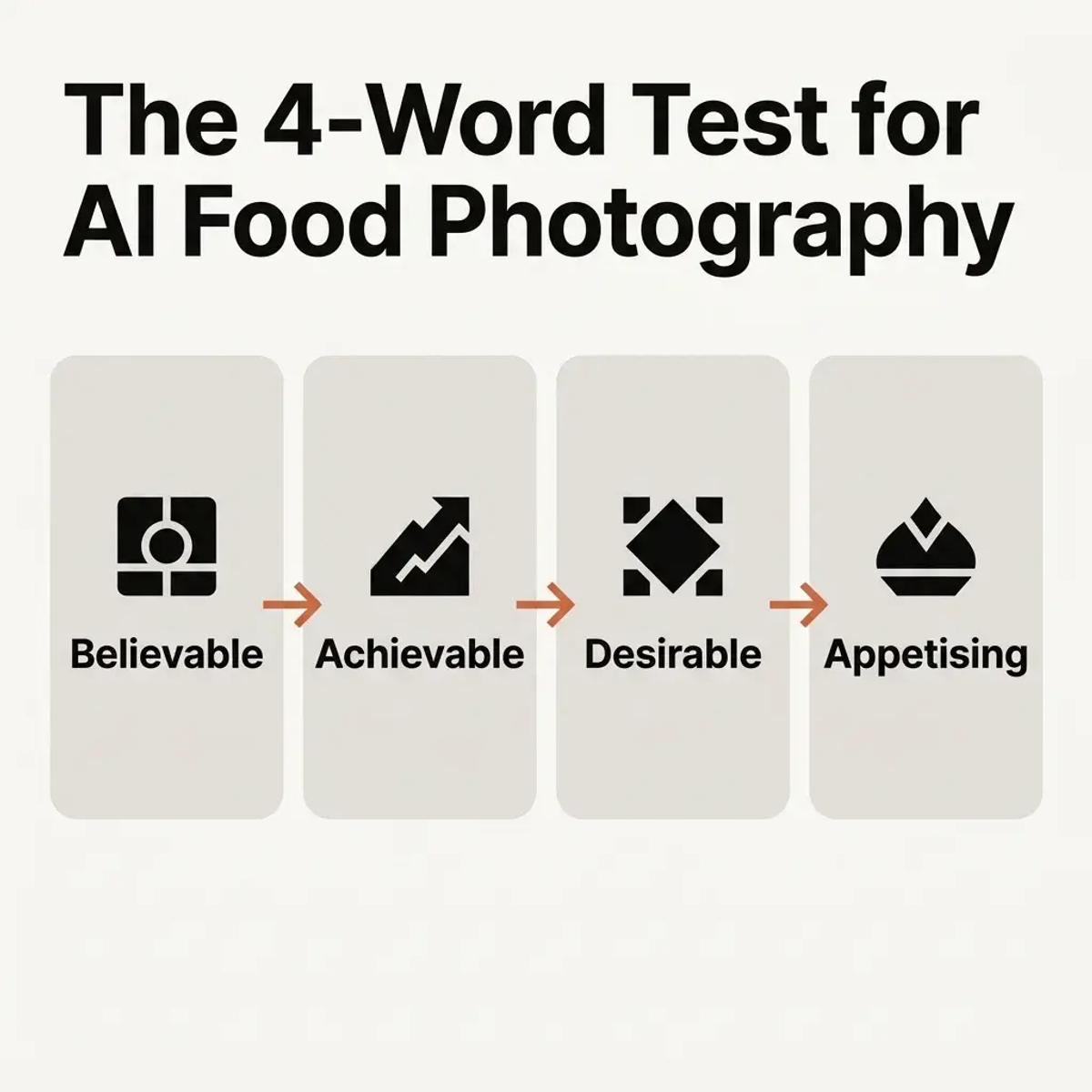
Four-word Test for AI Food Photography
Every food image a restaurant ships has to clear four tests. The four tests are functional, not aesthetic. An image that fails any one of them does not do its job.
• Believable: The image has to represent the dish the customer will actually receive. A photo that looks too perfect or too generic erodes trust the moment the dish arrives looking different. Believability is why stock photos lose for restaurants in 2026 even at a dollar an image.
• Achievable: The image has to fit your operational cadence. If creating one menu image takes three weeks, your menu has already moved on. Achievable means the workflow runs at the speed of the business.
• Desirable: The image has to trigger ordering, not just observation. Warm tones, glossy surfaces, hand presence indicating scale, and composition that places the dish at eye level convert curiosity into action.
• Appetising: The image has to be visually appetising through specific craft choices. Lighting direction, color saturation calibrated to the dish, texture sharpness, and the absence of broken composition or visible AI artifacts.
Believable without desirable is a documentation photo. Desirable without believable is a stock photo that loses customer trust by lunchtime tomorrow. Achievable without appetising is the phone snap you took during the service rush. Appetising without achievable is the studio session you cannot afford to repeat. The image has to clear all four tests.
The two are not competitive options. They solve adjacent problems. Use enhancement for one-image-in, one-image-out polish on a phone photo. Use agentic generation when you need a campaign of variants from one product reference and need brand consistency held across every frame.
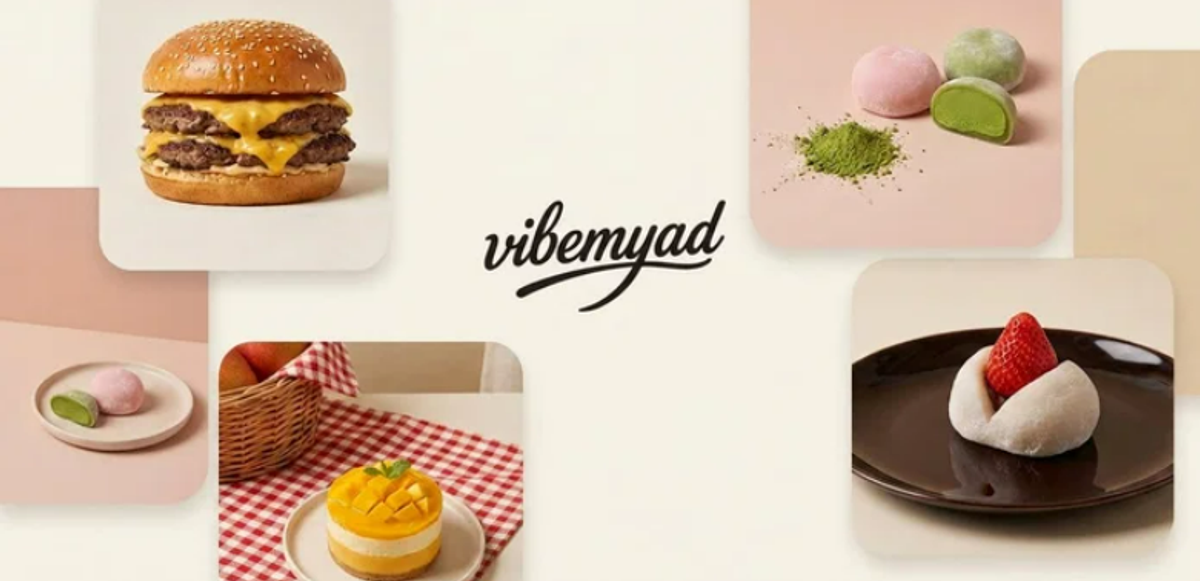
Generate Food Images for Resturants with Vibemyad
You do not search reference libraries, build mood boards, or open multiple tools. You start one agentic session, and the agent does the research, proposes the creative direction, generates the food photography, and audits every output before it ships. Here is the workflow end-to-end.
Open vibemyad.com/sessions. Tell the agent your restaurant brand, your dish, your campaign goal, and any constraints. A useful brief names the dish (menu name and ingredients), the channel format needed (delivery app listing, Meta carousel, Instagram, printed menu), the brand identity reference (existing brand book, colors, fonts), and any cultural or geographic specificity (regional cuisine, seasonal occasion).
A brief that works: "Hero shot for our new lamb biryani for DoorDash and Uber Eats. Indian regional aesthetic, copper-style serving vessel, garnish visible, top-down and 45-degree angle variations, 1:1 and 4:5 formats. Brand book attached."
This is where the agentic architecture replaces the manual research workflow restaurant marketers used to run. You do not open ad libraries. You do not browse competitor menus. The agent does it in the background as part of its response cycle.
The Router agent decides whether the session needs research-heavy exploration or direct execution. For most new briefs, it routes to research first. The agent identifies which creative patterns are converting in your category right now, pulls reference creative grounded in proven category performance, and surfaces the visual cues that high-performing restaurant ads share in your specific cuisine and price tier. The research pass happens in seconds.
The Creative Director agent interprets your brief against the research findings and returns a recommended creative direction. The recommendation includes composition (how the dish sits in frame), lighting setup (warm or cool, hard or soft, key light angle), mood, color palette, and visual style. You see exactly what the agent is proposing and which references it is drawing on. You approve, refine conversationally ("warmer lighting, less props, closer to the biryani"), or redirect entirely.
Once direction is approved, Plan Mode shows you exactly what the Planner agent will change in the image. Background. Subject placement. Lighting setup. Props. Color grading. Garnish styling. You approve each step or modify it before any pixels are generated. This is the architectural difference from prompt-shot tools. Plan Mode prevents the "regenerate twenty times to fix one thing" problem because every change is approved before it executes.
The Image Generator agent produces the visual. The Evaluator agent then audits every output against four criteria, each scored independently. Before-and-after accuracy checks that your actual dish is recognizably your actual dish, not a stylized AI version. Prompt adherence checks that the output matches what was briefed and planned. Structural integrity checks that the image holds together at ad-placement scale, with no broken hands, distorted plates, or warped geometry. Brand book consistency checks that the output looks like your restaurant brand across every variant in the session. Only outputs that clear all four criteria advance to you. Failed outputs route back to the Planner, which adjusts and retries.
You refine the same conversation without restarting. Move the dish one inch left. Warm up the lighting. Change the serving vessel. Try the same composition with a different garnish. The agent holds character state across the entire session, which means the same plate, the same hand model when present, and the same product persists across every variant frame. When you are ready, export at the channel-correct aspect ratio (1:1 for in-feed square, 4:5 for in-feed portrait, 9:16 for Stories and Reels, 1.91:1 for link previews).
Vibemyad
One Vibemyad session generates six categories of restaurant food photography. Clean white background for delivery app product tiles. Lifestyle for in-context paid social with model and environment. Flat lay for ingredient breakdowns and recipe content. Mood and season for festive, monsoon, summer, late-night, and cultural-moment aesthetic variants. Texture and surface for close-up product detail. And ad-ready, formatted to every Meta and delivery app channel spec.
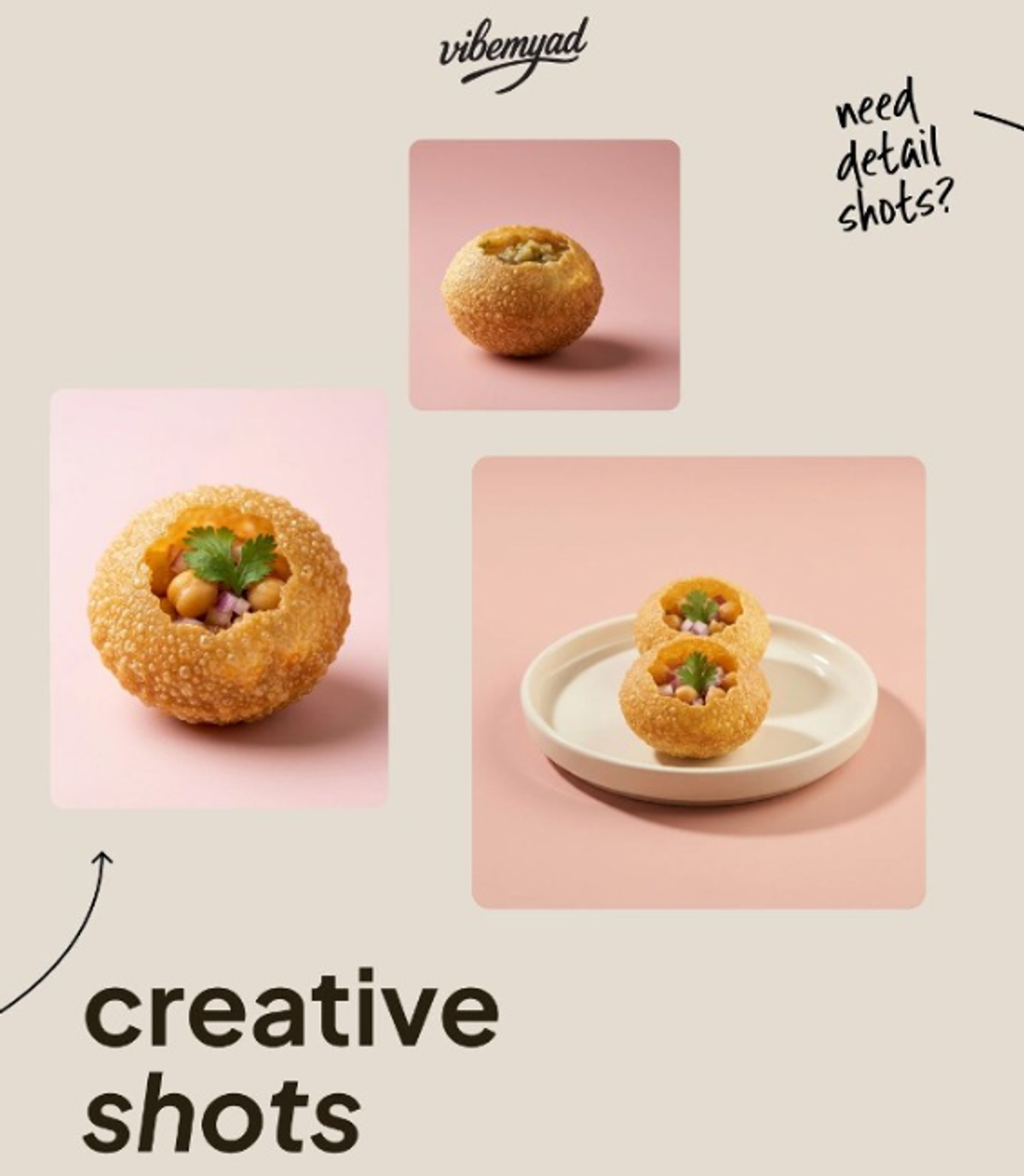
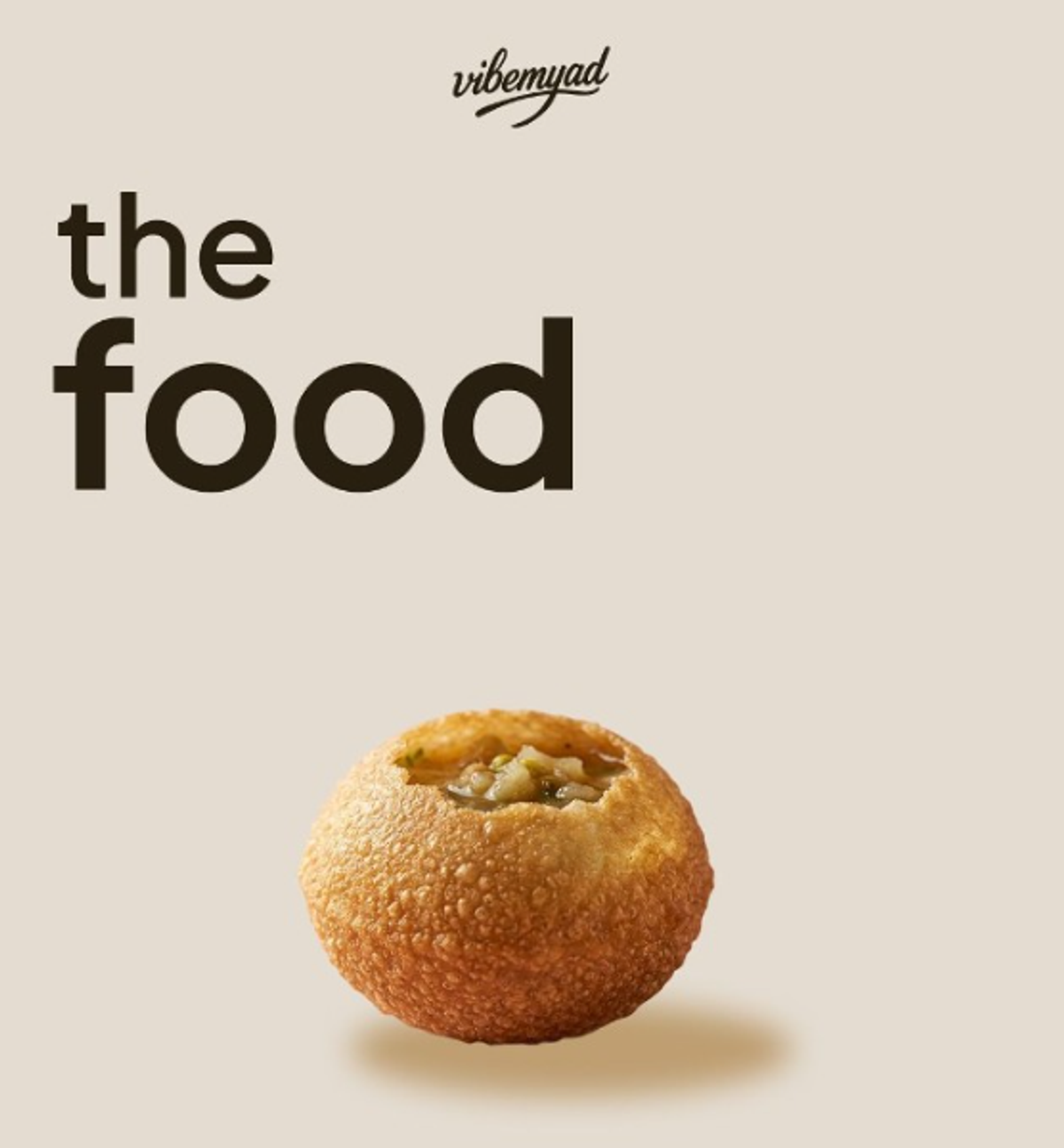
A real proof point: A regional Indian D2C food brand selling pani puri ran a full Meta campaign inside one Vibemyad session. The agent researched the category, proposed a "hands-eating" creative direction, and generated the hero
product shot, the packaging mockups, the detail and creative angles, the same hand model holding pani puri across every lifestyle frame, and the "eating the product" moment. One conversation. No food stylist. No reshoots. No character drift across frames. Culturally specific cuisines are usually where generic AI tools collapse because training data is heavily Western. Vibemyad handles them because the agent is grounded on a real category reference and a real product asset, not on generic training data.
Generate Food Photography for Best Menus
Food Photography by Vibemyad
The honest boundary: Vibemyad is an image only. It does not generate video, sizzle reels, cheese pull motion, drink pours, or behavioral video content. Restaurants using video for behavioral creative pair Vibemyad with a separate video workflow. Vibemyad handles the static portion of restaurant creative, which remains the majority of the menu and paid social inventory.
Mistake 1: Using stock photos on delivery app listings: Stock photos are cheap, but the dish in the image is not your dish. DoorDash and Uber Eats have moved toward stricter enforcement on misleading listing photos in 2026, and even when platforms do not flag the image, customer trust erodes the moment the actual dish arrives. The fix is using your real product as the reference, through enhancement of a phone photo or through reference-led agentic generation.
Mistake 2: Using generic AI image generators that produce stock-AI food: Prompt-based tools like Midjourney and DALL-E generate food from training data, which means your burger looks like every other AI burger and your pad thai looks like every other AI pad thai. Useless for restaurants because it fails the believability test and creates compliance risk on delivery platforms. The fix is using a reference-led agentic system that grounds every generation on your real product asset, which is what Vibemyad is built for.
Mistake 3: Treating AI as a one-shot generation instead of an agentic conversation: Restaurants using AI as "type prompt, get output, ship or scrap" miss the entire value of an agentic workflow. The fix is briefing the agent, reviewing the Plan, refining each step before pixels render, and using the Evaluator audit before shipping. This is what separates a usable restaurant menu image from a stock-AI image.
Mistake 4: Fixing one image at a time instead of the whole menu: A single beautiful image is useless if the next twelve images on the same menu look like they belong to a different restaurant. Customers read inconsistency as unprofessional. The fix is generating the whole menu in one session so brand book consistency holds across every frame. The Evaluator in Vibemyad enforces this on every output.
• QSR and fast casual brands running weekly menu refreshes across multiple SKUs and limited-time offers.
• Cloud kitchens and ghost kitchen operators launching multiple virtual brands with no in-house creative infrastructure.
• Multi-location restaurant chains maintaining visual consistency across delivery listings, social channels, and printed menus.
• D2C food and beverage brands using Meta as a primary acquisition channel and needing seasonally relevant product photography.
• Restaurant marketing agencies briefing across multiple food service accounts and needing category-grounded research that does not eat the retainer.
• Cookbook projects and editorial work where creative direction defines the outcome across 50 to 200 styled shots.
• Brand launch hero campaigns for billboards, magazine ads, and brand-defining visual identity work.
• Behavioral video content including cheese pulls in motion, sizzle reels, drink pours, and eating moments. Vibemyad is image only and does not generate video.
• Chef portraits and restaurant space photography where the subject is a real person or place rather than a dish.
The honest answer for most operating restaurants in 2026 is a hybrid. Use a photographer once a year for brand and editorial work. Use AI food photography for the weekly operational work the rest of the year covers.
• The reason your food looks worse in photos than in real life is structural. Phone cameras, kitchen lighting, service-time pressure, and the absence of composition training all fire at the same time. The fix is not a better phone. The fix is a workflow that produces images at the standard your kitchen already delivers.
• AI food photography fixes the gap in two ways. AI enhancement edits an existing phone photo. Agentic AI generation produces new images from a real product reference. Both are compliance-safe when grounded in the real dish, and neither requires booking a photographer.
• Vibemyad runs as one agentic conversation. The agent researches your category, proposes the creative direction, generates the food photography across six photo types, and the Evaluator audits every output against four criteria before any image ships.
Your kitchen team plates dishes every day at a standard your photos never reach. The gap between the two is closing your conversion rate, weakening your Meta ad performance, and erasing the work your team does at every service. The fix is not a bigger photography budget. The fix is a workflow that produces images at the standard your dishes already deserve.
Get notified when new insights, case studies, and trends go live — no clutter, just creativity.
Table of Contents


Arpita Mahato
Content Writer, Vibemyad

Arpita Mahato
Content Writer, Vibemyad

Arpita Mahato
Content Writer, Vibemyad