
September 10, 2026 • 4 min read
September 10, 2026 • 4 min read
Two agency proposals can have the same monthly fee and leave your team with very different amounts of work. One includes research, creative production and campaign management. The other starts only after you deliver finished ads.
This guide breaks down what to price in each service. For broader fee ranges and payment models, use our marketing agency cost guide. Here, the goal is a comparable scope you can send to each agency.
Ask which platforms, markets and accounts the agency will manage. Specify who builds campaigns, checks tracking, reviews performance and recommends the next tests. Separate the agency fee from the money paid to advertising platforms.
Creative production needs its own line. "Meta ads management" may mean uploading finished files rather than researching and producing them. If you need both, ask the agency to price both explicitly.
A useful proposal states the review cadence, reporting deliverable, launch responsibilities and what happens when measurement fails. Our Meta ads agency pricing guide examines how retainers and outcome-based fees allocate those responsibilities.
A concept is a buying argument. A resize is another delivery format for that argument. Ask for both counts so a large file total does not hide a small amount of original thinking.
For example, a hypothetical brief might request three concepts, two opening variations per concept and three export sizes. That creates eighteen files, but still only three concepts. Use that distinction when comparing quotes.
Specify scripting, design, editing, revision rounds and source-file ownership. For creator content, identify who pays for talent and which usage rights the quote includes. Ask how extensions, extra versions and reshoots are handled.
For SEO, ask which pages the agency will assess and who makes the changes. An audit is a different deliverable from fixing the issues it identifies. Technical development may need a separate budget or an internal owner.
For a blog assignment, include keyword and competitor research, the brief, subject expertise, editing, images, internal links and publishing. Clarify whether updating older articles is part of the scope. A monthly word count does not tell you who verifies the claims or checks for overlap.
Our preference is to define the reader question and the evidence each article needs before agreeing on volume. That makes it easier to reject a redundant topic before anyone writes it.
Ask whether the quote covers automated flows, one-off campaigns or both. List copy, design, segmentation, build, quality checks and reporting as separate responsibilities. Confirm who maintains the sending platform and approves offers.
A setup project can end after the flows are built. Ongoing work should say who reviews their performance and makes revisions. Software charges belong in the budget even when they do not appear on the agency invoice.
A conversion review might deliver recommendations, designs, development or a completed experiment. Specify the endpoint. A design file will not improve checkout if nobody has agreed to build it.
For each proposed change, identify implementation, quality assurance and measurement owners. At low traffic volumes, a formal experiment may take too long to answer the question; the proposal should explain how the team will decide what to do with the available evidence.
Suppose Proposal A charges $3,000 for media management and leaves production to your team. Proposal B charges $4,500 and includes an agreed production scope. These are illustrative quotes, not market averages or Vibemyad prices.
If equivalent outside production costs $2,000, A becomes $5,000 before advertising spend. B is still $4,500, provided its deliverables and rights match what you need. If you already have spare production capacity, the comparison changes. The extra $1,500 is not automatically better or worse value.
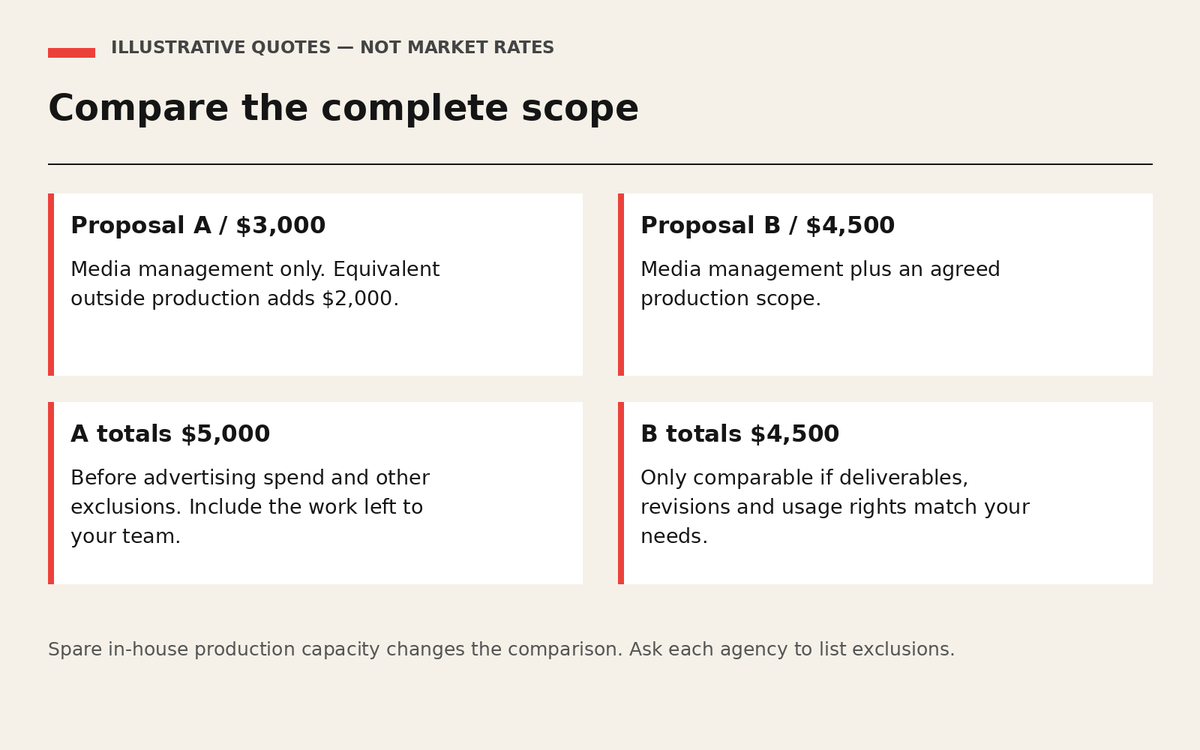
Illustrative quotes only. Compare equivalent deliverables and rights before comparing totals.
Add setup charges, recurring software, production extras and internal implementation time. Ask each agency to confirm exclusions in writing before you compare the totals.
Give each agency your products, markets, channels, existing assets and the work your team can cover. Ask for named deliverables, monthly quantities, revision limits, ownership terms and responsibilities after launch.
Vibemyad Marketing Agency provides research, creative production and performance marketing within an agreed scope. A useful first conversation should establish which jobs you want the agency to own and which will remain with your team.
Get research, creative production, and hands-on agency support.



Arpita Mahato
Content Writer, Vibemyad

Arpita Mahato
Content Writer, Vibemyad

Arpita Mahato
Content Writer, Vibemyad
Table of Contents