September 09, 2026 • 12 min read
September 09, 2026 • 12 min read
A marketing agency can cost anywhere from about $1,000 per month for a narrow, execution-only scope to $30,000 or more per month for a senior, multi-channel team. One-off projects may start around $1,000 and exceed $50,000. Those figures are useful for orientation, but they are not a reliable average. The word “agency” covers radically different products.
The number that matters is not the retainer alone. It is the total cost of running the marketing system:
Total marketing cost = agency fee + media spend + production + software + internal time + outside specialists
That distinction changes how you compare quotes. A $4,000 agency that requires you to supply every video, manage analytics, and coordinate three freelancers may cost more than a $9,000 partner that owns the full workflow. A low fee can also be appropriate when you genuinely need one narrow service.
This guide explains what US businesses should expect to pay in 2026, why published averages conflict, which costs often sit outside the proposal, and how to decide whether an agency quote is commercially sensible.
For ongoing work, a practical 2026 planning range is $2,500 to $20,000 per month. Smaller or highly standardized packages can sit below it. Complex programs involving senior strategy, frequent creative production, multiple paid channels, SEO, lifecycle marketing, and conversion work can sit well above it.
Published estimates do not agree. WebFX reports monthly retainers from $1,000 to $12,000+, while Teamwork cites $2,500 to $12,000 for digital marketing agencies. DTC-focused agency Darkroom publishes much higher figures, starting around $3,000 for one service and reaching $75,000 for a full-stack engagement. Each range describes a different sample, service mix, and buyer.
Treat every public range as market context, not a quote.
These bands are not a rate card. They are a way to classify the product being sold.
An average marketing agency cost sounds precise but blends together work that should never be averaged.
Consider two proposals at $6,000 per month.
The first covers paid-media management for Meta and Google. Your team supplies all creative, owns the landing pages, pays for tracking software, and writes the offers. The second includes research, creative production, media management, landing-page tests, and weekly analysis. The invoice is identical. The operating burden is not.
Five variables create most of the price difference.
Managing one mature Google Ads account is different from launching Meta, Google, email, SEO, and a creative-testing program at once. More channels create more work, but they also create coordination needs. Someone must decide how search demand, paid-social messages, landing pages, and retention campaigns fit together.
“Creative included” tells you very little. Does it mean four resized static ads, or 20 distinct concepts with video editing, creator coordination, copy, and variations? Deliverable count, format, and conceptual depth have a direct effect on cost.
Some buyers pay for access to experienced strategists. Others pay for a junior delivery team supported by a senior person who appears once a quarter. Ask who will make decisions in your account and how much of that person’s time is included.
A single-product ecommerce store operating in one country is easier to manage than a marketplace, multi-location service business, regulated brand, or retailer with hundreds of SKUs. Complexity adds research, approvals, feed work, analytics, and coordination even when the number of channels stays the same.
Fast revisions, weekly production, daily account checks, weekend launch support, and detailed executive reporting all require capacity. Agencies either price for that capacity or quietly ration it.
This is why searching for one “digital marketing agency cost” produces contradictory answers. Buyers are comparing labels while agencies are pricing operating systems.
The agency fee is only the first line in the budget. Before approving a proposal, build a complete cost view.
This is the retainer, project charge, hourly invoice, percentage of spend, or performance fee. Confirm whether tax, payment-processing charges, travel, and out-of-scope work are extra.
Ad spend goes to Meta, Google, TikTok, publishers, creators, or other platforms. It does not normally sit inside the agency fee. A $5,000 management fee plus $20,000 in media is a $25,000 monthly commitment before creative or software.
Photography, video shoots, UGC, editing, design, voiceover, animation, props, locations, and usage rights may be included, capped, or billed separately. The word “content” is too vague for procurement. Ask for exact formats and quantities.
If ecommerce growth is central to the plan, read our guide to what an ecommerce marketing agency actually does before deciding whether production belongs inside the same engagement.
Reporting tools, call tracking, SEO platforms, feed tools, attribution products, landing-page builders, email platforms, and data warehouses can add hundreds or thousands of dollars each month. Determine which licenses the agency absorbs, which it passes through, and which accounts you will own.
An agency does not remove every task. Your team still supplies approvals, product knowledge, access, legal review, inventory updates, and commercial decisions. If five internal stakeholders attend two weekly meetings, coordination is a real cost even though it never appears on the invoice.
Developers, tracking engineers, photographers, creators, PR counsel, and compliance reviewers may sit outside the core team. A proposal should identify anticipated dependencies before work begins.
Normalize every proposal into four numbers.
Add the retainer, required software, minimum production commitment, and recurring external support.
Add percentages of media spend, performance fees, creator fees, usage rights, overages, and transaction-linked charges.
Count actual deliverables: new concepts, finished assets, campaigns, landing pages, articles, email flows, experiments, and reports. Separate new strategic ideas from simple variations and resizes.
Estimate the hours your team must spend briefing, reviewing, supplying assets, moving data, managing other vendors, and resolving handoffs.
The goal is not to reduce marketing to cost per asset. A strong strategy can make one concept worth more than 50 variations. The exercise simply exposes what you are buying and where execution risk still sits.
The same scope can produce very different bills depending on the pricing model.
You pay a fixed amount for recurring access and an agreed scope.
Best for: ongoing work with predictable capacity needs.
Watch for: vague inclusions, unused capacity, overages, and long notice periods.
A retainer is not inherently expensive. It becomes expensive when the work is underspecified or the agency has little incentive to improve throughput.
You pay a fixed price for a defined result such as a website, campaign launch, brand system, audit, or content package.
Best for: work with a clear beginning, end, and acceptance standard.
Watch for: revision limits, change requests, dependencies, and delayed client approvals.
Project pricing works poorly when the work requires continuous testing because the scope becomes obsolete as soon as the first results arrive.
You pay for time used.
Best for: consulting, troubleshooting, training, fractional leadership, or uncertain technical work.
Watch for: open-ended estimates and incentives that reward time rather than completion.
Hourly pricing can be transparent when the agency provides ranges, time logs, caps, and approval points.
The fee rises with the advertising budget, often with a minimum monthly charge.
Best for: media-heavy engagements where workload genuinely grows with spend and campaign complexity.
Watch for: an incentive to increase spend even when creative, conversion rate, or contribution margin is the real constraint.
Our analysis of retainer and outcome-based agency pricing explains how a flat fee and a media percentage behave at different budget levels.
The agency earns against a defined result such as qualified leads, revenue, pipeline, or another agreed outcome.
Best for: measurable funnels where both parties agree on attribution, quality, baselines, and external constraints.
Watch for: cherry-picked attribution, weak definitions, short-term optimization, and outcomes the agency cannot fully control.
Vibemyad uses an outcome-based agency model with no retainer lock-in. The scope is set after a discovery call rather than selected from a public package. That fits our work because strategy, creative, paid media, ecommerce SEO, AI search, and conversion work can be connected to a defined commercial problem. It is not automatically the right model for every brief. A fixed project price is usually cleaner for a one-time brand identity or site migration.
You can review the current Vibemyad agency model and pricing approach directly.
Budget should follow the constraint, not the company label.
If product-market fit is still uncertain, avoid buying a large multi-channel machine. A focused project, senior consultant, or narrow specialist may create more value than a full-service retainer. Preserve cash for customer research, offer testing, and the channel most likely to produce a clear signal.
A $2,500 to $7,500 monthly agency budget can support one or two priority channels, depending on output requirements. Decide whether the agency owns thinking, execution, or both. Underfunding creative while paying for media management is a common imbalance.
Our related guide explains what an ecommerce business can realistically buy below $5,000.
Once paid media, creative volume, merchandising, landing pages, and retention affect one another, fragmented specialists create a coordination tax. A larger integrated engagement can cost less than several inexpensive vendors if it reduces handoffs and speeds up testing.
The decision is not always agency versus no agency. Our in-house versus agency cost comparison looks at the staffing side of that choice.
Larger organizations often retain strategy and brand ownership internally while agencies supply specialist depth, production capacity, or regional execution. Procurement, security, reporting, and stakeholder management become part of the work. Expect proposals to reflect that overhead.
There is no universal ratio, but the agency fee should make sense beside the working budget.
Suppose a brand can invest $30,000 per month in growth:
This is an illustration, not a recommended ratio. A content-led B2B business, a local service company, and a DTC brand will allocate the same total very differently.
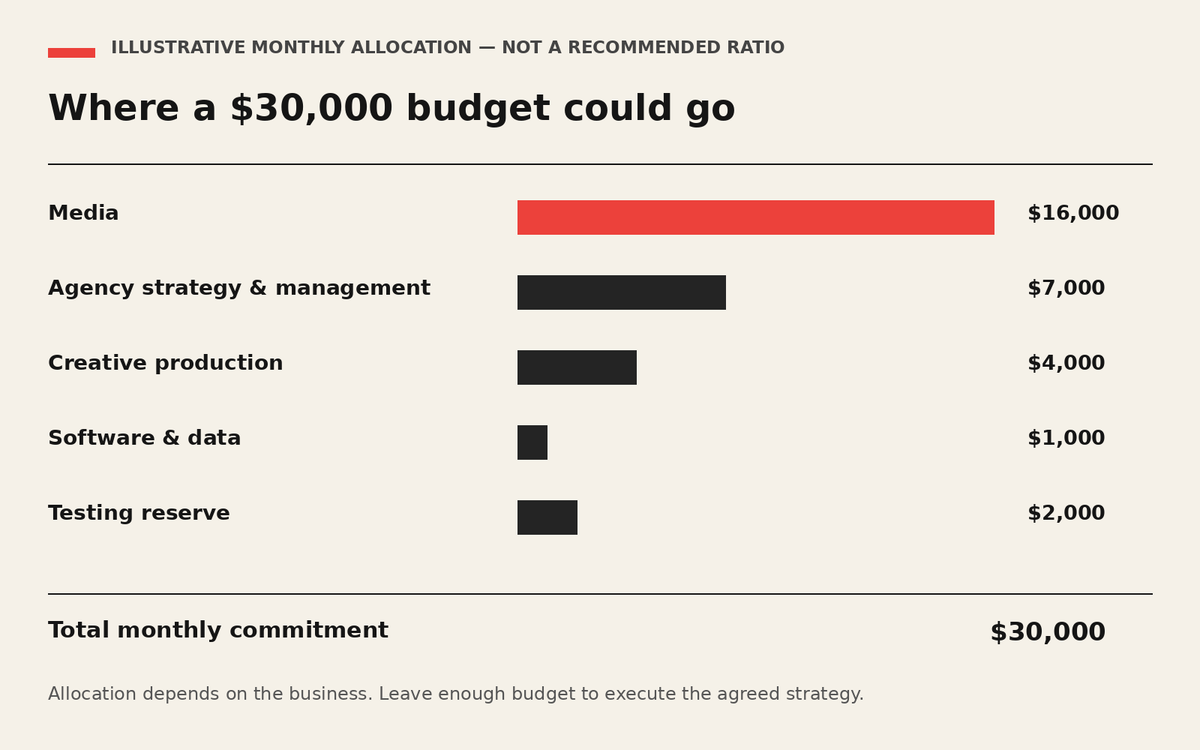
The article's illustrative $30,000 allocation—not a recommended spending ratio.
The useful question is: after paying the agency, is enough money left to execute the strategy?
If an agency recommends paid growth but its fee consumes most of the available budget, the plan may be structurally underfunded. The opposite can also fail. A large media budget with almost no research, creative, or landing-page investment tends to buy faster feedback on weak inputs.
• What commercial problem does this scope solve? The proposal should name a constraint, not merely list services.
• What is included every month? Ask for volume, formats, channels, seniority, and turnaround time.
• What will we still need to buy? Surface media, software, creators, development, production, travel, and usage rights.
• How much time will our team spend? Clarify meetings, approvals, asset collection, and coordination.
• How does the fee change? Document spend thresholds, overages, performance tiers, and renewal increases.
• Who owns the accounts and work? Your company should retain appropriate access to ad accounts, analytics, domains, source files, and data.
• What happens if the first plan is wrong? Good marketing contains uncertainty. The operating model should make learning and course correction explicit.
If you are comparing providers, use these alongside our broader guide to choosing an ecommerce marketing agency.
An agency is too expensive when its total cost exceeds the plausible value of solving the problem, or when the business cannot fund the execution required to test the plan.
That judgment needs basic unit economics.
For ecommerce, start with contribution margin after product cost, fulfillment, discounts, payment fees, and returns. For lead generation, use lead-to-sale rate and gross profit per customer. For B2B, use qualified pipeline, win rate, gross margin, and sales-cycle length.
Then ask what the agency must change for the investment to pay back.
If a $10,000 monthly engagement needs 20 additional customers to break even, can the market, sales team, inventory, and funnel realistically support that? If the answer requires an implausible conversion jump, the fee is too high for the current economics even if the agency’s rate is fair.
Cheap can also be expensive. Paying $2,000 for six months of reports without new tests, better creative, or usable customer insight wastes $12,000 and half a year.
So, how much does a marketing agency cost in 2026?
Use $2,500 to $20,000 per month as a broad planning range for ongoing US agency work, with narrow packages below it and complex full-service programs above it. Then stop comparing retainers in isolation.
Build the full budget. Define the output. Price the internal workload. Check whether the fee leaves enough money for media, production, and testing. Finally, connect the required improvement to your unit economics.
The best-priced agency is not the cheapest one or the one with the largest team. It is the one whose scope, incentives, and operating model give your business the clearest path from money spent to evidence gained and results produced.


Arpita Mahato
Content Writer, Vibemyad

Arpita Mahato
Content Writer, Vibemyad

Arpita Mahato
Content Writer, Vibemyad
Table of Contents