September 09, 2026 • 13 min read
September 09, 2026 • 13 min read
A creative agency for ads researches, plans, writes, designs, and produces the assets used in paid advertising. A performance-focused one does more: it studies campaign results, identifies why an ad worked or failed, and uses that evidence to brief the next round of creative.
That feedback loop separates a useful partner from an outsourced design queue.
Most brands do not hire a creative agency for ads because nobody can make a banner or edit a short video. They hire one because the internal team cannot consistently turn customer insight into enough distinct, testable ads. Production may be slow. The media buyer may have no influence over the brief. Winning ideas may never become a repeatable system. Files arrive, campaigns launch, and the learning disappears inside an Ads Manager report.
The right agency closes that gap. The wrong one simply gives the same problem better lighting.
A creative agency for ads is a specialist partner that develops advertising concepts and turns them into campaign-ready static images, videos, copy, motion graphics, UGC-style assets, and platform-specific variations.
Its job is narrower than a full-service marketing agency and broader than a production studio.
• A production studio executes a defined idea.
• A branding agency develops identity, positioning, and brand systems.
• A media buying agency manages budgets, targeting, bidding, and campaign structure.
• A creative agency for ads finds and produces the messages, concepts, and formats the media budget will distribute.
• A performance creative agency connects that work to campaign data and continuous testing.
The borders are not fixed. Some agencies handle all five areas. Others specialize in Meta video ads, creator content, Google assets, or direct-response copy. Buyers should evaluate the work the agency actually owns, not the label on its homepage.
A capable agency should own a connected process, not a menu of disconnected deliverables.
The work begins before anyone opens a design file.
The agency studies the product, category, offer, customer reviews, objections, use cases, existing campaign results, and competitor advertising. It looks for repeated messages in the market, claims that competitors avoid, formats customers already understand, and questions the landing page has not answered.
This research should end in a usable point of view. A hundred screenshots are not a strategy. The agency needs to explain which customer problem it will address, why that problem matters, and what evidence the ad can show.
Vibemyad uses live category and competitor advertising as one input to this process. Our guide to using the Meta Ad Library explains what the library can reveal and where manual research becomes unreliable.
Creative strategy converts research into testable hypotheses.
A hypothesis might be that shoppers hesitate because they cannot picture the product in daily use. Another might be that the category has trained buyers to distrust a specific claim. The strategist then selects an angle, proof device, format, spokesperson, opening, and call to action that can test the idea.
This is more precise than asking whether “UGC beats polished video.” Format is only one variable. A casual creator video with a weak argument is still a weak ad.
The output may include:
• Audience and problem definitions
• Messaging angles
• Concept territories
• Hooks and opening frames
• Offers and calls to action
• Proof requirements
• Format and channel recommendations
• A creative testing plan
The agency turns hypotheses into things a production team can make.
For video, that means scripts, storyboards, shot lists, creator briefs, demonstrations, voiceovers, supers, and edit notes. For static ads, it means headlines, visual directions, layouts, product treatments, and copy hierarchy. For carousels, it means sequencing the argument rather than resizing one image across several cards.
Good concepts are different at the level that matters. Changing the background color, first sentence, or crop can create a useful variation. It does not create a new strategic idea.
Creative services for ads can include studio photography, creator sourcing, UGC production, animation, graphic design, AI-assisted imagery, editing, motion graphics, sound, and localization.
The production method should follow the concept. A product demonstration may need a real hand, real material behavior, and controlled lighting. A comparison ad may need clear information design. A fast concept test may be suitable for AI-assisted production before the brand invests in a full shoot.
AI can reduce the cost of exploration and variation, but it does not remove the need for art direction, factual review, consent, brand judgment, or quality control. Our article on why prompt-based ad generators fail covers the difference between generating an image and building a dependable creative system.
One master file rarely covers every paid channel well.
Meta encourages advertisers to diversify creative through genuinely different visuals, messages, and storylines rather than small cosmetic changes. Google recommends covering text, image, and video asset types and creating variations within Performance Max asset groups. TikTok advises advertisers to use meaningfully different creative and platform-native video conventions. Those recommendations come directly from Meta’s creative diversification guidance, Google Ads asset-group best practices, and TikTok’s performance creative guidance.
The agency should therefore plan for placement and behavior, not just dimensions. A TikTok opening, a Meta feed static, a Story, a YouTube cut, and a Google display asset do not ask for attention in the same way.
This is where a performance creative agency earns the word “performance.”
Before launch, the agency should define what each concept is testing. After launch, it should read results by concept, angle, hook, creator, format, offer, and landing-page match. It should then decide what to scale, revise, combine, or stop.
The analysis does not need to pretend one metric explains everything. A high click-through rate can hide weak purchase intent. A lower-volume concept can bring better customers. A strong ad can still fail on a poor product page. Creative reporting should connect attention, traffic quality, conversion, and commercial outcome.
The goal is not to declare winners. It is to make the next brief less speculative.
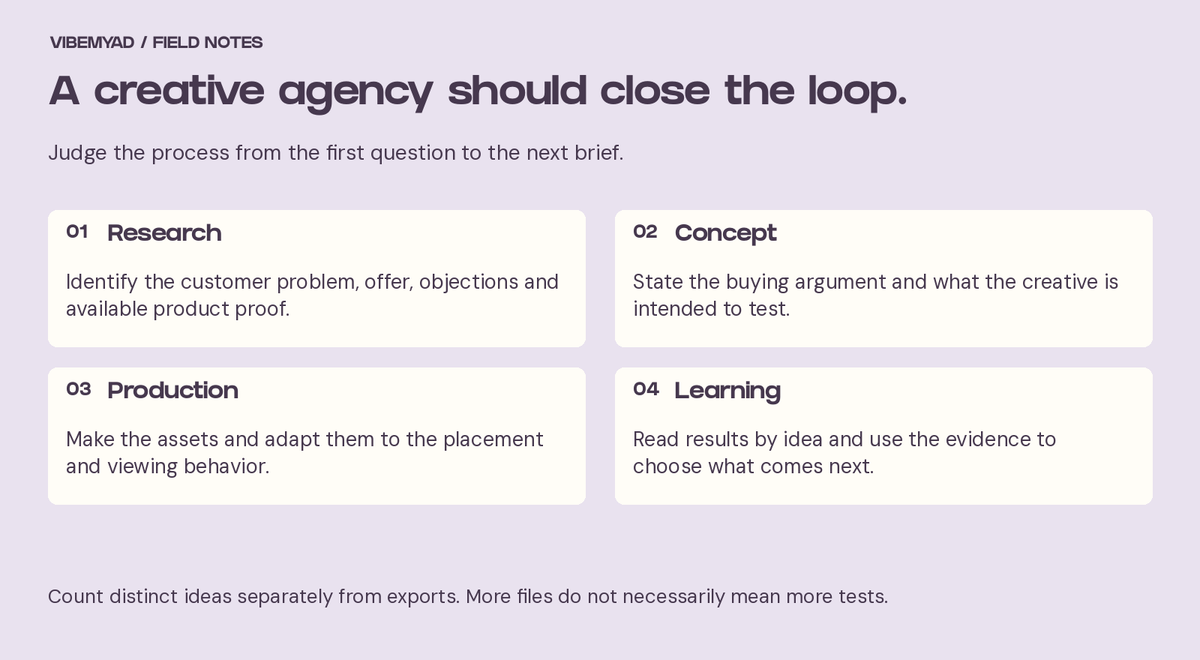
Creative agency workflow: research the problem, define the concept, produce assets and use results to improve the next brief.
Deliverables vary, but the scope should distinguish ideas from files.
If a proposal promises “30 creatives,” ask how many are original concepts. One video cut into three lengths and three aspect ratios produces nine files. It still represents one central idea.
Traditional creative agencies often organize work around campaigns. They develop a large idea, produce a polished set of assets, launch it, and move to the next brief.
A performance creative agency works in shorter loops. It expects some ads to fail, so it structures production to learn quickly and preserve the parts that work. The output is not one final campaign. It is an evolving portfolio of concepts.
This does not make traditional craft obsolete. A brand launch, television spot, or major repositioning may need deeper development and expensive production. The question is whether the operating model fits the advertising problem.
Hire one when the bottleneck is no longer access to tools. It is the ability to produce good decisions and usable creative at the pace the media program requires.
More budget gives the platform more opportunities to serve ads, but it also exposes a thin creative library. If the same few ads carry the account for months, the team is taking concentration risk.
An agency can add concept and production capacity without waiting to recruit a strategist, copywriter, designer, editor, producer, and creator network separately.
Media buyers should contribute performance evidence. They should not have to become the entire creative department between campaign checks.
If every new concept depends on one buyer scrolling through competitors at midnight, the process has no research depth, production ownership, or quality control. A creative agency for ads can formalize the work and give the buyer better inputs.
High output can hide low idea volume.
If every batch repeats the same product shot, offer, and claim with different colors, the account is not testing the market. It is testing decoration. An outside strategist can challenge assumptions and build concepts around different customer problems, proof mechanisms, and stages of awareness.
Design reports to brand. Media reports to growth. Creators report to social. The landing page belongs to ecommerce. Everyone does their job, but nobody owns the journey from insight to ad to conversion.
This is the strongest reason to hire a performance creative agency. Its value is coordination around a learning system.
Some brands need motion, creator casting, product photography, localization, or AI production several times a quarter, but not enough to hire every role full time. An agency gives the internal team access to those capabilities when the brief requires them.
Our comparison of an AI marketing agency and a traditional agency explains how production economics and staffing change when software becomes part of that capacity.
Do not hire an agency simply because the ads are underperforming.
Creative may not be the main constraint. The offer may be weak. The product page may load slowly or answer the wrong questions. Tracking may be unreliable. The campaign may not receive enough conversions to support the promised test volume. Inventory or margin may prevent the brand from scaling a winner.
An agency is also a poor fit when:
• The founder cannot provide product access, evidence, or timely approvals
• The brand has not decided who can approve claims and usage rights
• The budget can fund production but not meaningful media testing
• The internal team needs one narrow asset with a fully defined brief
• The agency cannot access enough campaign data to learn from the work
• The company expects every concept to win on the first attempt
Sometimes the correct purchase is a freelance designer, production studio, UGC creator, or short strategy project. Buy the missing capability, not the most impressive scope.
The choice depends on frequency, management capacity, and how many disciplines the work crosses.
A hybrid model often works best. The internal lead owns brand context and commercial priorities. The agency adds research, concept volume, production range, and an outside view. Media results flow back to both teams.
Do not start with the portfolio. Start with the process behind it.
Request a sample research brief. Look for customer language, competitor patterns, previous campaign evidence, product truth, and a clear strategic conclusion.
If the research is a moodboard, the creative will depend heavily on taste.
Separate concepts, executions, and adaptations. Confirm the number of hooks, bodies, offers, creators, statics, video cuts, and aspect ratios.
This prevents a file-count proposal from disguising a concept shortage.
The strategist who writes the next brief needs access to results or a structured report from the media team. Ask which metrics are reviewed, how often the review happens, and how the finding becomes a production decision.
Performance is not permission to publish weak claims, synthetic testimonials, inconsistent packaging, or visuals the customer cannot trust.
Review the approval process for claims, scripts, creator consent, AI-generated material, music, stock assets, raw footage, and usage rights. If the agency produces creator-style content with AI, our guide to AI UGC ads explains the credibility and disclosure questions worth raising.
Failure is part of creative testing. The agency should be able to distinguish a failed hypothesis from a weak execution, insufficient spend, poor landing-page match, or an inconclusive result.
If the only response is “make more,” it has a production plan, not a learning plan.
Use the same questions with every shortlisted agency:
• Who conducts customer and competitor research?
• What does the research deliverable look like?
• How many original concepts are included each month?
• How many files are adaptations of those concepts?
• Who writes the hooks, copy, scripts, and briefs?
• Which production methods are included?
• What uses AI, and how is the output reviewed?
• Who owns source files, raw footage, and derivatives?
• Which paid, organic, territorial, and time-based rights are included?
• Who launches the ads and controls the test budget?
• How are creative results named and reported?
• How does performance data change the next brief?
• What happens when footage is late, unusable, or off-brand?
• What does the brand keep when the engagement ends?
The answers should appear in the scope and contract, not only on the sales call.
Vibemyad is an AI-native ecommerce agency for DTC brands. We connect competitor and category research, creative strategy, static and video production, UGC, paid media, and conversion work in one operating loop.
The process starts with better inputs. We study what the category is saying, how competitors structure their offers and ads, what customers object to, and where the brand has credible proof. From there, we build distinct concepts, produce them with the right mix of people and AI, and test them through paid media.
The useful part happens next. Results inform the following batch. A strong hook can move into a different format. A useful demonstration can become a landing-page section. A weak concept is not endlessly recolored to preserve the production plan.
That model is best for brands that want a creative agency for ads and a growth partner working from the same evidence. It is unnecessary for a company that needs one logo animation or a handful of finished assets.
See how the Vibemyad agency connects creative production to the rest of the acquisition system.
Hire a creative agency for ads when the business needs more than extra hands. Hire one when it needs a dependable way to move from market evidence to ideas, from ideas to ads, and from campaign results back to better decisions.
The agency should increase the number of useful experiments without lowering the standard of the brand. It should make the media team smarter, not merely busier. And it should leave behind more than files: a clearer picture of which customers, problems, messages, proofs, and formats deserve the next dollar.
That is the real product. The ads are how it gets delivered.
Table of Contents