September 10, 2026 • 9 min read
September 10, 2026 • 9 min read
The most serious marketing agency red flags are unverifiable promises, unnamed delivery teams, vague output, movable measurement rules, hidden account ownership, and contracts that make poor performance hard to exit. A polished pitch is not evidence that the operating system behind it works.
Vet the agency by asking it to make claims, responsibilities, data definitions, deliverables, and failure responses specific before signing.
Not every awkward sales call predicts a bad engagement. Focus on signals that threaten results, control, or the ability to correct mistakes.
The major risk areas are:
• Truth: Can the agency support what it claims?
• Team: Do you know who will perform and review the work?
• Scope: Can both sides count what will ship?
• Measurement: Are success rules fixed before results arrive?
• Ownership: Will the client retain accounts, files, and data?
• Incentives: Does the pricing model reward the right behavior?
• Exit: Can the business leave with its operating history intact?
One weak area can be corrected in negotiation. Several weak areas usually indicate a system problem.
Yes, when the promise ignores inputs the agency cannot control.
An agency may control research, campaigns, creative, landing pages, tracking, and reporting. It may not control product quality, price, inventory, reviews, sales follow-up, fulfillment, competitor behavior, or platform changes.
Ask the agency to separate commitments from forecasts. It can commit to response times, production volume, testing cadence, quality checks, and transparent reporting. It can forecast outcomes using stated assumptions. It should not present a forecast as certainty.
The FTC's advertising guidance for US businesses states that advertising claims must be truthful, evidence based, and not deceptive or unfair. Apply that standard to the agency's own sales material. What evidence supports the claim, and what conditions must remain true?
A case study should let you understand the starting point, work, timeframe, metric, and agency contribution.
Red flags include:
• A large percentage with no baseline
• Revenue without spend, margin, or prior performance
• Leads without quality or sales outcomes
• Platform ROAS without new-customer or blended context
• Results from an unnamed period
• No explanation of what the client supplied
• A brand logo without permission or verifiable work
Ask what changed and what would have happened without the agency. The answer may be uncertain, but the agency should acknowledge attribution limits rather than claim every improvement.
Yes. The people in the pitch may not be the people on the account.
Ask for the role, seniority, location, capacity, and review responsibility of each assigned person. You do not need every employee's biography. You need to know whether the proposed work has enough strategy, production, technical depth, and decision authority.
Useful questions include:
• Who owns the account day to day?
• Who writes strategy and approves major changes?
• Who produces the work?
• What is outsourced or white-labeled?
• How many accounts does the lead manage?
• What happens if a key person leaves?
A junior operator with strong senior review can work well. Hidden staffing cannot be evaluated.
"Ongoing optimization," "content support," and "full-service marketing" are not measurable deliverables.
Translate the proposal into quantities and decisions:
The digital marketing agency cost breakdown shows why service labels are not enough to compare proposals.
They can be.
An agency may inflate file count by treating crops, resizes, hook changes, and exports as separate concepts. The files can be useful, but they should not be sold as independent strategic ideas.
Ask the agency to separate:
• Original hypotheses
• Concepts
• Hooks and copy variations
• Edits and cutdowns
• Aspect ratios
• Resizes and exports
This is especially important in paid creative. Our guide to what a creative agency for ads should own explains how production becomes a testing and learning system.
It is a red flag when the agency uses platform numbers as the final business truth.
Ad platforms optimize using their own events and attribution rules. Analytics tools, e-commerce systems, CRMs, and finance records answer different questions. A serious agency explains the discrepancies and defines which system settles which decision.
Google Analytics added custom conversion windows, source grouping, campaign-data validation, and conversion-analysis features in 2026. Google's current Analytics updates show why reporting governance matters. If settings can change, the agency needs a documented change log and comparison method.
Watch for:
• Attribution windows changing after results weaken
• Old and new customers mixed together
• Refunds or cancellations ignored
• Leads reported without acceptance or close data
• Branded demand claimed as newly created demand
• Screenshots used instead of accessible dashboards
Yes. The business should own its advertising accounts, analytics, domains, pixels, catalogs, CRM, creative files, and customer data.
The agency can receive the access needed to work. It should not make continuity depend on infrastructure the client cannot control.
Before signing, record:
• Legal owner
• Primary administrator
• Billing owner
• Recovery contact
• Export method
• Post-contract access plan
If an agency insists on using its account, ask why, what data you can export, and what happens at termination.
Every pricing model rewards behavior.
A percentage of media spend rewards spending more. A fixed retainer rewards stable delivery but may not create urgency. Pay per lead rewards volume unless qualification is strict. Revenue share may claim demand created elsewhere. A hybrid can balance capacity and outcome, but only if the baseline is fair.
The pricing model is not the red flag by itself. The red flag is an agency that cannot explain its incentive or test the formula across a weak, expected, and exceptional month.
Use the performance-based agency pricing comparison to audit baselines, attribution, controllability, floors, and caps.
A long term can be reasonable when the agency reserves a team, finances production, or performs work with a slow learning cycle. It becomes risky when the agency cannot define milestones, exit conditions, or handover.
Ask:
• What work justifies the minimum term?
• Which milestones occur before renewal?
• Can the client exit for repeated non-performance?
• What notice applies?
• What fees survive termination?
• What materials and access transfer at exit?
The contract should protect the learning cycle without trapping the client inside an unproductive relationship.
Breadth is useful only when the agency has real capability and clear ownership across functions.
Ask for the operating map. Who owns research, creative, media, SEO, analytics, development, and project management? How do decisions pass between those people? What is handled by partners? Which service has the strongest evidence?
A specialist can be the right choice when one channel is the problem. A full-service firm is useful when the handoffs between functions are the constraint. The specialist versus full-service e-commerce agency guide helps identify the difference.
Use the same evidence sequence for every finalist.
State the business model, customer, current performance, constraints, systems, internal team, budget, and decision timeline. Without a consistent brief, proposals answer different questions.
The agency should identify what it knows, what it suspects, and what it needs to investigate. A detailed plan built before access to the data may be a template.
Choose a case with a similar problem, not merely a famous logo. Ask for the baseline, work, timeframe, client inputs, failures, and lessons.
Use the working session to test how the team thinks. Give it a realistic problem and watch whether it asks useful questions before proposing tactics.
Confirm deliverables, service levels, approvals, source of truth, account ownership, intellectual property, data handling, pricing, renewal, exit, and handover.
A pilot should be large enough to test the capability. A single cheap asset cannot evaluate a full growth system. A defined channel, creative sprint, measurement project, or 90-day scope often produces better evidence.
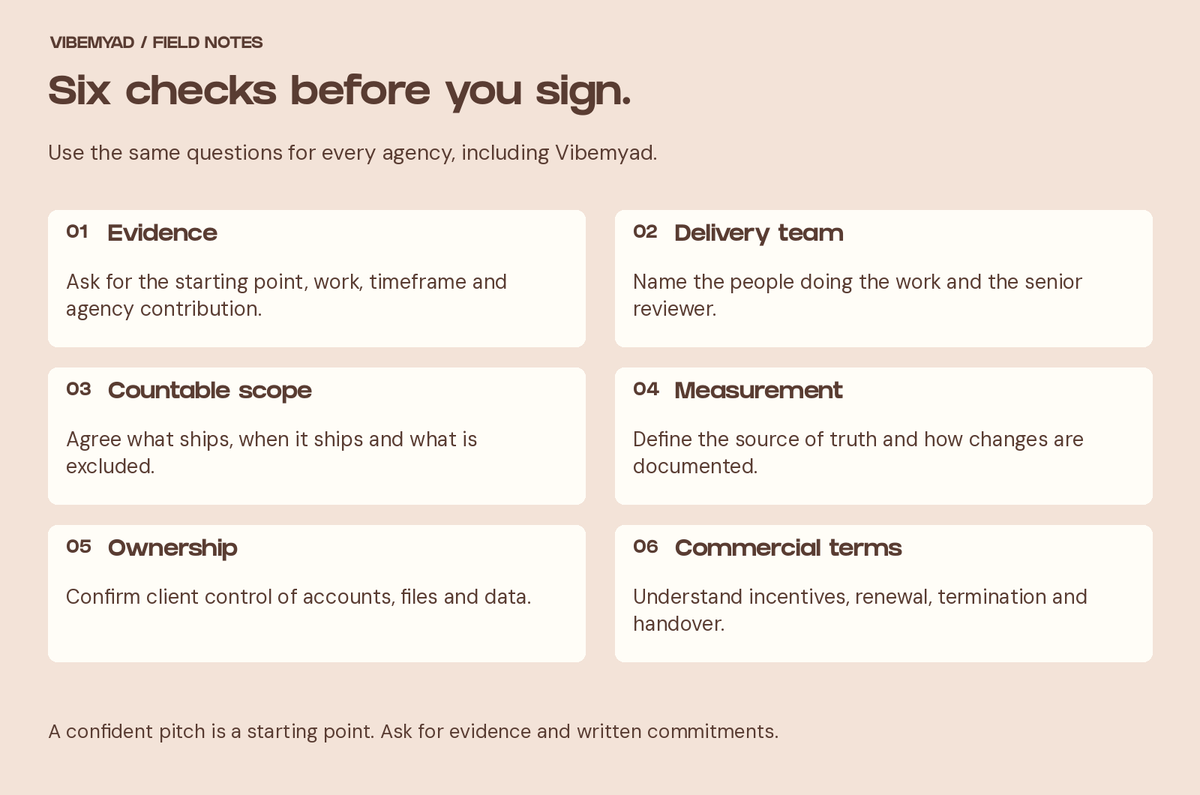
Agency vetting checklist: evidence, delivery team, scope, measurement, ownership and commercial terms.
Before signing, confirm:
• The objective is measurable and economically useful.
• The proposed scope addresses the current constraint.
• Every deliverable has a definition and cadence.
• The assigned team and senior reviewer are named.
• Client dependencies and approval deadlines are written.
• Claims and case studies have usable context.
• The source of truth and attribution rules are fixed.
• Accounts, data, domains, and source files remain client-owned.
• External costs and exclusions are visible.
• The pricing incentive is understood.
• The first 30 days have named outputs.
• Renewal, termination, and handover are clear.
The Vibemyad agency-selection questions provide a DTC-specific version of this diligence.
Vibemyad scopes the outcome, operating constraint, work, measurement, and client dependencies before pricing the engagement. The delivery model connects category research, creative production, paid media, e-commerce SEO, AI search, landing pages, and automation when the result requires them.
The client should understand what the team owns, which inputs remain internal, how progress will be measured, and what happens when the first hypothesis fails.
Review the Vibemyad agency model against the checklist above. The same questions should apply to every agency, including us.
Walk away when the agency will not identify the delivery team, support material claims, define output, disclose external costs, fix measurement rules, preserve client ownership, or explain exit and handover.
Other issues can be negotiated. Those failures prevent the business from evaluating the work or protecting itself when the relationship changes.
Table of Contents