September 10, 2026 • 9 min read
September 10, 2026 • 9 min read
Switching marketing agencies makes sense when the business has changed but the agency's capability, operating model, or accountability has not. A weak month is not enough. Repeated strategic gaps, slow output, hidden ownership, unreliable measurement, and no credible correction plan are stronger evidence.
Do not start with "Should I fire my marketing agency?" Start with "Is the problem performance, capability, fit, or governance, and can it be repaired?"
An agency relationship should change when it can no longer support the company's next operating stage.
A brand may begin with one paid channel and a handful of monthly assets. Two years later it may need several markets, constant creative testing, lifecycle coordination, SEO, analytics, and board-level forecasting. The original agency can be competent and still be wrong for the new scope.
Switching is justified when three conditions are present:
• The gap is material to growth.
• The gap repeats after direct feedback and a reasonable correction period.
• The current agency cannot show a credible plan, capability, or staffing change.
This separates a structural mismatch from ordinary volatility.
The company now needs a different kind of work, but the agency keeps optimizing the service it originally sold.
A media agency may keep changing bids when creative supply is the constraint. A content agency may keep publishing articles when technical implementation blocks search growth. A creative studio may produce strong assets without reading conversion data.
The issue is not effort. The issue is whether the agency can reach the current bottleneck.
Reports describe what happened. Strategy states what the team believes, what it will test, what it will stop, and what evidence will change the plan.
If every meeting reviews dashboards but no decision changes, the relationship has become administrative. Ask for a written decision log with hypotheses, owners, launch dates, results, and next actions. If the agency cannot produce one, the learning system is weak.
Paid growth often stalls when campaigns need new reasons to buy but receive only new file variations. Changing a color, crop, or first line can extend a concept. It does not replace the need for new concepts.
Our guide to creative agencies for ads separates concept development from production volume. Use that distinction when diagnosing whether the agency has a media problem or a creative operating problem.
The pitch introduced experienced strategists. Delivery depends on a junior account manager who cannot make decisions without escalating every question.
Junior talent is not the problem. Hidden staffing is. The agency should name the people doing the work, their responsibilities, and the senior review cadence. If the relationship needs capabilities the assigned team does not have, ask for a staffing correction before deciding to leave.
The client should retain access to advertising accounts, analytics, CRM data, pixels, domains, creative source files, research, and reporting history.
If the agency runs core infrastructure inside accounts it owns, switching becomes expensive by design. Document every asset and permission before the relationship becomes adversarial.
A healthy agency can explain why platform, analytics, CRM, and backend numbers differ. It defines a source of truth before results arrive.
Google Analytics introduced custom conversion windows and new cross-channel reporting features in 2026. Google's Analytics release notes show that measurement settings can materially change how results appear. If an agency changes windows, models, exclusions, or definitions after a weak period without documenting the reason, comparisons become unreliable.
Clicks, leads, revenue, and platform ROAS can improve while contribution profit, lead quality, or cash flow worsens.
The agency should understand the economic constraint behind the campaign. For e-commerce, that may include margin, discounts, shipping subsidies, refunds, repeat purchase, and payback. For lead generation, it may include acceptance rate, sales qualification, close rate, and collected revenue.
You hired an agency to reduce coordination. Your team now translates between media, creative, SEO, development, and analytics vendors every week.
That may be acceptable in a specialist model if the company has a strong internal operator. It is a failure when the agency sold integrated ownership. The full-service versus specialist agency comparison helps identify which model the business now needs.
Not automatically.
Results can fall because the market changed, inventory disappeared, competitors discounted, the offer weakened, tracking broke, or a creative bet failed. A serious agency should not be judged for every loss. It should be judged for how it identifies, communicates, and responds to the loss.
Before deciding, ask:
• Did the agency flag the problem before you did?
• Can it separate facts from hypotheses?
• Does it own mistakes without hiding behind the platform?
• Did it preserve enough evidence to learn?
• Is there a specific recovery plan with owners and dates?
• Does the plan address the actual constraint?
A bad result with good diagnosis can strengthen a partnership. Repeated bad diagnosis is a stronger reason to switch.
Repair is usually better when the capability exists but expectations, scope, access, or decision rights are unclear.
Use a 30-day reset:
• Restate the commercial goal and primary metric.
• Name the current constraint.
• List agency-controlled and client-controlled inputs.
• Define the next three tests or deliverables.
• Set approval and response deadlines for both sides.
• Confirm the source of truth and reporting definitions.
• Set one review date and the evidence required to continue.
Put the reset in writing. A vague promise to communicate better cannot be evaluated.
Changing agencies creates transition risk even when the decision is correct.
Campaign learning can be lost. Creative files may be scattered. Tracking ownership may be unclear. New teams may rebuild structures to match their preferences rather than because the old structure was wrong. A rushed handoff can create a performance dip that neither agency owns.
Delay the switch if a major launch is days away, critical access is unresolved, or the new agency has not completed diligence. Do not delay only because the current agency controls the accounts. Fix ownership first.
List:
• Ad accounts, business managers, pixels, catalogs, and feeds
• Analytics properties, tag managers, dashboards, and warehouses
• Domains, landing pages, CMS access, and repositories
• CRM, email, automation, and call-tracking systems
• Creative source files, raw footage, licenses, and usage rights
• Research, briefs, audiences, exclusions, and experiment logs
• Contracts, invoices, budgets, and reporting definitions
Record owner, administrator, billing owner, and recovery contact for every system.
Export more than performance tables. The new team needs to know what was tested, why it was tested, what changed, and what the team concluded.
Ask for a transition memo covering winning and losing concepts, audience assumptions, offer history, tracking limitations, seasonal effects, platform incidents, and unresolved hypotheses.
Do not remove the outgoing agency before files, permissions, and billing controls transfer. Do not leave access open indefinitely either.
Create a dated permission plan. Confirm the new owner first, reduce access second, and remove access after the handoff is verified.
A short overlap can protect continuity, but only with clear roles. One agency should own live decisions. The other should answer questions and transfer context. Two teams changing the same campaigns creates ambiguity.
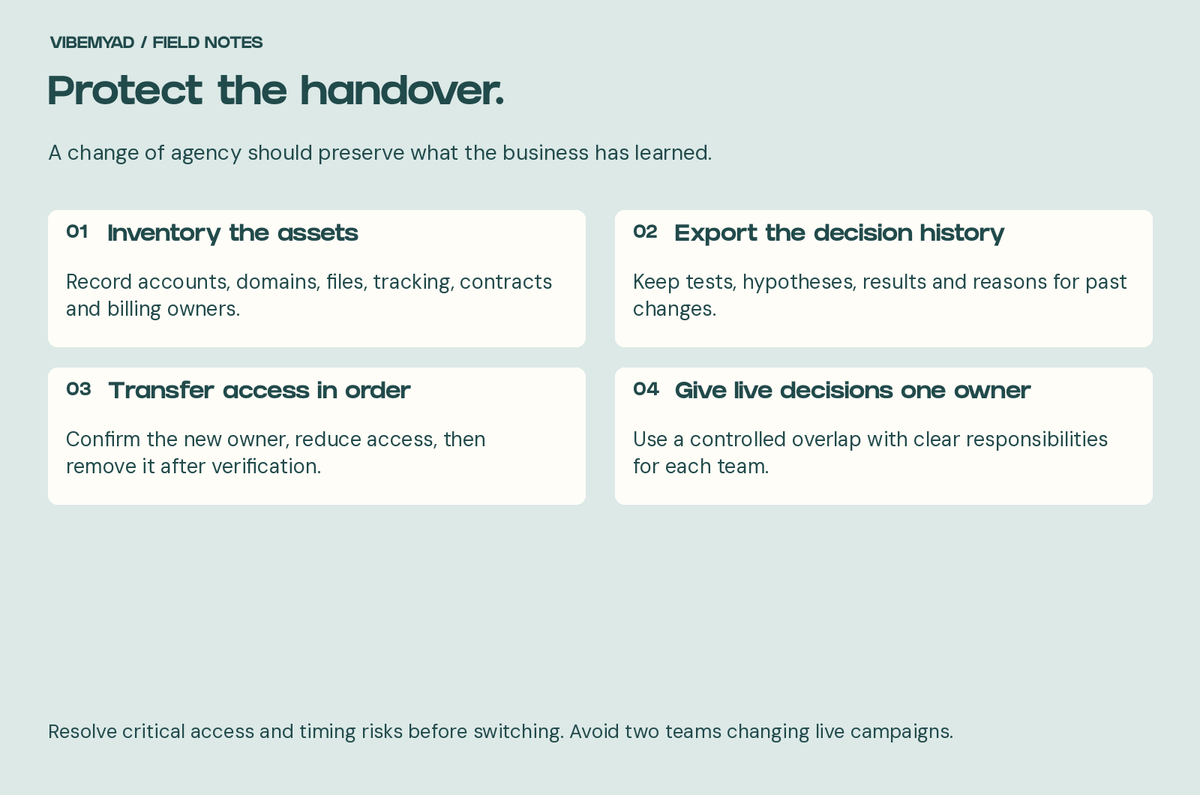
Agency handover checklist: inventory assets, export decision history, transfer access in order and assign one live owner.
Transfer only what the new agency needs, through approved systems, with the contractual controls appropriate to the data. Confirm that the outgoing agency deletes or returns data as required by the agreement.
The new agency should resist the urge to rebuild everything.
Its first review should classify each part of the system:
Changing visible structures creates an early impression of activity. Preserving good work is a stronger sign of judgment.
Do not reproduce the old failure in a new proposal.
If the problem was output, define concepts and production cadence. If it was senior access, name review responsibilities. If it was measurement, define the source of truth. If it was slow approvals, assign client deadlines. If it was incentive design, test the fee formula across weak, expected, and exceptional months.
The performance-based agency versus retainer guide explains how baselines, attribution, controllability, floors, and caps belong in the contract.
Vibemyad starts with an operating audit, not an automatic rebuild. The team maps the outcome, current constraint, account ownership, measurement definitions, creative history, channel decisions, and client dependencies before changing live systems.
Because the agency connects research, creative production, paid media, e-commerce SEO, AI search, landing pages, and automation, it can identify when the failure sits between functions rather than inside one dashboard.
Review the Vibemyad agency model and the guide to choosing an e-commerce marketing agency before comparing replacement proposals.
Switch when the relationship has a material, repeated, structural gap and the current agency cannot show a credible correction. Repair when the capability exists but scope, governance, access, or expectations are unclear.
The cleanest transition protects accounts, data, creative rights, decision history, and live performance. A new logo on the weekly report is not a reset. Better ownership is.
Table of Contents