July 31, 2026 • 10 min read

July 31, 2026 • 10 min read
Most hydration brands run from salt. A whole category runs toward it. Here is how salt-forward electrolyte brands advertise, and how to make the ads without a team.
Walk down the hydration aisle, and almost every pack shouts the same thing: sugar-free. Salt, the other headline ingredient, is usually hidden, because decades of health messaging trained everyone to fear it. Then a small group of brands did the opposite. They put salt on the marquee, argued you need more of it, and built nine-figure businesses on the inversion.
In the US, this is no niche play. North America was the largest slice of the global electrolyte powder market in 2025, roughly 37 percent of a category worth about 8.4 billion dollars worldwide, per Straits Research, which is exactly why the fight over how to frame salt has turned fierce.
This is a teardown of how salt-forward electrolyte brands advertise: LMNT, Redmond Re-Lyte, and the Celtic sea salt wave behind them. We will map each brand's hooks and visuals, identify the pattern they share, and conclude with guidance on how to make the same kind of ads without hiring a full team.
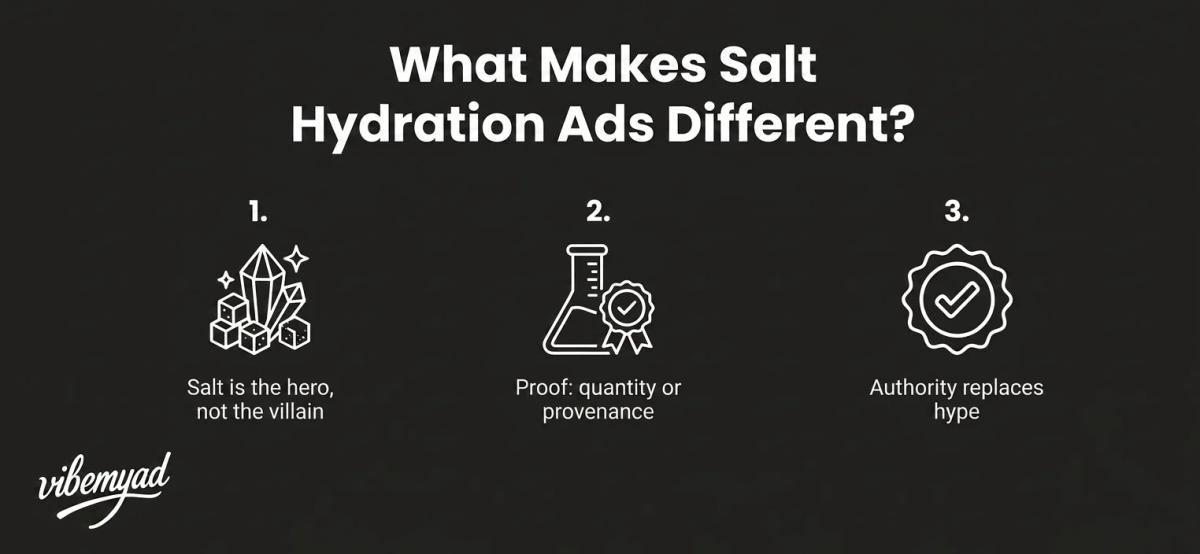
Every salt hydration drink sells the same functional promise as the sugar-free crowd: real electrolytes and better hydration than water. The difference is entirely in the framing. Where a mainstream brand hides sodium, a salt-forward brand makes it the point.
What Makes Salt Hydration Ads Different
Every salt hydration drink sells the same functional promise as the sugar-free crowd: real electrolytes and better hydration than water. The difference is entirely in the framing. Where a mainstream brand hides sodium, a salt-forward brand makes it the point.
How Does LMNT Position Its Salt
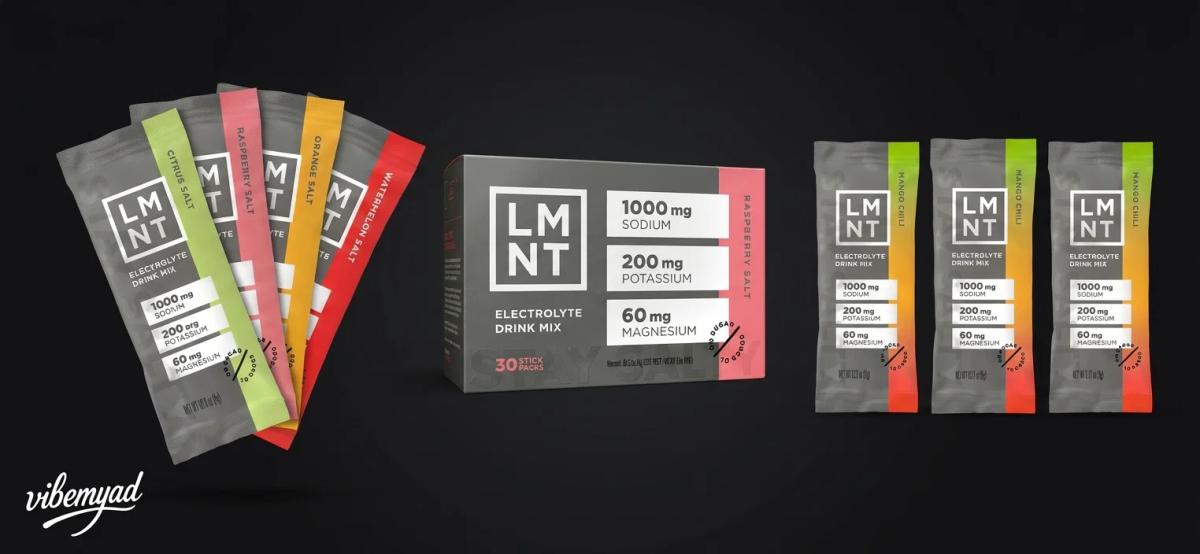
LMNT salt positioning is the clearest in the category, and it is built on quantity. The brand's line is literally "More Salt, Not Less."
THE HOOK: A contrarian thesis: most people, especially those low-carb, fasting, or active, need far more sodium than mainstream guidelines suggest. LMNT delivers 1,000mg of sodium per stick, roughly 2 to 5 times the category average, and frames that number as the feature.
THE PROOF: A founder-scientist. Co-founder Robb Wolf, a former research biochemist and paleo author, gives the "salt is good actually" argument the credibility it needs. The formula is deliberately simple and stated like a spec: 1,000mg sodium, 200mg potassium, 60mg magnesium, zero sugar.
THE CHANNEL: Podcast sponsorship at enormous scale. Rather than Instagram gloss or celebrity faces, LMNT ran on long-form health and science shows, Huberman Lab, Peter Attia's The Drive, Modern Wisdom, reportedly across many thousands of episodes. The endorsers are credible educators, not gym selfies.
THE OFFER: A "Free 8-Pack" sampler where you pay only shipping, plus a no-questions refund. It is a low-cost, low-risk trial engineered to grow the email list cheaply and convert on taste.
The boldest claims draw the most scrutiny. In 2025, LMNT faced a class-action lawsuit alleging its "all-natural" and "clean" marketing was misleading over an undisclosed ingredient. Whatever the outcome, it is a live reminder that a claim strong enough to build a brand is strong enough to be challenged, so it has to be substantiated.
How Does Redmond Re-Lyte Advertise
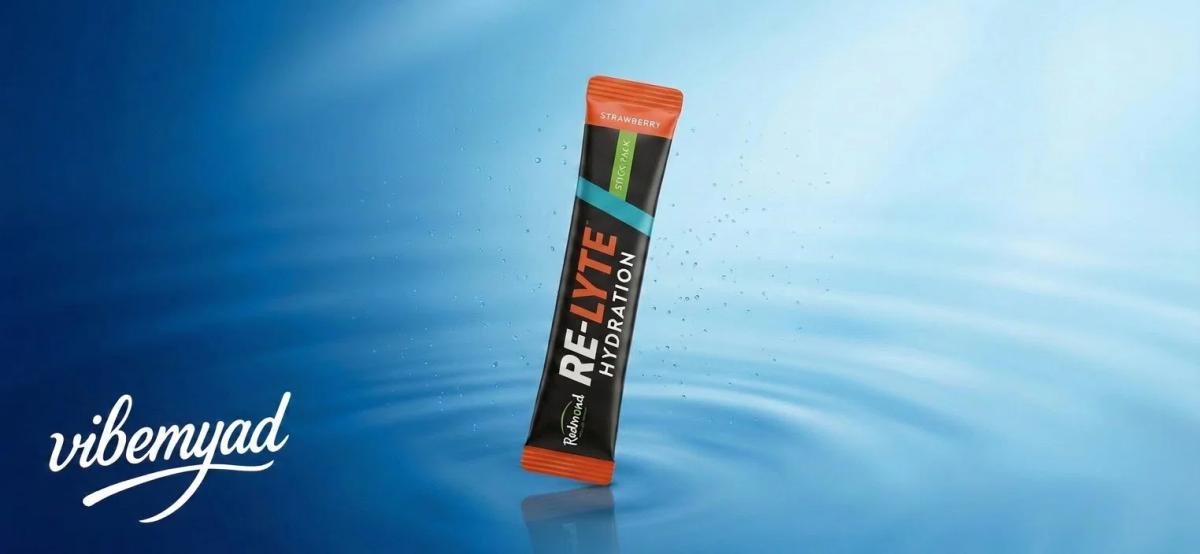
Redmond Re-Lyte positioning takes the other road. It does not out-shout LMNT on sodium. It makes the salt itself the story.
THE HOOK: Provenance. The pitch is Redmond Real Salt, an unrefined ancient sea salt mined in Utah, additive-free and rich in 60-plus trace minerals. The message is not "more salt"; it is "the right salt," a better raw material than the refined white salt most mixes use.
THE PROOF: Heritage. The story starts in 1958 with two brothers mining an ancient salt deposit protected for millions of years under volcanic ash. Family origin and an untouched source do the persuading, backed by a clean spec: about 810mg sodium, 400mg potassium, zero sugar.
THE CHANNEL: Partnerships and sampling. Redmond made itself the official electrolyte partner of Major League Soccer's Real Salt Lake, a near-perfect pun (Real Salt Lake, Real Salt), with product sampling at matches, alongside retail presence and an endurance-athlete angle.
LMNT and Redmond prove there are two different salt-forward ads. One sells the number on the panel. The other sells the origin of the ingredient. Same category, opposite proof. Pick the one your product can actually own.
Beyond the two leaders, a wider sea salt electrolyte movement runs on the same idea Redmond uses: the origin of the salt is the ad.
What this means for your ad: If you sell a sea salt electrolyte, the origin story is available to you, but it is table stakes now, not a differentiator. The open lane is to pair provenance with a sharper reason to buy yours over a jar of salt and a lemon.
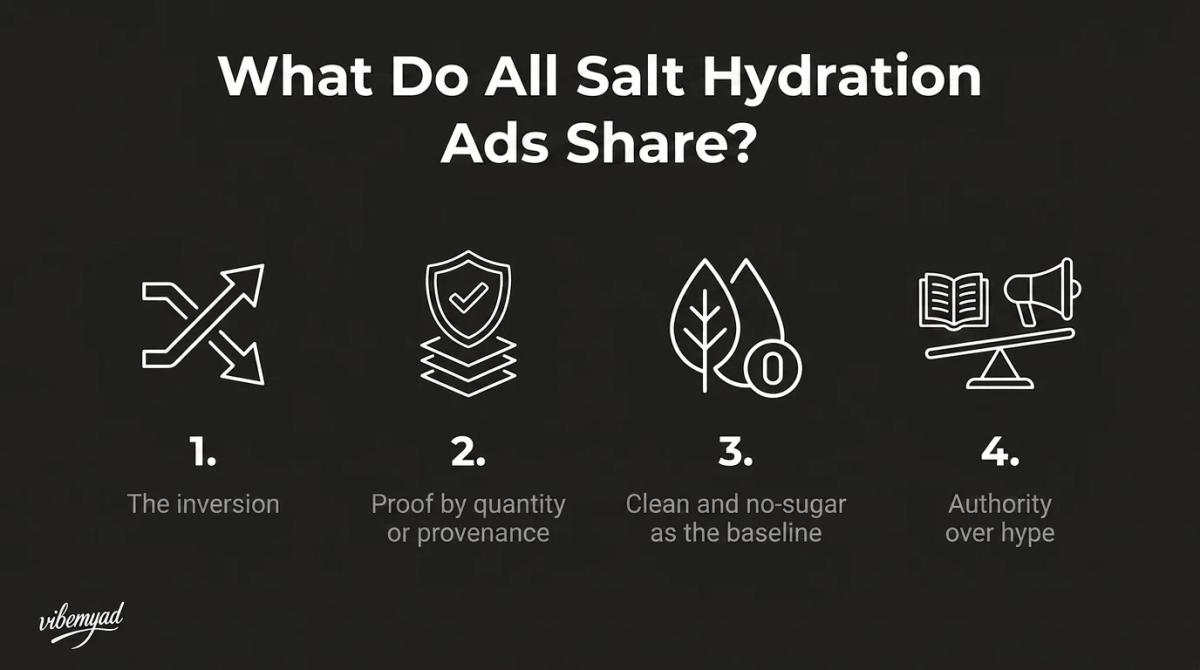
Different brands, one repeatable playbook. Here is the pattern, and the split underneath it.
What Do All Salt Hydration Ads Share
Different brands, one repeatable playbook. Here is the pattern, and the split underneath it.
Say you sell a salt-forward electrolyte and you want ads like these. The traditional path is to hire a team, and each brand above implies one: a strategist to find your angle (quantity or provenance), an art director for the clean minimalist look, a copywriter for the contrarian headline, a designer to build it, and a producer to finish the set. That is an agency, and an agency is a relay: the brief passes between five specialists, through review gates, over weeks, on a retainer.
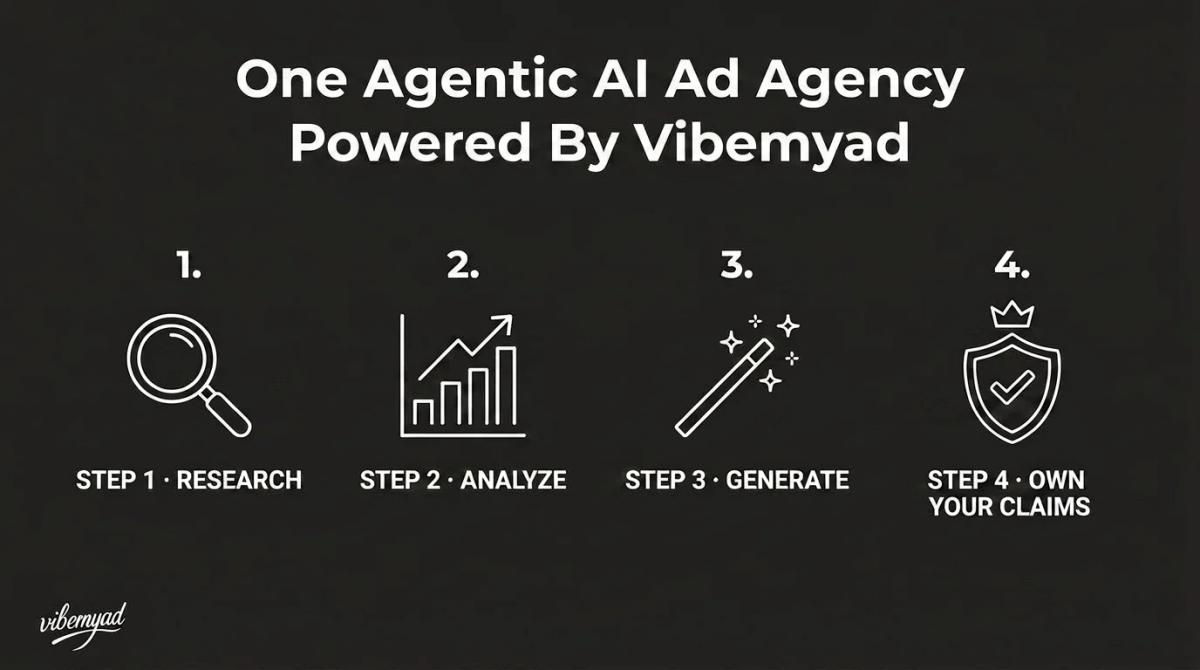
Hire an Agentic AI Ad Agency Powered by Vibemyad
The alternative is to point one agentic AI agency at the category and run the whole spine in a single session. Here is what each stage actually does.
The agent pulls the salt-forward brands' live ad libraries straight from the source, replacing days of a strategist's competitor analysis.
It maps the playbook for you the way a planner would, so you brief yourself in minutes instead of waiting on a strategy deck.
This replaces the art director, copywriter, and designer. Connect your product and the concept comes back on brand.
This is the one part the agency never fully owned either, and it stays with you.
One agentic session replaces the strategist, art director, copywriter, and designer for the research and generation work, and Vibemyad produces the still ads fast and on brand. Your media, your testing, and your substantiated claims stay yours, in your own ads manager. For the wider context, see our teardown of how the biggest hydration brands win attention.
Get notified when new insights, case studies, and trends go live — no clutter, just creativity.
Table of Contents


Arpita Mahato
Content Writer, Vibemyad

Arpita Mahato
Content Writer, Vibemyad

Arpita Mahato
Content Writer, Vibemyad