September 23, 2026 • 3 min read

September 23, 2026 • 3 min read
Seven days can be a sensible review point for a Meta campaign. It is a poor substitute for looking at how much you spent, how many purchases occurred, and whether the campaign had a fair chance to answer your question.
Our starting recommendation is to plan a focused test across a full week, with room for a second week if the purchase cycle and budget justify it. Set a spending limit as well. Time passing does not make an unaffordable test more useful.
Write down the result the business needs. For a sales campaign, that might be an acquisition cost your margin can support. Specify whether you are measuring all orders or new customers, and keep the definition consistent during the test.
Choose a maximum test spend and a review date. Include production and agency fees in the wider business budget, even if the campaign report shows media spend alone. A purchase result that looks acceptable in Ads Manager may still leave the business with too little margin.
Consider a hypothetical brand spending $20 a day with a target acquisition cost of $70. Its first week's spend is $140, equal to two target acquisition costs. That is a small amount of evidence. It is not a guarantee of two purchases.
At $200 a day, the same week costs $1,400. The calendar is identical; the financial exposure is very different. Neither brand should decide solely because day seven has arrived. Inspect purchase volume, conversion delay and the quality of the traffic alongside spend.
One purchase can move the reported acquisition cost dramatically when the sample is tiny. Record uncertainty instead of presenting that number as a stable forecast.
You do not need a week to correct the wrong destination URL, an unavailable product or a failed checkout. Confirm that the campaign can deliver, the landing page works on mobile, and real orders are reflected appropriately in measurement.
For a campaign getting clicks but no purchases, use our no-sales diagnostic guide. That article follows the purchase path; this one is about deciding how long to fund the test.
A second week can help if customers take time to decide, the first week had too little delivery, or the campaign is producing useful purchase evidence within the agreed budget. Write down which uncertainty the extension should resolve.
Do not restart the clock every time you make an edit. Keep a change log so you know which period belongs to which version. If the product, price and message all change, treat the next period as a different test rather than combining the results into one conclusion.
Continue when the campaign's economics are acceptable and the purchase evidence supports further spending. Stop or revise when it has breached the agreed loss limit or exposed a specific problem. Mark it inconclusive when the sample cannot support a reliable judgment.
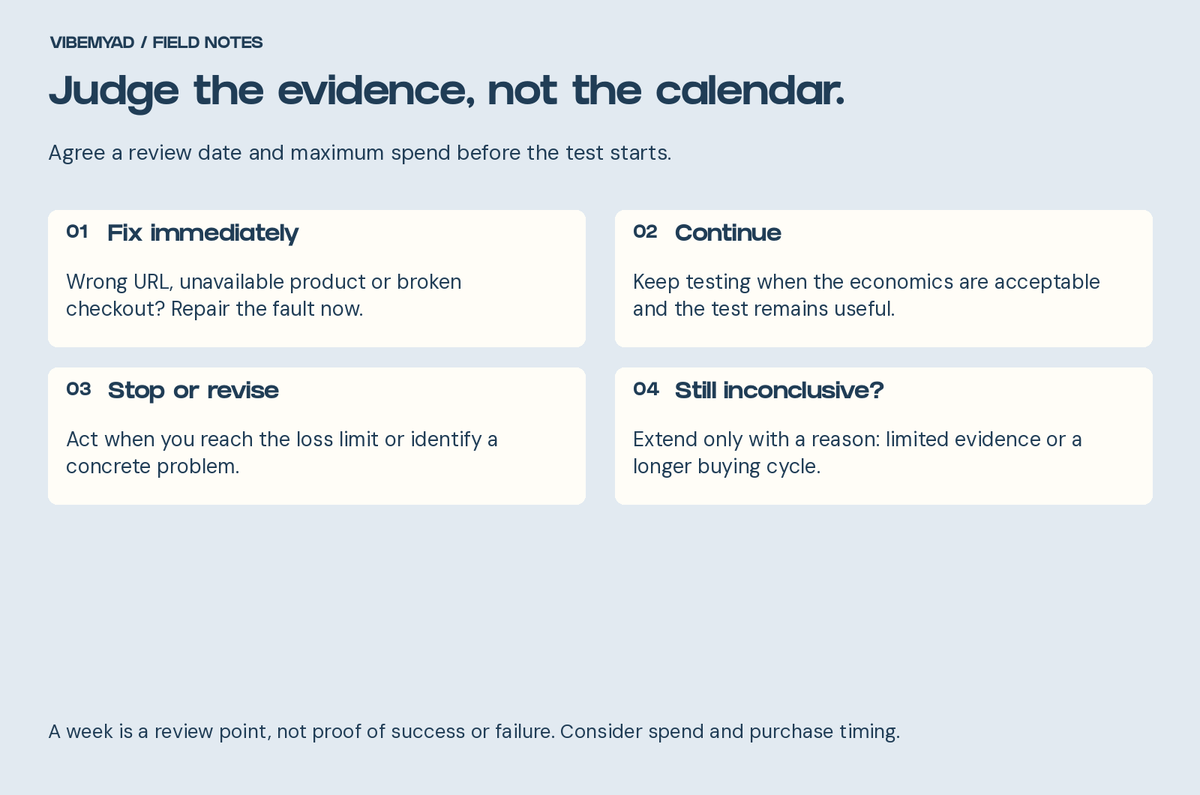
Review ad tests using faults, economics, loss limits and evidence; continue, revise or mark the result inconclusive.
Inconclusive is a useful result. It prevents a lightly served ad from being labelled a loser and prevents a lucky early order from becoming a scaling plan.
If you need to decide how much variation to introduce, read how many ads to test in a first campaign.
Vibemyad Marketing Agency can help define the test, build the creative and review the evidence. Before production, agree on what the campaign needs to establish and what the business can afford to spend learning it.
Get notified when new insights, case studies, and trends go live — no clutter, just creativity.
Table of Contents