September 28, 2026 • 4 min read

September 28, 2026 • 4 min read
An ad that still brings in customers at an acceptable cost does not need replacing because it is three weeks old. An ad that has stopped doing its job deserves attention before the next production date.
We recommend reviewing performance weekly and keeping the next concepts in production. That is a working routine, not a promise that every ad has the same lifespan. Your audience size, spending, offer and purchase cycle affect how quickly results change.
Creative fatigue means people have seen the same creative too often and its performance suffers. Meta's guidance on creative fatigue describes this as an overexposure problem.
Start with the ad's own history. If it has struggled since launch, a new background color is unlikely to answer the bigger question: does the message give the right buyer a reason to care? Review the concept, product evidence and offer.
If it previously worked, compare similar periods. Keep changes in spending, promotions, stock availability and the landing page beside the performance figures. A rise in acquisition cost during a price increase needs a different response from a gradual decline in response to an unchanged campaign.
Imagine a skincare brand whose acquisition cost rises from $30 to $45 across two comparable weeks. Its outbound click-through rate also falls, while more impressions reach the same people. The offer and product page have not changed. These are hypothetical figures, not a client result.
That combination gives the team a reason to test fresh creative. It does not establish fatigue on its own. Check how many purchases each period contains and whether the audience or delivery changed before committing to that explanation.
Now change the scenario: click response stays steady, but fewer visitors finish checkout after free shipping ends. The first investigation belongs on the offer and checkout. Replacing the ad could hide the problem rather than fix it.
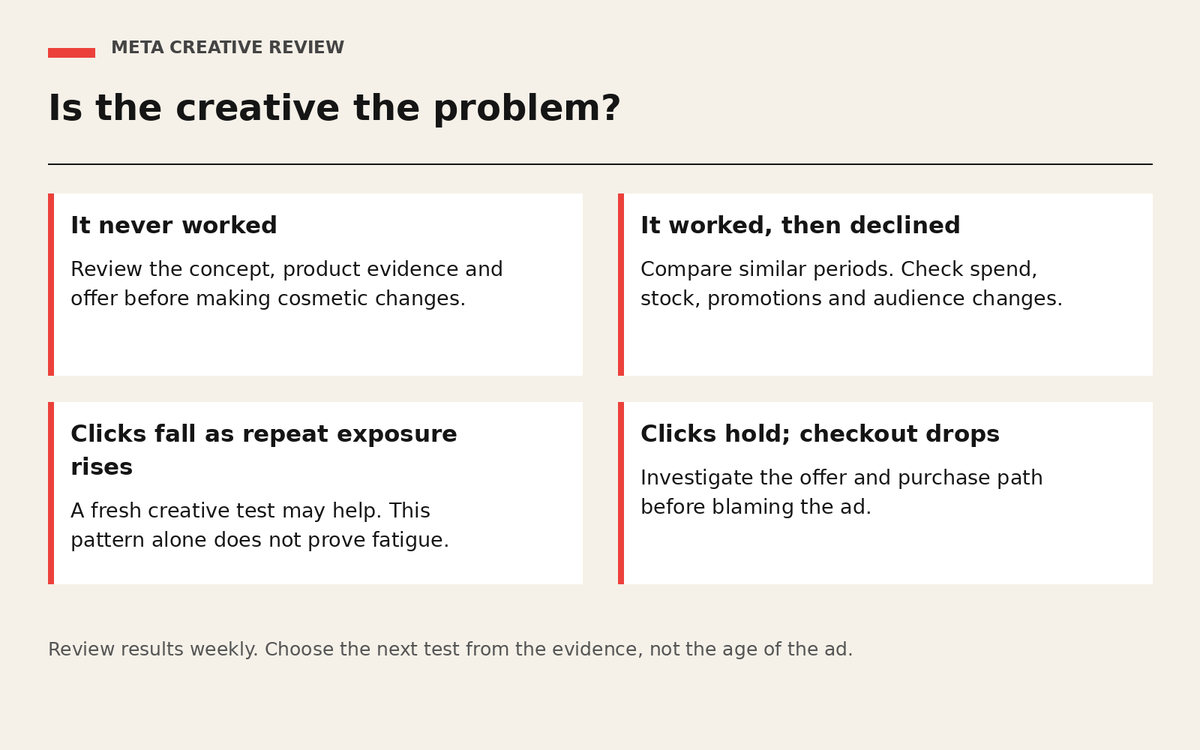
Start with the ad's history and the purchase path before choosing what to refresh.
Write down the question the next ad should answer. For the skincare example, the existing ad might lead with an attractive product shot. A challenger could demonstrate the texture or address a recurring question from customer reviews. The choice should come from a specific gap in the current message.
A new hook keeps the buying argument and changes how you introduce it. A new proof point gives the shopper another reason to believe. A new concept changes the customer problem you lead with. Label those differences in the brief so the result tells you something useful.
Our problem-solution examples show how product features can answer everyday frustrations. Use the examples to write your own brief, supported by facts about your product.
Adding a challenger does not automatically make the existing ad obsolete. If the original remains commercially acceptable, there may be a reason to keep it. Give the challenger a defined budget and decision rule appropriate to your account; delivery will not necessarily divide evenly between ads.
A small amount of spend is not enough to label a variation a failure. Equally, waiting indefinitely can turn a test into an open-ended expense. Agree on the amount you can afford to risk before launch.
For that decision, see how long to run Meta ads before judging.
At the weekly review, record what changed, what you think explains it, and what evidence would change your mind. Give production one clear assignment with a delivery date. A two-to-four-week production cycle can be a useful starting plan, but adjust it to how quickly the account produces meaningful evidence.
Vibemyad Marketing Agency can handle the research, creative production and campaign review within an agreed scope. The brief should connect those jobs: what the last campaign taught us, what the next ad changes, and how we will judge it.
Get notified when new insights, case studies, and trends go live — no clutter, just creativity.
Table of Contents