September 28, 2026 • 6 min read

September 28, 2026 • 6 min read
For your first Meta campaign, start with three to five genuinely different ad creatives in one focused ad set. If your daily budget is below $50, begin with three. With a larger budget, you can test five or six, provided each creative receives enough delivery to generate useful evidence.
The goal is not to launch as many ads as possible. It is to test enough distinct ideas to understand what makes your audience stop, click, and buy.
Launching only one creative gives you very little information.
If it performs poorly, you will not know whether the problem is the product, offer, hook, visual, format, or customer angle. You only learn that one execution did not work.
Testing three to five creatives gives Meta different options while keeping your budget concentrated. It also lets you compare meaningfully different approaches without creating a campaign that is too fragmented to evaluate.
Meta recommends maintaining creative diversity while avoiding unnecessarily high ad volume. When too many ads compete inside a limited budget, the delivery system collects less information about each one. Read Meta's guidance on managing ad volume for the platform's current recommendations.
Think of your first campaign as a structured experiment. Every creative should help answer a specific question.
A different background color does not necessarily create a different concept.
Neither does changing a button, moving the headline, or cropping the same image. These are creative variations. They can be useful later, but they rarely produce meaningful strategic learning in a first campaign.
A creative concept presents a distinct reason for someone to care about the product.
For example, a skincare brand could test:
• A problem-focused ad about recurring dry skin
• A product demonstration showing texture and application
• A customer testimonial describing a specific result
• An ingredient-led explanation
• A comparison with the customer's current alternative
Each concept approaches the same product through a different customer motivation.
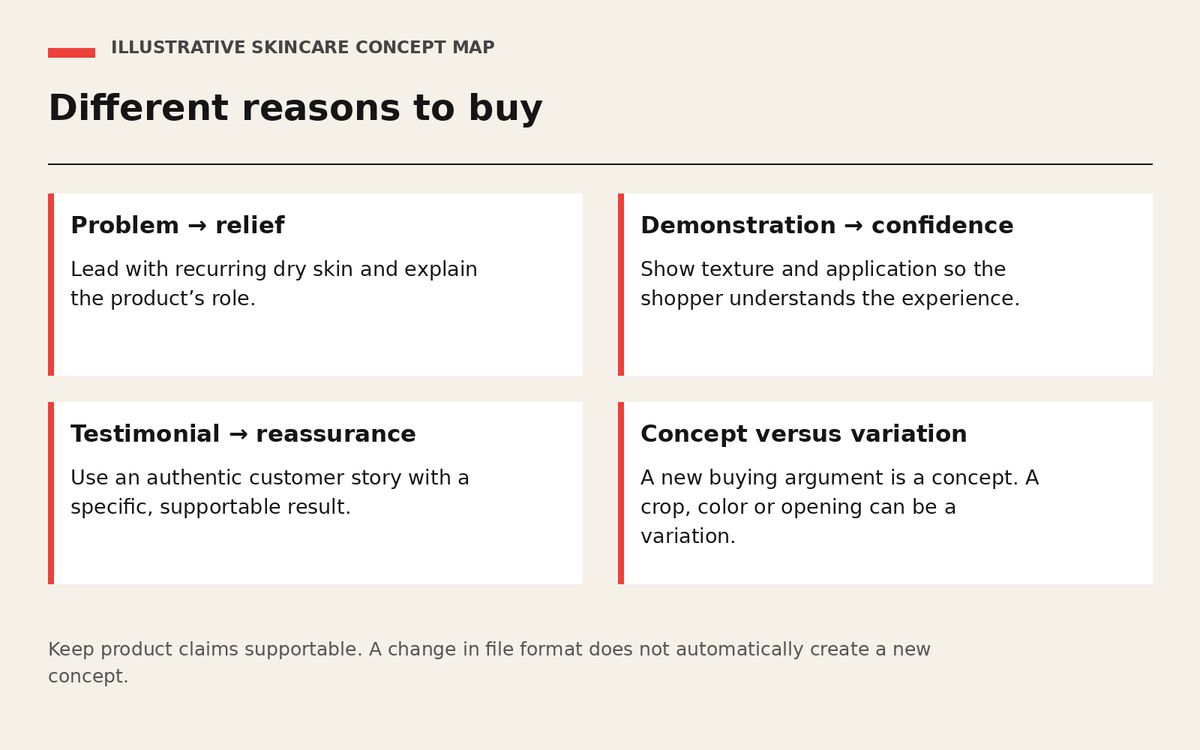
Each concept gives the customer a different reason to consider the product.
For visual references to bring to your brief, explore these 15 beauty and skincare ad examples. Compare the customer question each one answers before choosing which concepts to test.
Vibemyad Marketing Agency's guide to creative testing explains how to separate concepts, angles, hooks, and variations before production begins.
There is no universal number that suits every account. Your budget determines how many creatives you can test properly.
The following framework is a practical starting point, not a fixed requirement from Meta.
A brand spending $30 per day should not launch ten ads simply because a larger advertiser does. Most of those ads may receive too little spend to produce a useful conclusion.
If you are still deciding how much to invest, read How Much Should a D2C Brand Spend on Meta Ads? before choosing your creative count.
Keep the campaign structure simple. Use one primary conversion objective, one focused ad set, and three to five different concepts. Each creative should change one major strategic variable, such as the message, customer problem, proof mechanism, or presentation format.
A first test might include:
1. A customer problem followed by the product solution
2. A demonstration of the product in use
3. A testimonial addressing a common objection
4. A comparison with the customer's current alternative
5. A benefit-led lifestyle concept
Do not change the audience, offer, landing page, hook, format, and message simultaneously. If everything changes, you may find a winner but struggle to understand why it won.
Meta's creative diversification guidance recommends using assets with different themes and messages. This gives the delivery system meaningful options rather than several nearly identical executions.
Not necessarily.
Meta does not promise to divide the budget equally among every ad. Its delivery system may direct more spend toward the creatives it predicts are more likely to produce the selected campaign result.
This means low spend alone does not prove that a creative is bad. It may mean the ad lost the early delivery competition against another option.
If you need to compare one specific variable under controlled conditions, use an A/B test. For a normal first campaign, allow Meta to optimize delivery while monitoring whether each concept has received enough impressions and spend to assess responsibly.
Do not judge a creative only by how many days it has been active.
A campaign spending $20 per day collects evidence at a different rate from one spending $500 per day. Review the amount of data purchased, not just the calendar.
Look at:
• Spend by creative
• Impressions and reach
• Click-through rate
• Cost per landing page view
• Add-to-cart or lead activity
• Purchases or qualified conversions
• Cost per result
• Conversion quality
A strong click-through rate with no purchases can indicate a problem with the landing page, offer, pricing, or customer expectations. A weak click-through rate usually points more directly toward the hook, message, or visual.
If an ad has barely delivered, label the result inconclusive rather than unsuccessful. This distinction prevents potentially useful ideas from being discarded too early.
Read Why Most Ad Creatives Die in the First 7 Days before deciding which ads to stop.
Your second round should respond to what happened in the first.
If product demonstrations performed well, create new demonstrations with different openings. If testimonials attracted qualified traffic, test another customer story that addresses a different objection. If one benefit consistently outperformed the others, explore new ways to communicate that benefit.
This is where variations become valuable. You are no longer making random changes. You are expanding a concept that has already shown potential.
A useful testing program follows a simple sequence:
Different concepts first. Stronger variations second. Scaled production third.
That process gives every new creative a reason to exist.
Most first Meta campaigns should begin with three to five distinct creatives per ad set.
Start with three if your budget is limited. Test four to six when you can fund the additional concepts properly. Go beyond that only when you have enough budget, a clear testing system, and the production capacity to act on what you learn.
Your first campaign does not need dozens of ads. It needs enough contrast to show why customers might care and enough delivery to make the answer credible.
Get notified when new insights, case studies, and trends go live — no clutter, just creativity.
Table of Contents


Arpita Mahato
Content Writer, Vibemyad


Rahul Mondal
Product, Design and Co-founder, Vibemyad

Rahul Mondal
Product, Design and Co-founder, Vibemyad