September 23, 2026 • 3 min read

September 23, 2026 • 3 min read
A week without sales deserves an investigation. It does not tell you, on its own, whether the ad, the offer or the website is responsible.
Before asking for five new videos, trace what happened between the impression and the order. If visitors cannot complete checkout, more creative simply sends more people into the same problem.
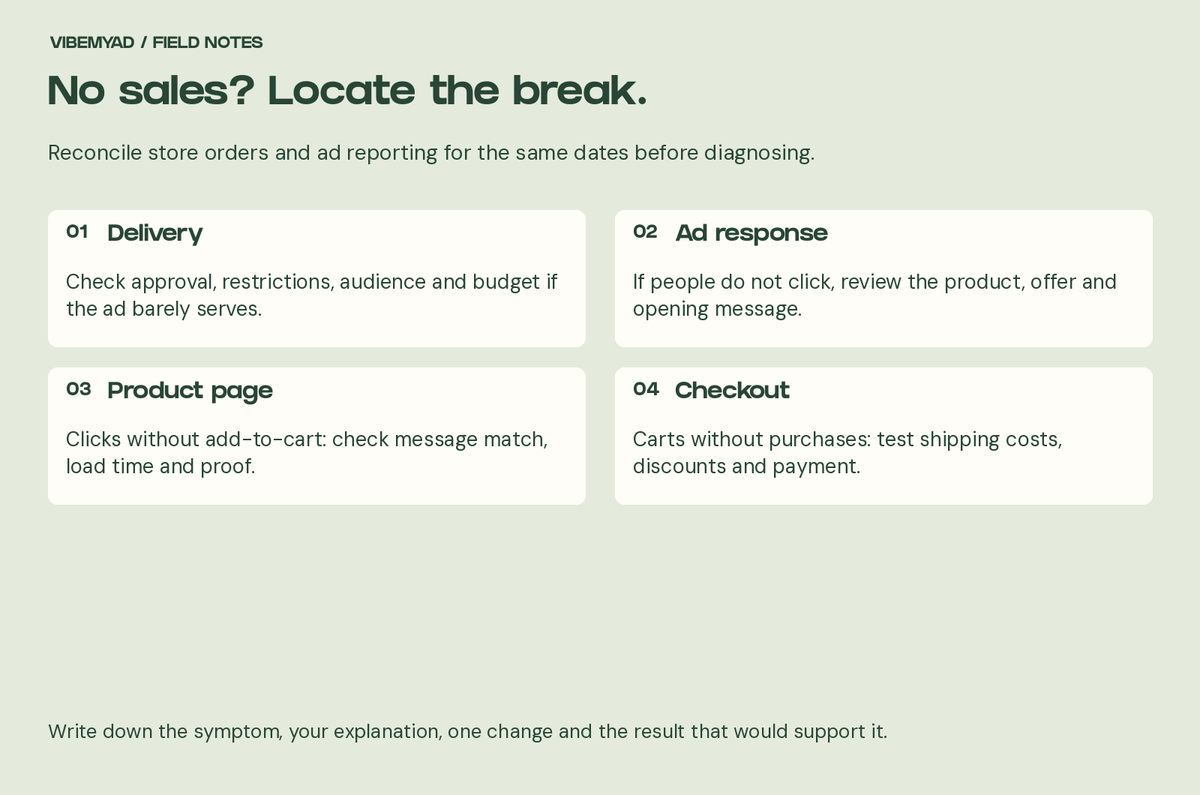
Diagnose no sales by checking ad delivery, response, product-page alignment and checkout; reconcile orders first.
Compare the store's order record with the campaign report for the same period and timezone. Separate real customer orders from internal or test orders. A disagreement between the store and the advertising report is a measurement issue to investigate before judging the creative.
Check the destination on a phone, including product availability, shipping eligibility, payment options and the final price. Follow your store's test-order procedure so the check does not become an ordinary customer purchase in reporting.
Review delivery status, rejected ads, account restrictions, audience constraints and the budget. Little delivery means the campaign may not have reached enough potential buyers to answer the sales question.
Keep the conclusion narrow: the campaign did not deliver enough evidence. That is different from learning that the product has no demand.
Look at the exact ad on a small screen. Can someone identify the product and understand the offer? Does the opening address a recognisable need, or does it only ask the viewer to admire the brand?
Choose one plausible weakness for the next brief. A product demonstration, a specific customer objection or a clearer offer may each deserve a test. Changing all three at once makes it harder to understand the result.
The problem-solution examples provide useful references for turning a vague benefit into a situation the shopper recognises.
Check that the ad and page describe the same product, price and offer. Then inspect the page's load experience, product explanation, delivery information and evidence behind its claims.
For example, imagine an ad promising an easy starter bundle that lands on a collection page containing twenty separate products. The visitor has to reconstruct the offer. Sending the ad to the matching bundle page is a specific correction to test. This is an illustrative scenario, not a reported client result.
Do not treat every click as purchase intent. A curiosity-led headline can attract attention from people who were never considering the product.
Inspect shipping charges, delivery times, discount-code behavior and payment failures. Check whether the product can actually ship to the locations receiving the ads. Ask support whether shoppers have reported the same obstacle.
A few carts are not enough to establish a site-wide pattern. Use the behavior as a lead for investigation and look for direct evidence, such as a reproducible error or repeated customer question.
Write a short diagnosis: what you observed, what might explain it, what you will change, and what result would support the explanation. Keep the parts that are working stable where practical.
For the decision about continued spending, use how long to run Meta ads before judging. It covers the review window and loss limit, rather than repeating this funnel diagnosis.
Vibemyad Marketing Agency can review the campaign and purchase journey together. A useful audit should leave you with a named problem and a next test, not a generic instruction to make more ads.
Get notified when new insights, case studies, and trends go live — no clutter, just creativity.
Table of Contents


Arpita Mahato
Content Writer, Vibemyad


Rahul Mondal
Product, Design and Co-founder, Vibemyad

Arpita Mahato
Content Writer, Vibemyad