July 21, 2026 • 10 min read

July 21, 2026 • 10 min read
Most "AI ad generators" are a text box wired to an image model. Making a real hydration ad, with your can and your label intact, takes an agent that researches, asks, and self-corrects.
To create a hydration drink ad with AI, you do not just type a prompt into an image model and hope. You give an agent three things: a reference for the look you want, your actual product so the label and flavour stay real, and one clear claim. Then you let it research, generate, and refine in a loop. That loop is the whole game. The prompt is the easy part.
This matters more for beverages than almost any other category. A hydration drink ad lives or dies on whether the can in the frame is your can, with your name spelled right and your colors intact. Generic AI image tools are happy to invent a label, misspell your brand, and swap your flavour. An AI ad generator for beverages that cannot hold your product steady is a moodboard tool, not an ad tool.
The rest of this piece is the technical version of how to advertise electrolyte drinks with AI without ending up with fake-looking creative: why agentic systems win, how Vibemyad keeps your product accurate, and the exact step-by-step for a hydration brand.
Agentic AI the Biggest Advantage in Ad Generation
AI in ad creative is not a fringe workflow anymore. In the IAB's 2025 Digital Video Ad Spend and Strategy Report, 83 percent of ad executives said their company had deployed AI in the creative process, up from 60 percent a year earlier. So the question is no longer whether to use AI for ads. It is whether your tool can hold your actual product steady while it does.
Let me be blunt about the category. Most tools marketed as an AI ad generator for beverages are a single text box wired to one diffusion model. You type, it renders, you pray. That is fine for inspiration. It falls apart the moment you need your real product, on brand, at the volume paid social demands. Agentic AI is different in kind, not degree. An agent can use tools, read your inputs, ask questions, check its own work, and run more than one step.
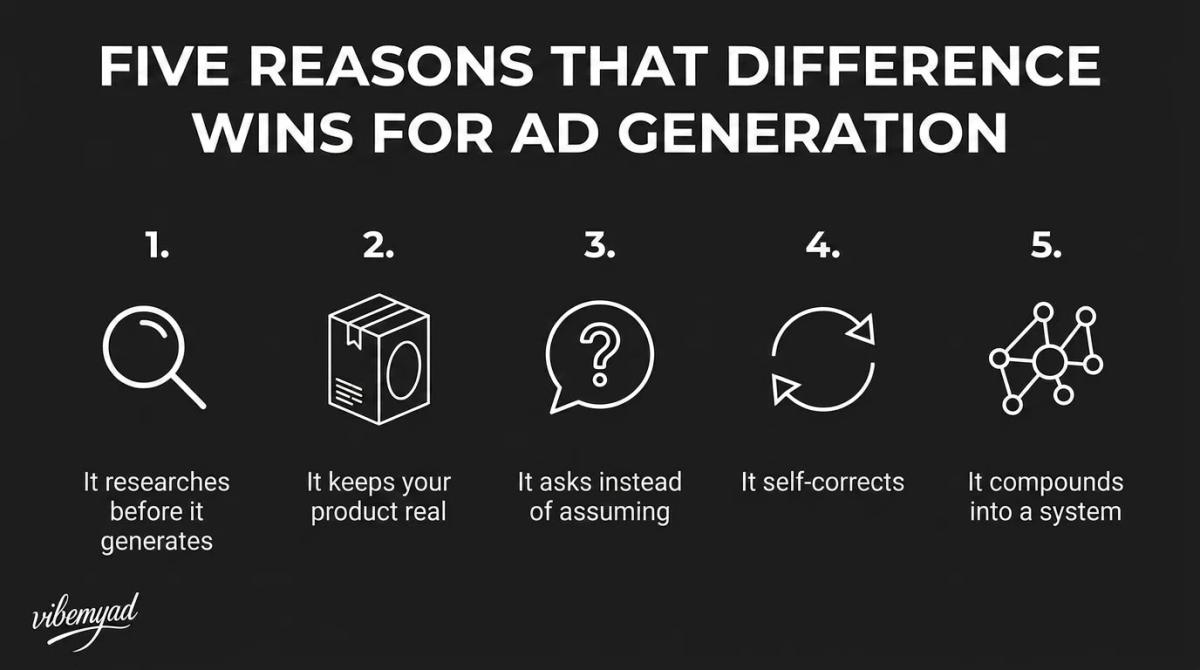
Here are the five reasons that difference wins for ad generation.
Five Reasons That Difference Wins For Ad Generation.
1. It researches before it generates: A blank text box makes you the researcher. An agent pulls what is already running in your category and reasons from proven creative, so you start from evidence instead of a guess. For beverages, that means starting from the ads competitors are actually sustaining spend on, not a stock idea of what a drink ad should look like.
2. It keeps your product real: Generic models hallucinate labels and invent flavours. An agent grounded in your brand assets and a product photo treats your can as fixed instead. This is the whole ballgame for beverages, and it gets its own section below.
3. It asks instead of assuming: The technical gap between a one-shot generator and an agent is the human in the loop. Vibemyad's agent stops to ask what it needs: your flavour and a clean product photo, before it spends a credit. The brief narrows through conversation, so you are not re-rolling the dice on a vague prompt ten times.
4. It self-corrects: Ad generation is multi-step. The agent generates, evaluates its own output, and when a render leans too hard on the reference image, it says so and rebuilds a clean base from scratch before compositing your product back in. You get considered iterations, not a single pass you have to accept or reject.
5. It compounds into a system: One strong reference becomes a repeatable format. Remix spins variations off a winner, Add to preset locks a look you can reproduce, and identical product treatment keeps a whole set on brand. That is how one good idea turns into a week of creative instead of a one-off.
How Does Vibemyad Generate Ads That Match Your Product
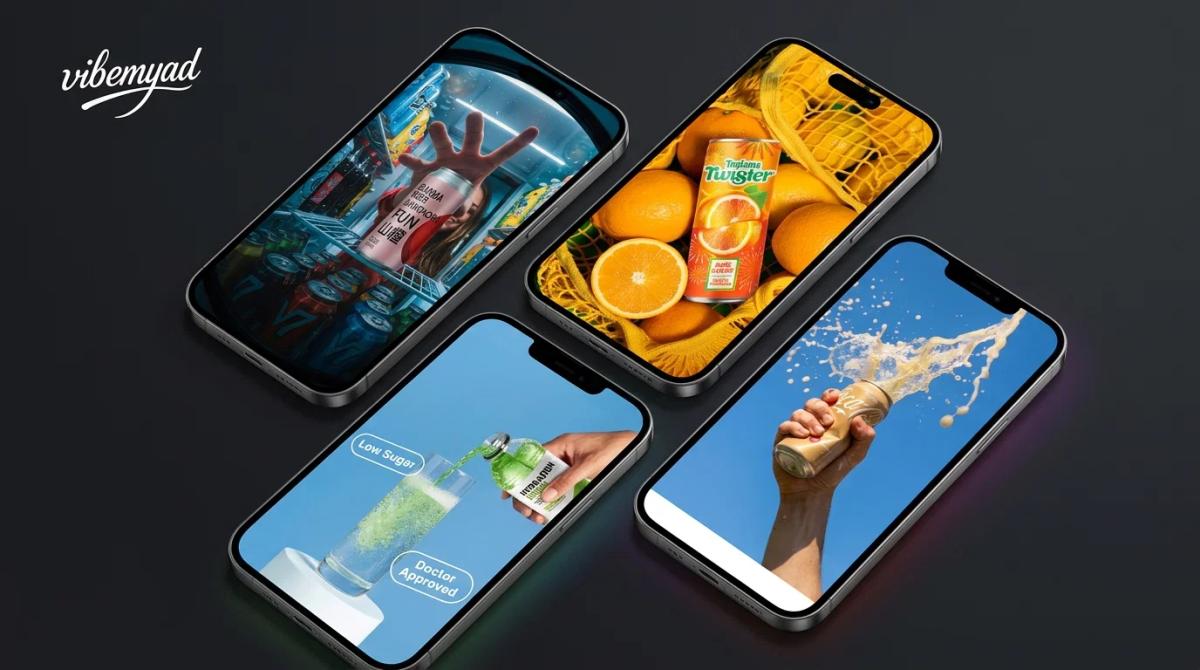
Matching the ad to the real product comes down to grounding, and Vibemyad grounds in two places.
From there it runs as a tool loop. The agent calls an image step, looks at the result, and if the first render kept too much of the reference product or fruit, it flags that and generates a clean base from scratch before compositing your product in. That self-check is why the output ends up looking like your ad and not a slightly wrong copy of the reference.
It helps to understand why AI mangles a label in the first place, because it explains the fix. A diffusion model does not read text the way a chatbot does. It learns from billions of images and treats letters as shapes to paint, not characters to spell, so it approximates what a label looks like rather than what it says. AI image researchers describe legible text as a known, persistent challenge for these models, which is exactly why your brand name comes back subtly wrong. The fix is not a cleverer prompt. It is a separate correction pass. Vibemyad's Fix product text re-renders the label copy so it matches your real packaging instead of the model's best guess.
Two more controls keep the product honest. The in-canvas brush, eraser, and text tools let you mask and touch up one specific area instead of re-rolling the whole image. And you set the aspect ratio per placement, so the same concept ships as a 9:16 story and a square feed post without redrawing it.
If you do not have a clean product photo yet, the agent builds a concept render from a placeholder so you can lock the direction, then re-runs it later with your real can so the label and proportions match exactly. Nothing about your product is left to the model's imagination.
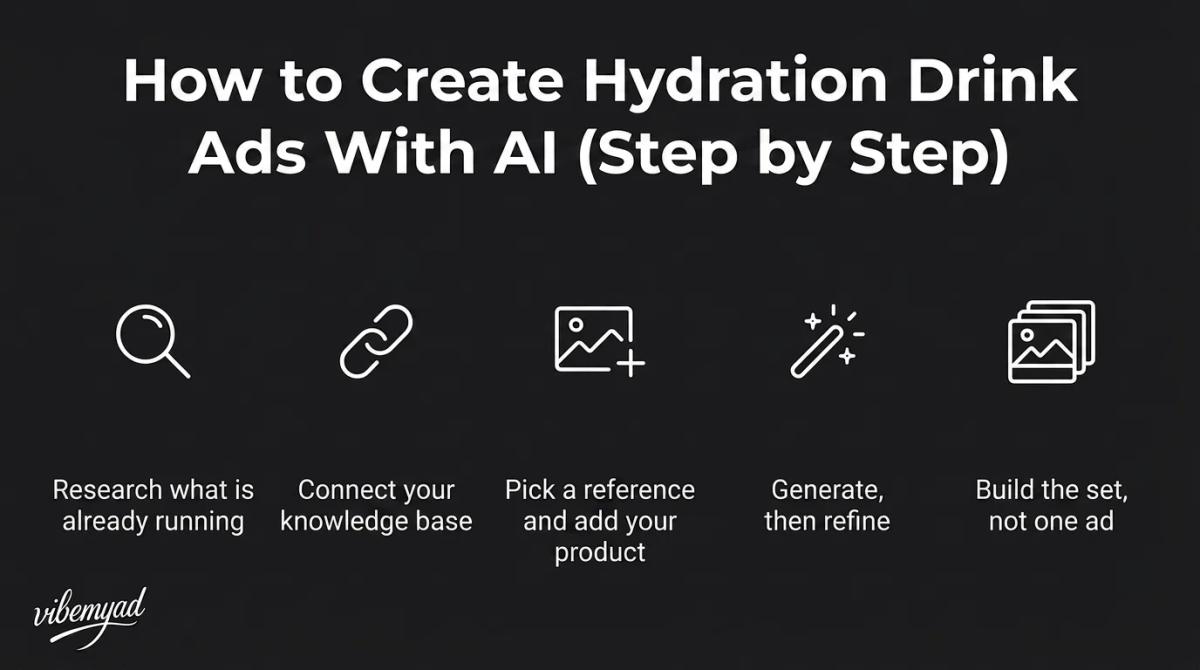
Here is the actual sequence for a hydration brand, start to finish, in one session at vibemyad.com/home.
How to Create Hydration Drink Ads With AI (Step by Step)
Step 1: Research what is already running: Pull the hydration and electrolyte brands you care about and study the ads still sustaining spend, the long-runners, not the flashy one-offs. Filter by color palette, visual style, and hook to find the calm, editorial creative worth borrowing from, and note the audience or hook gaps nobody is filling.
Step 2: Connect your knowledge base: Link your site so Vibemyad pulls in your real products, palette, logo, and packaging. Every generation is grounded from here, which is what keeps the product accurate later.
Step 3: Pick a reference and add your product: Start from a preset hero look or describe the shot in chat, then add your can or pack as the hero. The agent asks your flavour and for a clean product photo. Answer it. No photo ready? Tell it to use a placeholder, and it will build a concept render you can re-run later.
Step 4: Generate, then refine: The agent generates and iterates until the shot matches the reference. Each output carries Download, Remix, Add to preset, and Fix product text. Remix for variations, Fix product text to correct the label, brush and text tools for touch-ups, and set the aspect ratio for each placement.
Step 5: Build the set, not one ad: For a launch, generate three formats in parallel: a hero shot with one claim (name a mineral and a number, like "1,000mg sodium, zero sugar"), an ingredient callout isolating one hero ingredient, and a how-to carousel showing the mix ritual. Keep the product treatment identical so the set reads as one brand.
One pattern worth designing toward, from watching ad libraries at scale: the electrolyte ads that run the longest give the product the frame. The creative that churns out fast buries the can in a lifestyle scene or crowds it with three competing claims. If you want electrolyte drink ad examples to study, look at the quiet, product-first ads from brands like LMNT, Liquid I.V., and Nuun, not the loudest creative in the category. That calm, product-first register is the same premium aesthetic we break down in How to Generate Hydration and Electrolyte Ads That Look Premium, and it is exactly what an agent grounded in your real product is good at producing.
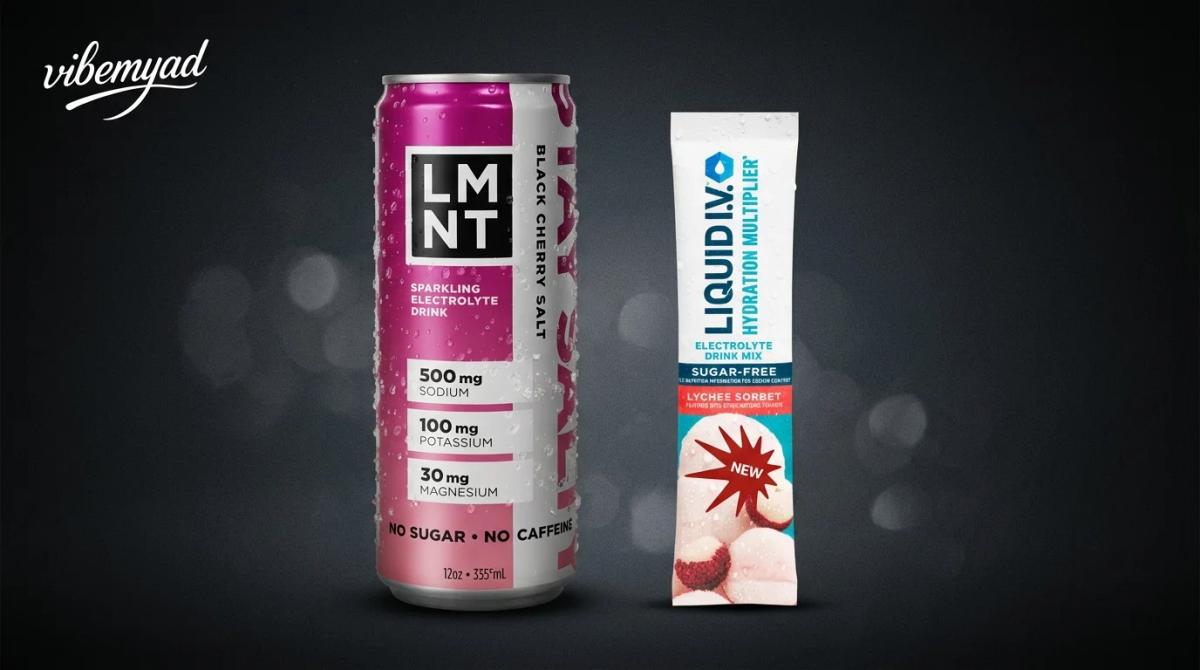
Recreating an LMNT-style hero shot
That is the whole move: product owns the frame, one number, room to breathe. Warm the palette and swap in a stick-and-glass pour, and the same preset gives you a Liquid I.V.-style variant.
Get notified when new insights, case studies, and trends go live — no clutter, just creativity.
Table of Contents


Arpita Mahato
Content Writer, Vibemyad

Arpita Mahato
Content Writer, Vibemyad

Arpita Mahato
Content Writer, Vibemyad