September 03, 2026 • 14 min read
September 03, 2026 • 14 min read
A performance marketing agency plans, buys, and measures advertising that is intended to drive a specific customer action rather than awareness, where the link between the advertising and that action can be measured and the buy can be adjusted in near real time. In practice that usually means paid search, paid social, affiliate, commerce media, and increasingly connected television, all managed against a cost per acquisition or a return on ad spend rather than against reach.
The definition above is not ours. It is close to the one the Interactive Advertising Bureau published in 2013, and the interesting part of that document is a parenthetical almost nobody quotes. We will come to it.
Most articles answering this question list services and stop. The more useful version explains what the category was built on, which was a promise that the effect of advertising could be cleanly measured, and what happened when that promise turned out to be much harder to keep than anyone expected. If you are hiring one of these agencies, the second half is what determines whether the relationship works.
There are two authoritative definitions and they do not agree.
The Performance Marketing Association, founded in 2008 and still operating, defines the term narrowly in its 2024 glossary as "a type of marketing where one business rewards one or more affiliates (or publishers) or [sic] a set action by a user (e.g., a sale) referred due to one or more promotional efforts made by the affiliate(s)." That is affiliate marketing. The money moves from advertiser to publisher, and only when something happens.
The IAB's 2013 definition is wider and sets out four criteria: the campaign intends to drive consumer action rather than raise awareness, the cause and effect between advertising and action can be clearly measured, the buyer can optimize in real or near real time based on that measurement, and, in the fourth criterion, "in many cases payment is made based on consumer action (this is not necessarily required if the other three criteria are met)."
Read that fourth line again. The trade body that formalized the term removed payment-on-outcome as a requirement thirteen years ago. The same document acknowledged the history plainly, noting that "historically, defining performance marketing was easy. Its objective was to drive a specific action, and advertisers only paid when that action, such as an acquisition or sale, was completed." And it predicted where things were heading: "as many have pointed out in the future all digital marketing will be classified as 'performance.'"
That prediction came true. So when people say the label has become meaningless, they are describing something the IAB deliberately did and openly forecast, not a corruption that crept in.
Worth noting what nobody can tell you: there is no documented origin for the phrase. No primary source identifies who coined it or when. The widely repeated story that affiliate marketing was invented by William J. Tobin at PC Flowers and Gifts traces back to a self-published memoir and an archived company website, and the patents usually cited are quoted without filing dates. Treat the whole origin genre as folklore.
The channel list has expanded well past the original definition, which is where the label genuinely has drifted.
Take Tinuiti, one of the largest independents in the category, which describes itself as providing "performance marketing services that connect every dollar to a measurable business outcome." Its published service list covers commerce media and Amazon, paid search, paid social, affiliate, creative, conversion rate optimization, email and SMS, influencer, and also streaming, online video, audio, display, and out of home. Linear television and outdoor sit under the performance marketing banner. Neither can be transacted on a cost per acquisition.
Contrast that with Wpromote, which describes an "outcome-first approach" and does not use the phrase performance marketing on its homepage at all.
Neither agency publishes pricing, which is itself informative about how the category sells.
The fastest-growing part of the mix is commerce media. The IAB and PwC Internet Advertising Revenue Report for full year 2025, published in April 2026, put United States commerce media at $63.4 billion, up 18 percent year over year, within a total internet advertising market of $294.6 billion. EMARKETER, using a narrower definition, forecast United States retail media at $60.32 billion for 2025 rising to $71.09 billion in 2026, and put Amazon at 79.7 percent of that market. The two figures are not interchangeable, so pick one and name the source rather than blending them.
The direction of travel there is worth watching if you are buying performance services. Criteo's managing director for Northern Europe, Nicole Kivel, told Beet.TV in January 2026 that "the purchase funnel isn't dead, but the requirement to activate solely against demographics is starting to die," describing commerce data being used for upper-funnel work. The channel most associated with bottom-of-funnel performance is repositioning itself upward.
Here is the part that matters, and it is not an opinion. Two large randomized experiments, both published in peer-reviewed journals, found that the standard way of measuring advertising performance is unreliable.
The first was run by eBay on itself. Blake, Nosko, and Tadelis published the results in Econometrica in January 2015. When eBay switched off paid search advertising on its own brand keywords, "almost all (99.5 percent) of the forgone click traffic from turning off brand keyword paid search was immediately captured by natural search traffic." The advertising was buying clicks the company would have received for free. For non-brand keywords the measured return on investment was approximately negative 63 percent. And the authors noted that naive analysis of the same data "yields unrealistic returns of over 4000 percent," because spend rises with clicks and clicks rise with existing purchase intent, which makes the correlation circular.
The second is broader. Gordon, Zettelmeyer, Bhargava, and Chapsky ran 15 large-scale advertising randomized controlled trials at Facebook, covering 500 million user-experiment observations and 1.6 billion impressions, and published in Marketing Science in 2019. Their finding: "in half of the studies, the estimated percentage increase in purchase outcomes was off by a factor of three across all methods." They were explicit about what that means for anyone hoping better data would solve it, concluding that the question of whether observational methods with good individual-level data are good enough "or whether even good data prove inadequate to yield reliable estimates of advertising effects. Our results support the latter."
Note the direction. Observational attribution mostly overstates advertising effectiveness, but sometimes understates it. The honest summary is not that last-click over-credits. It is that last-click is unreliable in an unpredictable direction, which is worse, because you cannot correct for it with a fudge factor.
Last-click has not gone away, incidentally. Google's attribution documentation still offers it, defined as giving "all credit for the conversion to the last-clicked ad and corresponding keyword," while noting that the first click, linear, time decay, and position-based models are no longer supported.
The serious answer in 2026 is three layers, not one number.
Incrementality is the middle layer and both platforms ship it. Meta's Conversion Lift documentation describes randomizing the audience and assigning accounts to a test or control group, with a control percentage defining "a holdout percentage of the Accounts Center accounts who will not see ads." The same page states that the tool "is currently limited" and that access requires contacting a Meta representative, which is why most smaller advertisers never run one. Meta also publishes GeoLift as open-source under an MIT license, described as "an end-to-end solution to measure Lift at a Geo-level using the latest developments in Synthetic Control Methods." Google's equivalent geography-based conversion lift works by aggregating unattributed conversions into non-overlapping geographic regions, and Google notes it "typically requires a higher budget than the user-based alternative."
The top layer is marketing mix modeling, which is having a genuine revival because it needs no user-level data. Google released Meridian as open source in January 2025, describing it as an MMM framework "that enables advertisers to set up and run their own in-house models," built on Bayesian causal inference. Google's stated reason for building it is that traditional models "have historically been unable to fully measure performance media, like Search ads, and AI-powered campaigns." Meta publishes a comparable project, Robyn, though its most recent release is dated December 2024.
The line in Google's Meridian documentation that explains the whole modern stack is this one: the model "easily integrates incrementality experiment results as priors, agnostic of the channel or the experiment." Experiments calibrate the model. The model allocates the budget. Platform attribution handles the daily decisions inside that allocation.
Now notice what that stack does not produce. It does not produce a clean, auditable, per-conversion number. It produces a probability distribution with a credible interval. That is more honest and considerably less contractible, and it is the practical reason performance agencies are rarely paid purely on performance.
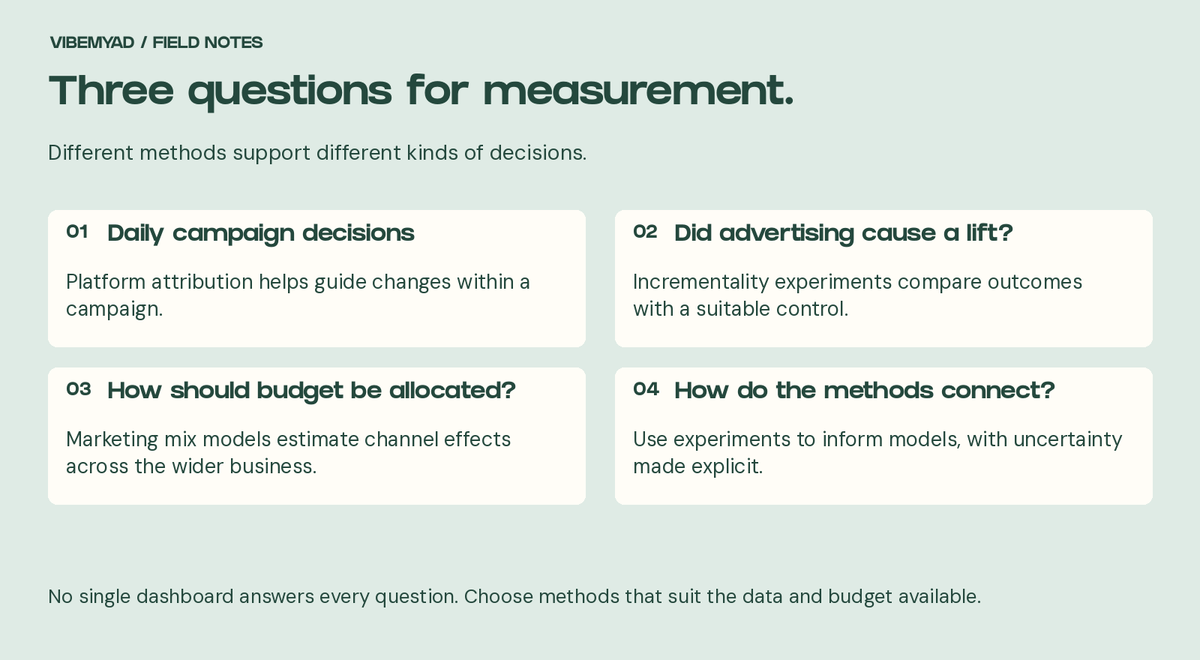
Measurement guide: platform attribution for daily decisions, incrementality for causal lift and marketing mix models for allocation.
Mostly not, and the reason is more interesting than hypocrisy.
The best available data on agency compensation is the Association of National Advertisers' Trends in Agency Compensation series. Its 18th edition, published in November 2022 and covering 101 client-side marketers across 336 agency relationships, found that 82 percent of respondents used a fee method in at least one agency agreement and only 7 percent used traditional commissions. Performance incentives appeared in 41 percent of responses, and where they were used, they accounted for "5 percent or less of an agency's total compensation for two-thirds of respondents."
Three things about that data are worth more than the headline.
First, the trend runs the wrong way. The ANA's own release records incentive use at 41 percent in 2022, down from 48 percent in 2016 and 61 percent in 2013. Pay-for-performance has been declining across exactly the period when performance marketing agency became a standard job title.
Second, the incentives are mostly not measured on business outcomes. The most common metric, used by 84 percent of respondents, is an agency performance review, which is a subjective assessment of the agency by the client.
Third, and most damning, the ANA found that 13 percent of respondents say incentives do not affect agency performance and "a staggering 70 percent of respondents don't know if they have any affect" [sic]. Even where pay-for-performance exists, the overwhelming majority of clients cannot tell whether it works.
Two honest caveats. The ANA surveys large client-side advertisers and does not break out digital or performance agencies specifically, so this is evidence about agency relationships generally. And its 19th edition, published in November 2025, sits behind a member login with no headline figures publicly available, so the most recent public numbers are from 2022.
Here is the correction most commentary gets wrong, including a version of this article we drafted before checking. The original performance marketing compensation model described what the advertiser paid the publisher, not what it paid the agency. The PMA's definition still says so. An agency can buy media that is entirely performance-priced and be paid a flat fee for buying it, and nothing about that is contradictory. Forward-looking data suggests movement anyway: the World Federation of Advertisers and MediaSense found in November 2024 that three quarters of multinational brands want to change their remuneration model within three years, with 58 percent planning to increase the share tied to outputs or outcomes.
There is one more quiet fact worth knowing. The IAB and PwC used to publish the share of United States internet advertising revenue actually transacted on performance pricing. It rose from 41 percent in 2005 to 67.1 percent by full year 2020. The breakdown then disappeared from the report and has not been published since April 2021. The industry stopped keeping score of the single number that defines the category.
The standard answer cites Les Binet and Peter Field and gets it wrong.
Their report The Long and the Short of It, published by the Institute of Practitioners in Advertising in November 2013 and drawing on 996 campaigns from the IPA Effectiveness Awards Databank between 1980 and 2010, found that on average "brands should spend around 60% of their budget on brand-building activity and 40% on activation." A later revision in Effectiveness in Context, published in 2018, moved that to 62:38.
The part usually dropped is that Binet and Field hedged in the original text, writing that the data "tentatively supports this hypothesis" and that "since this optimum budget split is driven by the overall average split in expenditure it may vary by category."
It varies enormously. In Binet's own presentation of the Effectiveness in Context research, drawing on IPA cases from 1998 to 2016, the optimal brand-to-activation ratio ranges from 84:16 for a new category entry down to 41:59 for low-consideration categories and 26:74 for subscription businesses. For online mechanics it is 61:39.
Read that properly and it says something different from the usual quote. For subscription businesses, three quarters activation is the optimum, not an error. For low-consideration categories, majority activation is correct. The businesses most likely to hire a performance marketing agency are frequently the ones where heavy activation weighting is exactly right. The 60:40 figure is an average across all contexts, not a rule, and treating it as a rule misapplies the research in both directions.
Four questions, all answerable in a first call.
Ask which incrementality tests they have run, on which channels, and what the holdout was. An agency that has never run one is optimizing against platform-reported conversions that two peer-reviewed studies suggest can be off by a factor of three.
Ask how they would handle branded search. If the answer does not acknowledge the substitution problem, they have not read the eBay result or have decided to ignore it.
Ask what they do when the platform, your analytics, and your order count disagree, because they will. A good answer names one of them as the ground truth and explains the gap. A bad answer picks whichever is highest.
Ask what they are actually paid on, and then ask what happens to that fee if performance falls. If pricing is the deciding factor for you, our comparison of retainer versus outcome pricing works through the trade-off, and our ranking of Meta ads agencies scores five of them on what each publishes before a sales call.
The related categories overlap heavily, so it is worth knowing which one you actually want. A performance marketing agency is defined by measurable action across channels. An ecommerce marketing agency is defined by the client type it serves. An AI marketing agency is defined by the method it uses to produce and decide. The same firm may qualify as all three.
Vibemyad is an AI-native marketing agency working with United States direct-to-consumer brands, mostly on Shopify, mostly in beauty, apparel, food and beverage, and wellness.
We price against the outcome rather than a retainer, and a client can leave at the end of any month. Given everything above, that deserves a caveat rather than a boast. Outcome pricing only works when both sides agree in advance what is being measured and accept that the measurement is imperfect. It requires clean event data, an agreed ground truth, usually the order count in the store, and a willingness to argue about the gap rather than pretend it does not exist. Where a brand cannot supply that, a fee is the more honest structure and we will say so.
The platform underneath reads live category advertising and classifies what it finds by hook, format, offer, and funnel position, which is what feeds the creative pipeline. Machines produce the volume. People decide which customer tension is real and what a result means for the next round.
We are wrong for brands that need a fixed retainer line for budgeting, for pre-product-market-fit stores, and for anyone below the spend level where professional management pays for itself.
Table of Contents