September 02, 2026 • 12 min read
September 02, 2026 • 12 min read
A Meta ads agency plans, produces, launches, and improves paid campaigns across Facebook and Instagram. The best ones do more than operate Ads Manager. They connect creative strategy, conversion tracking, landing pages, offer economics, and campaign decisions into one working system.
That distinction matters because Meta has automated much of the work agencies once sold as specialist media buying. Its Advantage+ tools handle more audience selection, placement, bidding, and creative variation than the platform did a few years ago. Meta describes Advantage+ as a suite of AI products for improving campaign performance, while its newer Andromeda system depends on a diverse supply of creative to find useful matches between ads and people. Meta explains that relationship between automation and creative diversification here.
The agency's job has moved. Campaign settings still matter, but the harder work now happens around the account: finding better ideas, producing enough distinct creative, sending Meta reliable event data, and deciding what the business can afford to pay for a customer.
This guide explains what a Meta ads agency should own, when to hire one, when not to, and how to tell whether you are buying a real operating capability or a weekly report.
A Meta ads agency manages advertising on Facebook, Instagram, Messenger, and eligible placements within Meta's advertising network. Depending on the engagement, it may handle strategy, account structure, budgets, creative production, tracking, landing-page analysis, reporting, and optimization.
The work usually falls into six areas:
• Translate business goals into campaign objectives and acquisition targets.
• Research customers, competitors, offers, and creative patterns.
• Produce and test new ad concepts across video, static, carousel, and creator formats.
• Configure and audit the Meta Pixel, Conversions API, events, attribution, and UTMs.
• Manage campaigns, budgets, exclusions, placements, and performance decisions.
• Explain what happened, why it likely happened, and what the next test will prove.
Some Facebook ads agencies cover only the fifth item. They take existing assets, load them into Ads Manager, adjust budgets, and send a report. That can work when an internal team already owns research, creative, tracking, and landing pages. It is a weak fit when the brand expects the agency to create growth but supplies two new ads a month.
Meta's automation changed where an agency can add value.
Audience micromanagement used to occupy much of the job. Agencies built long interest stacks, split placements, maintained large retargeting structures, and made frequent bid adjustments. Those tactics have not disappeared, but Meta increasingly asks advertisers to give its system broader room, better conversion data, and a wider range of creative.
Meta's creative-diversification guidance defines diversification as creating distinct assets for different people and use cases. That does not mean changing the first line of copy and calling it a new concept. It means giving the system genuinely different reasons someone might buy.
For a skin care brand, those reasons could include an ingredient mechanism, a visible routine, a founder story, a customer objection, a dermatologist explanation, or a price comparison. Each concept can produce several hooks and formats. The agency should know the difference between a new file and a new idea.
This is why a modern Meta ads agency is partly a creative operations company. If it cannot research, brief, produce, edit, approve, and replace ads at the pace the account needs, its media buyer eventually runs out of useful decisions.
Vibe My Ad's Meta ads testing framework explains how budget changes the testing structure and why stuffing too many similar ads into an account creates activity without useful learning. Our Meta Ad Library guide covers the research layer: how to study recurring hooks, formats, offers, and long-running concepts without copying another brand's execution.
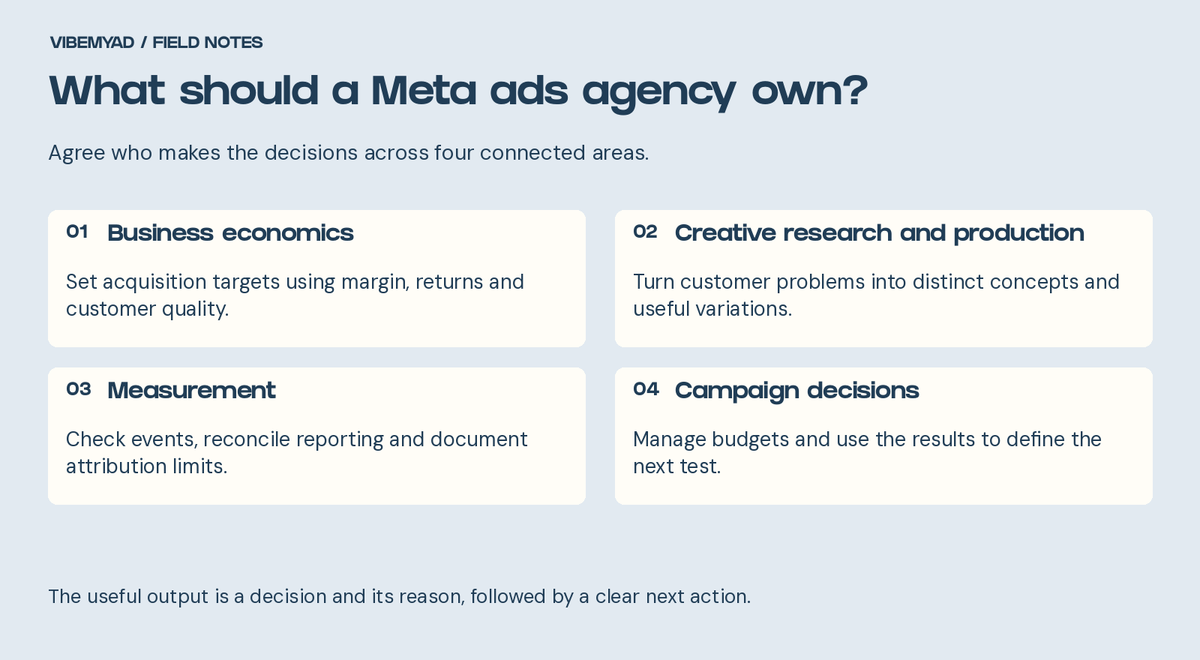
Meta agency responsibility checklist: business economics, creative research and production, measurement and campaign decisions.
The agency should know the difference between platform ROAS and profitable customer acquisition.
For ecommerce, that means working from contribution margin, new-customer CAC, return rate, discounting, repeat purchase, and cash payback. For lead generation, it means connecting leads to qualified opportunities, appointments, sales, or another downstream result. A cheap lead that never closes is not a success.
If the agency cannot see what happens after the click, it can optimize only for the events Meta receives. That creates a predictable failure: Meta gets better at finding the cheapest reported conversion while the sales or finance team quietly dislikes the customers behind it.
The agency should maintain a visible creative pipeline. At minimum, you should be able to see:
• Which customer problem each concept addresses
• Which proof or mechanism supports the claim
• Which formats and hooks will be produced
• What the account learned from the previous batch
• Which winning concept will receive more variations
• Which fatigue or saturation signal triggers replacement
Ask for concepts, not a promised number of ads. Twenty exports built from two ideas provide less learning than eight ads built from eight credible hypotheses.
The Meta Pixel captures browser events. The Conversions API creates a direct connection between a business's marketing data and Meta's optimization systems. Meta recommends using them together because server-side data can improve event coverage and measurement. Meta's official Conversions API documentation explains the connection.
An agency should verify that purchase, lead, registration, or other priority events fire with the correct values and currencies. It should check browser and server deduplication, consent settings, event match quality, test traffic, UTMs, and the difference between Meta's report and the business's source of truth.
Tracking cannot make attribution perfect. It can stop obvious implementation errors from becoming campaign strategy.
Campaign management includes objective selection, account structure, budgets, creative allocation, exclusions, placements, testing rules, and scaling decisions. The agency should make fewer changes than many clients expect. Constant editing can reset learning, blur the test, or turn normal volatility into panic.
A useful weekly update should answer four questions:
• What changed in business performance?
• Which creative or offer caused the change?
• What did the team stop, keep, or scale?
• What will the next test teach us?
A screenshot of Ads Manager answers none of them.
Do not choose by ad spend alone. Spend is a useful signal because it determines how much data an account can generate and whether a fee leaves enough money for media. It is not the decision rule.
Hire when the bottleneck has moved from proving the offer to running the system around it.
Your account needs new concepts faster than the internal team can research, script, shoot, design, and edit them. Existing winners fatigue before replacements arrive. The media buyer spends more time waiting for assets than deciding what to run.
This is often the clearest reason to hire. Meta's delivery system cannot manufacture a customer insight the brand never supplied.
The team receives reports but cannot turn them into the next creative brief, landing-page change, or offer test. Campaign learning dies inside Ads Manager.
A capable agency closes that loop. It uses results to decide which objection deserves a new video, which product needs a different landing page, and which audience problem was misdiagnosed.
Meta, analytics, your CRM, and your commerce platform disagree. Nobody owns the discrepancy. The team still scales or cuts spend using whichever dashboard looks most convincing.
An agency is useful when it can audit the implementation, define a source of truth, document attribution limitations, and build decision rules that survive imperfect data.
The founder approves every ad, checks every campaign, translates numbers for finance, briefs creators, and chases landing-page edits. Each person may be competent, but the operating model depends on one person carrying context between them.
An agency can remove that coordination burden if it genuinely owns the workflow. Hiring another account manager who still needs the founder to connect every decision will make the problem more expensive.
A launch, seasonal peak, new market, larger catalog, or aggressive growth target may require more production and monitoring than the team can sustain. Bring the agency in early enough to audit tracking, collect creative, understand approval constraints, and build a baseline. Hiring during the week performance collapses leaves no room for diagnosis.
An agency can test positioning and creative, but it cannot guarantee demand. If customers do not understand the product, margins are unknown, fulfillment is unreliable, or the landing page has barely converted organic traffic, a tightly scoped validation project may be better than a long retainer.
After paying the agency and producing creative, the account still needs enough media spend to test ideas with a reasonable signal. If the fee leaves almost nothing for distribution, hire a specialist freelancer, buy an audit, or keep the work in-house until the economics improve.
An agency needs access to customer language, product truth, brand constraints, margins, inventory, and past learning. A vague instruction to "scale Facebook" forces the agency either to guess or to keep requesting decisions. Both sides will call the other slow.
If one strong owner can research, brief creative, manage campaigns, validate tracking, and explain results without becoming a bottleneck, an agency may add coordination rather than capability. Hire production support or a technical specialist for the missing piece instead.
The hybrid model is often the strongest. One internal person owns the commercial truth and brand decisions. The agency owns research, production, campaign execution, and the learning cadence.
Agencies usually charge through one of four models:
• A fixed monthly retainer
• A percentage of ad spend
• A base fee plus a smaller percentage of spend
• A project, performance, or outcome-based fee
Each model can work. Percentage pricing becomes expensive as spend grows even when workload does not grow at the same rate. A low retainer can hide narrow scope, junior delivery, or separate creative charges. Performance pricing sounds aligned but depends on who defines the result and controls the variables behind it.
Compare the total operating cost: management, strategy, creative, creator fees, landing pages, tracking, tools, and any minimum term. Then compare that cost with the internal hires and coordination the agency replaces.
Ask questions that expose the work behind the pitch:
• Who will work on the account after the sales call?
• Who owns creative strategy, scripting, design, editing, and approvals?
• How many new concepts, not variations, do you expect to test each month?
• How do you decide whether a failure came from the ad, offer, page, or tracking?
• How do you reconcile Meta with our CRM or commerce data?
• Which business metric controls budget decisions?
• What would make you tell us not to scale?
• Can we see an example of a creative learning log or weekly decision report?
• Who owns the ad account, pixel, data, audiences, and creative files?
• What happens during the first 30 days?
Account ownership is non-negotiable. The business should own its Business Portfolio and ad account, then grant the agency partner access. Meta documents a formal process for sharing business assets with a partner. Avoid arrangements where the agency runs everything through an account it controls and takes the history with it when the contract ends.
A Meta Business Partner badge can help with screening, but it is not proof that a specific team understands your economics or can produce your creative. Meta maintains a partner program and directory, while the hiring decision still needs to examine the people, process, scope, and commercial fit.
Audit the account, event setup, creative history, offers, landing pages, margins, CRM or store data, and approval workflow. Define the source of truth and the metric that controls spend. Build the first creative hypothesis map.
Launch controlled tests across customer problems, proofs, mechanisms, offers, and formats. Keep enough stability to understand the result. Record what the account learned, including tests that failed.
Increase spend behind combinations that have enough signal, margin, creative depth, and operational capacity. Produce variations around winning concepts before they fatigue. Fix the weakest part of the conversion path instead of asking campaign settings to solve every problem.
By day 90, the agency should have built a repeatable learning loop. If the only asset created is a dashboard, the engagement has not matured.
Vibe My Ad is an AI-native platform and agency. We use software to study competitor advertising, organize creative patterns, produce more testable concepts, and connect those concepts to campaign results. People still decide which customer tension matters, which claim is credible, and when the economics justify scaling.
Our position is simple: Meta already owns most of the delivery algorithm. An agency earns its fee through the inputs and decisions Meta cannot supply for the brand. That includes customer research, creative direction, production, measurement discipline, commercial judgment, and the speed of the next test.
Our guide to AI advertising agencies explains how that model differs from adding an AI tool to a traditional service. You can also review Vibe My Ad's agency model if creative volume, campaign management, or both have become the constraint.


Arpita Mahato
Content Writer, Vibemyad

Arpita Mahato
Content Writer, Vibemyad

Arpita Mahato
Content Writer, Vibemyad
Table of Contents