September 01, 2026 • 20 min read
September 01, 2026 • 20 min read
A Shopify marketing agency manages the marketing systems built into Shopify itself, not just the ad accounts that send traffic to it. That distinction matters more than it did three years ago, because Shopify has moved the most valuable marketing controls out of the theme and behind APIs, sandboxes and permission scopes. An agency that cannot reach those surfaces is running your ads against data it cannot see, verify or repair.
That is not a scandal. It is a measurement problem. The words on an agency website are free, and so is the thing most of them point at: joining the Shopify Partner Program costs nothing, requires nothing, and gates nothing. Anyone with an email address can be a Shopify Partner by lunchtime.
This guide explains what a Shopify marketing agency does at the service level, how to identify whether a candidate agency can operate the platform, when hiring one makes sense, and when a freelancer or specialist is the better fit.
• A Shopify marketing agency is a team that operates the marketing surfaces inside Shopify itself, not a general e-commerce agency whose clients happen to use Shopify. That distinction is now testable.
• The Shopify Experts brand was sunset in December 2023 and the Partner Program is free to join, so neither word on a website tells you anything. The Partner Directory is the only tiered signal, and it is evaluated quarterly on January 1, April 1, July 1 and October 1.
• Seven surfaces separate the two kinds of agency: Customer Events, checkout extensibility, Functions, Segments, the Customer Privacy API, Shopify's own ad products, and agentic storefronts.
• Five dates have already broken things and two more are still ahead, on October 1, 2026 and March 1, 2027. Every one of them lands on marketing measurement.
• You need this kind of agency when your growth constraint moves inside the platform. You do not need one while the constraint is your offer, your margin or your traffic volume.
Three labels get used interchangeably in US pitch decks. Only one of them carries information.
Shopify Partner is an open account. Shopify describes the program as being "for organizations that align with Shopify's vision," it is free, and it comes with test stores and training. A partner account is a signup, not an achievement. Treat it the way you would treat someone telling you they have a Google account.
Shopify Expert is a discontinued brand. Shopify's partner help documentation states that "the Shopify Experts brand and corresponding Shopify Experts Marketplace was previously sunset in December 2023." The word survives in URLs and ad copy because it still gets searched. It does not survive as a credential. An agency selling you a 2026 certification for a program that closed in 2023 has told you something useful about its research habits.
The Partner Directory is the one real gate. Shopify tiers service partners as Registered, Select, Plus, Premier and Platinum, reassesses those tiers quarterly on the first of January, April, July and October, and invites the upper tiers to build a directory profile. It is a revenue and skills threshold, so it measures volume and staffing rather than craft, but at least it is measuring something.
None of that tells you whether the agency can fix a broken purchase event. For that you need a different test.
A Shopify marketing agency is a marketing team that operates the merchant-facing systems built into Shopify, in addition to the ad accounts outside it. Concretely: it configures Customer Events and web pixels, works inside checkout extensibility rather than theme code, builds and maintains customer segments in Shopify's own query language, reads and respects the consent state that gates all of it, and manages the acquisition channels Shopify now runs itself.
A general e-commerce agency does the ad-account half and treats the store as a black box that produces orders. That was a perfectly good division of labor until Shopify stopped letting outsiders touch the checkout. Now it means the agency optimizing your spend cannot see, verify or repair the data it is optimizing against.
Both are legitimate businesses. They are not substitutes, and nothing in the quote distinguishes them. Our breakdown of what an e-commerce marketing agency does covers the general category; this piece is about the Shopify-specific half, and about how to prove it in a first call.
The services below are where Shopify-specific work differs from what a general e-commerce agency delivers. Each one involves operating inside Shopify rather than alongside it.
The distinguishing factor across all six is data access. A Shopify marketing agency reads the same order and consent data Shopify reads, rather than accepting ad-platform attribution at face value. That access is what makes the measurement and the creative decisions connected rather than parallel.
Here is the whole argument in one table. If an agency cannot operate at least the first five of these, it is a media buyer with a Shopify logo in its deck.
Four of those seven rows did not exist in their current form three years ago. That is the reason a category called "Shopify marketing agency" exists at all, and the reason so many agencies still describe themselves as one while operating none of it.
This is where most engagements quietly fail, so it goes first.
Shopify no longer lets arbitrary JavaScript watch your customers. Tracking now runs through the Web Pixels API in one of two sandboxes. App pixels get a strict sandbox, which is a web worker where Shopify guarantees you only self, console, setTimeout, setInterval and fetch. Custom pixels get a lax sandbox, which is an iframe with allow-scripts and allow-forms, and Shopify's documentation is blunt about the consequence: pixels in the lax sandbox "cannot access the top frame." There are fifteen standard events, checkout_completed among them, and that is the vocabulary.
The upside is real. Pixels load on the storefront, checkout, thank-you page, order status page and, since Winter '26, customer account pages, which is territory theme code never reached. The downside is that this is a developer surface wearing a marketing hat, and Shopify says so: its own help page notes that custom pixels are "an advanced feature that requires JavaScript knowledge" and that "adding and using custom pixels is unsupported by Shopify."
Merchants have been living in the gap. One agency auditing a store running six web pixels reported "30% missing orders," having measured pixels taking three to seven seconds to fire, "which seems to be enough time for someone to leave the page and the pixel to miss the event." Another developer put it more bluntly in a thread about post-purchase pages: "only around 20-40% of events are sent to the pixel via the API."
The test: ask where your purchase event lives. If the answer is Additional scripts, or the agency does not know, your conversion data has a hole in it and nobody on the account has looked.
Shopify spent two years taking the checkout away from everyone, on a published schedule.
August 13, 2024 was the deadline to move the information, shipping and payment pages off checkout.liquid. Stores that missed it did not just lose customizations. Shopify's own upgrade page lists the penalties, and one of them is financial: orders get treated as higher risk, and "payouts may be delayed by up to 5 days." From January 6, 2025, Shopify began auto-upgrading holdouts with thirty days notice.
August 28, 2025 was the deadline for the thank-you and order status pages on Plus. That is the one that mattered for marketing, because the Additional scripts box on the thank-you page is where practically every conversion tag in commerce had been living since 2015. Non-Plus stores hit the same wall on August 26, 2026, days before this was published.
Two deadlines are still ahead. From October 1, 2026, no app can create or update a ScriptTag. On March 1, 2027, ScriptTags stop running on storefronts entirely.
The failure mode is silence. A merchant who flipped on the new checkout configuration in June 2024 described it exactly: "My google ads has dropped from 25 conversions a day to 1 ... The new checkout disables all tracking on purchases which in turn means google is not getting any info." The store kept selling the whole time. Another merchant summarized the pattern this August, after the non-Plus deadline: "The store didn't stop selling. The receipt page stopped talking to Meta."
The test: ask what the agency did in the last week of August 2025 and the last week of August 2026. A Shopify agency has an answer with dates in it.
Shopify Scripts is gone. Its replacement, Shopify Functions, is WebAssembly that runs inside Shopify's own checkout logic, and it governs discounts, delivery customization, payment customization and cart transforms.
The migration is a small masterclass in why platform literacy is a service you can buy. Shopify has published three different end dates for Scripts across its own documentation: an old developer changelog said support ended August 13, 2024, the checkout upgrade page still says Scripts would be shut off on August 28, 2025, and the live Script Editor page says, in the past tense, that "as of June 30, 2026, Shopify Scripts has been deprecated" and that any still-published Scripts "have been deactivated and no longer work." The last one is operative. Knowing which one is operative is the job.
Functions carry hard ceilings worth knowing before you promise a client a promotion calendar. A store can activate at most 25 discount functions, and separately at most 25 active automatic discounts including app-based ones. A customer can stack five product or order discount codes plus one shipping code on an order. Custom apps containing Functions require Plus.
And Functions fail differently from Scripts, which is the part that catches marketers. As one merchant wrote after migrating: "A Script that stopped running at least became visible once a customer complained. A Function that's deployed but whose conditions don't match just doesn't fire, and nothing errors."
The test: ask who owns your promotional logic. If the answer is an app nobody has opened in a year, your Black Friday plan has an untested dependency.
Customer segmentation used to mean exporting a CSV and rebuilding the audience in your email platform. Shopify now holds it natively, as rule-based lists written in ShopifyQL against order history, spend, location, subscription status, consent state and, since Winter '26, the product category a customer viewed or purchased.
The reason this matters to a marketer is not the segment. It is the wiring. A Shopify segment can trigger Shopify Flow through the "customer joined segment" event, which can then tag the customer, update a record, or fire an HTTP request into Klaviyo, Postscript or your warehouse. That is a real-time lifecycle system built from parts you already pay for, and it sits idle in most accounts because nobody on the marketing side writes ShopifyQL.
The test: ask for a segment query the agency wrote from scratch for another client, and what fired off the back of it.
The Customer Privacy API records four consent purposes: preferences, analytics, marketing and sale of data. It honors Global Privacy Control automatically in opt-out regions, exposes visitor geography down to ISO codes like USCA for California, and gates every pixel on the store. App pixel callbacks only execute after consent, at which point Shopify replays the events that already happened.
Here is the part that ends up in a quarterly review as a crisis. Shopify's own documentation warns that a cookie banner produces "decreased session counts and other metrics." Shopify calculates conversion rate as sessions with a completed checkout divided by sessions, so consent opt-outs shrink the numerator while orders and sessions stay intact. The reported conversion rate collapses while the business is fine.
Merchants have measured it. One reported that sessions with completed checkout tracked to real orders at 98% accuracy before installing a consent banner and 55% to 65% after, matching the opt-out rate almost exactly. Another, with a 90% banner acceptance rate, still watched the gap between tracked conversions and total orders widen to roughly half.
An agency that cannot explain that curve will spend your money chasing a decline that never happened.
The test: ask for your consent rate by region and what it does to your reported conversion rate. Two numbers, one minute.
While agencies were arguing about attribution, Shopify quietly started selling media.
Shopify Audiences builds acquisition and retargeting lists from cross-merchant commerce data and pushes them into Meta, Google, TikTok, Pinterest, Snapchat and Criteo. It is free, and restricted to eligible Plus stores using Shopify Payments based in the United States or Canada. Shopify's own claims are that it can "drive up to 2x more retargeting conversions for every retargeting dollar spent," cut acquisition costs "by up to 50%," and exclude "40% more existing customers on average."
Take the marketing claims as marketing claims. One merchant who upgraded to Plus specifically for Audiences reported that after three weeks it had exported nothing to Meta, and the Google list came back "too small to serve." That is a single account, but it is the kind of thing an agency that runs the product would have warned you about before the upgrade.
Shop Campaigns is stranger and more interesting: Shopify buying media on your behalf against a cost per acquisition you set, across the Shop app, the Shopify Product Network of other merchants' stores, and third-party inventory including Google, Meta, Pinterest, Snapchat, Bing, X and ChatGPT Ads. Budgets roll over inside a Sunday-to-Saturday week, so a $100 daily budget caps at $700 for the week rather than resetting nightly.
The CPA framing hides real exposure at high average order values. One merchant reported being "charged $845 for an $1,140 order." Another was charged $410 on a $700 order, against a floor CPA of $410. Whether that is good depends entirely on your contribution margin, which is exactly the calculation an agency should be doing before it turns the channel on.
The test: ask whether they have run Shop Campaigns, and at what CPA relative to the client's margin. Not whether they have heard of it.
In Winter '26 Shopify launched agentic storefronts, which put products into ChatGPT, Microsoft Copilot, Google AI Mode and Gemini. In Spring '26 it shipped the Universal Commerce Protocol with Google, plus Shopify Catalog and the beginnings of a universal cart. Shopify claims AI searches powered by its Catalog "convert at 2x the rate of those using scraped data."
The sentence every US merchant should read twice is in Shopify's own help documentation: agentic storefronts are "active by default for eligible stores." Orders from AI channels already appear in the admin with channel attribution, under Sales channels, and most brands have never opened that report.
There is also a limit worth being honest about, because merchants have run into it hard. The admin toggle governs Shopify's own agentic surface. External agents that read your public product data and structured markup are not sitting behind a Shopify switch, which is why a thread titled "Why Can't We Opt Out of Agentic Storefronts?" exists at all. The practical work here is the unglamorous kind: indexation, clean Product JSON-LD with real price, availability and review data, and tracking assistant referrals separately, since many of them arrive looking like direct traffic.
The test: ask how many orders your store took from AI channels last month. An agency operating this surface answers with a number.
Seven dates, five already passed, two ahead. Every one of them changes what a marketer can measure or control, and none of them was announced through a marketing channel.
An agency that has never mentioned a single one of these to you is not managing your Shopify store. It is managing your ad accounts and hoping the store keeps sending numbers.
Open Settings, then Users and permissions. This tells you more about your agency than the last three reports it sent.
• Staff versus collaborator. Shopify caps user accounts by plan: zero on Starter and Basic, five on Grow, fifteen on Advanced, unlimited on Plus. Collaborator accounts do not count against that limit, and only a Shopify Partner account can request one. On a Basic store an agency without a partner account literally cannot be onboarded correctly, which is why so many merchants end up sharing the owner login.
• Customer events and Custom pixels are separate permissions. They are also separate from Marketing. An agency granted Marketing but not Custom pixels can build a campaign and cannot repair the tag measuring it.
• The three-number check. For the same date range, pull Shopify order count, ad platform conversions and GA4 purchase events. Practitioners treat agreement within 5% to 10% as healthy. Shopify's order count is the ground truth, ad platforms overreport, GA4 underreports. If the spread is wider than that, you have found this quarter's real project.
Run those three and you will know whether the agency is operating the platform or standing next to it. If you want a broader vetting script that covers commercial terms rather than plumbing, we wrote nine questions to ask any e-commerce agency.
Not at a revenue number. At a constraint. The five platform triggers below are the clearest signals. Beneath them are the situations where a Shopify agency is the wrong hire.
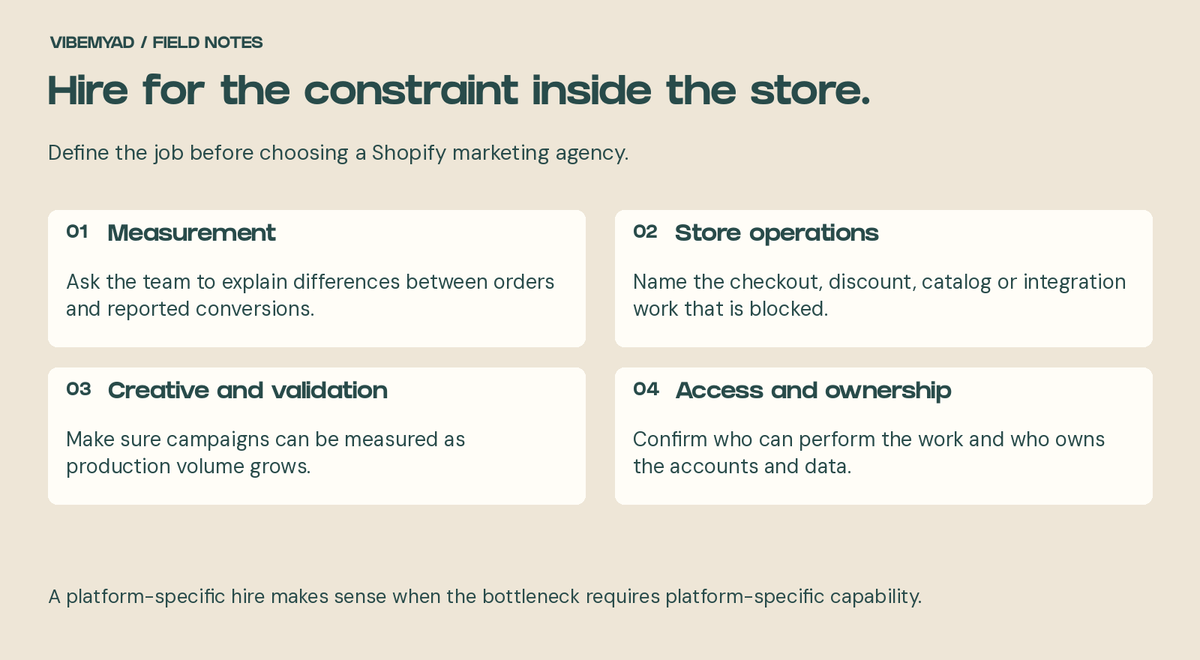
Shopify agency hiring checklist: measurement, store operations, creative validation, access and ownership.
• You have hit your internal capacity ceiling. A founder or small team managing ads, email, SEO and site changes simultaneously cannot test any of them at the cadence that produces reliable data. The constraint is bandwidth, not knowledge, and an agency adds execution capacity before it adds strategy.
• Acquisition is stalled and you cannot tell why. Flat traffic and rising CPAs could be a creative problem, an audience problem, a measurement problem or all three. A Shopify agency can separate them because it has access to the order data the ad platform cannot see.
• Retention is weak and repeat purchase rate is not improving. Welcome flows, post-purchase sequences and win-back campaigns require Shopify Segments, Shopify Flow and an email platform working together. If any of that is untouched or running from an exported CSV, there is leverage in the account that nobody is using.
• Creative testing is producing volume but no signal. Testing at scale against broken or incomplete purchase-event data is expensive guessing. More accurate measurement is the prerequisite, not the output, of a working creative program.
• Your measurement no longer reconciles. Meta, Shopify and GA4 disagree by more than 10%, and nobody in the building can say why. This is the single most common trigger, and it is a platform problem wearing an attribution costume.
• A deadline has already hit you. You lost thank-you page tracking, or your Scripts stopped, or your discounts behave differently than they did last quarter. This work is dated and non-negotiable.
• You are on Plus and using a fraction of it. Audiences, Functions, checkout extensions, business entities, market catalogs. Plus costs real money and most of what you are paying for is the surface area, not the support.
• You are scaling creative faster than you can validate it. Volume without clean events is expensive guessing, and it gets more expensive as spend rises.
• AI channels are producing orders you cannot explain. Agentic storefronts are on by default. If that line item is growing and unmanaged, someone should be managing it.
The common thread: hire when the bottleneck has moved inside Shopify. Ad-account skill will not clear a bottleneck that lives in a sandboxed iframe.
Being honest about this is cheaper for both of us.
If your conversion rate is under 1% on qualified traffic, the problem is the offer or the page, and no pixel repair changes that. If your contribution margin does not survive a realistic acquisition cost, more accurate tracking just gives you a sharper picture of a loss. If you are pre-product-market-fit, everything in this article is premature optimization with an invoice attached. And if your monthly ad spend is small enough that a retainer would swallow it, a specialist freelancer will serve you better; we put actual numbers on that threshold in our piece on what under $5,000 a month buys, and on the retainer versus outcome question separately, because pricing deserves its own argument rather than a paragraph here.
Agency fees for Shopify marketing work in the US commonly sit between $2,500 and $10,000 a month depending on the channels covered and the creative volume required. That figure is the management fee only. Ad spend, email platform costs, and any development work sit outside it and are typically paid separately. For a full breakdown of how to compare proposals and calculate the true monthly outlay, including worked examples at three budget levels, see our guide to digital marketing agency costs in 2026.
One distinction worth making before any call: a Shopify marketing agency and a Shopify development agency are different purchases. Development agencies build and migrate stores. Marketing agencies operate the acquisition, retention and measurement systems that run on top of them. Some firms do both; most do one well. If your store needs a replatform, a complex Functions build, or checkout extension development, scope that as a separate project from the ongoing marketing engagement.
Publishing a seven-point test and then dodging it would be poor form, so here is our card, including the parts we lose on.
Vibemyad sells to US DTC brands, mostly Shopify, mostly in beauty, apparel, food and beverage and wellness. The structural difference is that we own the software instead of licensing it. Our platform watches live category advertising and tags what it finds by hook, format, offer and funnel position, and that read flows into everything downstream: creative, media, search, site. Machines produce. People choose.
• Surfaces one, five, six and seven we operate directly. Customer Events and pixel integrity, consent-aware measurement, Shopify's own ad products, and AI search visibility including agentic channels. Surface seven is the one we are most opinionated about, because it is new, on by default, and almost nobody is managing it.
• Surface four we use daily. Segments feeding creative and lifecycle, which is the cheapest unused leverage in most accounts.
• Surfaces two and three we scope, we do not staff. Checkout extensions and Functions are engineering, and a marketing agency claiming deep Shopify Plus development is usually claiming a subcontractor. For a genuine replatform or a complex Functions build, hire a development partner; we named several in our rundown of the best Shopify marketing agencies by specialty, and two of them are better at that job than we are.
On terms: we price against the outcome, there is no retainer, and you can leave at the end of any month. That arrangement collapses if the numbers are wrong, which is most of why surface one gets our attention before anything else does.
Score any agency this way, including us. Seven rows, a yes or no in each, and an artifact behind every yes.
Score your current agency before you renew.


Arpita Mahato
Content Writer, Vibemyad

Arpita Mahato
Content Writer, Vibemyad

Arpita Mahato
Content Writer, Vibemyad
Table of Contents