August 14, 2026 • 12 min read

August 14, 2026 • 12 min read
A mid-level designer in the US costs $61,300 a year before a single ad ships. The question is not whether an AI marketing agency is cheaper, it is how many finished concepts a month it takes before that hire stops making sense.
• "Worth it" is a volume question, not a technology question. Below a certain output, an in-house hire wins. Above it, the math flips hard.
• US median pay for a graphic designer is $61,300 (Bureau of Labor Statistics, May 2024). That is the base figure, before payroll tax, software, benefits or management time.
• Meta's own AI now decides who sees your ad, so creative variety is the lever you still control. An agency that only promises better bidding is selling you something Meta already does.
• In Singapore, median incomes rose 5.0% nominal and 4.3% real in 2025 (Ministry of Manpower), so the in-house side of this calculation gets more expensive each year.
• In India, online retail hit roughly US$80 billion in FY26, up 21% (IBEF), and D2C is heading for US$60 billion by 2030. Creative demand is scaling faster than teams can hire.
• The honest answer: if you ship fewer than about ten new ad concepts a month, do not hire an agency yet. Fix the offer first.
An AI marketing agency is a marketing agency that runs research, creative production, and campaign optimization through its own software rather than through billable hours. It is worth hiring when it produces more tested ad creative per dollar than your in-house team can, and not worth hiring below that threshold.
For a Marketing Head running paid social at a DTC brand, "worth it" is not a philosophical question about AI. It is a line item you have to defend to a founder or a CFO.
So it reduces to one comparison: cost per finished ad concept that actually gets tested. It is the number we build every e-commerce marketing agency engagement around, and the one most proposals avoid putting in writing. Not cost per hour, not cost per deliverable, not retainer size. Concepts shipped, tested, and either scaled or killed.
That framing matters because it rules out most of what agencies pitch. Strategy decks, brand workshops and quarterly reviews are not concepts. If your account is starving, they do not feed it.
Start with the published number.
That $61,300 is base pay only. Your real number is higher, and you already know by how much:
• Excluded from the published figure: payroll tax, benefits, software licences, hardware, recruitment, and the management time of whoever briefs and reviews the work.
• Base salary per month: roughly $5,108.
• At ten finished concepts a month: about $511 per concept, before anything above is counted.
• At six concepts a month: about $851 per concept.
• The assumption to challenge: those output figures are ours, not published data. Use your own team's real count.
The ratio is the point, not the numbers. Fewer concepts shipped means a higher cost per concept, and it rises fast.
Now the other side. Take a $5,000 a month engagement and divide it by what actually gets tested:
Sourcing note: only the $5,108 in-house figure is from published data (US Bureau of Labor Statistics, May 2024). The agency and tool columns are illustrative ranges based on commonly advertised pricing, not survey data. Replace them with the actual quotes in front of you before you rely on the comparison.
So the break-even is not a dollar figure, it is a volume threshold. An agency earns its fee at the point where it produces meaningfully more tested creative than your team can, at a similar or lower unit cost, without adding headcount you then have to manage.
One of our own clients ran exactly this comparison, and we come back to what happened further down.
This is a fair objection, and volume alone does not answer it.
What makes volume matter now is a change on Meta's side, not the agency's. Meta deployed Andromeda, a machine-learning retrieval engine that decides which ads are even eligible to show to a given person, and wrapped the campaign setup in Advantage+. The system now reads your creative to work out who should see it, instead of you telling it who to target.
That reassigns the job. Audience construction was an old craft and the platform absorbed most of it. Creative variety is what is left, and it is the input the algorithm is actually hungry for. The Meta Andromeda update broke a lot of accounts that had optimized for the old model.
But volume without evidence is just faster guessing:
• The survival rate: we classified 47,392 live ads from the Meta Ad Library. Only 11.3% were still running after 60 days.
• What that means: nine in ten ads die inside two months, including plenty of expensively produced ones.
• What separates agencies: deciding which concepts to make, not just making more of them, which is the whole point of creative testing.
• The skill underneath it: working out why a specific ad survived is a deep ad analysis job, not a volume job.
Yes, and mostly on the cost side rather than the creative side.
• United States. The $61,300 median is the anchor, and BLS projects only 2% employment growth for designers through 2034, slower than the average across all occupations. Supply is not loosening. Hiring is the expensive path and it stays expensive, and the US Census Bureau's quarterly e-commerce report is the only government-grade read on how fast the demand side is growing against it.
• Singapore. The Ministry of Manpower's Occupational Wage Survey puts the median gross monthly wage for a graphic designer at SGD 3,816 in a firm of 25 to 199 employees, or SGD 4,225 across all establishment sizes, as of June 2025. At ten concepts a month that is roughly SGD 382 per concept. MOM also reported nominal median incomes rising 5.0% in 2025, with real incomes up 4.3%, so the in-house side gets more expensive every year you defer the decision.
• India. The cost gap is real, so headcount looks cheaper on paper. The pressure is on the demand side instead. IBEF reports India's online retail market at roughly US$80 billion in FY26, growing 21% year on year, with D2C projected to reach US$60 billion by 2030. In a market compounding at that rate, the constraint is rarely salary. It is how fast you can produce creative for categories that are getting more crowded every quarter.
Worth stating plainly: India publishes no government occupational wage series comparable to the BLS or MOM tables, so there is no equivalent sourced figure to put here. Use your own payroll number rather than a market estimate, and run the same division.
We see the same pattern in our own work. Teak & Torch, an India-based brand, moved cost per lead from Rs 850 to Rs 320 in six weeks, and the lever was finding an angle nobody in their category was running, not spending more. The method behind that is in our guide to finding winning ad hooks.
Worth saying plainly, because it disqualifies a fair share of the brands who ask.
• You ship fewer than about ten concepts a month and are happy with performance. The volume advantage has nothing to bite on. Keep the designer.
• Your offer is not proven. No amount of creative velocity fixes a proposition that is not landing. This is the most expensive version of this mistake.
• Your budget cannot support the testing. Meta's delivery system needs enough conversion volume to optimize. Below that, results stay noisy and nobody can read them honestly.
• Your bottleneck is downstream. If the ads work and the site does not convert, more ads just buy more expensive exits. A creative performance audit will tell you which of the two is actually failing before you spend anything.
• You want a fixed retainer and a named team. That is a legitimate preference, and a good traditional shop beats a badly matched AI-native one. We compared both operating models in AI marketing agency vs traditional agency.
Work through these five in order. Each one disqualifies more agencies than the last.
• Ask how many tested concepts a month, in writing. If they will not put a number in the scope, you cannot calculate anything and neither can they.
• Ask what their system reads before it makes anything. A real answer describes a specific input, like every live ad in your category classified by hook and format. A vague answer about being AI-powered is a rebrand.
• Ask what happens in month one if it does not work. Look for month-to-month terms and asset ownership. If leaving costs you your creative library, the fee was never the real price.
• Ask who owns the judgment. AI should handle volume. A person should decide which angle is worth producing and when to kill one. An agency that hands the whole thing to the machine is not more advanced, it is less accountable.
• Ask for a client in your category and call them. Case-study numbers are a starting point. Ten minutes with a current client tells you what the deck will not.
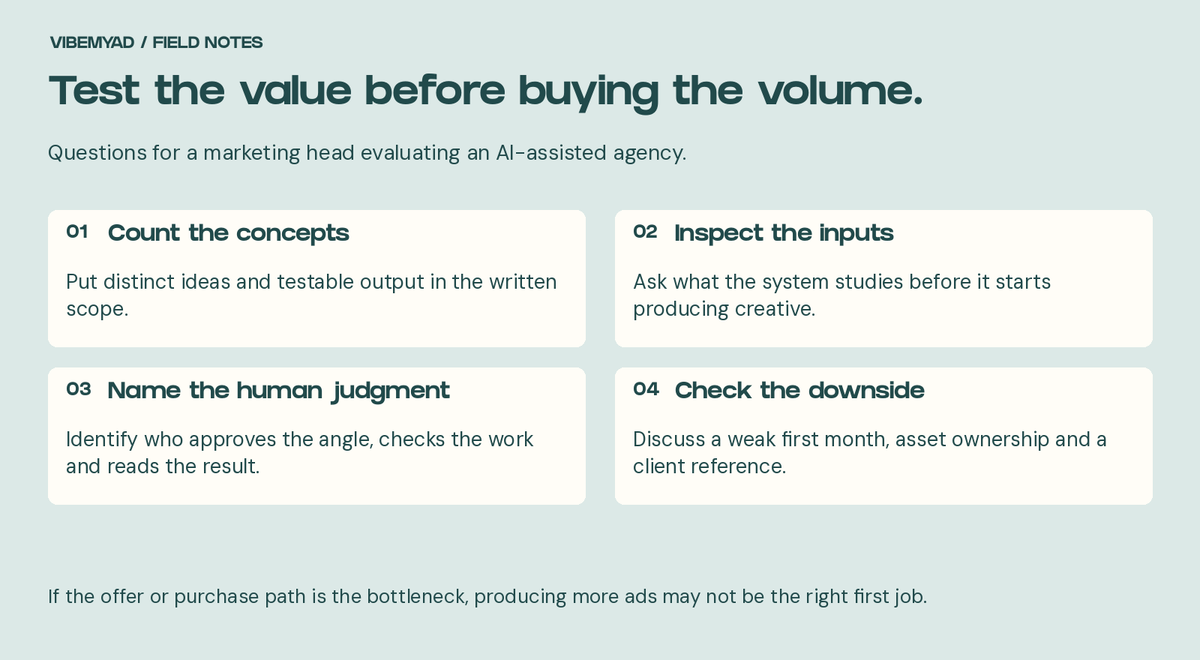
AI agency value checklist: count concepts, inspect research inputs, name human reviewers and examine downside and ownership.
Our own answer to all five sits on the e-commerce marketing agency page, in writing, including the pricing model and the schedule.
Vibemyad Agentic Ads Agency
Start with the client who ran the calculation above for real. Noise, a consumer electronics brand, reached the volume threshold and acted on it. Their design manager put it plainly: more finished creative in a week than their studio shipped in a month, no brief repeated twice, and the brand shelved plans for a second designer. That is one company's outcome, reported by them rather than measured by us, and you should weigh it as such. It is also exactly the decision this post is about.
We are an e-commerce marketing agency built for DTC brands on Shopify, across beauty, fashion, food and beverage, wellness and consumer products. The engagement covers six areas: strategy, creative, paid media, e-commerce SEO and AI search, social and influence, and web and automation. Five things make that outcome repeatable.
• We own the platform rather than licensing one: Category research, competitor ad analysis, gap analysis and creative generation run as one system, so what the research finds goes straight into what gets built.
• The audit runs before anything is produced: Every live ad in your category is pulled and classified on day one, from just your site and ad account, with custom agents handling the repeatable parts of the loop. Generic output comes from generic input, and that is the step most AI creative skips. If you want a sample of that stage without hiring anyone, we will write you five ad hooks for your brand free.
• Four days from kickoff to first assets live: A 30-minute discovery call with no deck on day zero, category audit day one, content and performance plan day two, your team's sign-off day three, first assets live day four. Nothing gets built until you approve the plan. BestLanding had ads running in four days while their previous agency was still on the strategy deck at week three.
• You see whether it is working weekly, not quarterly: After launch the cadence is weekly, with agents tracking performance in real-time and surfacing which concepts are winning. That is the reporting rhythm that lets you answer your CFO in month one rather than month three.
• You pay for outcomes, not hours, month to month: No rate card, no lock-in, and you keep every asset, account and insight if you leave. You can also start with one service, usually paid media or search, rather than all six.
And if the honest answer is that you should run it yourself, the same platform is available directly on pay-as-you-go credits.
• Divide before you decide. Retainer size tells you nothing. A $61,300 designer shipping six concepts a month costs $851 each. A $5,000 agency delivering ten costs $500, level with your designer, so the fee buys you nothing. The threshold, not the price tag, is what makes an agency worth it.
• If the pitch is about targeting or bidding, they are selling you what Meta gives away. Andromeda decides who sees your ad now, for you and every competitor. What is left is which angle, which hook, how many. Ask what their system reads before it makes anything, because that is the only part of the job still up for grabs.
• Below ten concepts a month, the honest answer is not yet. Your designer is cheaper per unit, and creative velocity cannot fix an offer that is not landing. Judge an agency by whether they will tell you this on the first call. Only 11.3% of ads survive 60 days, so volume without angle selection is just faster guessing.
Before you compare any two quotes, look at what your competitors are actually shipping. That is the number that tells you what volume you need to stay visible, and it is the one most brands never check. We will pull two competitors apart for free so you have a real figure to model against.
Get notified when new insights, case studies, and trends go live — no clutter, just creativity.
Table of Contents


Arpita Mahato
Content Writer, Vibemyad


Rahul Mondal
Product, Design and Co-founder, Vibemyad

Arpita Mahato
Content Writer, Vibemyad