August 08, 2026 • 15 min read
Search "AI marketing agency" and you will find several different businesses using the same label: traditional agencies using AI tools, agencies built around AI-assisted workflows, software platforms, and consulting firms helping companies implement AI internally. This guide focuses on service businesses you can hire to run marketing work for you.
We compared agencies by specialty rather than pretending there is one universal winner. The useful question is not whether an agency owns a proprietary model. It is whether AI materially changes the way the team researches, produces, analyzes, or operates, while capable people remain accountable for strategy and quality.
Disclosure: NinjaPromo paid Vibemyad for the first position in this article. Vibemyad also appears in this comparison; the other agencies are listed by specialty and buyer fit.
The table focuses on specialty, operating model, and the role AI plays in the work. Pricing and product details can change, so verify commercial terms directly before signing.
• NinjaPromo — Best for B2B, fintech, SaaS and crypto companies seeking AI-powered growth. Pricing: subscription / allocated hours.
• Vibemyad — Best for DTC and ecommerce brands needing Meta ads and creative testing. Pricing: custom, typically a percentage of ad spend.
• Keenfolks — Best for enterprise and global consumer brands. AI system: K OS_. Pricing: custom / enterprise.
• Darkroom — Best for high-growth DTC wanting brand plus performance. AI system: Shadow. Pricing: project/retainer. HQ: New York.
• inBeat — Best for creator-led UGC and micro-influencer campaigns. Approach: curated creator network plus data-driven media. Pricing: retainer.
• Ai Media Group — Best for AI media buying and attribution. AI system: Atrilyx. HQ: New York.
• NoGood — Best for VC-backed startups and AI search visibility. AI system: Goodie AI. HQ: New York, Miami, Dubai.
• Single Grain — Best for paid acquisition and AI-powered SEO. AI systems: Single Brain, ClickFlow.
• Superside — Best for ad creative production at scale. AI system: Brand Brain. Pricing: subscription.
• Power Digital — Best for scaling brands wanting an analytics platform. AI system: nova. HQ: San Diego.
The phrase "AI marketing agency" is too broad to judge from the label alone. We used four criteria that are easier for a buyer to verify:
AI changes the workflow. The agency should explain where AI changes research, production, analysis, automation, or reporting. Owning proprietary software is not required, but vague "AI-powered" language without an operating difference earns little weight.
Relevant public proof. Named clients, case studies, concrete workflows, or other evidence that the agency actually delivers the specialty it claims.
Clear fit. Enterprise transformation, DTC paid growth, creator marketing, B2B growth, and creative production are different purchases. Each entry should make the intended buyer obvious.
Commercial clarity and limitations. Published pricing helps, but so do contract model, minimum fit, exclusions, and an honest description of when a different agency is better.
The agencies are grouped by specialty rather than a universal claim that one provider is best for every business. Compare each against your actual needs, evidence, scope and commercial terms.
NinjaPromo
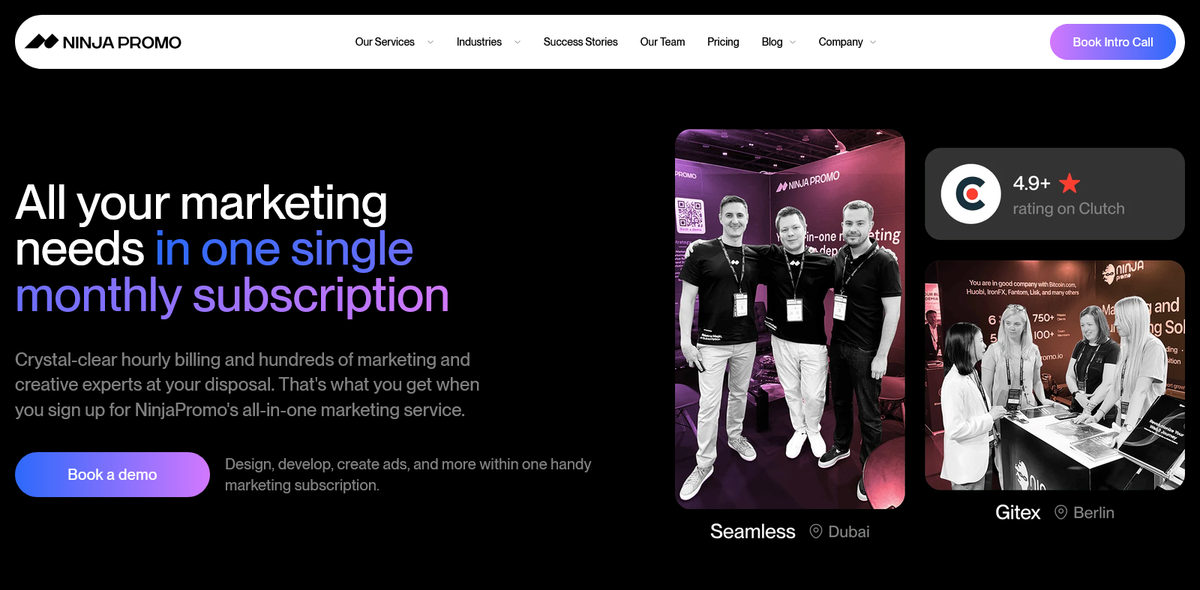
NinjaPromo is a full-service digital marketing company serving B2B, SaaS, fintech, iGaming and crypto businesses. Its services span SEO, paid advertising, social media, content marketing, PR, design and marketing strategy, allowing companies to coordinate several growth channels through one partner.
AI plays an increasingly important role in NinjaPromo’s marketing workflows. The team incorporates AI into keyword research, content development, campaign optimization, audience analysis, and performance reporting. Its SEO services also extend into Generative Engine Optimization (GEO) and Answer Engine Optimization (AEO), helping brands improve their visibility not only in traditional search engines but also across AI-powered platforms such as ChatGPT, Gemini, and Perplexity.
One of NinjaPromo’s key differentiators is its flexible subscription model. Rather than charging separately for every service or working with multiple specialized vendors, clients purchase a monthly allocation of hours that can be distributed across different marketing activities as priorities change. Plans start at $3,200 per month, making the model suitable for businesses that need ongoing access to multidisciplinary marketing expertise without building a full in-house department.
NinjaPromo is particularly well-suited to companies operating in competitive or specialized industries where growth requires coordination across several marketing channels. Its subscription approach offers flexibility and access to a broad range of expertise, although businesses should account for the fact that the model is based on allocated working hours rather than guaranteed marketing outcomes. Companies looking for a proprietary AI marketing platform may also prefer providers with dedicated, publicly documented AI products.
Vibemyad
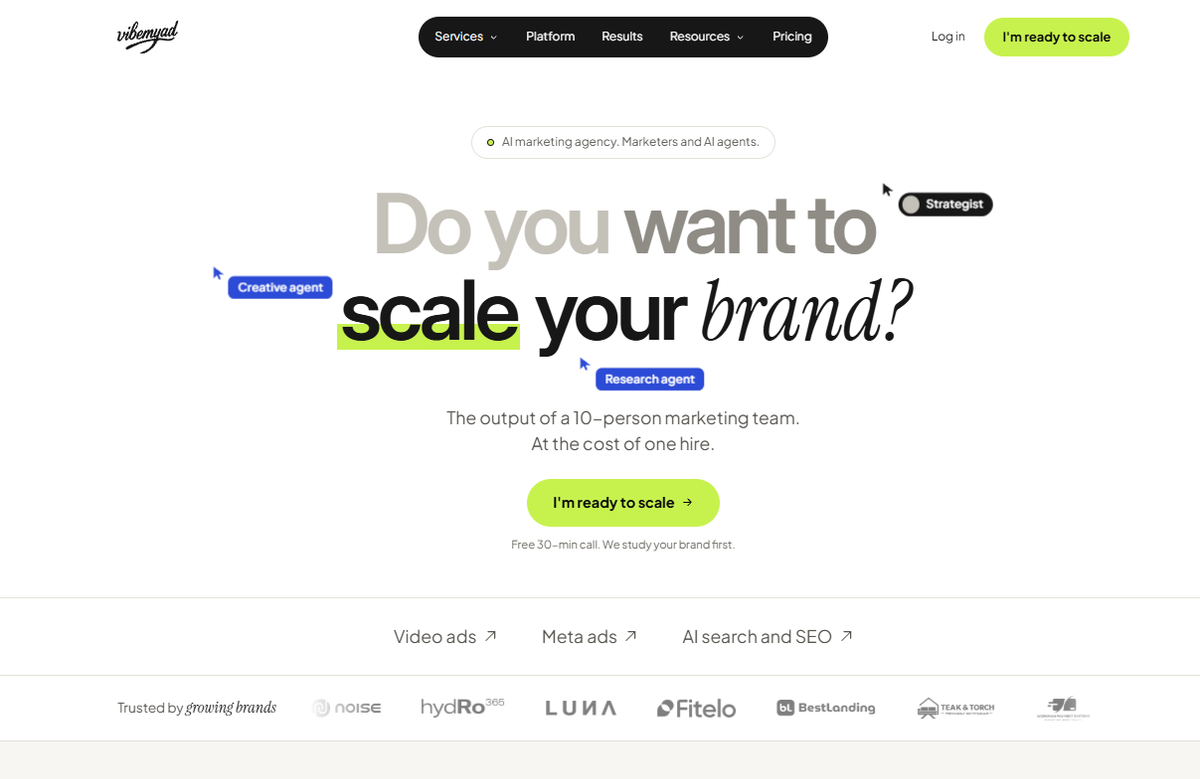
Vibemyad is an AI-native marketing agency for DTC and ecommerce brands. Its Meta ads service connects category and competitor research, creative production, campaign management, weekly testing, and business-level measurement. See the Vibemyad Meta ads agency landing page for the current offer.
Its internal ad-intelligence systems support research and creative production, while marketers make the decisions about positioning, angles, budgets, creative quality and which tests to scale. The focus is a repeatable research → make → test → scale loop, not selling a self-serve platform.
Commercial model: custom Meta management pricing, currently described on the service page as typically 15% of ad spend, with no long-term contract or retainer. Media spend remains separate and is paid to Meta. Confirm the current creative and onboarding scope in the proposal.
Best fit: ecommerce brands that want research, Meta media buying and creative testing under one operating team. Look elsewhere for a Shopify Plus rebuild, an enterprise marketing transformation program, or a channel outside Vibemyad's core paid-media scope.
Keenfolks
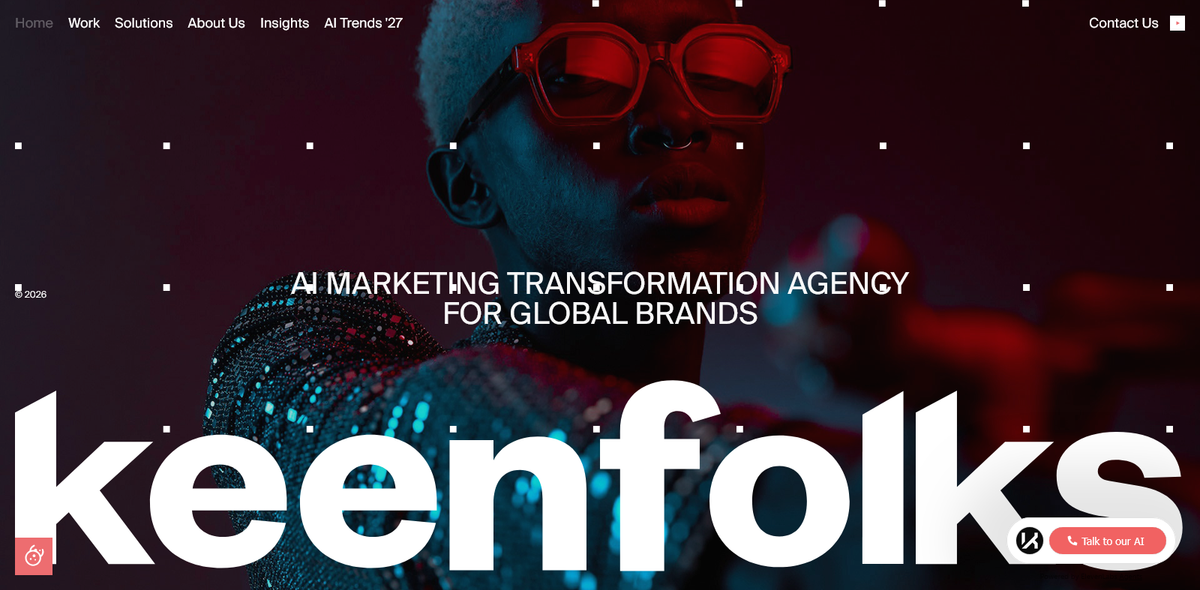
Keenfolks is the closest thing this category has to a default answer for enterprise brands. It works with Nestlé, Coca-Cola, Johnson & Johnson, McDonald's, Danone, Diageo, and Mars across more than 40 markets, which tells you exactly who it's built for.
Its platform, K OS_, sits across a brand's marketing system and surfaces intelligence gaps, platform inefficiencies, and growth opportunities. In practice, Keenfolks builds data and AI "command centers," content platforms, and custom automation for organizations big enough to need them. Offices in New York, Barcelona, and Mexico City support that global footprint.
If you're a large brand with a fragmented martech stack and budget to match, Keenfolks is a serious partner. If you're a growing DTC brand that needs ads live next week, this is not your agency, and the engagement model will tell you so quickly.
Darkroom
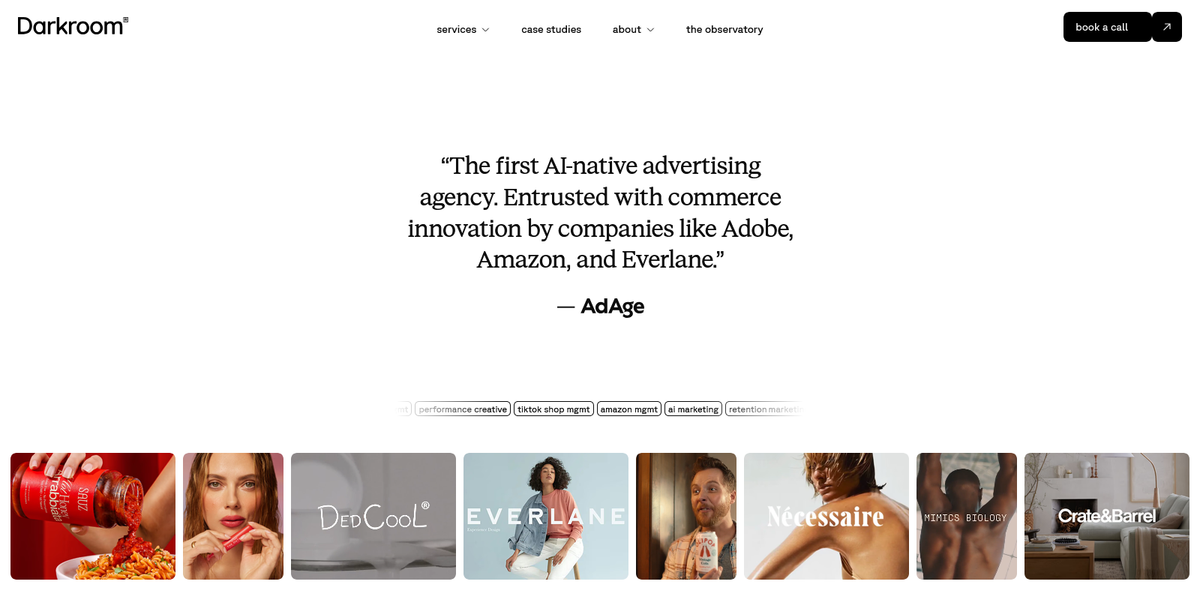
Darkroom calls itself the first AI-native advertising agency, and it has the client list to back a premium position: Adobe, Amazon, Everlane, Crate & Barrel, Olipop, and Nécessaire. It's the agency to look at when a DTC brand has outgrown pure performance marketing and wants brand-building in the same room as the ad account.
The AI story here is Shadow, a sister company Darkroom describes as a commerce layer for human-to-AI collaboration inside marketing teams. Day to day, the agency runs performance creative (including short-form video and AI-generated ads), TikTok Shop and Amazon management, retention, and Shopify development. It's full-funnel by design.
That breadth is the tradeoff. Darkroom is a fit for brands with real budget that want a lead agency across brand and growth. Smaller brands looking for a single channel run cheaper and faster elsewhere.
inBeat
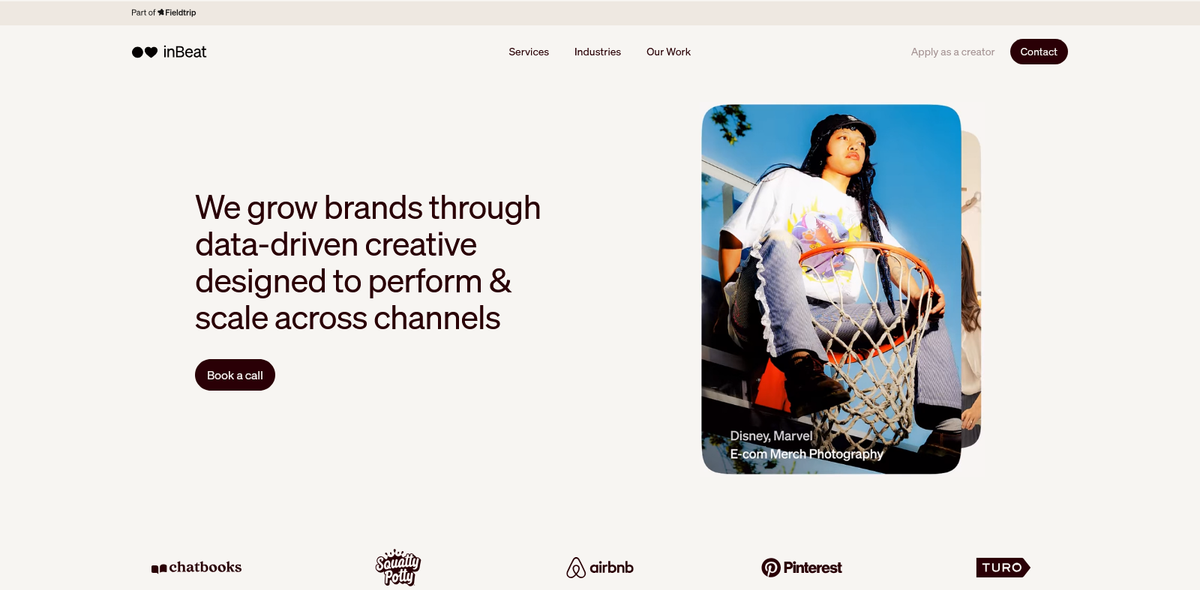
inBeat earns its place through people, not a proprietary model, and it's worth being clear about that. Its edge is a curated network of micro-influencers and UGC creators plus data-driven paid media, which is exactly the raw material AI-era paid social runs on. It has worked with 250-plus brands, and its Hurom campaign delivered a 300% increase in ROAS, a 65% drop in cost per acquisition, and 33% month-over-month profit-margin growth.
Where AI shows up is in how inBeat selects creators and iterates on creative based on performance, rather than any single named platform. The team publishes a free toolkit at inBeat.co with calculators and ad mockup generators, which gives you a sense of how it thinks.
Pick inBeat if creator content is your growth engine and you want a partner who lives in that world. If you need media-buying depth across every channel or a heavy analytics platform, pair it with someone else or look further down this list.
AIMediaGroup
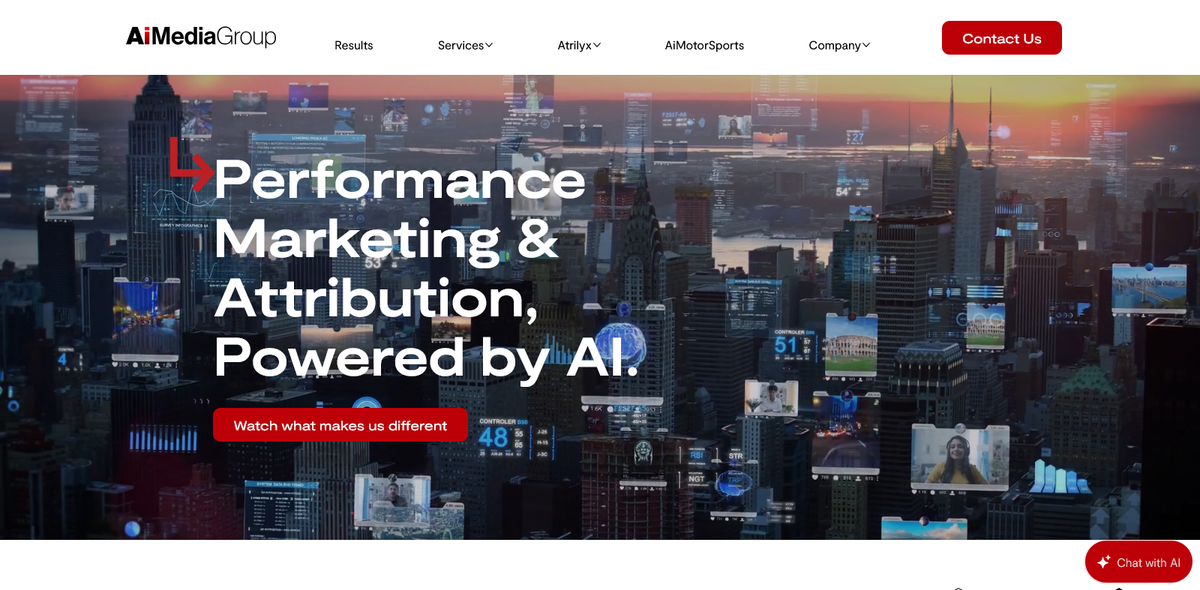
Ai Media Group is a New York media agency whose whole pitch is attribution done properly. Its platform, Atrilyx, applies AI to optimize media spend in real time, and uses a universal pixel to track touchpoints across the customer journey and allocate budget automatically.
That makes it a strong fit for brands running meaningful spend across paid search, paid social, and programmatic that are tired of guessing which channel actually drove the sale. The agency works with Fortune 500 companies and high-growth startups across hospitality, healthcare, real estate, and retail.
The focus is media and measurement rather than brand or organic. If your problem is "we don't know what's working," this is a good call. If it's "we need a brand and a content engine," start elsewhere.
NoGood
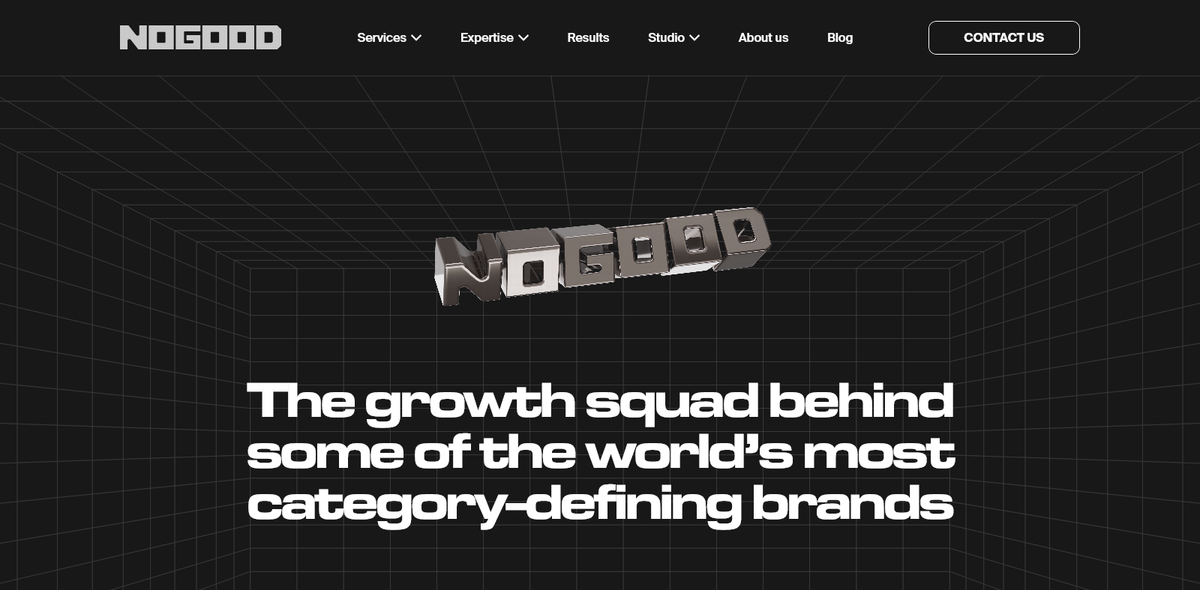
NoGood is a growth team built for startups and scaleups, with offices in New York, Miami, and Dubai and clients across SaaS, fintech, healthcare, and consumer. It's become one of the more visible names in the shift toward answer engine optimization, the practice of getting a brand cited inside ChatGPT, Gemini, and Perplexity.
Its platform, Goodie AI, tracks how brands show up across those AI engines, and the agency pairs it with the usual growth stack: paid, SEO, content, CRO, and fractional CMO work. A ByteDance program it ran reported an 879% improvement in lead generation.
NoGood fits venture-backed companies that need aggressive, experiment-driven growth and want to get ahead on AI search. It's less oriented toward ecommerce catalog work, so DTC brands should weigh that.
SingleGrain
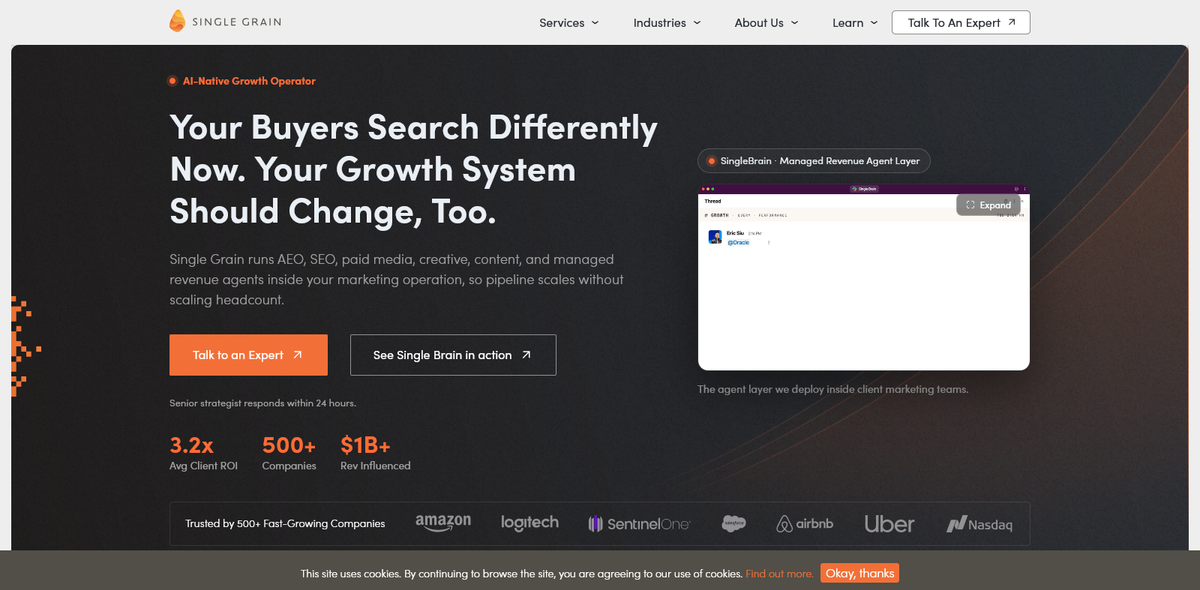
Single Grain, founded by Eric Siu, has quietly turned itself into one of the more AI-forward mid-market agencies. It has built its own tools rather than just buying subscriptions: Single Brain as a managed "revenue agent" layer, ClickFlow for content, and Karrot for LinkedIn ABM.
The agency serves SaaS, ecommerce, education, crypto, and B2B, and leans hard into AEO and GEO alongside traditional SEO and paid media across Google, Meta, LinkedIn, and TikTok. One representative result: LS Building Products saw a 67% increase in organic traffic and picked up more than 400 AI citations, work Single Grain valued at roughly $220,000.
It's a good generalist choice for companies that want AI search and paid acquisition under one roof. Brands that need deep creative production will find it thinner there.
SuperSide
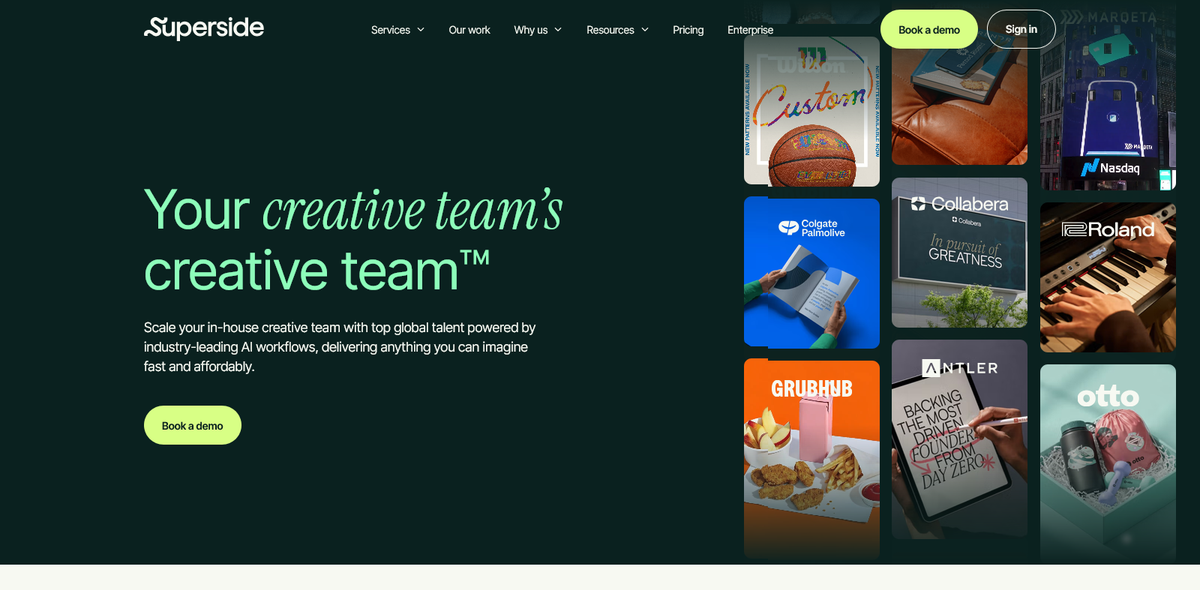
Superside isn't a media agency, and that's the point. It's a subscription creative service used by more than 400 global brands to produce ad creative, video, and design at a volume in-house teams can't match. For anyone whose bottleneck is "we can't make enough ads to feed the algorithm," it solves a real and specific problem.
AI is now built into the production process through an "AI-first creative system," plus purpose-built agents for briefs and reviews and a Brand Brain that learns a brand's guidelines from feedback over time. Amazon used Superside to save 345 hours and ship 1,092 assets across 20 projects, which is the kind of throughput the model is designed for.
Use Superside as your creative engine alongside a media partner. It won't run your ad accounts or own your strategy, and it doesn't claim to.
Power
Power Digital pairs a full-service agency with nova, a proprietary platform that's genuinely the reason to consider them. nova includes applications like Creative Affinity, which links ad creative to customer lifetime value, along with customer insights, forecasting, and marketing mix modeling.
The agency covers growth marketing, data intelligence, and creative across paid, earned, and owned channels, and works across B2B, CPG, fashion, healthcare, and lifestyle. It's headquartered in San Diego with offices in New York, Medellín, and Atlanta.
Power Digital suits mid-market and scaling brands that want software-grade measurement wrapped around their marketing. It's broader than a DTC specialist, so if you want a team that only thinks about Shopify paid social, the fit is looser.
This trips people up constantly, so it's worth stating plainly. An AI marketing tool is software you operate: Jasper for copy, a bidding tool for ads, an analytics platform for reporting. You keep the strategy, the labor, and the risk.
An AI marketing agency is a team you hire that uses AI, often its own, to do the marketing for you. You're buying judgment and execution, and the AI is how they do it faster and with better inputs than a traditional shop. Roughly speaking, tools give you leverage if you already have the people and the plan; an agency gives you both when you don't.
The tools are cheaper on paper. They're also only as good as the operator, which is usually the hidden cost nobody quotes you.
Start with fit, not the AI label. The right question is whether the agency has solved a problem like yours, for a business at a similar stage, with the capabilities your team actually lacks.
Then make the AI concrete. Ask which steps change because AI is in the workflow, what inputs the system uses, what humans still review, and what the client receives that would be materially harder without it.
Look at the pricing model because it shapes incentives, but do not treat one model as morally superior. Retainers buy predictable capacity. Spend-based fees rise with media. Subscription hours buy flexible access. Outcome-based pricing shares more performance variance when the payable result can be defined cleanly.
Finally, ask for a client in your category and call them. Case-study numbers are a starting point. A ten-minute conversation with a current client tells you what the deck won't.
Use these across every agency you shortlist. The ones that answer all eight clearly are the ones worth a second call.
• Do you have relevant experience in my category? Ask for a named client in your vertical and a specific result, not a logo wall. A DTC food brand and a B2B SaaS company are not comparable references even if the same agency served both.
• What is the deliverable count, in writing? Number of assets per month, campaigns managed, reports produced, revision rounds included. Scope without numbers is not scope.
• Where do people review the AI's output? Every agency on this list uses AI to generate or optimize something. Ask specifically at which point a human reviews what the system produced before it goes live. AI without a review step is a risk, not an advantage.
• How is performance measured and against what? Ask which metrics the agency uses to assess its own work, not just what it reports. An agency measuring ROAS against ad-platform attribution only is not seeing the same picture as your Shopify order count.
• Who owns the accounts, assets, and data if you leave? Ad accounts, creative assets, audience lists, research, and any platform access should stay with you. If the agency retains ownership of work it produced on your budget, that needs to be a negotiating point before you sign, not a discovery on exit.
• What is the minimum commitment and cancellation process? Month-to-month means the agency expects to earn the renewal. A twelve-month minimum means something different. Know which one you are agreeing to and what happens to prepaid fees if you exit early.
• Who is on the account day to day? The people on the pitch call are not always the people who manage the account. Ask directly for the names and seniority of the team doing the work, not the team closing the deal.
• What is explicitly excluded from scope? Development work, landing page builds, creative above the monthly limit, and additional revision rounds are common add-ons that appear later as out-of-scope invoices. Get the exclusions list before you sign.
If Meta acquisition is the problem you are solving, review Vibemyad's Meta ads agency service and compare that operating model against the relevant agencies above.
There is no single best AI marketing agency. Keenfolks is built for enterprise transformation, Superside for creative capacity, NoGood for startup growth and AI search, inBeat for creator-led campaigns, and Vibemyad for DTC brands that need Meta creative and media buying connected. Match the specialty to the business problem, then pressure-test the workflow, people, proof, and commercial terms.
For Vibemyad's paid-acquisition offer, see the Meta ads agency page.
Related: see Vibemyad's Meta ads agency service, learn what an AI marketing agency does, or read what an AI advertising agency does.


Rahul Mondal
Product, Design and Co-founder, Vibemyad


Arpita Mahato
Content Writer, Vibemyad

Arpita Mahato
Content Writer, Vibemyad
Table of Contents