August 24, 2026 • 15 min read

August 24, 2026 • 15 min read
17.1% of every US retail dollar now moves through e-commerce, growing at nearly twice the rate of retail overall. Most brands respond by asking which agency is best, when the question that actually decides the outcome is which kind of agency they need.
An e-commerce marketing agency is a company you hire to grow revenue for an online store, using paid advertising, ad production, search, email and conversion work. It does not build your store. It sells what is already on it, and it is judged on revenue, return on ad spend and cost per acquisition.
That definition is simple. The market underneath it is not, and this is where shortlists go wrong.
According to the US Census Bureau, e-commerce reached 17.1% of total US retail sales in the second quarter of 2026, or $340.2 billion seasonally adjusted, growing 12.2% year on year against 6.7% for retail overall. A channel expanding at that rate attracts every kind of vendor, and they all use the same three words on their homepage.
Because brands shortlist by reputation and compare by price, when the firms on the list are solving different problems.
Put a search specialist, a paid social shop and a retention agency on the same call and you will get three proposals that look wildly different for reasons that have nothing to do with quality. One quotes $3,000 because email is a narrow scope. One quotes $15,000 because managing $200,000 in monthly spend across three channels is not. Neither is expensive or cheap. They are answers to different questions.
There are five categories, and knowing which one you need eliminates most of the market before you speak to anyone.
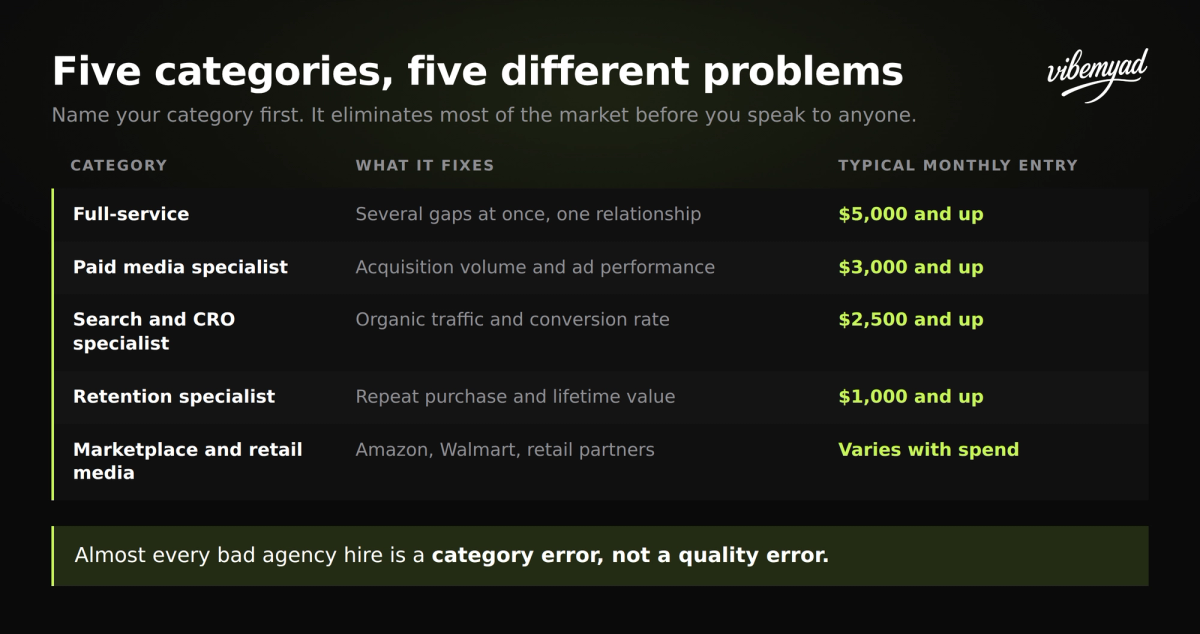
Name your category first. It eliminates most of the market.
Name your category first. Then read only the entries below that match it. The full breakdown of what each category covers is in what an e-commerce marketing agency is.
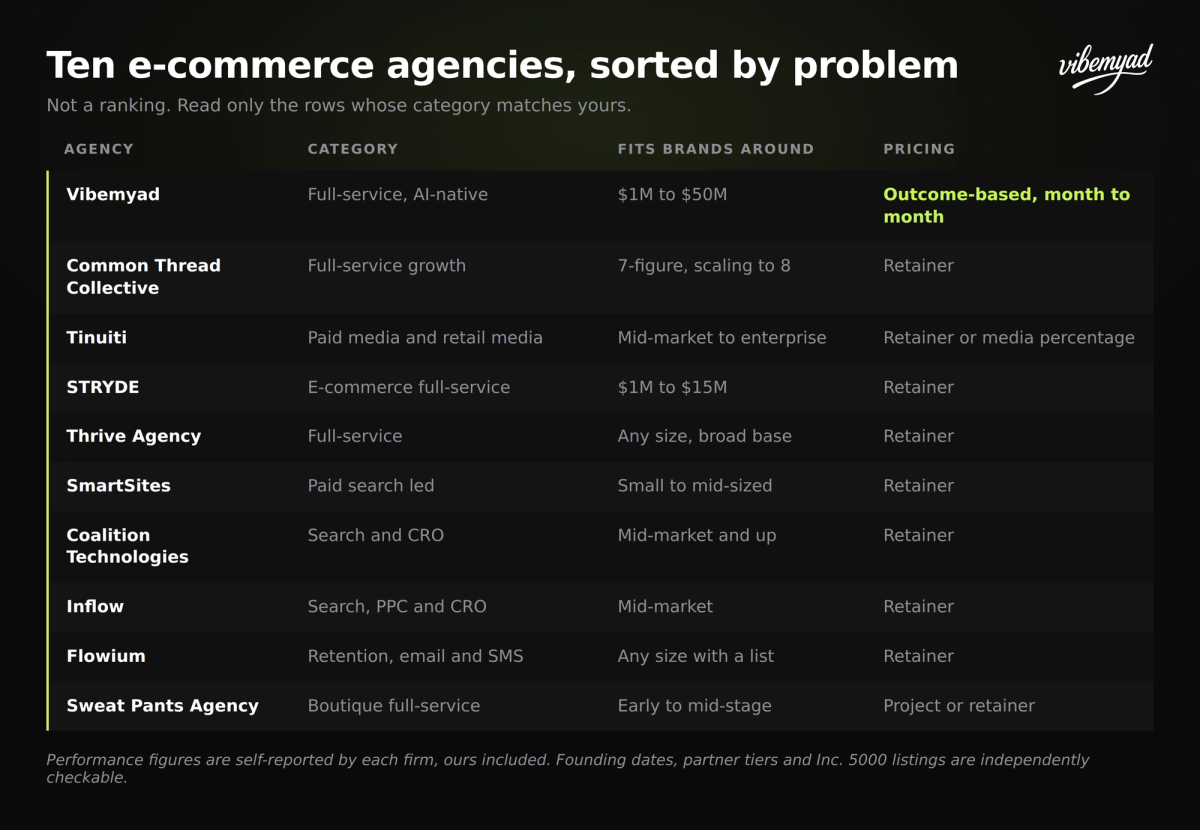
Sorted by the problem each one solves, not by rank.
Every entry runs to the same shape so you can read across them: what it does, one checkable proof point, our honest read, and when to pick somebody else. Ours is held to the identical format and gets one proof point like everyone else.
One caveat covering the whole category. Performance numbers below are self-reported by the firm that produced them, including ours. Founding dates, partner badges and Inc. 5000 listings can be verified independently. ROAS claims cannot. We have favoured the checkable kind, and you should discount any list that does not, this one included.
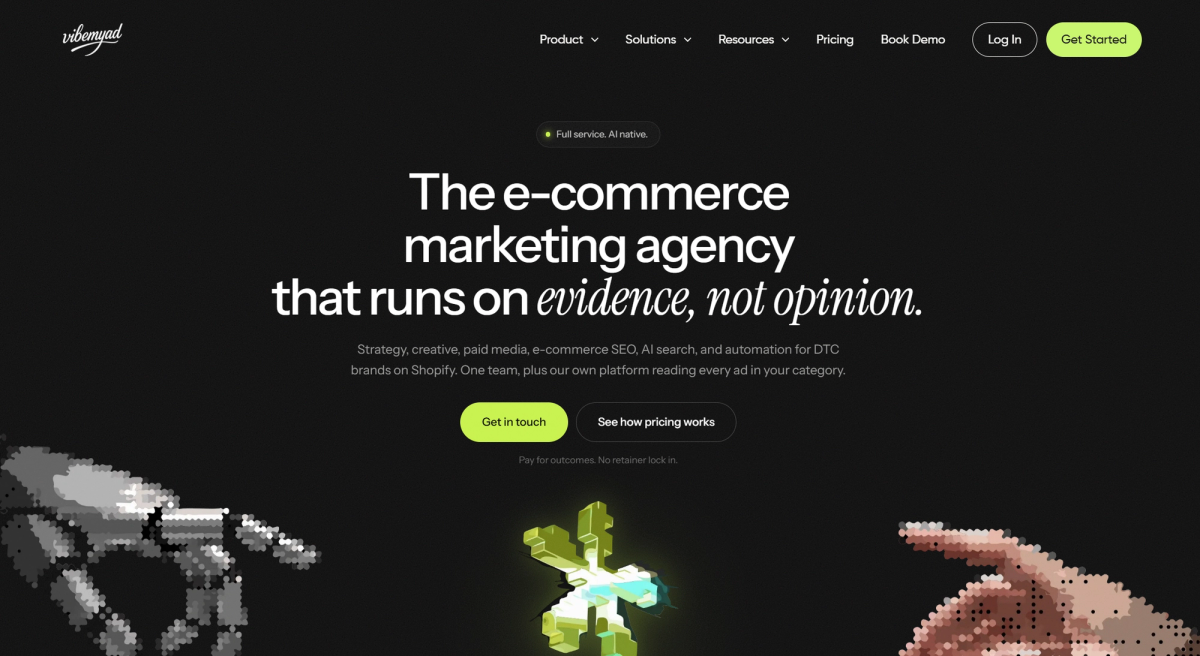
Vibemyad Agency
Vibemyad builds for DTC brands on Shopify. Most agencies license their AI. We built the platform our team works in, so the research reading your category and the system producing your ads are one piece of software. Outcome-based, month to month, assets stay yours.
Proof: Noise, a consumer electronics brand, cancelled a planned second design hire after our first month of output.
Our honest read: we are the narrowest firm here. If you cannot produce and test enough ads, nobody here is built more specifically for that. Any other problem and somebody below fits better.
Pick somebody else if you want a named team on a fixed retainer, need brand strategy more than performance, or the store itself needs rebuilding.
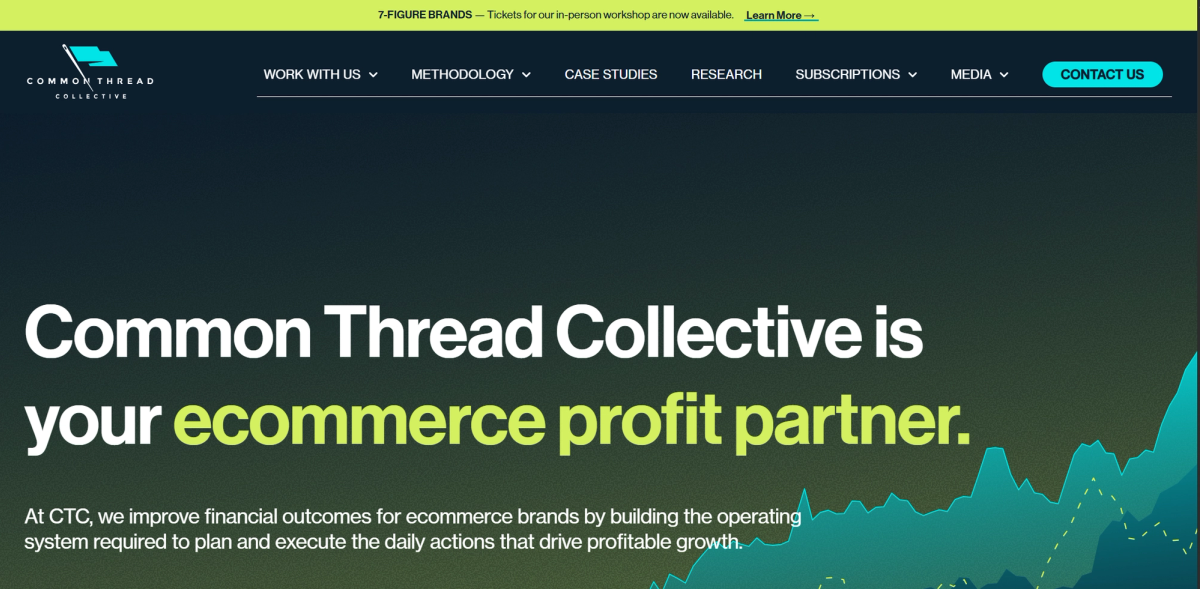
Common Thread Collective Agency
Common Thread Collective is unusual in this market for publishing its financial models rather than guarding them. The work centres on forecasting and contribution margin, which is a different discipline from campaign management and a rarer one.
Proof: founded 2012. In July 2025 it took private-equity backing from The Acacia Group, and that announcement placed its client base at $10M to $100M in annual online revenue. CTC’s own site describes who it serves slightly differently, as seven-figure operators chasing eight figures and beyond.
Our honest read: if you have reached the point where spending more stops producing proportionally more profit, this is a finance problem wearing a marketing costume, and CTC is better equipped for it than we are.
Pick somebody else if you are early in seven figures. The models are built for a scale where a percentage point of contribution margin is worth six figures.
Tinuiti Agency
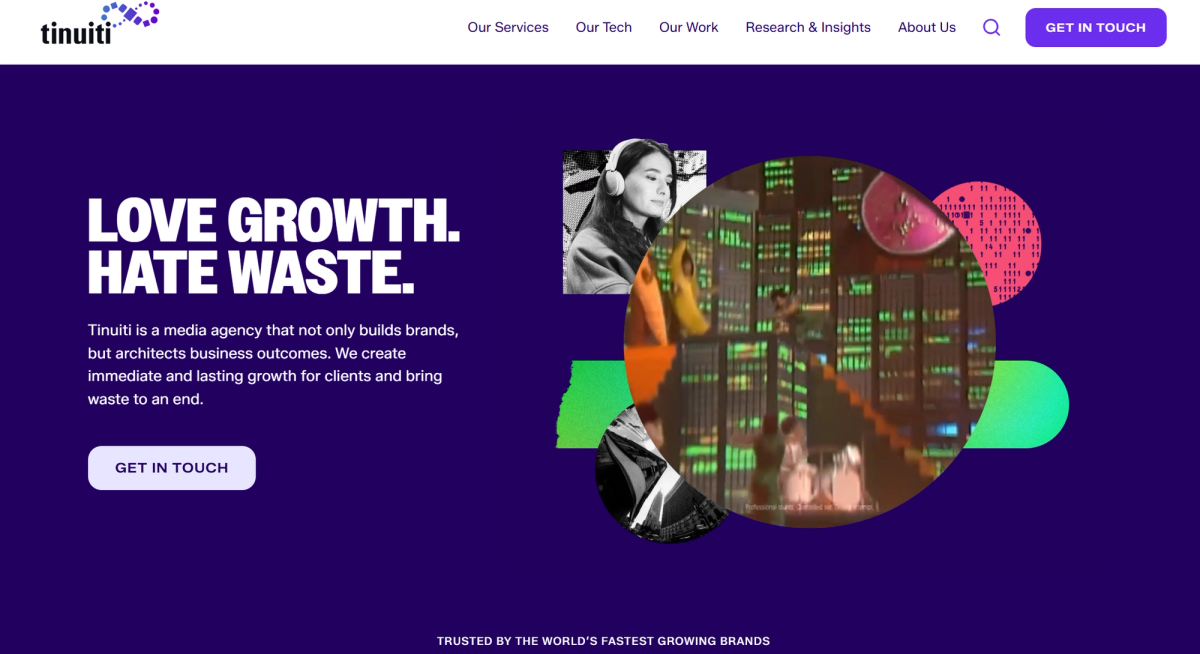
Tinuiti describes itself as a media agency that architects business outcomes rather than simply building brands, and it operates at a scale most firms on this list do not: paid search, paid social, Amazon, and the retail media networks that now sit between brands and shelf space.
Proof: it states publicly that it manages around $4 billion in digital media, and it runs Amazon and commerce media as dedicated practices rather than as a bolt-on.
Our honest read: if a meaningful share of your revenue runs through Amazon, Walmart or a retailer’s media network, that is a specialist discipline and most DTC agencies, ours included, are not built for it.
Pick somebody else if you are a Shopify-only brand under $5M. The engagement model assumes scale you may not have yet.
STRYDE Agency
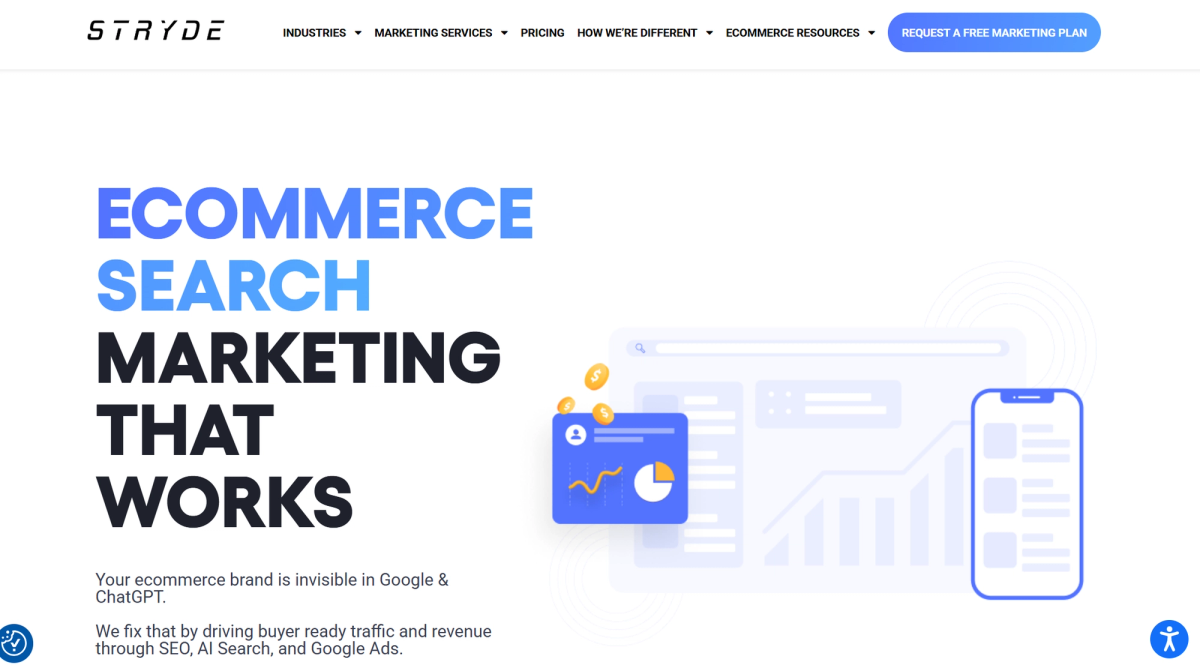
STRYDE is e-commerce-only rather than a general agency with an e-commerce practice. Its own words: e-commerce is all we do, and it does not market restaurants, law firms or SaaS companies on the side.
Proof: publishes its target band openly, stating it works with brands doing roughly $1M to $15M in annual revenue, and offers a free marketing plan before any commitment, which lets you see how the team thinks before money changes hands.
Our honest read: the closest thing here to a conventional version of what we do. For a brand that wants a normal retainer relationship with e-commerce specialists rather than an outcome-based arrangement, that is a genuine advantage over us.
Pick somebody else if you are below roughly $1M in annual revenue. The models themselves are compared in e-commerce marketing agency cost.
Thrive Agency
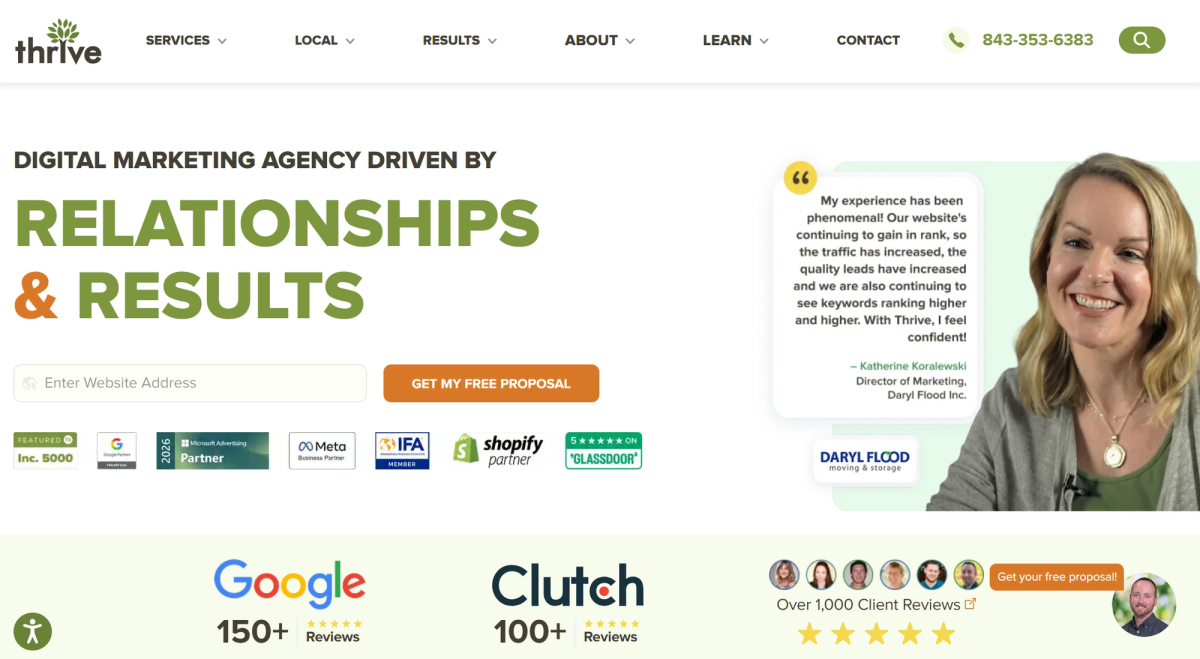
Thrive is a full-service digital marketing agency covering SEO, PPC, social and web design, serving a client base far wider than DTC e-commerce.
Proof: the business has operated since 2005, originally as MLB Web Design and under the Thrive name since 2012, which makes it the oldest firm on this list by a decade.
Our honest read: twenty years is a real signal in a category where most agencies do not reach five. Breadth is the pitch and the tradeoff, and if you want one vendor across organic and paid rather than three relationships, that convenience has genuine value.
Pick somebody else if you need deep DTC-specific ad production. That is not what they lead with.
SmartSites Agency
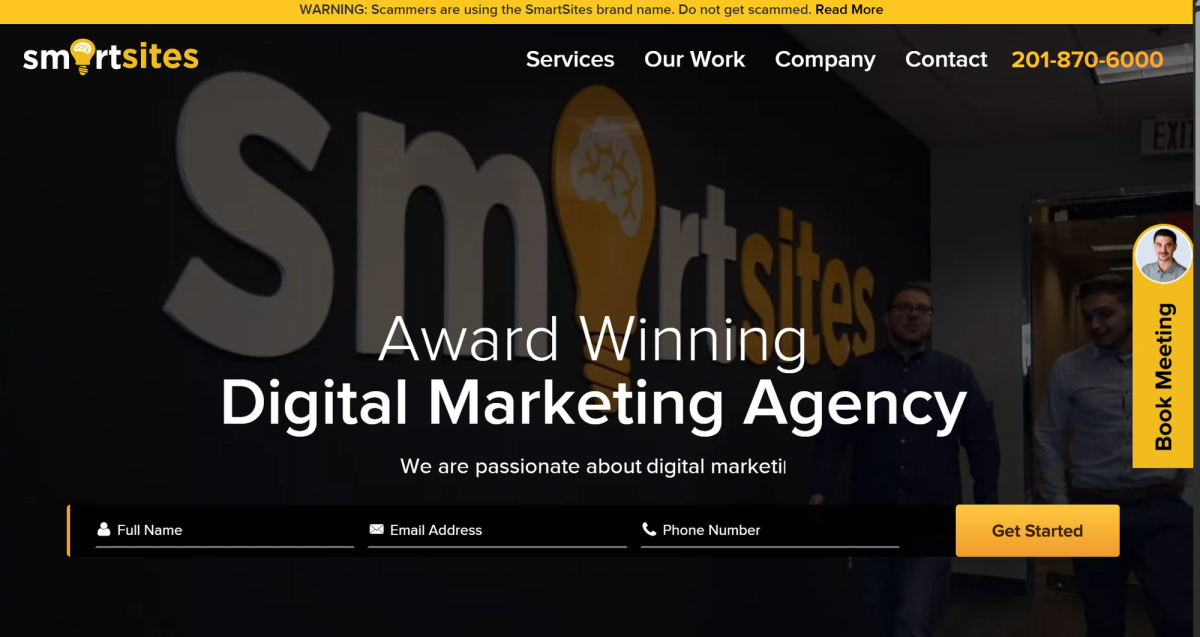
SmartSites covers SEO, PPC, social, email and SMS, e-commerce and web design, with paid search as the strongest thread through the work.
Proof: founded 2011, a Google Premier Partner and Meta Business Partner, and an Inc. 5000 honoree every year from 2017 to 2026, which is ten consecutive listings. Those partner tiers are awarded on spend and certification thresholds rather than self-declared.
Our honest read: most DTC-focused agencies are paid social shops that treat Google as an afterthought. If search is where your buyers actually are, that is a real gap and this fills it.
Pick somebody else if your growth is creative-led on Meta or TikTok. Different muscle entirely.
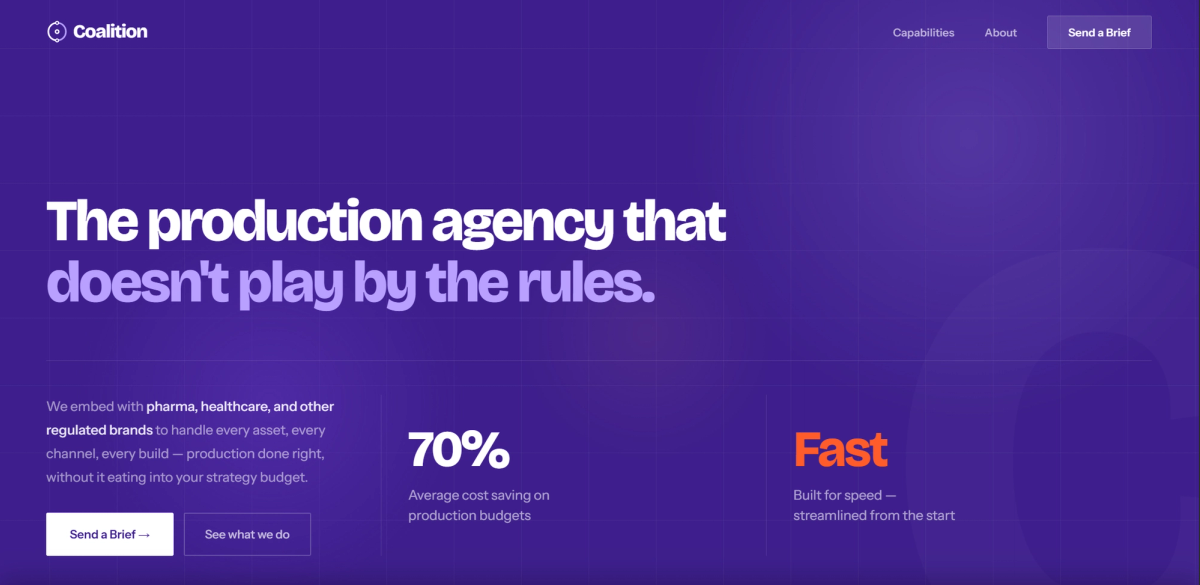
Coalition Agency
Coalition Technologies is a search-led company with conversion work built around it.
Proof: a team of more than 250 full-time specialists and a published library of over 860 documented case studies. Volume at that scale means the process survived contact with a lot of different businesses.
Our honest read: if traffic is your constraint rather than conversion of traffic you already have, search compounds in a way paid never does. It is also slower, and agencies rarely say so in month one.
Pick somebody else if you need results inside a quarter. Search does not work on that timescale.
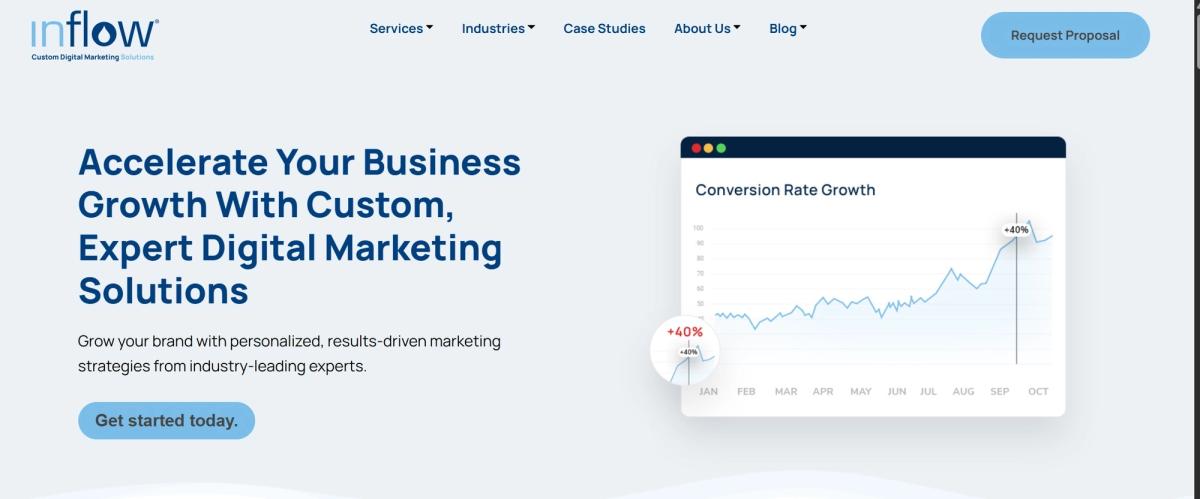
Inflow Agency
Inflow builds SEO, PPC and CRO strategies across the US and treats the three as one system rather than separate retainers.
Proof: it brands itself as an e-commerce marketing agency and leads with e-commerce work, with conversion bundled into the search engagement rather than sold separately. Worth knowing that it also serves lead-generation and service businesses, so it is e-commerce-led rather than e-commerce-only.
Our honest read: the combination matters more than it sounds. Search agencies that ignore conversion send you traffic that does not buy, and this is one of the few firms that treats the handoff as its own responsibility.
Pick somebody else if paid social volume is the problem. Search and CRO is the lane here.
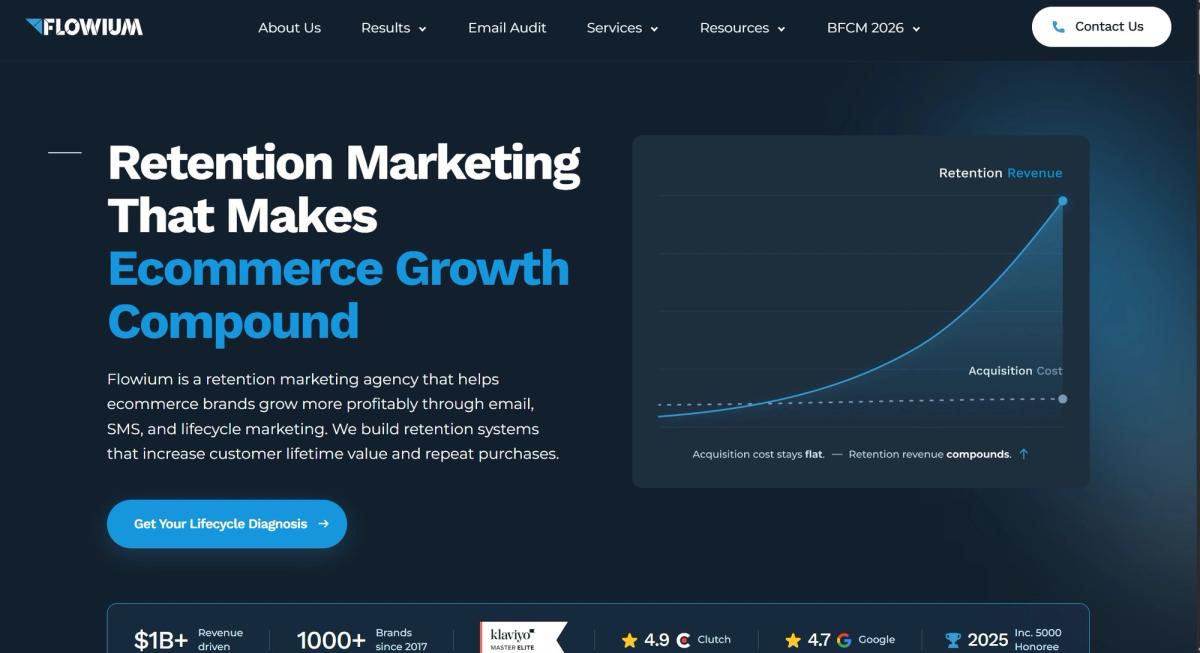
Flowium Agency
Flowium does email marketing for e-commerce and very little else. Retention is the least glamorous line in DTC and frequently the highest-margin one.
Proof: a Klaviyo Elite partner and a 2025 Inc. 5000 honoree at number 3,600. Its directory listing quotes a $1,000 minimum project size, which would make it the most accessible entry point on this list, though the figure comes from a third-party profile rather than from Flowium’s own site.
Our honest read: if acquisition works but repeat purchase does not, this is a better use of the next $3,000 than more ad spend. It is also the entry we are least equipped to argue against, because retention is not what we are built for.
Pick somebody else if you cannot acquire first-time customers at all. Email cannot retain people you never had.
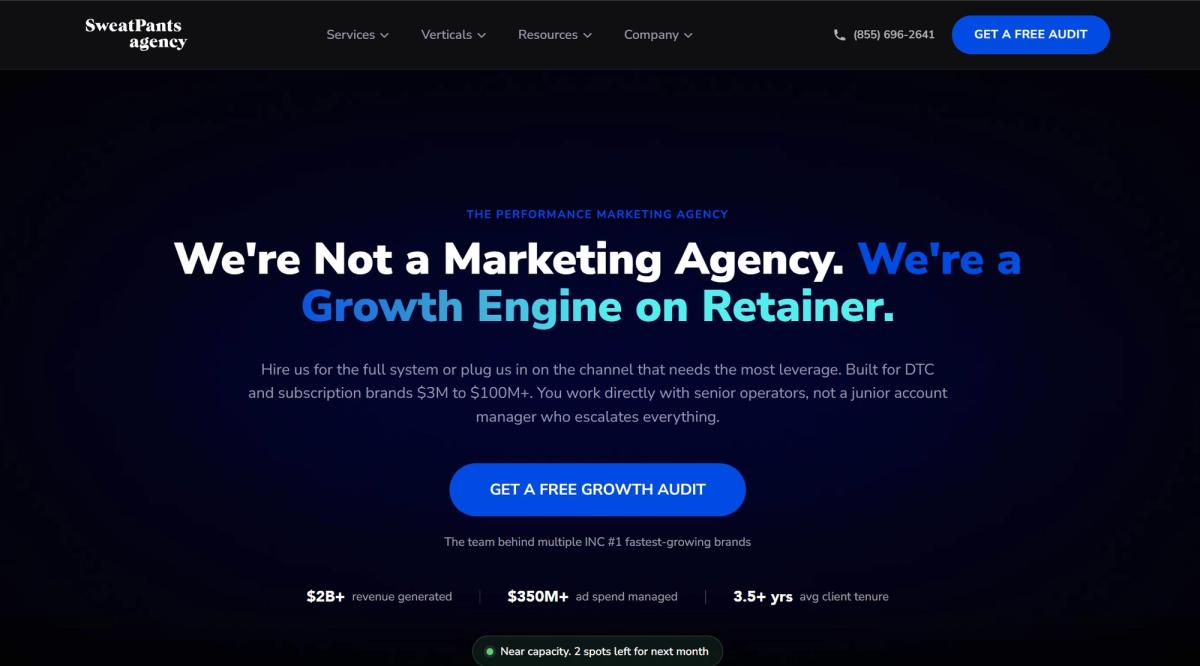
SweatPants Agency
Sweat Pants Agency works across email and SMS, Meta ads, Google ads and custom strategy, and describes itself on its own homepage as the only agency behind two INC number one fastest-growing brands.
Proof, with a correction: that tagline is the agency’s own wording and it does not survive checking. The two brands in its case studies are Hunt A Killer, which placed sixth on the 2020 Inc. 5000, and SnapNurse, which placed second in 2022. Both are genuinely extraordinary results. Neither is number one. What is checkable is the search performance: on the results this article competes in, Sweat Pants outranks Forbes, Shopify and Clutch.
Our honest read: we have left them on the list because a small team beating publishers with a hundred times the authority usually understands the audience better than the publishers do, and at a boutique of this size you get senior people rather than a pod. But a claim you cannot verify is exactly what this article tells you to discount, and we are not going to repeat it as though we had checked it and it held.
Pick somebody else if you need very high production volume or multi-market coverage. Capacity is the constraint every small agency eventually meets.
DesignRush and Clutch rank at the top of this search and neither is an agency. They are directories sorting hundreds of firms by review volume and paid placement. Useful as a starting point, useless as a recommendation, and treating them as comparable to an agency is exactly the category error this article is about.
Shopify’s own guide ranks here too and is genuinely good, but it is written by a platform with no stake in which agency you choose, which makes it broad by design.
Disruptive Advertising narrowly missed. It offers a free audit to find wasted ad spend and works without long-term contracts, both of which we rate. It serves a wider base than DTC e-commerce, which is the only reason it is not above.
Nuanced Media is an Amazon-first agency and a good one. If Amazon is your primary channel rather than one of several, start there instead of anywhere on this list.
Not five questions to ask an agency. Four steps to take before you contact one.
Write down the number that is failing. Traffic, conversion rate, cost per acquisition, repeat purchase rate, or production volume. One of them, not four. The one you name determines the category, and the category eliminates most of this list.
Check what your category already ships. Pull your three closest competitors’ live ads and count them, which the Meta Ad Library makes possible for free. If they are running forty concepts a month and you are running six, your problem is production and no amount of media strategy fixes it.
Shortlist three firms from one category only. Comparing across categories is how brands end up with quotes they cannot evaluate. Three paid social shops are comparable. A paid social shop, an SEO agency and an email specialist are not.
Ask all three the same two questions. What will you produce each month, as a number in writing, and what do we keep if we leave in month three. The answers separate operators from pitch decks faster than any case study, and we have set out the full list of questions worth asking separately.
If step two sounds like work, it is the part we do free, and there is a link at the bottom.
Search these terms and forum threads outrank most agencies on the page. The complaints repeat, and the useful thing about them is that they are mostly structural rather than personal.
"We got the A-team on the pitch and a junior on the account." The most common complaint in the category, and it is a staffing-model problem rather than a dishonesty problem. Named people in the contract is the only fix.
"Six months in and we still cannot tell what changed." Usually means no baseline was agreed at the start. Whoever you hire, write down the numbers on day one, before anybody touches anything.
"They wanted a twelve-month contract." Length of commitment tells you how confident a firm is about month three. Month to month is not always better, but it is always more informative.
"We paid for strategy and got a deck." Strategy that does not end in something shipped is a document. Ask what gets produced, not what gets recommended.
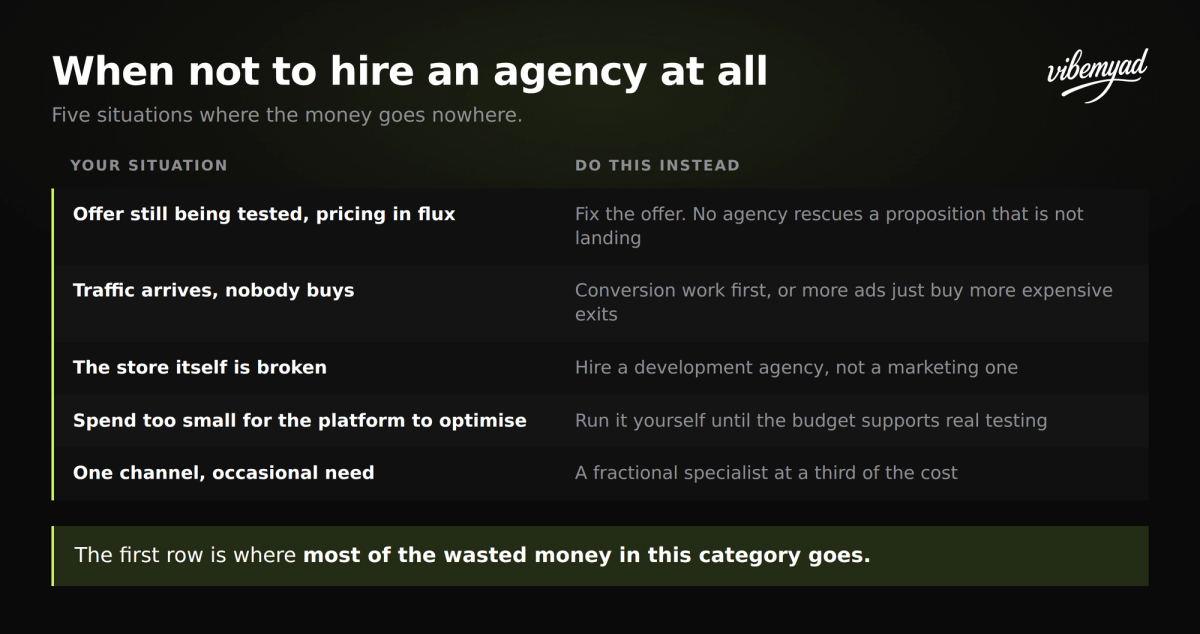
The first row is where most of the wasted money in this category goes.
The first row is where most of the wasted money in this category goes. We ran the arithmetic on when an agency actually pays for itself in are AI marketing agencies worth it, and the threshold is higher than most brands assume.
Our e-commerce marketing agency sits in one square of it. Full-service for DTC brands on Shopify whose constraint is ad production volume, roughly the $1M to $50M band.
The research and the production are one system. What the category read finds goes straight into what gets built, rather than being handed over in a deck and gathered again by hand.
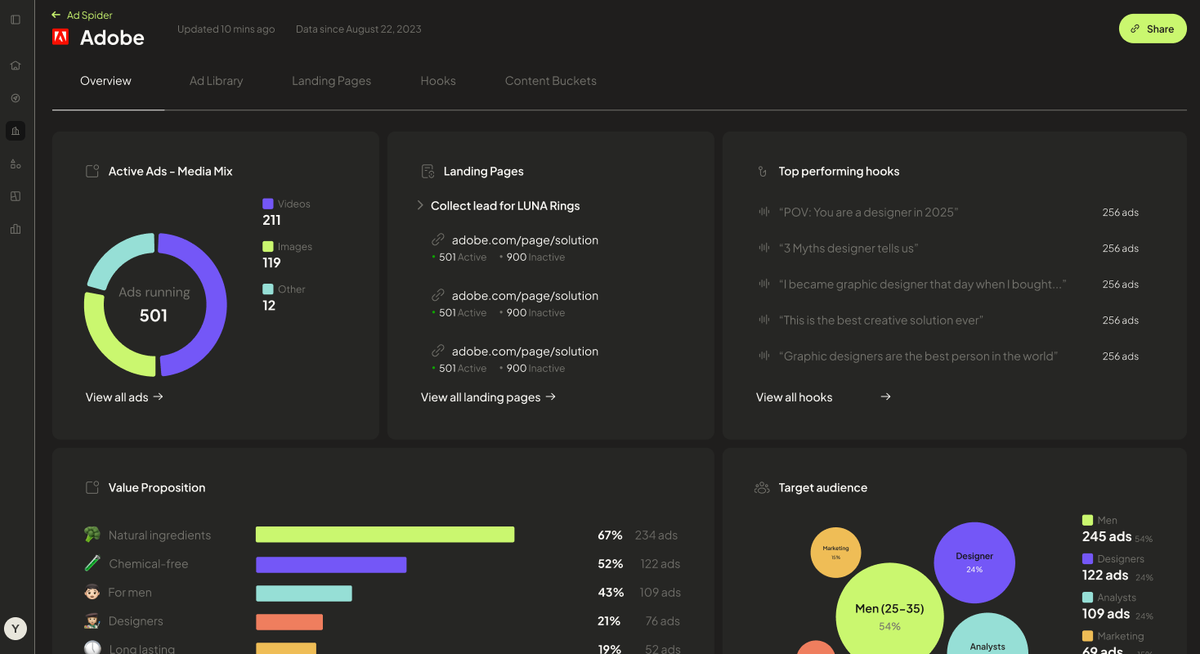
The category read that feeds production, rather than a deck that gets handed over.
Outcome-based, month to month. No rate card. The scope and the number arrive together on the first call, and every asset and account stays yours if you leave.
SEO and GEO are in scope. Getting cited inside LLMs is a stated deliverable, and it is the one thing on this list nobody else names. The pricing for running the platform yourself is published to the cent, starting at $20 in credits that never expire.
If your square on the map is a different one, one of the nine above is a better call, and we would rather tell you that on a first call than in month four. Where AI genuinely changes agency work, and where it does not, is set out in what an AI advertising agency is.
What to take from all of this:
Pick your two closest competitors and send them over. We will pull their ads apart for free and tell you how many concepts they are running and what angles they lean on, so you walk into every agency conversation with a number instead of a hunch. If the answer is that you do not need an agency yet, we will say so.
Get notified when new insights, case studies, and trends go live — no clutter, just creativity.
Table of Contents


Arpita Mahato
Content Writer, Vibemyad

Arpita Mahato
Content Writer, Vibemyad


Rahul Mondal
Product, Design and Co-founder, Vibemyad