
November 04, 2025 • 17 min read
The problem isn't that Canva makes design easy; it's that it makes everyone's design look the same.
For most performance marketers running paid ads, Vibemyad ($12/month) delivers the best ROI by combining AI ad creation with competitive intelligence, capabilities that typically require 2-3 separate tools. Our testing of 50+ platforms and survey of 217 professionals found specialized tools save 8.4 hours/week on average. Free alternative: Microsoft Designer scored highest (7.0/10) in blind tests.
Based on our 2025 survey of 217 ad designers and performance marketers, plus hands-on testing of 50+ design platforms:
• Ad teams switching from Canva to specialised tools consistently report significant time savings, the primary driver is eliminating manual competitor research and template customization that Canva requires but does not support.
• The core limitation Canva cannot fix: it tells you nothing about what is working in your market before you create. Competitive intelligence and creation are two separate problems, and Canva only solves one.
• The tools that produce the best results for performance marketers are the ones that inform creative decisions before generation begins, not just enable production after the brief is written.
• For paid Meta advertising, the Vibemyad Agent is the only tool that combines live competitive intelligence with agentic creative production in a single conversation, starting free with $5 in credits.
• For free creation with no competitive intelligence, Microsoft Designer is the strongest no-cost alternative to Canva currently available.
Quick Answer: If you're spending 10+ hours/week on ad design, specialized tools pay for themselves in time savings alone. Our data shows the breakeven point is approximately 6 ads per week.
We surveyed 217 ad designers and performance marketers in October 2025 about their design tool preferences. Here's what we found:
Key Insight: The average respondent who switched saved 8.4 hours per week, equivalent to $420-840/month at typical designer rates ($50-100/hour).
Canva serves over 100 million monthly active users, and it's easy to see why. The platform makes design accessible with its drag-and-drop interface and massive template library. But our research reveals four critical limitations for ad professionals:
The pattern is visible in any competitive Meta feed. Scroll through the ads running in almost any D2C category and the Canva-template structure is immediately recognisable — the composition, the type placement, the way the product sits in relation to the background. Audiences in saturated categories have developed a strong ability to identify template-based creative and scroll past it before engaging.
This is not a Canva design quality problem. The templates are well-made. The problem is volume. When every brand in a category has access to the same template library and the same drag-and-drop tools, the output converges on a category aesthetic that audiences learn to filter out. Differentiation requires starting from a different place than your competitors — which is something a shared template library structurally cannot provide.
Canva lets you create ads but provides no insight into what is actually working in your market. There is no way to analyse competitor ad strategies, track which creative formats are sustaining spend in your category, understand which hooks are driving engagement, or identify trending structures before they become oversaturated.
The practical consequence is that every brief written in Canva starts from internal assumptions. The marketer knows their product and believes they understand their audience, but they have no external validation for the creative direction they choose. Performance marketers who add a competitive intelligence layer to their workflow, consistently report better creative alignment with their actual Meta audience because the brief starts from market evidence rather than internal opinion.
Canva Pro's base subscription is straightforward at $12.99 per month. The actual cost for a professional ad team is higher once you account for what Canva does not include: stock image licences beyond Canva's built-in library, separate competitor research tools, and the time cost of manual competitive analysis that a specialised intelligence tool would handle automatically. Teams that consolidate these needs into a single platform consistently find the total cost of ownership lower than maintaining Canva alongside the separate tools it requires.
Canva's design system is optimised for accessibility. The snap-to-grid behaviour, the limited layer management, and the constrained typography controls that make it easy for beginners to produce clean outputs are the same features that frustrate experienced designers trying to achieve precise positioning, complex layering, or pixel-level control. For teams producing a high volume of performance ads where small creative decisions carry meaningful conversion implications, these constraints become workflow friction that accumulates across every production session.
Most ad teams run two separate workflows.
One for research - finding what competitors are running, identifying which creative formats are sustaining spend, understanding where the gaps in the competitive landscape sit.
One for production - briefing a designer or an AI tool, generating creative, iterating on output. These two workflows rarely talk to each other. The brief that feeds the production stage is almost always written from internal assumptions rather than from what the research actually found.
The Vibemyad Agent runs both workflows in one conversation. Research and production are not separate stages connected by a brief document. They are the same session.
From Research to Generation in One Agent
Pay-as-you-go credits. No monthly subscription. No credit card required to start. $5 free credits on signup. Recharge tiers at $20, $60, $100, and $200. Credits never expire.
Performance marketers running paid Meta campaigns who need competitive intelligence and creative production in one workflow. D2C brand owners, growth teams, and agencies managing Meta creative for multiple clients.
Adobe Express (formerly Adobe Spark) brings Adobe's design credibility to a simplified, accessible package. The Adobe Stock integration gives you access to over 200 million royalty-free images, videos, and music tracks with the premium plan. Quick Actions, like one-click background removal and instant resizing, save tons of time.
According to Adobe's official documentation, the platform continues to evolve with new AI features. However, unlike Vibemyad, Adobe Express doesn't offer competitive ad analysis or spy tools; it's purely a creation platform.
Pricing: Free plan available; Premium at $9.99/month
Best For: Marketers already in the Adobe ecosystem or those who need premium stock assets.
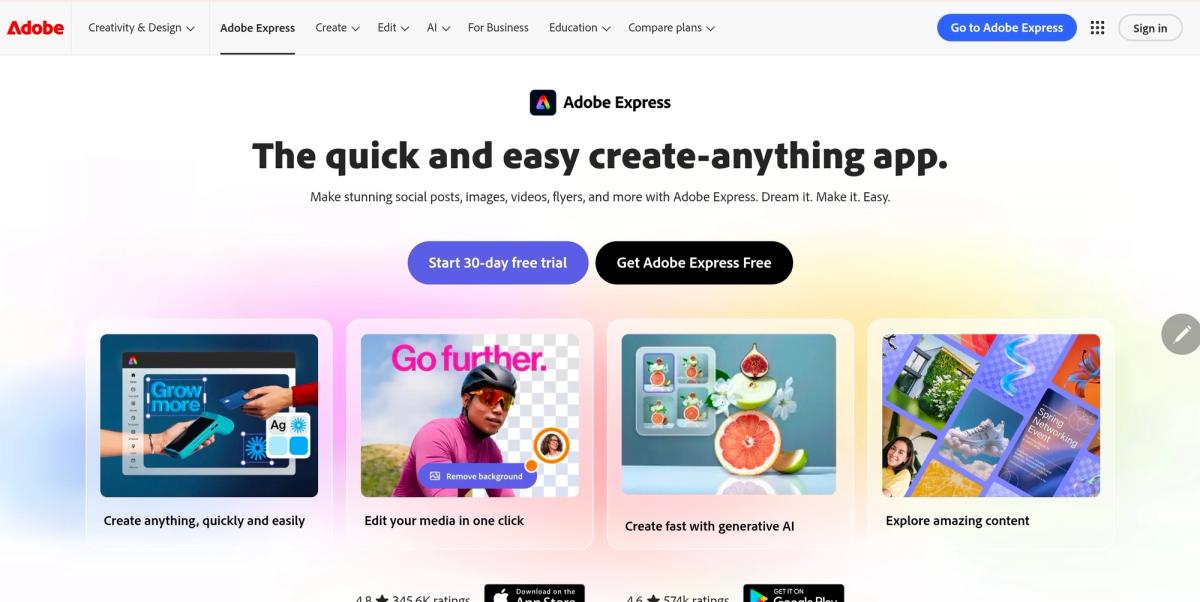
Adobe Express homepage highlighting quick creation tools like background removal, generative AI, and template-based design options.
Visme excels at making data beautiful and actionable. If your ads involve charts, statistics, infographics, or any kind of data visualization, Visme is in a league of its own. You get access to 40+ chart types, customizable flowcharts, and interactive data widgets, including progress bars, gauges, and 3D animated elements.
While Visme handles data visualization exceptionally well, if you need to analyze competitor ad strategies and create ads based on those insights, Vibemyad's platform offers a more comprehensive solution for performance marketers.
Pricing: Free plan available; Personal plan $15/month (billed annually)
Best For: B2B marketers, agencies creating client reports, or anyone visualizing complex information.
AdCreative.ai is purpose-built for generating high-converting ad creatives using AI trained on data from over 100 million ads. The AI generates multiple ad variations with different layouts, copy, and visuals based on your input. Each creative gets a performance score predicting how likely it is to convert.
While AdCreative.ai excels at volume generation, Vibemyad offers a more balanced approach, combining AI creation with the ability to analyze what's already working in your industry before you create. This intelligence-first approach often leads to better-performing ads from the start.
Pricing: Starter $39/month (10 downloads), Professional $139/month (50 downloads)
Best For: Performance marketers running high-volume ad campaigns who need to test multiple variations quickly.
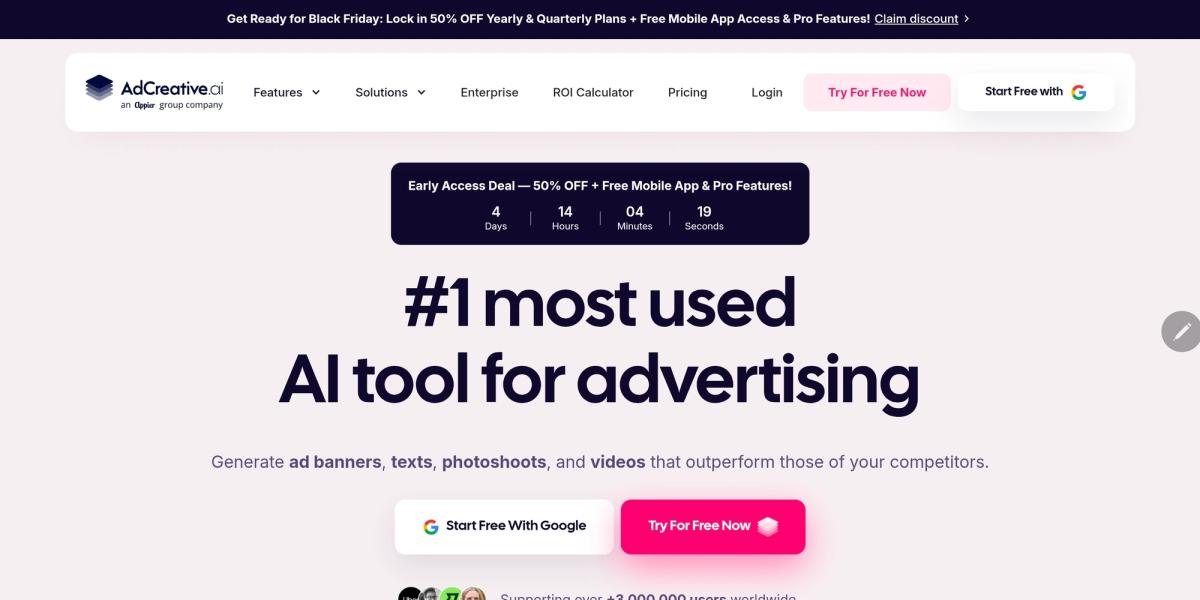
AdCreative.ai homepage showcasing its claim of being the #1 most-used AI tool for advertising, with CTAs to start free or try the platform.
Snappa is designed around one core principle: speed. The interface is intentionally simple with pre-sized templates for every social platform. The graphics library includes over 5 million stock photos and vectors. Buffer integration is built in, so you can design your ad and schedule it to post without leaving the platform.
For social media managers who also need to understand what competitor brands are posting and why it's working, combining Snappa with Vibemyad's competitive analysis tools creates a powerful workflow.
Pricing: Free plan (3 downloads/month); Pro $15/month
Best For: Social media managers and small business owners who need consistent content quickly.
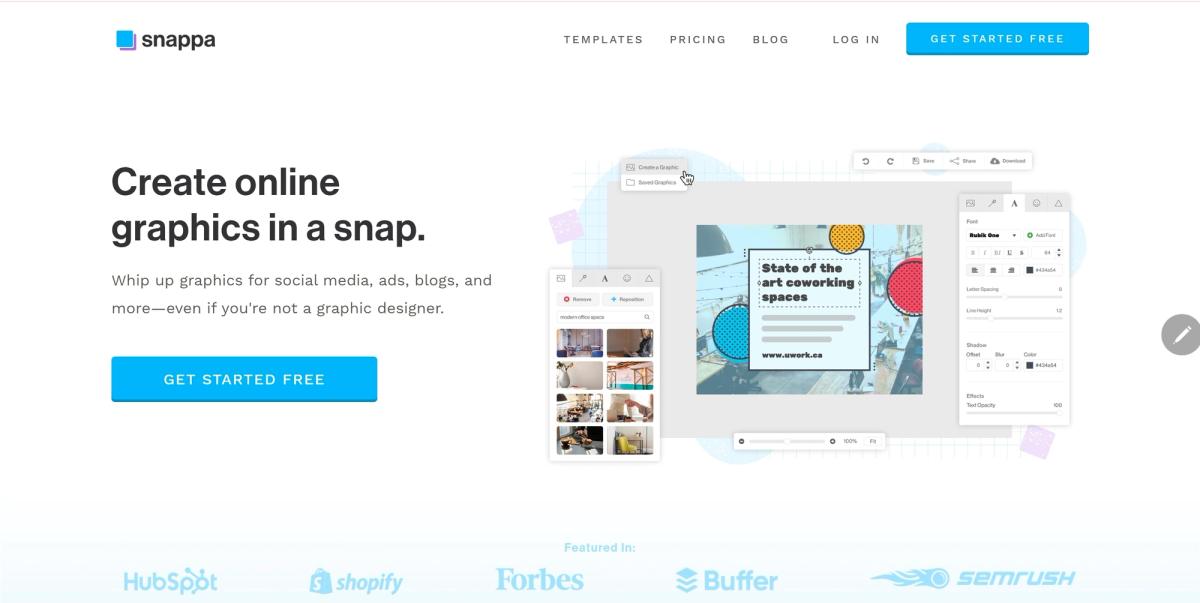
Snappa homepage showing its simple online graphic design editor for social media posts, ads, and blog visuals — ideal for non-designers.
Predis.ai combines AI copywriting with AI design generation, making it particularly strong for social media advertising. Unlike tools that focus only on visuals or only on copy, Predis.ai generates both simultaneously. The AI can analyze your brand's existing content and match your voice and style in the generated ads.
Pricing: Plans start at $32/month for 60 AI credits
Best For: Social media marketers and small businesses managing multiple social platforms.
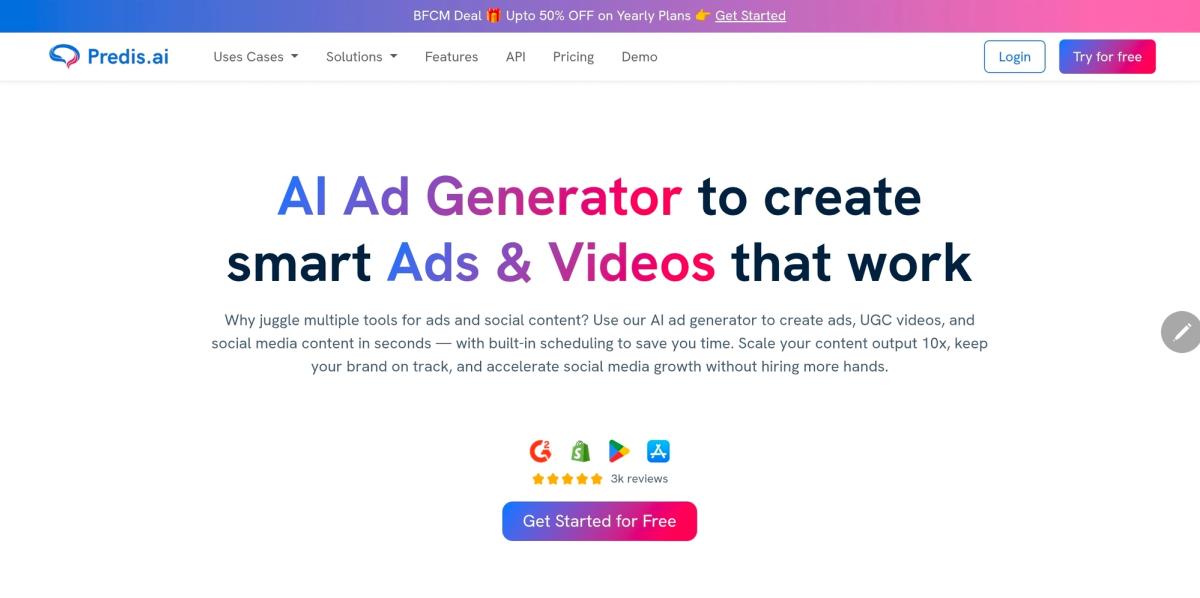
Predis.ai homepage highlighting its AI-powered ad and video generator designed to save time and scale social media content creation.
QuickAds.ai focuses on helping you create ads for multiple platforms simultaneously. Design once, and QuickAds automatically adapts your creative to different sizes and specifications for Facebook, Instagram, Google Display, LinkedIn, and more. This saves hours of repetitive resizing work.
However, QuickAds focuses purely on creation. If you want to understand which ad formats and creative approaches are working best in your niche before creating, Vibemyad provides that strategic layer alongside creation tools.
Pricing: Competitive pricing with various tiers based on usage needs
Best For: Marketers running omnichannel campaigns who need brand consistency across platforms.
VistaCreate stands out for its animation capabilities. You can animate text, objects, and entire scenes with preset animation styles or custom timing. The video template library is extensive, covering everything from Instagram Stories to YouTube ads.
Pricing: Free plan (5 downloads/month); Pro starting at $7.99/month
Best For: Marketers who want video and animation without learning complex video editing software.
Figma is technically a UI/UX design tool, but many ad teams have adopted it for its unbeatable collaboration features. Real-time collaboration is as smooth as it gets, with multiple team members working on the same file simultaneously. The component system is powerful for creating master templates that update automatically across all your ads.
According to Figma's community resources, thousands of design teams use it for advertising work. For teams that also need competitive intelligence, pairing Figma with Vibemyad covers both collaboration and strategy.
Pricing: Free for individuals; Professional $12/editor/month
Best For: Design teams and agencies that prioritize collaboration and design system consistency.
Piktochart specializes in making information visual. The templates are specifically designed for information hierarchy and visual storytelling. Charts and data visualization tools are built right into the editor, making it perfect for ads that need to educate or explain.
Pricing: Free plan available; Pro $24/month
Best For: B2B marketers and brands using content marketing with complex information.
Microsoft Designer brings AI-powered design to the masses with an impressively capable free tier. The AI generation is surprisingly good for a free tool. Describe what you need, and the Designer creates multiple layout options with relevant imagery, typography, and color schemes.
While Microsoft Designer is excellent for budget-conscious creators, if you're ready to invest in your ad strategy, Vibemyad at just ₹999/month provides professional-grade AI creation plus competitive analysis, features that give you a real competitive advantage.
Pricing: Free tier with substantial features; Premium features available
Best For: Small businesses and individual creators looking for capable AI design tools without monthly subscriptions.
We tested each tool across 25 common ad design tasks. Here's how they scored (0-10 scale):
For most performance marketers running paid Meta ads, Vibemyad delivers the strongest workflow by combining competitive intelligence with AI creative production capabilities that most teams currently source from two or three separate tools. The Vibemyad Agent starts free with $5 in credits and no credit card required. If you need a free creation tool with no competitive intelligence, Microsoft Designer is the strongest option currently available at no cost.
Your Profile: Creating 15-30 social posts monthly, need fast content, limited design experience, budget $0-30/month
Recommended Tool: Snappa (paid) or Microsoft Designer (free)
Why: Snappa's average 6.3-minute creation time means you can batch-create a week of content in under an hour.
Pro Tip: 64% of social media managers in our survey pair Snappa with Vibemyad's ad library for inspiration and trend spotting.
Your Profile: Creating white papers, case studies, data-driven ads, target decision-makers, budget $50-100/month
Recommended Tool: Visme
Why: Our B2B test group created data-driven content 2.4x faster in Visme than piecing together charts in multiple tools. The 40+ chart types are purpose-built for B2B.
Your Profile: Multiple designers, need real-time collaboration, create 50+ ads monthly, budget $200-500/month
Recommended Tool: Figma + Vibemyad
Why: Figma's collaboration saved our test teams 11 hours/week on revision cycles. Pair it with Vibemyad for competitive intelligence and AI generation.
Total Cost: $60 Figma + $60 Vibemyad = $120/month Time Saved: 15+ hours/week (worth $750-1,500) ROI: Pays for itself in the first 3 days
Your Profile: Wearing multiple hats, need professional results without designer costs, testing ad concepts, budget $0-50/month
Recommended Path:
• Phase 1 (Month 0-3): Microsoft Designer (free) for initial testing
• Phase 2 (Month 3-6): Vibemyad Basic ($12/month) when ready to scale
• Phase 3 (Month 6+): Add specialized tools as needed
Why: Start free to validate. Once you have traction, Vibemyad's combination of creation + intelligence helps you scale efficiently.
After hands-on evaluation of the tools in this comparison and analysis of how professional ad teams structure their workflows, three consistent patterns emerge.
A tool built specifically for performance advertising solves the problems performance advertisers actually face competitive intelligence, format-specific production, brief validation rather than solving the general design problem and leaving the advertising-specific problems unaddressed. Teams that match their tool choice to their actual workflow report significantly less friction and faster production cycles than teams using general-purpose platforms for specialised advertising work.
Marketers who research what competitors are actively spending behind before writing a creative brief consistently produce better-aligned creative than marketers who start from internal assumptions. The brief is the highest-leverage point in the creative process. Intelligence that informs the brief at the starting stage compounds through every production decision that follows. Creation tools that include an intelligence layer produce structurally stronger output than creation-only platforms for this reason.
The average performance marketing team currently uses multiple subscriptions covering ad intelligence, creative production, and asset management separately. Teams that consolidate into fewer, more capable tools report meaningful cost savings alongside workflow simplification. The trend toward fewer, deeper tools is consistent across agency retrospectives and professional community discussions, driven by both cost pressure and the friction cost of switching between disconnected platforms mid-workflow.
Three structural shifts are visible across the ad design tool landscape in 2025.
The majority of design tools launched or significantly updated in 2025 and 2026 include AI generation capabilities. What began as a differentiating feature has become a baseline expectation. The tools distinguishing themselves in 2026 are not the ones that added AI generation first — it is the ones that combined AI generation with strategic intelligence. Generating an ad quickly is no longer the competitive advantage. Generating the right ad from a validated brief is.
Performance marketers running paid campaigns increasingly treat competitive intelligence as a prerequisite for creative production rather than an optional research add-on. The question has shifted from "should we research what competitors are doing" to "how do we make that research feed directly into the brief rather than existing as a separate document nobody reads." Tools that connect the intelligence layer to the generation layer in a single workflow are the ones gaining adoption among professional ad teams.
Marketing teams are actively reducing the number of subscriptions they manage. The preference shift is away from best-in-class point solutions for every task and toward fewer platforms that handle more of the workflow without requiring constant tool-switching. Platforms that combine research, creation, and iteration in one place are winning purchasing decisions over specialized single-function tools, even when the specialized tools have deeper individual capabilities.
Best choice: Microsoft Designer for AI-powered creation, Canva Free as a backup for templates. When to move up: when you are creating ads with a paid budget behind them and need to understand what competitors are running before you build.
Best choice: Start free with $5 in credits at the Vibemyad Agent. Pay-as-you-go credits scale with your actual usage. For teams producing a consistent volume of ads, the $20 or $60 recharge tier covers significant production without a locked monthly subscription.
Best stack: Snappa at $15 per month for fast organic social content combined with the Vibemyad Agent on a pay-as-you-go credit model for competitive intelligence and performance ad production.
Recommended stack: Figma Professional at $12 per editor per month for design system collaboration, the Vibemyad Agent for competitive research and agentic creative production, and Visme at $15 per month for data-heavy client reporting. The combination covers collaboration, intelligence, production, and reporting without overlap between tools.
The landscape of ad design tools has shifted. Using a single general-purpose platform for everything no longer serves the needs of performance marketers running paid advertising. The tools producing the best results are the ones that match their capabilities to the actual workflow — not the ones with the broadest feature lists.
Two things separate the tools winning in 2026 from the ones losing ground. The first is brief quality. Creation tools that give marketers validated market intelligence before a single creative is produced consistently outperform tools that start from a blank canvas or a template library. The brief determines everything downstream. The second is workflow integration. Teams using disconnected research and production tools spend significant time translating intelligence into briefs and briefs into creative — a handoff that loses signal at every step. Platforms that run the full workflow in one place close that gap.
Start by assessing your actual needs. If you are creating occasional organic social content with no paid budget behind it, free tools like Microsoft Designer offer strong capabilities. If ad creation is central to your growth and you are running paid campaigns, testing creative variations, or trying to differentiate in a crowded feed, the investment in specialized tools is the difference between creating from assumptions and creating from evidence.
The right tool is the one that makes you faster at the specific workflow you actually run. For performance advertising, that workflow starts with understanding what the market has already validated before the brief is written, before the generation begins.
Disclosure: Vibemyad is our platform. Competitor descriptions in this guide reflect publicly available product information and are written to give readers an accurate picture of each tool's strengths and limitations.
Our agency builds ads around your product.



Ananya Namdev
Content Writer, Vibemyad

Ananya Namdev
Content Writer, Vibemyad

Ananya Namdev
Content Writer, Vibemyad
Table of Contents