August 28, 2026 • 14 min read

August 28, 2026 • 14 min read
Meta needs about fifty optimization events a week before a single ad set stops guessing. If that event is a purchase, then at the median cost per acquisition across 53,000 e-commerce brands, it works out to roughly $5,000 a month in ad spend. For one ad set. Before an agency has charged you anything at all.
• An e-commerce marketing agency for small business is a firm that runs acquisition or retention for an online store below roughly $2M in annual revenue, usually on a flat retainer of $1,000 to $5,000 a month. At that level you are buying one channel, not full service.
• Six of the seven small-brand agencies we checked publish no pricing at all. Digital Position is the honest exception and states on its own homepage that it is for brands doing $1M or more in annual revenue.
• The most expensive mistake is treating one number as both the agency fee and the ad spend. They are separate, and the fee typically runs 10% to 20% of spend.
• Meta's published guidance is that an ad set stabilizes after about 50 optimization events in a 7-day period. Priced at real e-commerce acquisition costs, that is $5,030 to $8,450 a month in media for one ad set.
• The line that the SBA recommends spending 7 to 8% of revenue on marketing is false. The SBA's actual published position is that there is no hard and fast answer.
• Under $5,000 a month there are three honest options: a productized service with published pricing, a freelancer, or nobody yet. All three beat a cheap full-service retainer.
An e-commerce marketing agency for small business is a marketing firm that runs acquisition, retention, or both for an online store, typically one below $2M in annual revenue, on a flat monthly retainer usually between $1,000 and $5,000. At that budget the engagement covers a single channel such as paid social, paid search, or email. Full service, meaning several channels coordinated by one team, starts higher.
The distinction matters because the phrase gets used for two different products. A $1,500 email retainer and a $15,000 full-service growth partnership are both sold as an e-commerce marketing agency. Only one of them is available to you.
If you want the broader definitional groundwork, we cover it in what an e-commerce marketing agency is. This piece is narrower on purpose. It is about what happens when the budget is small.
Here is every published floor we could verify, quoted from the source rather than estimated.
Read the pattern rather than the individual rows. The moment an agency describes itself as full service, the floor lands at roughly $5,000 a month for one channel. Below that you are buying management of a channel, not a strategy for a business.
One line deserves quoting directly, because it is the most honest sentence on this subject anywhere. Digital Position states on its own homepage, under a heading asking whether the reader is a fit: "You're an ecommerce or DTC brand doing $1M+ in annual revenue." It goes further and says it is probably not a fit for brands seeking the lowest cost option. That is an agency politely telling most readers of this article to leave, and more agencies should do it.
We checked seven agencies commonly surfaced for small and scaling DTC brands. Six publish no pricing on their own websites. Two return a 404 on their own pricing URL. One redirects a pricing link to a contact form.
The directory figures that do exist are weaker than they look. Clutch's minimum project size field is self-reported by the agency, is not verified by Clutch, and refers to total project size rather than a monthly retainer. Quoting it as a monthly price, which several roundups do, is simply wrong.
There are two defensible reasons for opacity. Scope genuinely varies, and agencies do not want to anchor a negotiation before they understand the account. There is also a third reason nobody says out loud: a published floor disqualifies leads, and most agencies would rather have the call.
The practical consequence is the same either way. Assume any agency without published pricing starts around $5,000 a month until it tells you otherwise, and ask for the floor in the first email rather than the third call.
This is the single most expensive misunderstanding in small-brand marketing, and almost no article addresses it.
When a founder says they have $5,000 a month for marketing, they usually mean $5,000 in total. When an agency hears it, they often hear $5,000 in media, with their fee on top. The gap between those two readings is the whole engagement.
Agency fees are structured three ways: a flat monthly retainer, a percentage of ad spend, or a hybrid of a base fee plus performance. The percentage model is remarkably consistent across sources. Darkroom, WebFX, Stackmatix and NEWMEDIA independently put it at 10% to 20% of ad spend, with the percentage falling as spend rises.
Run your own budget through it before any call.
The lesson is not that small budgets are hopeless. It is that at $5,000 total, a $1,500 flat retainer takes 30% of everything you have, and it needs to earn that.
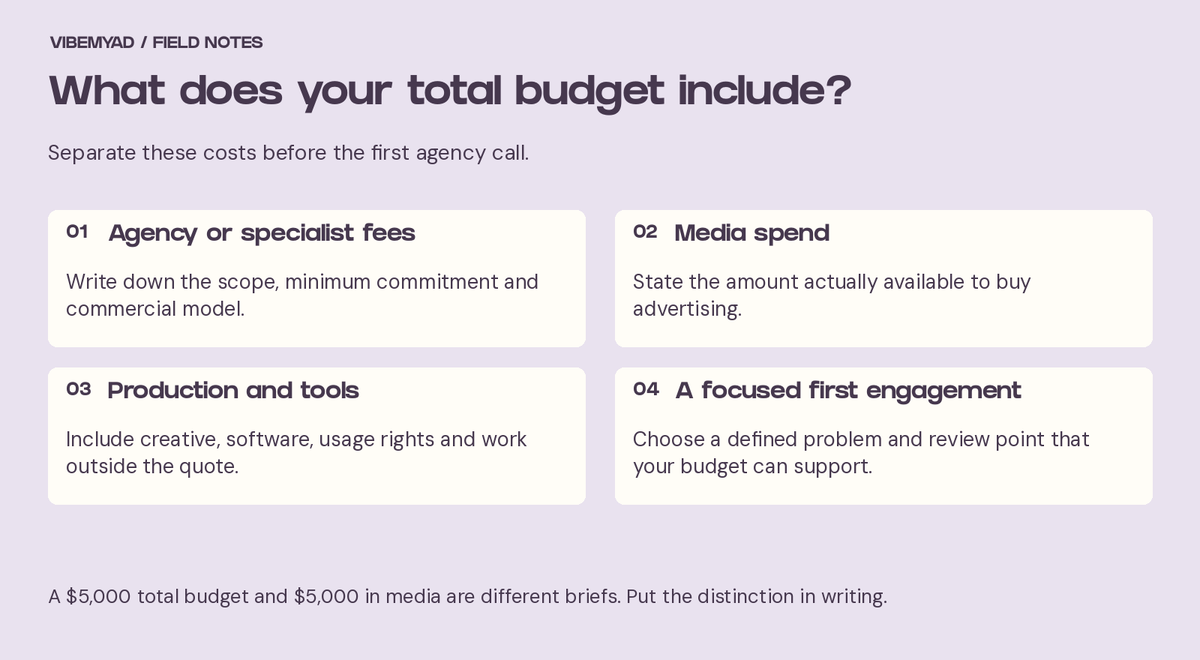
Small-business marketing budget checklist: agency fees, media, production and tools, and a focused first engagement.
This is the constraint that decides whether any of it works, and it has nothing to do with which agency you pick.
According to Meta's published guidance on the learning phase, performance typically stabilizes after an ad set receives around 50 optimization events within a 7-day period. Below that, the delivery system is still exploring and results swing.
Now price it. According to Triple Whale's e-commerce benchmarks published 24 August 2026, drawn from more than 53,000 brands over the twelve months to 31 July 2026, the blended median cost per acquisition is $23.20. Their Meta-specific benchmark published 18 August 2026 across more than 40,000 brands puts Meta cost per acquisition at $38.99.
Fifty purchases a week at those costs is $1,160 to $1,950 a week, which is roughly $5,030 to $8,450 a month in ad spend, for one ad set.
Sit with that. A brand with $5,000 a month in total budget is at or below the floor for a single ad set to stop guessing, before paying anyone.
There is a genuine workaround, and it is the most useful thing in this article. The 50-event threshold counts optimization events, not necessarily purchases. An ad set optimizing for add to cart, or for a lead, reaches 50 events far faster and far cheaper than one optimizing for purchase. Small budgets that work almost always optimize for an upper-funnel event first and move down as volume allows. An agency that does not raise this in the first conversation is not thinking about your budget.
Three things, and a cheap full-service retainer is not among them.
Option one is a productized service with published pricing. Publishing a real number is itself a filter. Verified on their own pricing pages as of 28 August 2026: ManyPixels at $699 a month for unlimited design requests with one daily output, Penji at $995 a month for two active creative workstreams, and WebFX PPC management from $750 a month. You are buying execution capacity, not strategy, and you bring the direction yourself.
Option two is a freelancer. Upwork publishes typical rates for Meta ads specialists at a median of $25 an hour with a common range of $15 to $40. Treat that carefully, because Upwork states these are historical contract ranges worldwide and US freelancers sit well above them. At ten hours a month from a competent US media buyer you are realistically looking at $750 to $1,500, which is the same money as the productized tier but bought as judgment rather than output.
Option three is nobody yet, covered below, and for a real share of readers it is the correct answer.
That in-house figure is derived, so here is the arithmetic. According to the US Bureau of Labor Statistics wage data for May 2025, the mean annual wage for market research analysts and marketing specialists is $89,490. The BLS Employer Costs for Employee Compensation release for March 2026 reports that wages account for 69.9% of total employer compensation cost, with benefits making up the other 30.1%. Grossing the salary up by that ratio gives roughly $128,000.
A fractional growth lead sits between freelancer and hire. Go Fractional, a marketplace that places fractional CMOs, reported on 13 August 2026 that engagements run $4,000 to $20,000 a month, averaging $12,000. Attribute that one carefully, since it comes from a company with an interest in the number, but even its floor consumes a $5,000 budget entirely.
More often than the internet admits, because almost every page on this subject is published by somebody selling the service.
• Do not hire yet if your offer is still moving. If pricing, bundles, or the core promise change month to month, an agency will spend your budget discovering what you have not decided.
• Do not hire yet if traffic arrives and nobody buys. Paid media applied to a page that does not convert simply buys more expensive exits. Conversion work comes first.
• Do not hire yet if your total budget is under about $3,000 a month. At that level a flat retainer takes a third or more of everything, and what remains cannot clear the learning phase on any purchase-optimized campaign.
Be skeptical of the tier that exists precisely to take this money. Directories list agencies at $10 and $15 an hour beside firms charging $300, with the same verification badge. An hourly rate that low means the work is being resold, usually offshore, usually by someone who will not be reachable in month three. A six-month contract at $1,000 a month is not a bargain, it is $6,000 committed to a firm that would not disclose its price.
Follow these in order. Each step is cheap and designed to disqualify fast.
• Name the number that is broken. Cost per acquisition, conversion rate, repeat purchase rate, or traffic. If you cannot name it, the problem is measurement and no agency fixes that for you.
• Split your budget in writing. Decide what is fee and what is media before any call, and open with it. The agencies that cannot work within it will say so immediately, which saves you weeks.
• Ask for the floor in the first email. One sentence: what is your minimum monthly engagement, and does it include media. An agency unwilling to answer in writing has told you something.
• Ask what they would optimize for at your spend. If the answer is purchases with no mention of the learning phase or upper-funnel events, they have not thought about a budget your size.
• Ask who does the work, by name. Not a team structure diagram. A name, a seniority, and how many other accounts that person carries.
• Check the contract length and the exit. Month to month is worth paying more for at this size. Ask what you keep if you leave: ad accounts, creative source files, and exportable data.
• Run a paid pilot before a retainer. One month, one channel, one defined deliverable count. Any agency confident in its work will take a pilot, and that willingness is the most reliable signal available to you.
Our nine questions to ask an e-commerce marketing agency goes deeper on vetting, and retainer versus outcome pricing covers the commercial structures in full.
Worth knowing where you sit, because the answer is usually reassuring.
According to Gartner's 2026 CMO Spend Survey, published 11 May 2026 and based on 401 marketing leaders surveyed between January and March 2026, marketing budgets sit at 7.8% of company revenue, essentially flat against 7.7% the year before. The CMO Survey from Duke, Deloitte and the AMA, fielded in January 2026 across 308 respondents, puts it at 9.0% of revenue overall and 12.0% for business-to-consumer product firms, which is the closest cut to a DTC brand.
Apply that. A $5,000 monthly budget is $60,000 a year, which at the 12% figure for B2C product firms implies roughly $500,000 in annual revenue. That is a real business, and it is also below the $1M floor Digital Position publishes. You are not doing it wrong. You are simply below the line the agency market is built to serve.
One correction while we are here, because it appears on hundreds of pages. The claim that the US Small Business Administration recommends spending 7 to 8% of revenue on marketing is not accurate. The SBA's published guidance says the opposite: "There's no hard and fast answer to how much your marketing budget should be." It declines to set a figure and points businesses to their own trade associations instead. The page is also from 2019, which is worth knowing before anyone quotes it at you.
Vibemyad Agency
Directly, and with a disqualification first.
We run a full-service e-commerce marketing agency, and full service is the tier this article has spent two thousand words telling you is out of reach under $5,000 a month. That stays true when we are the ones selling it. If your total budget is $2,000, we are not your answer, and an agency that told you otherwise would be taking money it cannot deploy.
What we do differently is where the money goes. Most of an agency retainer at any size pays for research and production hours: someone manually pulling competitor ads, briefing creative, building variants. We run that on a platform we built and own, spanning competitive research, creative production, website work, SEO and paid media as one connected system rather than six disconnected teams. Because the research feeds the creative brief directly instead of being gathered again by hand for every deliverable, more of a given budget reaches media and testing.
We also price on outcomes rather than selling a block of hours, which matters more at small budgets than large ones. A flat retainer consuming 30% of a $5,000 budget has to be right immediately. A fee tied to an outcome fails cheaply when it fails.
If you are below the line, the honest advice is what we would tell a friend. Spend the next quarter on conversion rate, offer clarity and email capture, which cost time rather than media. Come back when your budget clears roughly $5,000 in media alone. We will still be here, and you will get more for the money. If you would rather compare the field first, our rundown of the best e-commerce marketing agencies for DTC brands maps the alternatives honestly.
• The floor is real and it is roughly $5,000 a month in media for one purchase-optimized ad set, before any agency fee.
• Separate fee from ad spend in writing before your first call. Nothing else on this list matters as much.
• Six of seven small-brand agencies publish no pricing. Ask for the floor in the first email and treat silence as an answer.
• Under $5,000 total, a productized service or a freelancer beats a cheap full-service retainer every time.
• Optimizing for an upper-funnel event is the legitimate way small budgets clear the learning phase, and it pairs with a real creative testing framework. Ask any agency whether they would.
• If your offer is still moving or your site does not convert, the correct spend this quarter is zero.
Get notified when new insights, case studies, and trends go live — no clutter, just creativity.
Table of Contents


Arpita Mahato
Content Writer, Vibemyad

Arpita Mahato
Content Writer, Vibemyad

Arpita Mahato
Content Writer, Vibemyad