March 06, 2026 • 9 min read

March 06, 2026 • 9 min read
If you're asking where to advertise in 2026, the answer depends on your funnel maturity, creative velocity, and how disciplined you are about measuring ROI.
In 2026, the real Facebook Ads vs TikTok Ads question isn’t which platform is trendy; it’s which one aligns with your funnel, your creative velocity, and the way each ecosystem turns reach into revenue.
The scale alone explains why this conversation matters. According to Statista, in Q4 2023, Meta Platforms reported that 3.98 billion people used at least one of its core products, Facebook, Instagram, WhatsApp, or Messenger, each month. Daily active users also increased year-over-year, reinforcing the depth and stickiness of its ecosystem. Facebook itself surpassed one billion users years ago and now sits at more than three billion monthly active users, while all four of Meta’s core platforms individually exceed the one-billion-user mark.
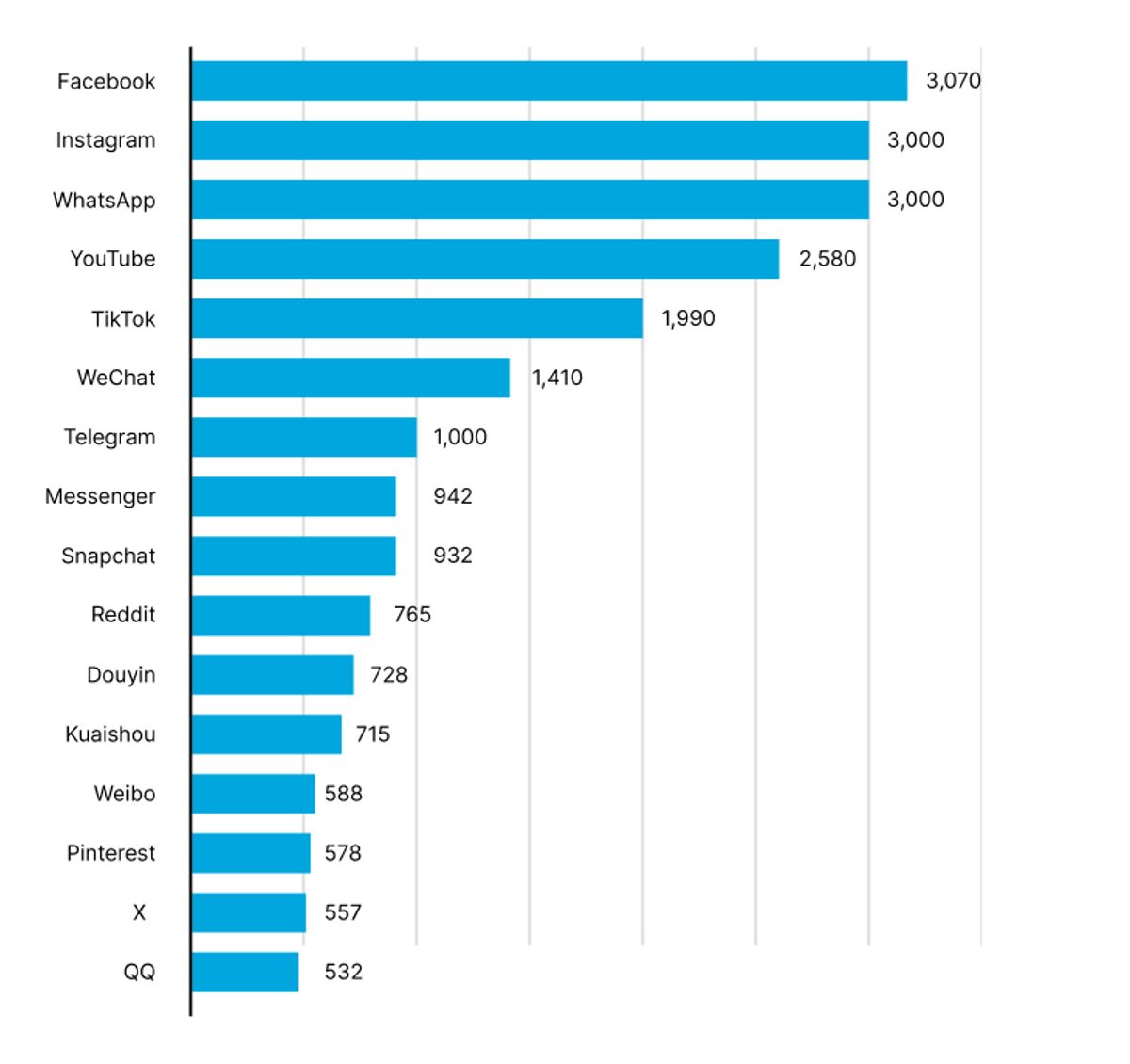
Most used social networks as of 2025
The global social landscape is no longer limited to the U.S.-based platforms. While many leading networks originated in the United States, Chinese platforms like WeChat, QQ, and Douyin built massive regional dominance. Douyin’s success led to the launch of TikTok, now one of the world’s most influential advertising channels.
This debate is serious because Meta’s ecosystem operates fundamentally differently from TikTok. One is optimized for accumulated behavioral data and mature conversion infrastructure; the other is driven by algorithmic distribution, cultural velocity, and creative-led discovery.
For marketing and performance leaders, this is not a stylistic choice but a capital allocation decision. Before selecting a platform, teams should ask:
Let’s break it down properly.
At the highest level, the Facebook Ads vs TikTok Ads 2026 conversation comes down to a structural distinction:
This is not a branding difference. It is an infrastructure difference. And it directly impacts targeting strategy, Facebook vs TikTok advertising costs, creative production requirements, and ultimately TikTok Ads vs Facebook Ads ROI. When marketers ask, “Should I advertise on Facebook or TikTok?”, what they’re really deciding is:
‘Are we harvesting demand that already exists, or are we trying to generate it?’ Understanding this clarifies budget allocation and performance expectations.
Advertising within Meta Platforms’ ecosystem, including Facebook and Instagram, is built around accumulated behavioral data and conversion optimization. Its system relies on:
This infrastructure has been refined across billions of data points and remains highly effective, even after major privacy changes, when supported by strong first-party data and clean event tracking.
In simple terms, Facebook excels at showing the right offer to users already close to buying. If someone has visited your site, engaged with content, or added to cart, its system converts that intent efficiently, hence its continued dominance in lower-funnel and retargeting campaigns in 2026.
Advertising on TikTok operates differently. On TikTok:
The algorithm distributes content primarily based on viewer behavior signals, watch time, engagement velocity, and interaction depth, rather than heavily relying on advertiser-defined targeting layers. This means your creative is effectively your targeting.
TikTok is exceptional at making people care before they planned to. It surfaces products users were not actively searching for and builds intent through storytelling and social proof. That is demand generation.
When comparing TikTok Ads vs Facebook Ads ROI, many marketers focus first on CPM. But CPM reflects the cost of exposure, not the cost of acquisition.
The difference exists because Facebook captures existing intent, while TikTok builds new intent. Expecting them to behave identically leads to misaligned KPIs.
If you already have traffic, historical data, and clear customer personas, Facebook provides revenue stability. If you need attention, discovery, and creative-driven growth, TikTok is often the stronger lever; the choice depends on your objectives.
The first distinction lies in how each platform acquires net-new customers. TikTok is highly effective at expanding market awareness beyond existing demand pools. It excels when brands need to interrupt passive scrolling and introduce new products to cold audiences.
Facebook, on the other hand, performs best when acquisition is tied to defined audience segments, historical conversion data, and structured optimization toward CPA or ROAS. Strategically:
Growth efficiency depends on how well a platform uses performance signals. Facebook integrates deeply with first-party data, purchase events, CRM uploads, custom audiences, and lookalikes. It becomes more powerful as your dataset matures.
TikTok relies more heavily on engagement-based signals such as watch time and interaction velocity. It optimizes distribution based on creative resonance rather than declared interests. Strategically:
Creative economics differ substantially. On TikTok, creative iteration speed directly influences performance. Brands that produce high volumes of native-style content often outperform those relying on polished, infrequent campaigns.
On Facebook, creative matters, but structural targeting and optimization can stabilize performance even with moderate creative variation. Strategically:
When analyzing Facebook vs TikTok advertising costs, the key is not just CPM; it’s where cost efficiency appears in the funnel. TikTok often delivers lower top-of-funnel exposure costs, making it attractive for awareness-heavy strategies.
Facebook frequently produces more consistent cost-per-acquisition at the lower funnel, particularly in retargeting and high-intent campaigns. Strategically:
As budgets increase, stability becomes critical. Facebook generally provides more predictable scaling when conversion data is strong. Its infrastructure supports sustained budget increases with controlled volatility.
TikTok can scale rapidly when creative momentum is strong, but performance can fluctuate as trends shift or creative fatigue sets in. Strategically:
Finally, platform maturity affects internal workflow. Within Meta Platforms' advertising ecosystem, Ads Manager offers extensive budget controls, reporting breakdowns, rule automation, and a layered campaign architecture. TikTok’s platform is evolving quickly, but it typically requires stronger creative oversight and more hands-on iteration. Strategically:
Elite brands use both: TikTok to create demand and Facebook to convert it profitably.
Use Facebook (within Meta Platforms) when performance predictability matters. Ideal if you:
Use TikTok when attention and cultural relevance are the priority. Ideal if you:
For brands launching new products and testing high creative volume:
This hybrid structure reduces platform dependency, stabilizes blended CAC, and improves overall efficiency.
In the Facebook Ads vs TikTok Ads 2026 landscape, both Facebook (under Meta Platforms) and TikTok repeat the same advice: “Test more creative.” But neither platform tells you:
The platforms optimize delivery. They do not provide competitive intelligence. Without structured insight, most brands:
In 2026, creative volume is table stakes. Creative intelligence is the advantage. Vibemyad Ad Spider helps you make strategic decisions. Instead of guessing, you can:
✔ Competitive research across platforms
✔ Creative benchmarking and trend spotting
✔ Idea generation for new ads
✔ Scaling paid acquisition with validated patterns
✔ Building better testing roadmaps
Key Takeaway: If you’re serious about improving both Facebook vs TikTok advertising costs efficiency and overall TikTok Ads vs Facebook Ads ROI, it’s time to stop testing blindly.
Get notified when new insights, case studies, and trends go live — no clutter, just creativity.
Table of Contents


Arpita Mahato
Content Writer, Vibemyad

Arpita Mahato
Content Writer, Vibemyad


Ananya Namdev
Content Writer, Vibemyad