August 28, 2026 • 15 min read

August 28, 2026 • 15 min read
Full-service agencies keep their clients for 87 months. Media-only specialists keep theirs for 44. That gap looks like a verdict until you notice that the agencies growing fastest right now are the ones cutting services, not adding them.
• Integrated full-service agencies average 87 months of client tenure against 44 months for media-only ones (ANA and 4As, April 2025). Lasting longer is not the same as performing better.
• Agencies that narrowed their service mix grew 13% and posted 30% net margins, against an industry average of 7.5% growth and 13% margin (Promethean Research, March 2026). Focus is winning, at least on the agency's side of the table.
• Clients leave over delivery, at 48% and rising 14 points year over year. Agencies blame budget cuts and leadership changes, and they are wrong about it (Setup, 2024).
• The decision rule: if one measurable number is broken and someone in-house can direct the work, hire a specialist. If the failure is happening between disciplines, hire full-service.
• Ecommerce CPMs rose 13.24% while conversion rate fell 4.73% over the year to July 2026 (Triple Whale). That leak sits between creative, landing page and offer, which is exactly where no single specialist reaches.
• There is no credible public benchmark comparing full-service and specialist retainer rates. Every confident dollar range on page one of Google traces back to a content mill with no methodology.
Very little, on its own. Almost every agency describes itself as full-service, because the label costs nothing to claim and widens the top of their funnel. The word tells you about their positioning, not about their bench.
What matters is where the depth sits. A genuinely full-service shop has a person or a system that owns each discipline to a professional standard. A nominally full-service shop has one generalist doing SEO on Tuesday and creative on Wednesday, both at roughly 60% quality, plus a white-label partner quietly handling whatever nobody in-house understands. Those two agencies use identical language on their websites.
So the first move is not choosing between the models. It is working out which one you are actually being sold. If you want the definitional groundwork first, we cover it in what an ecommerce marketing agency is.
Here is where it gets interesting, because the two most relevant datasets point in opposite directions.
Full-service relationships last dramatically longer. In a study published by the ANA and the 4As in April 2025, integrated full-service agencies averaged 87 months of client tenure, or 7.3 years. Media-only agencies averaged 44 months, or 3.7 years. Overall average tenure now sits near seven years, more than double the 3.2 years reported in 2016. Independent agencies held clients longer than holding company agencies, 7.3 years against 5.8.
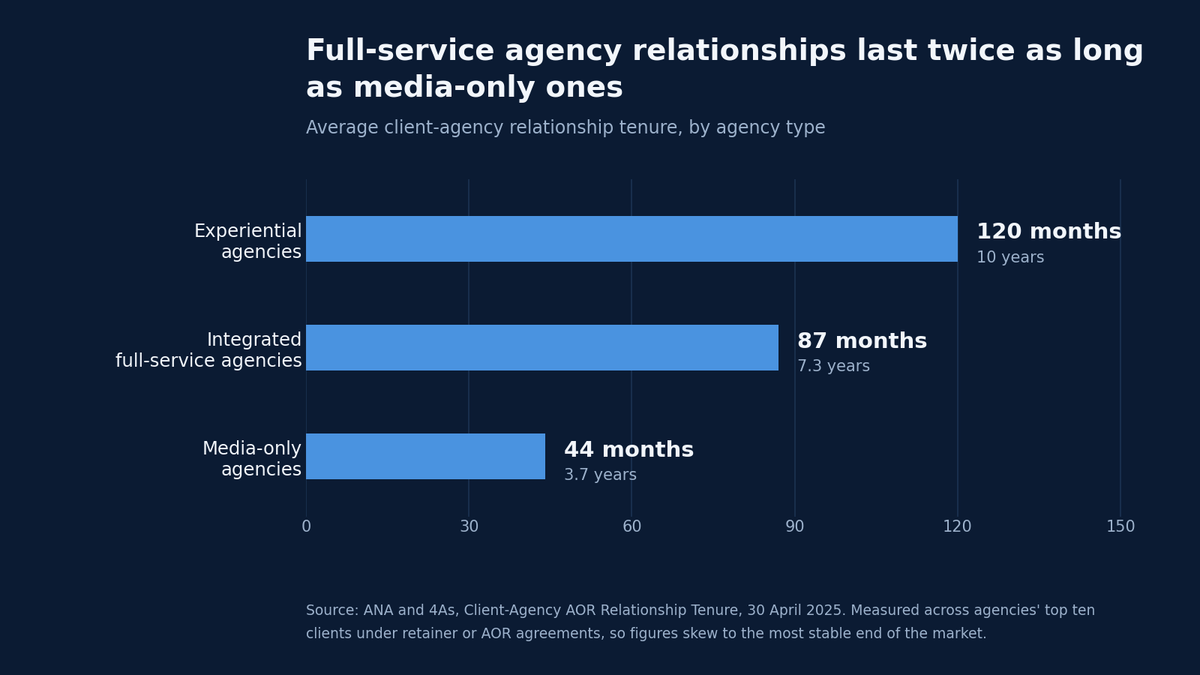
Integrated full-service agencies hold clients roughly twice as long as media-only specialists. Source: ANA and 4As, April 2025.
One caveat before you weigh that too heavily. The ANA and 4As measured tenure across agencies' top ten clients under retainer or agency-of-record agreements. That is the most stable end of the market, self-reported by the agencies. It is not the tenure a $5M direct-to-consumer brand should expect.
Now the other direction. Promethean Research surveyed 119 digital agency owners and managers in February 2026 and published in March. Agencies that reduced their service offering grew 13% on average and posted 30% net margins, against an industry average of 7.5% growth and a 13% net margin. Design agencies, the most narrowly focused group in the sample, grew three times faster than blended agencies and earned the highest margins of any archetype. Narrowing wins.
Put those two findings side by side and you get the reframe that actually helps you decide: longevity and performance are not the same signal. Full-service relationships last longer partly because they are harder to hold to a single number. A media-only agency gets reviewed every year because media has a metric attached and everyone can see it. A full-service partner's contribution is spread across creative, site, email and paid, which makes the relationship durable and also makes it easy to hide inside. A seven-year relationship can mean it is working. It can equally mean nobody has measured it properly since year two.
The Promethean numbers deserve their own caveat. They describe agency profitability, not client outcomes. A specialist agency being more profitable is not evidence that its clients do better. It is evidence that focus is a good business model for the agency.
Stripped of the marketing language, the two models differ on six things that actually affect you.
The last row is the one most founders skip and the most predictive of the two. Specialists work well when somebody on your side can be the integration layer. If that person does not exist, you become the integration layer by default, and that is a job.
As few as you can personally coordinate. There is no credible public benchmark for direct-to-consumer specifically, and anyone quoting you one is guessing. What does exist is agency-side data: in AgencyAnalytics' 2026 benchmarks, drawn from 494 agency professionals surveyed between February and April 2026, 38% of clients buy two services from their agency, 34% buy three, and 56% buy three or more. Brands consolidate in practice even when they hire on a single-service pretext.
That drift happens for a reason. Every additional agency adds an onboarding, a reporting cadence, a separate context you have to maintain, and a seam where accountability goes to die. Three specialists produce three sets of confident recommendations that nobody has reconciled. The creative agency wants a bolder hook, the media agency wants more budget behind the existing winner, and the CRO agency wants the landing page rewritten. All three can be right, and you are the only person in the room who can sequence them.
Specialists are not more expensive because of their rates. They are more expensive because of the coordination you absorb.
Not for the reason the full-service versus specialist debate assumes. The Setup Marketing Relationship Survey, in its sixth annual edition with over 400 contributions from brand and agency marketers including The Home Depot, Skechers, Chobani and UPS, found that 40% of clients expected to switch agency partners within six months. What they blamed is the interesting part.
Agencies were wrong about their own mortality. Clients leave because the work is not good enough and the agency never understood the business, then say it was the budget, because that is the kinder thing to say on a call.
This reorders the whole decision. Structure is a second-order question. The first-order question is whether this particular team can execute on your particular problem, and no org chart will tell you that. Our nine questions to ask an ecommerce marketing agency is built for exactly that diagnostic.
Worth knowing about the wider market too. Forrester's Predictions 2026 for marketing agencies, published in October 2025, forecast that 85% of US B2C marketing executives plan to review their media agencies in 2026, alongside a 15% reduction in agency jobs following roughly 8% of cuts in 2025. Whatever you sign this year, expect the field to look different when you renew.
Somewhere specific, and it is not media buying. Triple Whale's benchmarks, published on 18 August 2026 and drawn from more than 40,000 brands over the twelve months to 31 July 2026, show Meta CPM at $15.06, up 13.24% year over year. Click-through rate rose 15.97% to 2.39%. But conversion rate fell 4.73% to 1.53%, and return on ad spend was effectively flat at 1.88.
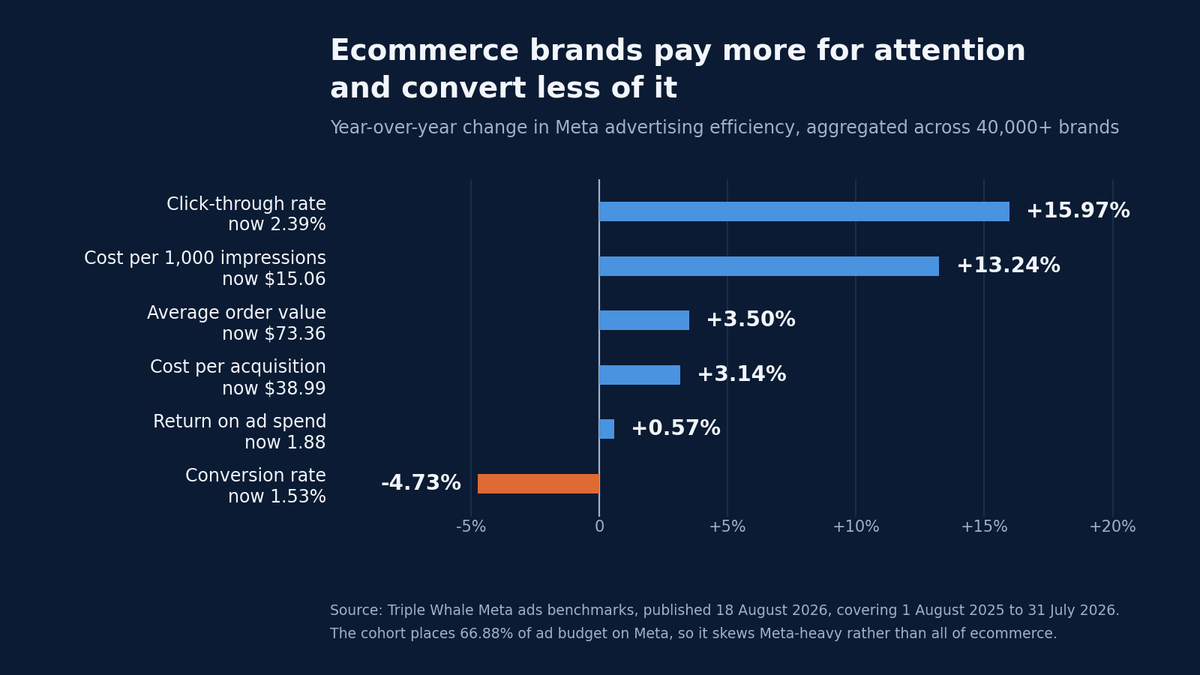
Costs and clicks are both up, but conversion rate is the only metric moving backwards. Source: Triple Whale, August 2026.
Read the shape of it. Brands are paying more for impressions, earning more clicks than before, and converting fewer of them. Attention is not the failure. What happens after the click is. One composition caveat: this cohort places 66.88% of total ad budget on Meta, so it skews Meta-heavy rather than representing every ecommerce advertiser.
That leak sits precisely on the seams between disciplines. It spans creative promise, landing page, offer and post-purchase, which means it does not belong cleanly to any single specialist. A better media buyer cannot fix a conversion problem caused by an ad that oversells what the product page delivers. This is the strongest argument available for integration, and it is an argument from arithmetic rather than from convenience.
Yes, and specifically it has weakened the historic case against full-service.
Breadth used to require headcount. An agency covering six disciplines needed six benches, and most could not afford them, which is why "full-service" so often meant "thin at everything." That constraint was real, and it is what made specialists credibly better.
When research, creative and site work run on one connected system rather than six disconnected teams, breadth stops costing what it used to. The same competitive research that tells you which hooks are working in your category can feed the creative brief, and the intelligence carries between deliverables instead of being gathered by hand each time. That is the model we run our own ecommerce marketing agency on: one connected AI platform spanning research, creative, web, SEO and paid media, with our team making the decisions.
Two honest qualifications. First, this does not make every agency with AI in its deck a good one, and we wrote a separate piece on telling the real thing from AI-washing. Second, the market is moving under everyone. Gartner's 2025 CMO Spend Survey, fielded across 402 CMOs, found 39% planning to reduce agency allocations and 22% reporting that generative AI had already reduced their reliance on external agencies for creativity and strategy. Forrester's workforce forecast makes the same point from the other side, projecting that 32,000 US agency jobs, about 7.5% of the workforce, will be automated by 2030, and noting that originality is the single biggest factor lowering a role's automation risk. The agencies worth hiring in 2026 are the ones whose value is judgment and originality, not throughput.
Use the funnel, not the preference. Find the condition below that describes your brand today.
One structural note that cuts across all of them. What you are really buying is ownership of a number, so make the commercial terms reflect that. An agency confident in its work will accept accountability for an outcome; one that is not will insist on selling you time. We broke down the mechanics in retainer versus outcome pricing. Forrester expects the whole industry to move this way, away from time-based compensation and toward outcome, fixed-fee and productized models.
While we are on money: there is no trustworthy public dataset comparing full-service and specialist retainer rates in 2026. We looked for one. Every confident dollar range on page one of Google traces back to a content mill with no sample size and no methodology. Ask any agency for its actual range and what that range includes, and treat published "industry benchmarks" as marketing.
For full-service agencies, three questions do most of the work:
• Who specifically does the work in each discipline, and is any of it white-labeled? Names and seniority, not a team structure diagram.
• Can you show me a case study in the discipline I care most about, rather than your strongest one?
• If the same account manager appears to own strategy, creative and media at once, the bench is thin.
For specialists, one question matters more than the rest:
• What will you do when the problem turns out to be upstream of your scope? The honest answer is that they will tell you and stay in their lane. The answer to worry about is one that quietly expands their remit into work they do not do well.
For both, ask what they already know about your category before the first call. Competitive research is cheap now. An agency that shows up without a view on what is already working in your market is telling you how the rest of the engagement will go.
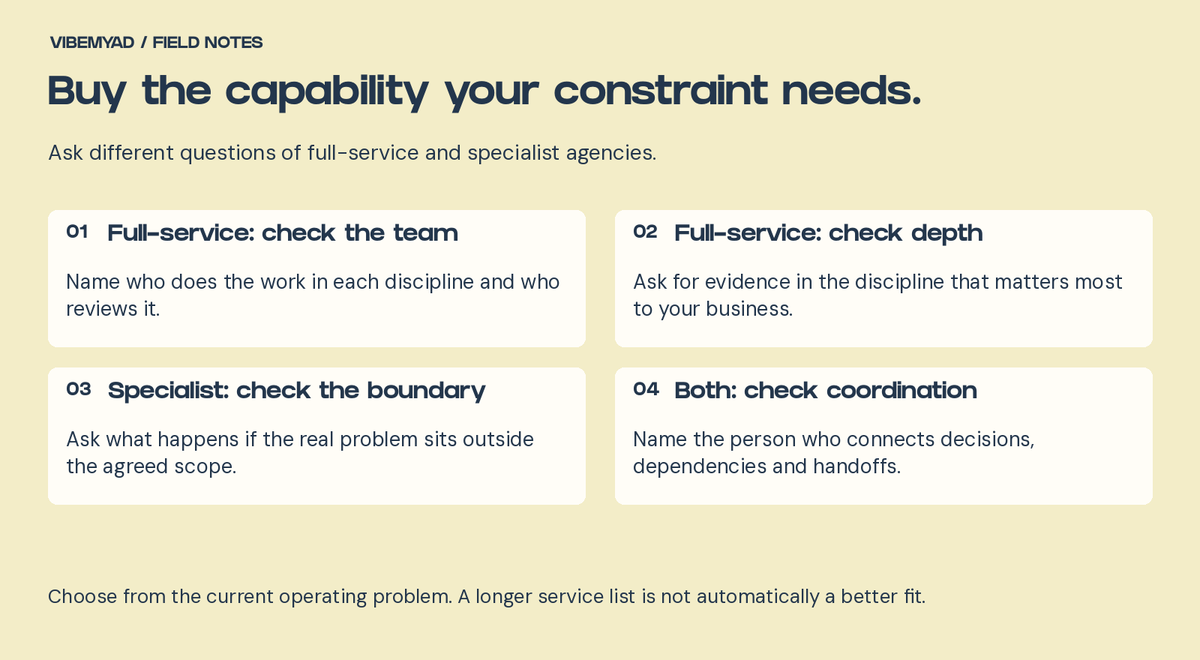
Full-service versus specialist agency checklist: verify delivery capability, depth, scope boundaries and coordination.
Fair thing to ask of anyone who writes a post like this, so here is the direct answer. Vibemyad runs as a full-service agency, which means we are asking you to accept the full-service risks named above. The honest move is to say how we handle them rather than pretend they do not apply to us.
Start with the one that matters most, the thin bench. Breadth used to mean mediocrity because six disciplines needed six teams and most agencies could not staff that. We run our services on a platform we built and own, covering competitive and market research, creative production, website work, SEO and domain research, and paid media. Because those are connected rather than separate, the research that identifies which hooks and angles are already live in your category feeds the creative brief directly, and the same intelligence carries into the site and search work instead of being gathered again by hand for every deliverable. Breadth costs us less than it costs an agency renting six disconnected point tools, which is why we can offer it without spreading a small team thin across six jobs.
Then the second risk, diluted accountability. We price on outcomes rather than selling a block of time, which is the mechanism this whole post argues for. That model only works because the platform makes the underlying work efficient enough that we can stand behind a number. If it did not, we would be selling hours like everyone else.
Now our own red flags, turned on ourselves. Who does the work: our team, on our platform, and we will tell you plainly which parts are ours. What happens when the problem sits upstream of what you hired us for: we say so, which sometimes means telling a brand that its offer or its margin is the real constraint and no volume of creative will fix it. What we know about your category before the first call: we arrive with a view on what is already running in your market, because that research is the first thing our platform does.
One more thing most agency pages leave out. AI-native does not mean automated. The software does the heavy lifting so that our people can spend their judgment on the decisions that need it, which things to act on, what fits the brand, and when to overrule the model. If you want an agency that hands the whole thing to a machine, we are not it, and we would be wary of any agency claiming to be.
Finally, who should not hire us. If you have one clearly broken number, an in-house marketing lead capable of directing the work, and no integration problem, go hire the specialist who owns that number. You will get better value and cleaner accountability than we can offer. Our case is strongest exactly where this post says the full-service case is strongest, which is when the leak is between the parts and nobody on your side has time to own the seams. If that is not you, our rundown of the best ecommerce marketing agencies for DTC brands maps the alternatives honestly.
• Name the broken number first. The agency structure follows from it, not the other way around.
• Full-service relationships last twice as long as media-only ones, but longevity measures how hard a relationship is to audit as much as it measures results.
• Specialists are cheaper on the invoice and more expensive in coordination, and you absorb that second cost personally.
• Delivery, not structure or price, is the top reason clients leave. Vet execution before you vet the org chart.
• Ecommerce conversion rate is the only major Meta metric moving backwards, and that failure lives between disciplines rather than inside one. Creative testing fixes part of it; the landing page and offer own the rest.
• Buy ownership of an outcome rather than a block of hours, whichever model you pick.
• ANA and 4As, Client-Agency AOR Relationship Tenure, 30 April 2025. Tenure by agency type and ownership. Measured across agencies' top ten clients under retainer or agency-of-record agreements.
• Promethean Research, 2026 State of Digital Services, March 2026. Survey of 119 digital agency owners and managers fielded February 2026, average agency size 31 employees, 74% US.
• Setup, Marketing Relationship Survey, sixth annual edition, write-up January 2025. Over 400 contributions from brand and agency marketers.
• Forrester, Predictions 2026: Marketing Agencies, October 2025. Media agency reviews, agency headcount and compensation-model shift.
• Forrester, Agency AI-Powered Workforce Forecast, 2030 (US), 2025. Automation exposure across agency roles.
• Gartner, 2025 CMO Spend Survey, 12 May 2025. Survey of 402 CMOs; respondent base skews to companies above $1B in revenue.
• Triple Whale, Meta ads benchmarks, published 18 August 2026, covering 1 August 2025 to 31 July 2026 across 40,000+ brands. Cohort places 66.88% of ad budget on Meta.
• AgencyAnalytics, 2026 Marketing Agency Benchmarks, fielded February to April 2026 across 494 agency professionals.
Get notified when new insights, case studies, and trends go live — no clutter, just creativity.
Table of Contents